




- Hardware & Software IT Services
- Global HR Analytics Market
Global HR Analytics Market Size, Share, and Growth Forecast 2026 – 2033
HR Analytics Market by Components (Solution and Service), Deployment (On-premises and Cloud), Enterprise Size (Large Enterprise and SME), Industry Vertical (Academia, BFSI, Government, Healthcare, IT & Telecom, Manufacturing, Retail, and Others), and Regional Analysis

HR Analytics Market Size and Share Analysis
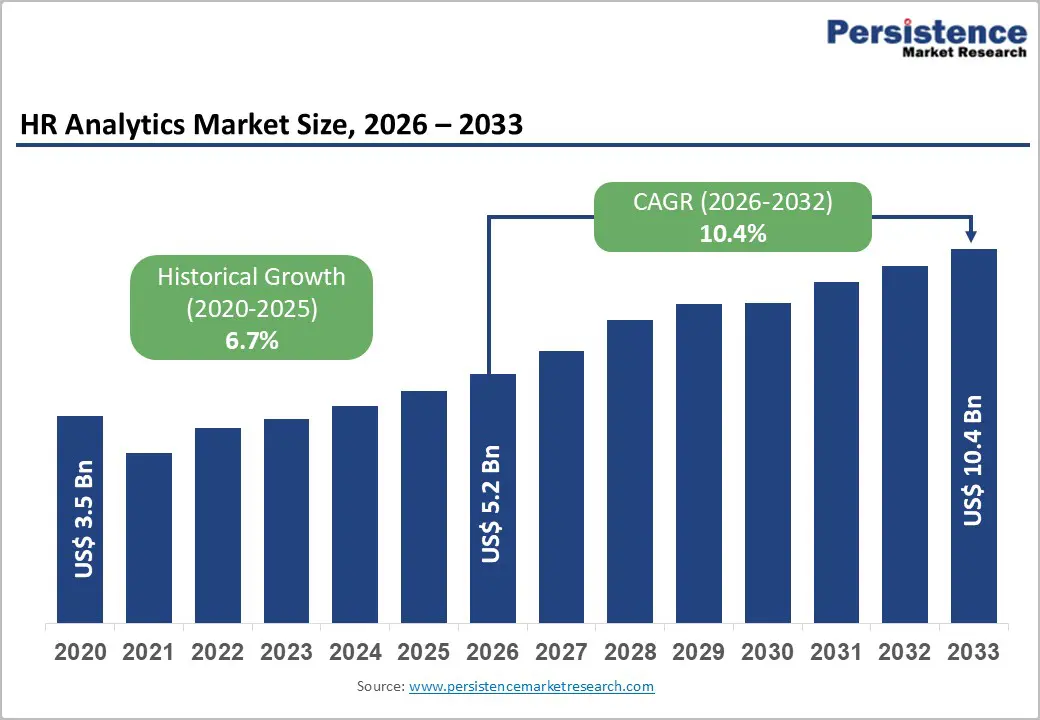
The global HR Analytics Market size was valued at US$ 5.2 Billion in 2026 and is projected to reach US$ 10.4 Billion by 2033, growing at a CAGR of 10.4% between 2026 and 2033. The market is experiencing robust expansion driven by escalating demand for data-driven decision-making in workforce management, widespread adoption of cloud-based HR analytics platforms, increasing workforce globalization requiring sophisticated talent analytics, and enterprise emphasis on employee engagement, retention, and optimization through advanced analytics. Organizations are prioritizing analytics capabilities to forecast workforce needs, predict employee attrition with greater accuracy, and align talent strategies with long-term business objectives, establishing analytics as a critical competitive differentiator in modern human capital management.
Key Market Highlights
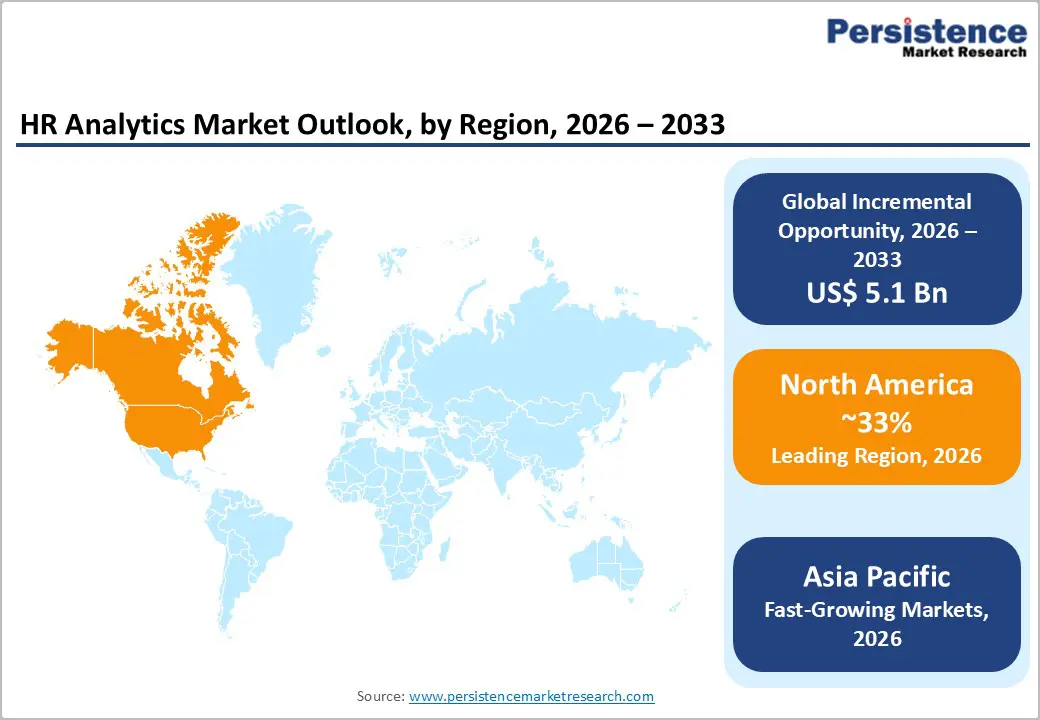
- Leading Region: North America commands approximately 33% of global HR Analytics Market revenue, driven by advanced cloud infrastructure adoption, sophisticated talent management practices, organizational emphasis on data-driven decision-making, and mature HR technology ecosystem supporting comprehensive analytics implementations.
- Fastest Growing Region: Asia-Pacific exhibits fastest market growth at 16.8% CAGR through 2033, propelled by rapid economic development, accelerating digital transformation, cloud technology adoption, emerging market talent management priorities, and government digitalization initiatives across China, India, and ASEAN nations.
- Dominant Components: Solution components command approximately 65% of market revenue, driven by essential role in workforce planning, talent analytics, and employee engagement supporting core HR function automation and strategic workforce management optimization.
- Growing Solution: Workforce planning expands fastest at 25% CAGR, reflecting organizational prioritization of aligning workforce strategies with long-term business objectives, anticipating future skill requirements, and supporting strategic business transformation initiatives through data-driven planning.
- Key Market Opportunity: Vertical-specific HR analytics solutions addressing healthcare staffing optimization, retail labor scheduling, government compliance, and IT services resource allocation represent highest-potential opportunities, generating superior ROI relative to enterprise suite generic approaches while addressing industry-unique workforce challenges.
| Key Insights | Details |
|---|---|
| Global HR Analytics Market Size (2026E) | US$ 5.2 Bn |
| Market Value Forecast (2033F) | US$ 10.4 Bn |
| Projected Growth CAGR (2026-2033) | 10.4% |
| Historical Market Growth (2020-2025) | 6.7% |
Market Dynamics
Market Growth Drivers
Accelerating Cloud Adoption and Demand for Scalable, Cost-Effective Analytics Solutions
Organizations globally are prioritizing cloud-based HR analytics platforms driven by superior scalability, flexibility, cost-effectiveness, and accessibility supporting distributed workforces and remote work environments. Cloud-based HR analytics solutions eliminate substantial infrastructure capital investments, reduce software licensing and technical staff requirements, and enable rapid deployment and integration with existing HR information systems. Cloud deployment models currently account for approximately 60% of HR analytics market revenue, with projections indicating continued dominance through 2033 driven by enhanced security certifications, improved compliance frameworks, and seamless data accessibility.
Small and medium-sized enterprises (SMEs) are particularly accelerating cloud adoption at 17.8% CAGR, as cloud-based SaaS platforms reduce cost and complexity barriers, with affordable offerings spanning US$ 5,000-25,000 monthly enabling mass-market adoption across emerging markets and resource-constrained organizations. Large enterprises continue expanding cloud analytics investments through enhanced integration with existing enterprise systems, real-time data accessibility, and comprehensive disaster recovery capabilities. The structural shift toward cloud infrastructure, combined with improving vendor security postures and regulatory compliance frameworks, continues establishing cloud-based HR analytics as the primary growth driver supporting market expansion through the forecast period.
Rising Emphasis on Employee Engagement, Retention, and Predictive Workforce Analytics
Organizations are substantially increasing investments in HR analytics solutions addressing critical business challenges including employee engagement optimization, turnover prediction, performance management, and strategic workforce planning with unprecedented data sophistication. Talent analytics and workforce planning represent the fastest-growing components at 16.2% CAGR, reflecting enterprise recognition that superior people analytics capabilities directly drive business outcomes including profitability, productivity, and competitive advantage. Advanced AI-powered predictive analytics enable organizations to forecast employee attrition with 70-85% accuracy, identify turnover risks proactively, and recommend targeted retention interventions before critical talent losses occur. Workday, SAP SuccessFactors, and Oracle Cloud HCM Analytics are integrating generative AI enabling conversational interfaces, natural language processing for survey sentiment analysis, and autonomous anomaly detection identifying organizational dysfunction indicators.
Research demonstrates that organizations implementing comprehensive HR analytics solutions realize productivity improvements including 25% reduction in administrative overheads, 30% increase in employee satisfaction, and estimated 275 basis point margin improvements in 2025. The convergence of AI/ML advancement, organizational urgency regarding talent retention, and demonstrated business impact establishes employee engagement and retention analytics as primary growth drivers supporting sustained market expansion.
Market Restraints
Data Privacy, Security Concerns, and Regulatory Compliance Complexity Creating Implementation Barriers
Sensitive employee data including compensation, performance records, health information, and personal identifiers create substantial security and privacy risks requiring robust protection mechanisms and regulatory compliance adherence. Organizations struggle with on-premises HR analytics implementations requiring substantial cybersecurity investments, compliance certifications, and ongoing security monitoring to protect sensitive workforce data.
Regulatory frameworks including GDPR, CCPA, India's DPDP Act, and emerging sector-specific regulations impose substantial compliance obligations, data residency requirements, and breach notification protocols creating operational complexity. Smaller organizations lack resources and expertise to implement enterprise-grade security infrastructure and compliance frameworks, constraining adoption particularly in resource-constrained markets and SMEs.
Shortage of Analytics Talent and Organizational Skills Gaps Limiting Effective Implementation
Organizations face critical challenges recruiting and retaining qualified HR analytics professionals, data scientists, and analytics specialists possessing specialized skills in HR domains, statistical analysis, and advanced analytics platforms. India witnessed 77% growth in HR analytics professionals, establishing dedicated roles including 'Data Scientist', 'Talent Analytics Director', and 'Diversity Analytics Specialist', yet talent supply remains constrained relative to explosive demand. Many organizations lack internal expertise to effectively implement complex HR analytics solutions, extract meaningful insights, and translate analytics outputs into strategic HR decisions, requiring expensive consulting and professional services.
Market Opportunities
Artificial Intelligence and Machine Learning Integration Enabling Advanced Predictive and Prescriptive Analytics
Next-generation HR analytics platforms incorporating generative AI, machine learning algorithms, and advanced automation technologies are creating exceptional market opportunities for solution providers delivering intelligent workforce management capabilities. AI-driven talent prediction systems improve hiring accuracy by 25-30%, reducing costly recruitment failures and onboarding expenses through evidence-based candidate evaluation and role-fit assessment. Machine learning algorithms enable identification of talent gaps through skill-gap analysis, predict employee attrition with 70-85% accuracy, and recommend targeted retention interventions supporting proactive workforce management.
Natural language processing technologies integrated into HR analytics platforms enable sentiment analysis from employee surveys, pulse checks, and feedback mechanisms providing deeper understanding of employee engagement drivers and organizational culture indicators. Oracle, SAP SuccessFactors, and Workday have launched 30+ HR-specific AI agents leveraging retrieval-augmented generation and reasoning capabilities delivering contextual insights supporting strategic workforce decisions. The convergence of AI/ML advancement, enterprise urgency regarding data-driven decision-making, and demonstrated ROI establishes advanced analytics capabilities as high-potential market segments capturing premium valuations and supporting exceptional growth through 2033.
Vertical-Specific Solutions and Industry-Tailored Analytics Addressing Sector-Unique Workforce Challenges
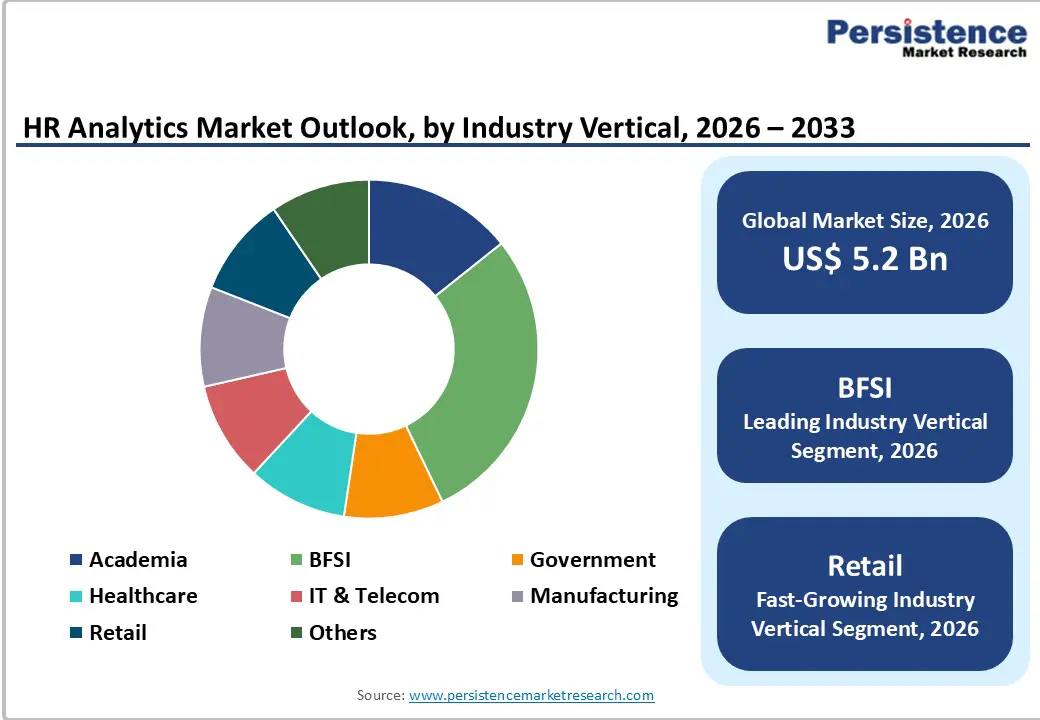
Specialized HR analytics solutions targeting vertical-specific requirements including healthcare staffing optimization, retail labor scheduling, government compliance frameworks, and IT services resource allocation represent high-growth opportunities for vendors developing tailored platforms addressing industry-unique challenges. Healthcare organizations hold approximately 32.3% of workplace analytics market share, experiencing acute workforce shortages, high turnover, and burnout requiring sophisticated scheduling optimization, predictive retention analytics, and succession planning supporting clinical operations. Banking, Financial Services, and Insurance (BFSI) organizations represent approximately 25.7% of market revenue, prioritizing workforce cost optimization, regulatory compliance, and talent management analytics addressing low-profit margins and compliance complexity.
IT and Telecom sectors contribute approximately 20.2% of market revenue with exceptional 10.25% CAGR, driven by distributed workforce management, resource allocation optimization, and rapid skill requirement changes necessitating continuous workforce analytics. Government and public sector organizations are increasingly adopting HR analytics supporting digital transformation initiatives, compensation equity analysis, and strategic workforce planning. Vertical-specific SaaS implementations generate superior ROI relative to enterprise suite generic approaches, creating substantial opportunities for specialized vendors and consultants addressing industry-unique analytics requirements.
Category-wise Insights
Components Analysis
Solution components encompassing employee engagement & development, payroll & compensation, recruitment, retention, talent analytics, and workforce planning collectively capture approximately 65% of HR Analytics Market revenue, driven by essential role in core HR function automation and analytics. Workforce planning solutions represent the fastest-growing component at 25% CAGR, reflecting organizational prioritization of aligning workforce strategies with long-term business objectives and anticipating future skill requirements. Talent analytics solutions expand at 16.4% CAGR, driven by increasing use of data for workforce planning, talent gap identification, and performance-driven organizational decisions. Employee engagement & development solutions gain momentum at 14.5% CAGR, supporting organizations' emphasis on personalized employee development, retention, and engagement optimization.
Service components including implementation and integration services, advisory services, and support and maintenance capture approximately 28% of market revenue and expand at 13.4% CAGR, reflecting growing complexity of HR analytics implementations and organizational reliance on specialized expertise. The convergence of expanding solution functionality and accelerating service demand establishes solution components as dominant market segments sustaining growth through the forecast period.
Deployment Analysis
Cloud-based HR analytics deployment commands approximately 60% of market revenue and expands at 15% CAGR through 2033, driven by superior scalability, accessibility, cost-effectiveness, and seamless integration with modern cloud-native applications. Cloud deployment offers organizations automatic updates, reduced IT burden, faster deployment timelines, and lower long-term total cost of ownership compared to traditional on-premises infrastructure. Workday, SAP SuccessFactors, and Oracle Cloud report that 78% of new deployments occur in cloud environments, supported by improved security certifications and enhanced compliance frameworks satisfying organizational data protection requirements.
On-premises HR analytics deployment maintains approximately 35% of market revenue while expanding at 18% CAGR in highly regulated sectors including BFSI, government, and defense requiring strict data sovereignty, localized data residency, and compliance mandates. Hybrid deployment models combining on-premises infrastructure for sensitive operations with cloud resources for flexible scalability are increasingly adopted, balancing local data control with cloud scalability through enhanced access controls and encryption mechanisms. Cloud-based deployment dominance reflects organizational structural preferences for operational flexibility, cost efficiency, and reduced capital expenditure, with growth accelerating as cloud providers enhance security postures and regulatory compliance frameworks.
Enterprise Size Analysis
Large enterprises capturing approximately 62% of HR Analytics Market revenue leverage extensive workforce data, complex organizational structures, and sophisticated talent management requirements driving demand for comprehensive analytics platforms. Large organizations employ enterprise-scale HR analytics solutions supporting multi-site operations, global workforce management, complex compensation structures, and sophisticated succession planning across diverse organizational hierarchies. Large enterprises expanded at 8.9% CAGR, driven by continued investments in analytics capabilities supporting cost optimization, talent retention, and organizational transformation initiatives.
Small and medium-sized enterprises (SMEs) represent the fastest-growing segment at 16.8% CAGR, expanding from approximately 38% of market revenue driven by accelerating cloud adoption, reducing cost and complexity barriers to analytics implementation. SMEs prioritize affordable, configurable SaaS solutions enabling workforce analytics without substantial infrastructure investments or specialized technical expertise. Approximately 70% of SMEs intend workplace analytics implementation within 24 months, reflecting market transformation from early-adopter technology to mainstream business requirement. The dual-track growth trajectories for large enterprises maintaining dominance and SMEs experiencing exceptional expansion establish enterprise size segmentation as critical differentiation driver through 2033.
Industry Vertical Analysis
IT and Telecom sectors command approximately 23% of HR Analytics Market revenue, driven by distributed workforce management, rapid skill requirement changes, and critical reliance on talent acquisition and retention analytics. IT sector organizations employ advanced HR analytics for recruitment optimization, employee engagement enhancement, performance management, and talent development supporting rapid business growth and competitive talent markets. The IT and Telecom sector expands at 10.2% CAGR, outpacing overall market growth driven by expanding digital transformation initiatives, aggressive hiring to support business scaling, and strategic emphasis on talent retention in highly competitive labor markets. BFSI (Banking, Financial Services, and Insurance) captures approximately 25% of market revenue, driven by regulatory compliance complexity, need for workforce cost optimization, and sophisticated talent management supporting competitive positioning.
Healthcare sector represents an emerging high-growth opportunity at 18.1% CAGR, driven by acute workforce shortages, high turnover rates, burnout challenges, and government initiatives supporting healthcare system strengthening. Government and Public Sector organizations are accelerating HR analytics adoption to support digital transformation, citizen service delivery, and administrative efficiency initiatives. Manufacturing, Retail, Education, and Others collectively represent approximately 15.8% of market revenue with growth trajectories of 6.8% CAGR. The concentration of analytics adoption in IT, Telecom, BFSI, and emerging Healthcare segments reflects industry-specific workforce challenges and data-driven decision-making priorities.
Regional Insights
North America HR Analytics Trends
North America commands approximately 33% of global HR Analytics Market revenue, with the United States representing the dominant regional market driven by advanced cloud infrastructure, sophisticated talent management practices, and widespread analytics adoption. The U.S. HR analytics market benefits from exceptional cloud adoption rates, mature HR technology ecosystem, and organizational emphasis on data-driven decision-making supporting workforce optimization and business transformation. North American organizations prioritize comprehensive analytics solutions supporting complex multi-site operations, remote work optimization, and strategic talent planning aligned with long-term business objectives.
Large enterprises across North America are substantially increasing investments in advanced AI-powered HR analytics, generative AI-enabled talent prediction systems, and predictive attrition modeling supporting proactive workforce management. The region's regulatory framework emphasizing data protection, combined with organizational sophistication in analytics implementation, establishes North America as a premium market commanding higher per-unit valuations for advanced analytics solutions. North America expands at approximately 8.5% CAGR, driven by continued enterprise investment in talent retention, workforce planning optimization, and analytics-driven organizational transformation.
Europe HR Analytics Trends
Europe represents approximately 22% of global HR Analytics Market revenue, with Germany, United Kingdom, France, and Spain leading regional adoption driven by stringent GDPR compliance requirements, emphasis on employee well-being, and sophisticated HR technology adoption. European organizations prioritize analytics solutions supporting compliance documentation, diversity and inclusion measurement, and employee engagement optimization aligned with regional emphasis on worker protections and organizational responsibility. The EU's GDPR regulatory framework requires organizations to implement robust data protection mechanisms, conduct privacy impact assessments, and maintain comprehensive audit trails, driving demand for secure HR analytics platforms supporting compliance documentation.
European manufacturers including SAP, established HR technology providers, and emerging specialists are advancing analytics capabilities through enhanced AI/ML integration and privacy-preserving analytics methodologies. The region's emphasis on sustainability, environmental responsibility, and stakeholder capitalism drives organizational investment in HR analytics supporting workforce well-being, diversity goals, and organizational purpose alignment.
Asia Pacific HR Analytics Trends
Asia-Pacific represents the fastest-growing regional market, commanding approximately 28% of global HR Analytics Market revenue with exceptional expansion at 16.8% CAGR through 2033, driven by rapid economic development, accelerating digital transformation, and emerging market adoption of cloud technologies. China dominates Asia-Pacific, contributing approximately 35.5% of regional revenue with government initiatives supporting smart cities, digital infrastructure, and enterprise technology adoption creating favorable conditions for analytics expansion. China experiences 60% of large organizations integrating HR analytics, driven by massive population, rapid urbanization, and government digitalization initiatives supporting workforce analytics adoption across enterprises.
India represents the second-largest Asia-Pacific market, expanding at 17.2% CAGR, driven by rapidly expanding IT sector, emerging startup ecosystem, and government initiatives promoting digital skill development and talent management. Ministry of Electronics and Information Technology (MeitY) initiatives and government Make in India programs are accelerating HR analytics adoption across emerging sectors supporting digital transformation. Japan leads Asia-Pacific in analytics maturity with 70% of large enterprises utilizing HR analytics platforms, supported by advanced technological infrastructure and emphasis on operational efficiency and innovation.
ASEAN nations including Vietnam, Thailand, Indonesia, Malaysia, and Philippines are emerging as high-growth markets driven by economic development, expanding IT service sectors, and accelerating cloud adoption among SMEs and startups. Approximately 45% of APAC SMEs currently utilize cloud-based HR solutions, reflecting dramatic increase from 28% in 2021, signaling rapid technology democratization. The structural shift of manufacturing toward Asia-Pacific combined with accelerating digital transformation and cloud adoption establishes the region as the primary growth engine for global HR analytics market through 2033.
Competitive Landscape for the HR Analytics Market
The HR Analytics Market exhibits moderately fragmented competitive structure with established enterprise software vendors, specialized analytics solution providers, and emerging technology startups competing across diverse market segments. Tier 1 competitors including Workday, Inc., SAP SE, Oracle Corporation, IBM, and Tableau Software leverage extensive R&D investments, comprehensive product portfolios, and established enterprise relationships maintaining market dominance. Tier 2 and emerging competitors including UKG Inc., Visier, Inc., Infor, MicroStrategy Inc., Sisense Inc., and specialized providers are expanding through innovative analytics capabilities, vertical-specific solutions, and cloud-native architectures.
Competitive differentiation strategies emphasize AI/ML integration, predictive analytics sophistication, user-friendly interfaces, vertical-specific customization, and comprehensive HR system integration. Strategic acquisitions including ADP's WorkForce acquisition and SAP's WalkMe acquisition reflect industry consolidation supporting expanded capabilities and market reach. OEM supply relationships and integration ecosystem partnerships create substantial competitive advantages for vendors achieving HRIS ecosystem dominance through API frameworks and marketplace extensions.
Key Market Developments
- In October 2024, ADP announced acquisition of Workforce Software, expanding payroll and workforce management capabilities while strengthening analytics and cost forecasting solutions supporting enhanced HR transformation offerings across enterprise segments.
- In August 2024, Workday unveiled Global Payroll Connect, a unified global payroll solution enabling seamless integration with payroll providers across partner ecosystems while delivering comprehensive HR and payroll analytics supporting distributed workforce management.
- In September 2024, SAP completed acquisition of WalkMe Ltd., enhancing digital adoption and user experience capabilities while integrating AI-powered analytics into SuccessFactors supporting improved employee experience and organizational transformation.
Companies Covered in Global HR Analytics Market
- Cegid
- Crunchr
- GainInsights
- IBM Corp.
- Infor
- MicroStrategy Inc.
- Oracle Corp.
- Sage Software Solutions Pvt. Ltd.
- SAP SE.
- Sisense Inc.
- Tableau Software, LLC.
- UKG Inc.
- Visier, Inc.
- Workday, Inc.
- Zoho Corp. Pvt. Ltd.
Frequently Asked Questions
The Global HR Analytics Market is projected to reach US$ 10.4 Billion by 2033, expanding from US$ 5.2 Billion in 2026 to a CAGR of 10.4%, driven by accelerating cloud adoption, enterprise emphasis on data-driven decision-making, workforce globalization, and increasing demand for advanced analytics supporting talent management and business transformation.
The market is primarily driven by accelerating cloud platform adoption, reducing cost and complexity barriers; rising organizational emphasis on employee engagement, retention, and predictive workforce analytics; increasing workforce globalization requiring sophisticated talent analytics; enterprise recognition that advanced analytics directly drive business outcomes and competitive advantage; and accelerating AI/ML integration enabling advanced predictive capabilities.
Workforce planning solutions dominate and expand fastest at 25% CAGR, driven by organizational prioritization of aligning workforce strategies with long-term business objectives, anticipating future skill requirements, and supporting strategic business transformation through data-driven workforce planning and optimization.
North America commands approximately 33% of global HR Analytics Market revenue as leading region, supported by advanced cloud infrastructure, sophisticated HR technology ecosystem, organizational emphasis on data-driven decision-making, and widespread analytics adoption driving market dominance.
Vertical-specific HR analytics solutions targeting unique industry requirements including healthcare staffing optimization, retail labor scheduling, government compliance frameworks, and IT services resource allocation represent highest-potential opportunities, generating superior ROI while addressing industry-unique workforce challenges.
Workday leads through cloud-native architecture and Skills Cloud AI/ML integration; SAP SuccessFactors dominates through comprehensive talent intelligence and WalkMe acquisition strengthening user adoption; Oracle Cloud HCM differentiates through advanced analytics and AI-driven insights; UKG, Visier, and emerging specialists compete through innovative analytics capabilities and vertical-specific solutions.


