




- Nutraceuticals & Functional Foods
- Organic Mushroom Market
Organic Mushroom Market Size, Share, and Growth Forecast, 2026 - 2033
Organic Mushroom Market by Product Type (Fresh, Dried, Frozen, Canned), Application (Food & Beverage, Nutraceuticals, Pharmaceuticals, Cosmetics, Others), Distribution Channel (Online Stores, Supermarkets/Hypermarkets, Specialty Stores, Others), and Regional Analysis for 2026 - 2033

Organic Mushroom Market Share and Trends Analysis
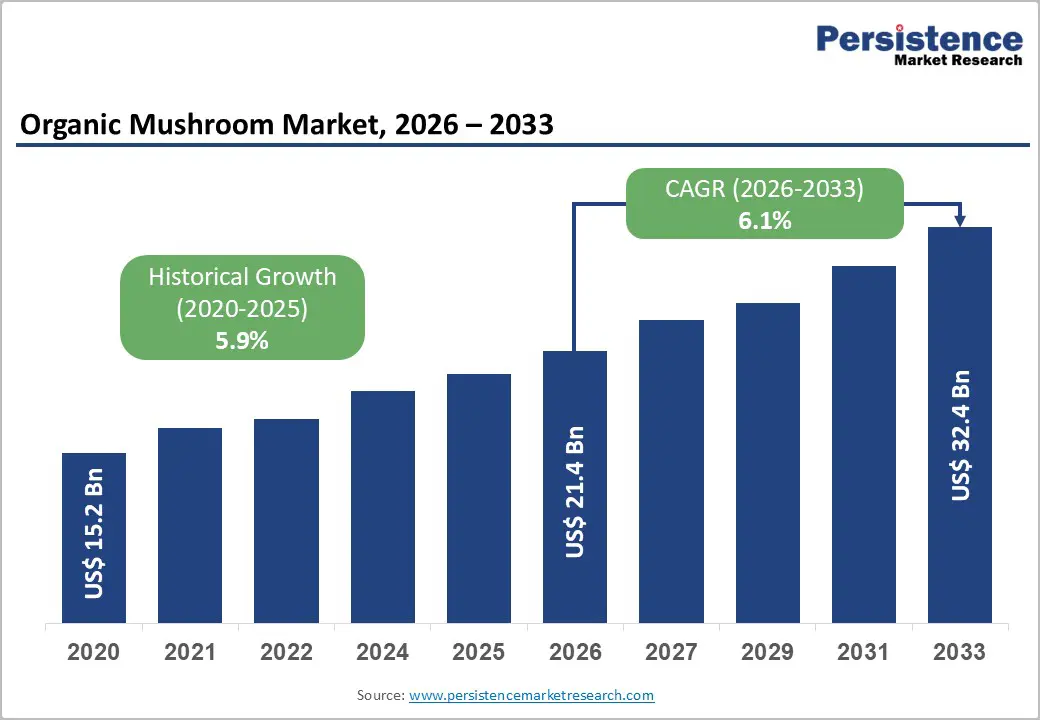
The global organic mushroom market is estimated to be valued at US$ 21.4 billion in 2026 and is projected to reach US$ 32.4 billion by 2033, growing at a CAGR of 6.1% during the forecast period 2026 - 2033.
The market is expanding in response to growing consumer awareness of the nutritional and environmental benefits of organic mushrooms, driving rising demand for chemical-free, nutrient-dense food products. The shift toward plant-based diets and demand for functional ingredients in food, nutraceutical, pharmaceutical, and cosmetic applications are significant growth catalysts. Organic farming practices aligned with sustainability goals are creating competitive advantages for certified producers. Technological advancements in cultivation, packaging, and supply-chain traceability are improving product quality and reach.
Key Industry Highlights
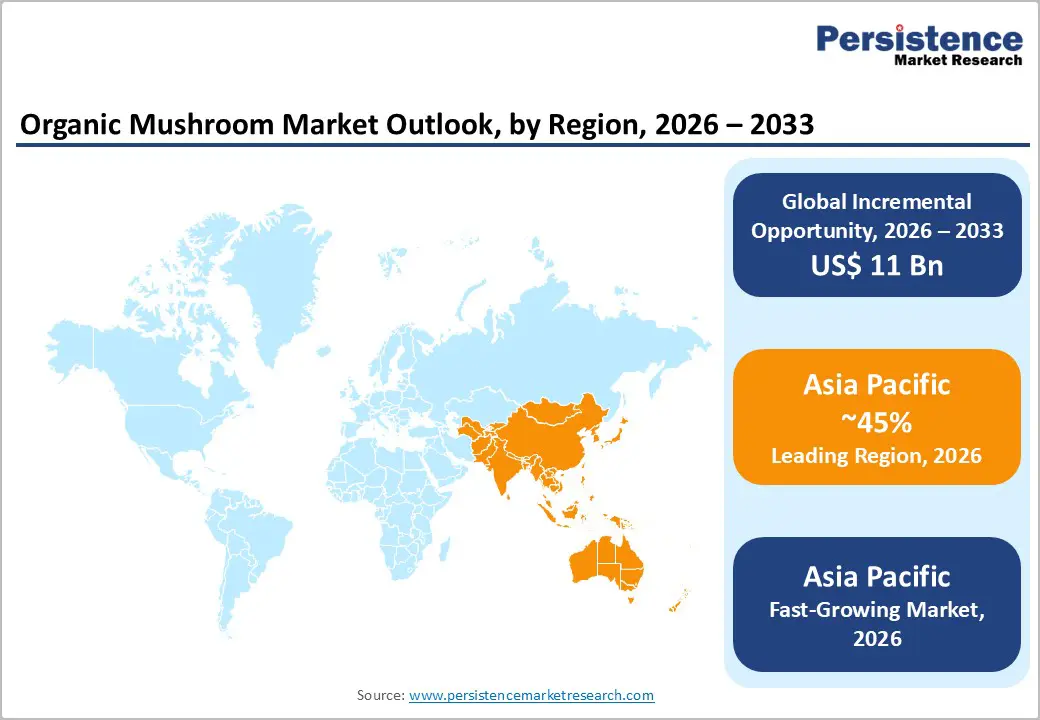
- Dominant Region: Asia Pacific is set to lead in 2026 with an estimated 45% market share, driven by high production capacity and a robust domestic demand.
- Fastest-growing Regional Market: Asia Pacific is projected to be the fastest-growing market during 2026 - 2033, supported by a steadily increasing demand for functional mushrooms.
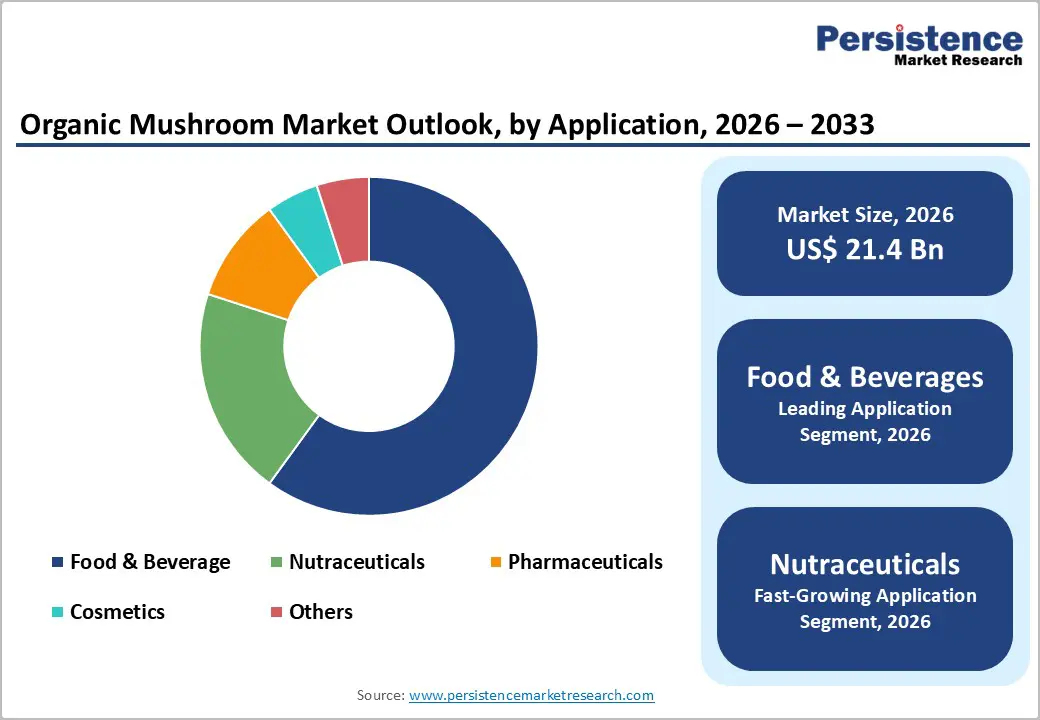
- Leading Application: Food and beverage are anticipated to lead with around 60% revenue share in 2026, owing to strong consumer demand for plant-based and clean-label mushroom products.
- Fastest-growing Application: Nutraceuticals are forecast to be the fastest-growing segment through 2033, driven by rising demand for functional mushroom-based supplements, immunity-boosting products, and innovative extract formulations.
- September 2025: Two River Mushroom rolled out its award-winning organic Lion’s Mane Mushroom Broth nationally, offering a vegan, gluten-free, shelf-stable alternative with umami flavor for sipping or cooking.
| Key Insights | Details |
|---|---|
| Organic Mushroom Market Size (2026E) | US$ 21.4 Bn |
| Market Value Forecast (2033F) | US$ 32.4 Bn |
| Projected Growth (CAGR 2026 to 2033) | 6.1% |
| Historical Market Growth (CAGR 2020 to 2025) | 5.9% |
Market Factors - Growth, Barriers, and Opportunity Analysis
Regulatory Support and Technological Advancements in Cultivation
Regulatory support has shaped production discipline, investment confidence, and supply chain transparency across organic food systems. Clear certification standards, input controls, and audit mechanisms create a predictable operating environment for growers and distributors. Policy-backed incentives linked to sustainable agriculture accelerate the adoption of controlled cultivation practices aligned with organic compliance requirements. This structure strengthens buyer trust across retail, hospitality, and export channels, improving contract visibility and pricing stability. Alignment between public policy and sustainability objectives encourages long-term capital deployment into infrastructure, training, and standardized operating models, reinforcing scalability while maintaining integrity across certified supply networks.
Technological advancements in cultivation convert regulatory clarity into measurable business outcomes through consistency, efficiency, and risk mitigation. Precision climate control, substrate engineering, and automation stabilize yields under organic constraints while limiting biological volatility. Digital monitoring systems strengthen traceability, data integrity, and audit readiness, aligning operations with regulatory and buyer requirements. Resource-efficient designs reduce water and energy intensity, supporting sustainability expectations from institutional customers. This alignment between regulation and cultivation technology drives a self-reinforcing growth cycle anchored in operational reliability.
Regulatory Hurdles and Competitive Threats from Conventional Alternatives
Regulatory hurdles limit scale, speed, and capital efficiency through rigorous certification, audit, and traceability requirements. Market entry depends on compliance across substrates, spawn sourcing, pest control, post-harvest handling, labeling, and logistics, enforced through repeated inspections and documentation. Any upstream non-compliance disrupts supply chains, leading to batch rejections and inventory losses. Divergent cross-border equivalency rules increase administrative complexity. A single compliance failure risks decertification, pricing pressure, and brand erosion, thereby reducing confidence in capacity-expansion decisions. For example, the United States Department of Agriculture National Organic Program mandates a three-year transition period before land qualifies for organic status, delaying revenue realization and constraining return on invested capital.
Competitive threats from conventional alternatives intensify this restraint through price discipline and operational flexibility. Conventional producers operate with broader input choices, faster crop cycles, and higher yields per square meter, enabling lower unit costs and consistent supply for food service and retail buyers. Price-sensitive channels often prioritize reliability and margins, leading to shelf competition where premium positioning faces resistance during inflationary cycles. Product parity further narrows differentiation as texture, appearance, and culinary performance converge at the point of sale, shifting purchase decisions toward price and availability. Marketing claims face scrutiny under labeling rules, limiting comparative messaging and raising the cost of consumer education.
Digital Integration and Policy-Driven Innovation
Digital integration emerges as a decisive growth lever through structural efficiency, transparency, and scalability across cultivation and commercialization. Advanced sensing systems support precise control over growing environments, improving yield consistency and cycle predictability. Data analytics platforms enable forward planning through demand-linked production scheduling, reducing surplus and margin erosion. Distributed ledger systems strengthen end-to-end traceability, reinforcing organic credibility across retail and food service channels. Digital procurement and direct-to-buyer platforms shorten distribution layers, improving price realization for producers and visibility for buyers. Automation in grading, packing, and cold-chain coordination standardizes quality benchmarks while sustaining operational scale.
Policy-driven innovation accelerates this opportunity through regulatory frameworks that reward digitization, transparency, and sustainable production practices. Digitally enabled certification systems streamline compliance processes and reduce verification timelines, supporting faster commercialization. Government-backed agri-technology incentives encourage the adoption of climate-controlled infrastructure, renewable energy inputs, and bio-based substrates aligned with organic principles. Digital food safety mandates raise traceability expectations across domestic and export channels, favoring operators with integrated systems. Trade facilitation initiatives built on electronic documentation reduce cross-border friction and improve access to high-value markets.
Category-wise Analysis
Product Type Insights
Fresh organic mushrooms are anticipated to secure around 65?% market share in 2026, reflecting strong consumer preference for fresh, natural ingredients in everyday cooking and professional culinary applications. Their dominance is fueled by demand from retail supermarkets, specialty grocery stores, and foodservice channels, where freshness, texture, and flavor significantly influence purchasing decisions. Consumers increasingly prioritize clean-label and minimally processed products, positioning fresh organic mushrooms as a premium choice. The segment gains additional benefits from the consistent year-round availability of mushrooms through controlled-environment cultivation and advanced supply chain management.
Dried varieties are expected to be the fastest-growing product type during the 2026-2033 forecast period, propelled by improvements in dehydration and packaging technologies that extend shelf life and preserve flavor, nutrients, and functional properties. Their growth is supported by rising incorporation in processed foods, soups, sauces, supplements, and nutraceutical applications, where convenience and long-term storage are critical. Export potential also drives expansion, as dried mushrooms reduce logistics costs and minimize spoilage during transportation compared with fresh produce. Consumer trends favoring plant-based, functional, and health-focused foods further accelerate adoption.
Application Insights
Food and beverages are poised to dominate with a forecasted market share of around 60% in 2026, powered by the widespread integration of organic mushrooms into home cooking, restaurant menus, and processed culinary products. This dominance is driven by strong consumer demand for plant-based, health-focused, and clean-label ingredients, where fresh and value-added mushrooms provide natural flavor, texture, and nutritional benefits. Retail, foodservice, and ready-to-eat meal channels reinforce adoption, while innovation in pre-packaged, ready-to-cook, and gourmet products further strengthens market presence. The segment benefits from established supply chains and brand recognition, making organic mushrooms a staple in mainstream culinary applications.
Nutraceuticals are estimated to be the fastest-growing segment from 2026 to 2033, fueled by rising consumer demand for functional foods and immunity-boosting supplements. Organic mushroom extracts, such as reishi, lion’s mane, and cordyceps, are increasingly incorporated into dietary supplements, powders, and capsules, offering antioxidant, cognitive, and immune support benefits. Growth is supported by scientific validation of health-promoting properties, increasing consumer adoption of preventive health measures, and integration into wellness-focused product portfolios. Manufacturers are focusing on advanced extraction techniques, standardization, and product innovation to meet evolving market expectations.
Distribution Channel Insights
Supermarkets and hypermarkets are likely to be the leading channel, accounting for an estimated 55% of organic mushroom market revenue share in 2026, driven by consistent shelf-space allocation, high consumer accessibility, and strong brand visibility. Large retail formats allow suppliers to maintain reliable inventory, manage bulk procurement efficiently, and ensure standardized pricing across regions. In-store promotions, product displays, and consumer trust in certified organic labels reinforce purchasing decisions, especially for fresh and value-added mushrooms. The convenience of these outlets, combined with their extensive geographic reach, makes them the primary point of contact for organic mushroom consumers.
Online stores are expected to be the fastest-growing channel from 2026 to 2033, driven by rising digital adoption, direct-to-consumer sales models, and evolving consumer shopping habits. E-commerce platforms overcome geographic limitations, enabling consumers in remote areas to access premium organic mushrooms with ease. Features such as detailed product information, transparent sourcing, customer reviews, and subscription delivery models enhance convenience and buyer confidence. Companies investing in digital marketing, cold-chain logistics, and user-friendly interfaces are driving market penetration throughout this period.
Regional Insights
North America Organic Mushroom Market Trends
North America maintains a significant position in the organic mushroom market share, bolstered by an advanced cultivation infrastructure, strong consumer demand for plant-based nutrition, and well-developed distribution channels across the United States and Canada. The regional market operates under a highly regulated organic framework, led by the U.S. Department of Agriculture’s National Organic Program, which standardizes production practices and ensures product credibility. Producers utilize climate-controlled indoor cultivation and vertical farming technologies to maintain year-round supply, improve yield reliability, and reduce resource consumption compared with conventional methods. These operational efficiencies align with consumer preferences for fresh, high-quality, and sustainably produced foods, increasing adoption in both retail and foodservice channels.
Long-term market growth is also supported by changing dietary patterns and increasing interest in gourmet and exotic varieties, which encourage product diversification and premium positioning. Regional production hubs continue to innovate in cultivation techniques, logistics, and supply chain efficiency. Challenges such as climate variability, labor constraints, and distribution pressures are prompting investment in automation, smart environmental controls, and sustainable resource management, enhancing resilience and competitiveness.
Europe Organic Mushroom Market Trends
Europe is expected to maintain a prominent position in the market for organic mushrooms, owing to its established cultivation infrastructure, technical expertise, and growing consumer preference for certified organic produce. According to Eurostat, the total area used for organic agricultural production in the European Union reached approximately 16.9?million hectares in 2022, equivalent to about 10.5?% of total agricultural land, demonstrating strong institutional support and capacity for organic farming. Germany and Poland together account for the majority of organic mushroom output, reflecting mature production systems, high-quality standards, and well-established export networks. Advanced controlled-environment cultivation and mechanized harvesting enhance operational efficiency, reduce post-harvest losses, and ensure year-round supply.
Structural factors suggest continued growth potential, supported by policy frameworks such as the Common Agricultural Policy (CAP) and the Farm-to-Fork Strategy, which provide financial incentives for organic conversion and promote sustainable farming practices. Consumption patterns vary, indicating untapped demand in emerging urban markets, while innovation in value-added products, including pre-sliced, functional, and medicinal organic mushrooms, aligns with evolving consumer preferences for convenience and wellness. Growing awareness of health benefits and sustainability drives adoption across demographics, while export opportunities to neighboring regions create additional revenue streams. Investment in quality certification, process optimization, and supply chain efficiency enhances market resilience.
Asia Pacific Organic Mushroom Market Trends
Asia Pacific is positioned to dominate in 2026, capturing an estimated 45% of the organic mushroom market share, reflecting its unparalleled combination of production capacity, technological integration, and established consumption base. Leading producers, particularly China, leverage advanced controlled-environment cultivation systems, optimized substrate utilization, and high-efficiency processing, ensuring consistent supply of diverse organic mushroom varieties. Strong domestic consumption rooted in culinary and medicinal traditions sustains demand, while modern processing techniques and high-quality standards position the regional market as a key exporter to global markets. Expansion of specialty retail networks and e-commerce channels enhances accessibility across urban and semi-urban populations, enabling a seamless connection between producers and consumers.
Not only is Asia Pacific set to lead but it is also forecast to emerge as the fastest-growing market through 2033, fueled by rising health-conscious consumer behavior, increasing disposable incomes, and growing demand for functional and immunity-enhancing mushroom varieties such as lion’s mane, reishi, and cordyceps. Innovative product formats, including powders, capsules, and ready-to-use formulations, expand applicability across food, beverages, and nutraceuticals, driving penetration in emerging urban segments. Policy support for organic agriculture and export facilitation, coupled with rapid urbanization and changing dietary patterns, accelerates adoption. Continuous improvements in logistics and post-harvest infrastructure increase efficiency and profitability, reinforcing growth momentum.
Competitive Landscape
The global organic mushroom market demonstrates a moderately consolidated structure, shaped by the presence of large multinational companies alongside specialized regional producers. Leading players such as Monterey Mushrooms, LLC, Bonduelle Group, Highline Mushrooms, Monaghan Group, and BioFungi GmbH hold a significant portion of global revenue, benefiting from advanced cultivation techniques, large-scale production facilities, and well-established distribution networks. These companies capitalize on strong brand recognition and extensive supply chain capabilities, enabling them to consistently meet demand from retail, foodservice, and industrial buyers while maintaining quality and safety standards. Their scale also allows for investment in research and development, supporting innovation in product varieties and value-added mushroom offerings.
Smaller organic farms enhance the market ecosystem through flexibility, niche product portfolios, and responsiveness to regional consumer preferences, introducing unique mushroom types and specialty products. Competition differs across regions, with North America and Europe showing higher consolidation among certified producers, whereas Asia Pacific remains fragmented, offering emerging players opportunities to expand and innovate. This balance between large multinationals and local specialists drives both efficiency and diversity in the market.
Key Industry Developments
- In October 2025, the Indian state of Tripura announced a push to become self-sufficient in organic mushroom cultivation by training 53 farmer producer companies and expanding production across its 26,000 hectares of organic farmland.
- In May 2025, Laird Superfood launched six new organic mushroom powders, including Calm & Relaxation and Focus & Memory blends, plus single varieties such as lion’s mane and reishi for cognitive, immune, and wellness benefits. All these powders are US-grown, filler-free for easy mixing into drinks.
- In February 2025, M2 Ingredients inaugurated a 155,000?sq?ft state-of-the-art organic mushroom growing facility in Vista, California, boosting production capacity and enabling faster delivery of premium functional mushroom ingredients to global customers.
Companies Covered in Organic Mushroom Market
- Monterey Mushrooms, LLC
- Bonduelle Group
- Highline Mushrooms
- Monaghan Group
- BioFungi GmbH
- Scelta Mushrooms BV
- Weikfield Foods Pvt. Ltd.
- Costa.
- South Mill Mushrooms Sales
- Smithy Mushrooms
Frequently Asked Questions
The global organic mushroom market is projected to reach US$ 21.4 billion in 2026.
Increasing awareness of nutrition, immunity benefits, and eco-friendly farming further fuels market growth.
The market is poised to witness a CAGR of 6.1% from 2026 to 2033.
Expanding value-added products, functional mushrooms, and sustainable cultivation methods are creating key growth opportunities.
Some of the key market players include Monterey Mushrooms, LLC, Bonduelle Group, Highline Mushrooms, and Monaghan Group.


