




- Retail
- Gift Card Market
Gift Card Market Size, Share, Trends, and Growth Forecast, 2026 - 2033
Gift Card Market by Card Type (Physical Gift Cards, E-Gifting), Price Range (High [Above US$ 400], Medium [US$ 200-400], Low [Below US$ 200]), Sales Channel (Online, Offline), Merchant, End-user, and Regional Analysis for 2026 - 2033

Gift Card Market Size and Trends Analysis
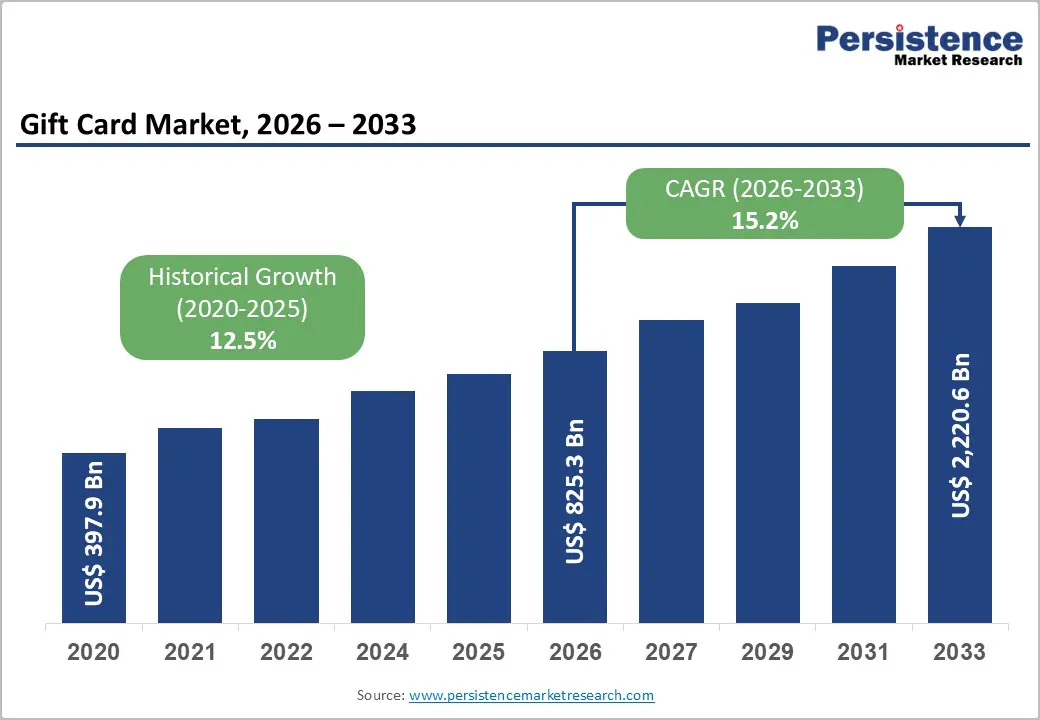
The global gift card market size is projected to rise from US$ 825.3 billion in 2026 to US$ 2,220.6 billion by 2033, growing at a CAGR of 15.2% during the forecast period from 2026 to 2033.
The growth is driven by rising demand for convenient, secure, and personalized gifting solutions. As consumers increasingly adopt digital and mobile payment platforms, gift cards have become a preferred option for both personal and corporate gifting. Their integration with loyalty and reward programs, coupled with the rapid expansion of e-commerce and online retail, is accelerating market adoption. Businesses are leveraging gift cards to strengthen customer engagement, improve retention, and enhance long-term brand loyalty.
Key Industry Highlights:
- Leading Merchant: Department stores dominate with over 24% share in 2026, exceeding US$ 198.1 Bn, leveraging diverse offerings and broad consumer reach. Supermarkets and hypermarkets are growing steadily and are expected to surpass 20% market share by 2033, driven by loyalty-linked programs and everyday gifting trends. Visa/Mastercard/American Express Gift Cards are expected to grow at a CAGR of 19.3%.
- Leading Card Type: Physical gift cards hold the largest share at over 55% in 2026, valued at more than US$ 453.9 Bn, driven by consumer preference for tangible gifting and personal touch. Closed-loop gift cards account for more than 68% of the physical gift card segment. E-gifting is the fastest-growing segment at a CAGR of 20.1%, expected to exceed US$ 1,487.8 Bn by 2033, supported by instant delivery, mobile wallets, and digital personalization.
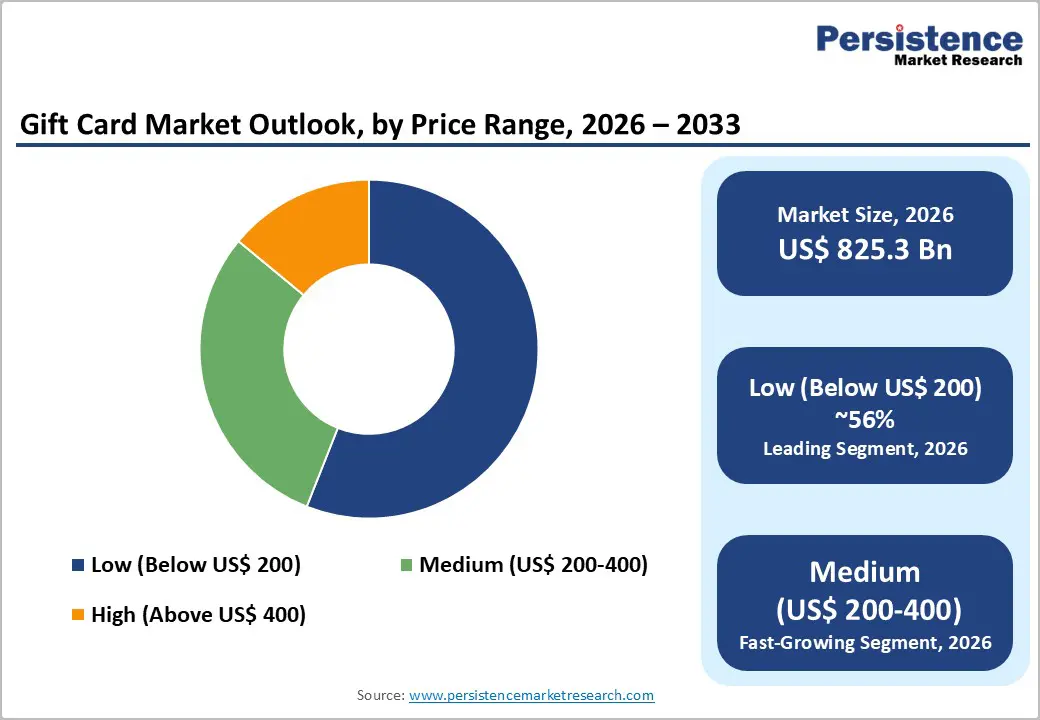
- Leading Price Range: Low-value gift cards (below US$ 200) account for over 56% of the market in 2026, valued at US$ 462.3 Bn, driven by frequent consumer engagement and accessibility. Medium-value cards (US$ 200-400) grow at a CAGR of 15.7%, appealing to both corporate buyers and individual consumers for thoughtful gifting.
- Leading Sales Channel: Offline channels hold over 53% share in 2026, offering convenience, instant activation, and personal assistance. Online channels are the fastest-growing segment, projected to exceed US$ 1,399.0 Bn by 2033, driven by e-commerce integration, mobile wallets, and instant redemption.
- Leading End-user: Individuals account for over 61% of the market in 2026, valued at US$ 503.4 Bn, fueled by convenience and flexible gifting solutions. Businesses grow at a CAGR of 19.6%, leveraging gift cards for employee recognition, corporate incentives, and customer loyalty programs.
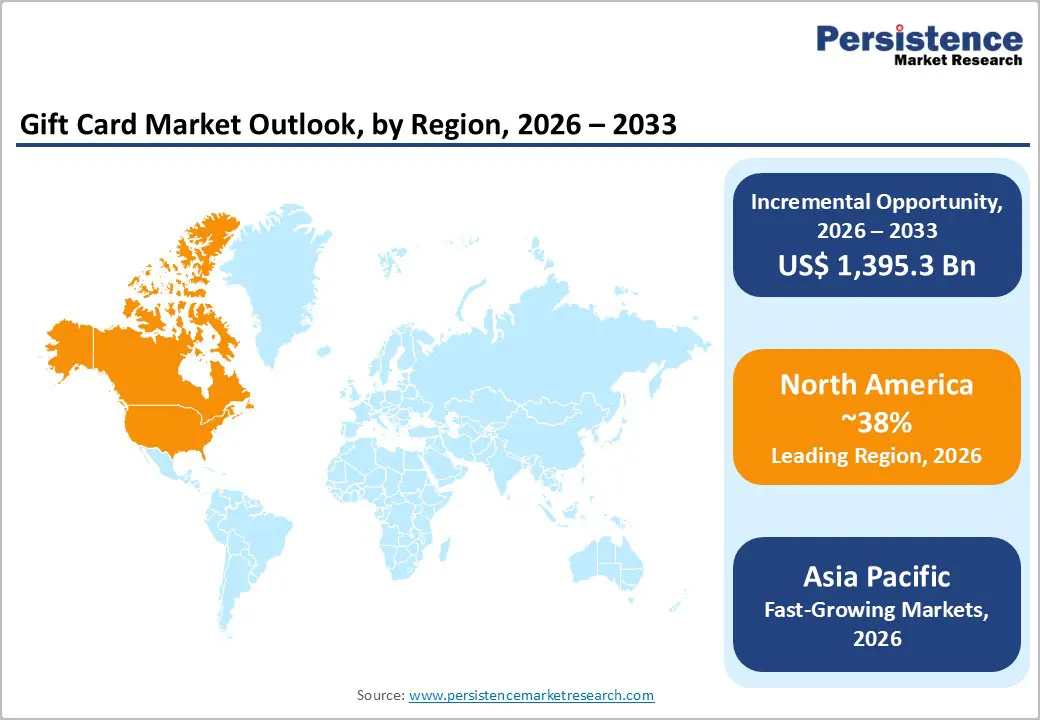
- Leading Region: North America leads with over 38% market share in 2026, valued at US$ 313.6 Bn, supported by advanced digital infrastructure, mobile payment adoption, and AI-driven personalization. The U.S. Gift Card market is projected to exceed US$550 bn by 2033. Asia-Pacific is the fastest-growing region at a CAGR of 20.6%, expected to exceed US$ 730 Bn by 2033, led by smartphone penetration, mobile payment platforms (UPI, Alipay, Paytm), government digital initiatives, and rising disposable incomes. The Indian gift card market is expected to grow at a CAGR of 26.7%.
| Key Insights | Details |
|---|---|
| Gift Card Market Size (2026E) | US$ 825.3 Bn |
| Market Value Forecast (2033F) | US$ 2,220.6 Bn |
| Projected Growth (CAGR 2026 to 2033) | 15.2% |
| Historical Market Growth (CAGR 2020 to 2025) | 12.5% |
Market Dynamics
Driver - Optimizing Mobile Gift Cards for Instant Consumer Engagement
Mobile devices have transformed consumer-brand interactions, creating demand for fast, convenient, and personalized experiences, making mobile-friendly gift cards essential. Traditional gift cards fall short for mobile-first buyers seeking instantly accessible and shareable options, while mobile-friendly cards drive engagement and revenue through peer-to-peer influence. Gen Z and Millennials increasingly prefer digital gift cards, reshaping gifting habits, with 50% of Gen Z and 49% of Millennials reporting increased usage over the past year, according to a survey by Bankrate. Capital One reports that 61% of consumers spend more than the card’s value when redeeming, adding an average of $31.75 per transaction, boosting overall profitability. Mobile gift cards offer seamless usability, higher redemption rates, and increased incremental spending.
Digital Payment Adoption and Regulatory Support Driving Gift Card Demand
The rapid adoption of mobile wallets, UPI, and contactless payments is driving consumer preference for digital or e-gift cards over physical cards, particularly among Millennials and Gen Z. Online platforms enable instant delivery, secure redemption, and integration with apps and loyalty programs, enhancing engagement and repeat purchases. Cross-border digital payments, such as UPI adoption in France, are boosting Indian tourist spending by 40%, expanding market reach. Government initiatives and regulatory support, including India’s Digital India, the ONDC framework (with YES BANK issuing the first ONDC Network Gift Cards), and European digital payment regulations, promote cashless economies, innovation, and enhanced fraud protection, further accelerating demand. Integration with Apple Wallet, Google Pay, and other digital wallets improves visibility and frequent use.
Restraint - Security Threats and Fraud-Related Concerns
Criminals exploit the high level of anonymity and ease of transferability of gift cards through schemes such as "gift card tampering," in which stolen cards are altered and resold internationally. Multi-step operations involving takers, tampering experts, placers, and acquirers target high-value goods, undermining consumer confidence. Weak regulations and security gaps in many jurisdictions further increase vulnerability. According to the FTC, over 41,000 reports of gift card fraud led to $212 million in losses in 2024, while Americans lost more than $228 million in 2023, with actual figures likely higher due to underreporting.
Regulatory Compliance and Legal Complexities
The fragmented regulatory landscape creates significant challenges for the gift card market. Inconsistent state laws and legal gray areas complicate the prosecution of gift card fraud, with only sixteen jurisdictions currently advancing prosecutorial legislation. Varying rules on expiry dates, fees, and KYC requirements create operational complexities for global operators. Stringent consumer protection laws in Europe further increase compliance burdens, while emerging markets often lack comprehensive regulatory frameworks, limiting market development potential.
Opportunity
Seamless Cross-Platform and Omnichannel Experiences
The growing demand for seamless omnichannel gift card experiences across stores, websites, apps, and social platforms presents significant market opportunities. According to a study, 53% of online-purchased gift cards are redeemed in-store, while 22% of in-store cards are used online, underscoring the need for integrated systems that bridge e-commerce and physical retail. Emerging technologies such as AR/VR for immersive gifting, AI-driven personalization for targeted recommendations, smart contracts, and IoT-enabled redemption enhance customer engagement and enable premium pricing. Companies like Blackhawk Network leverage AI to boost satisfaction and conversion rates, demonstrating the potential of tech-enabled gift card solutions.
Integration of Gift Cards with Loyalty Programs and POS Systems
Combining gift cards with loyalty programs enhances customer retention and engagement by allowing loyalty points to be instantly redeemed as gift cards, encouraging repeat purchases and long-term brand loyalty. For example, Factor4’s partnership with Realtime POS enables retailers to seamlessly manage gift card and loyalty programs directly through POS systems, improving operations and sales. Instant reward recognition is crucial, as 75% of consumers prefer immediate benefits, and 68% are more likely to revisit stores with real-time loyalty updates. Retailers integrating POS-based loyalty software report up to a 20% increase in repeat visits, according to Novus Loyalty Limited.
Category-wise Analysis
Merchant Insights- Department Stores Leveraging Diverse Offerings for Flexible Gifting
Department stores are expected to account for more than 24% share in 2026 & expected to surpass the value of US$ 198.1 Bn, capitalizing on their diverse product offerings and established customer relationships. These retailers benefit from high-traffic locations and comprehensive product categories that appeal to a broad range of consumers. Their strength lies in offering universal gifting solutions suitable for various occasions, providing recipients with convenience and flexibility to select products they truly want. The supermarkets and hypermarkets are expected to exceed a 20% market share by 2033, supported by increasing everyday-use gifting and loyalty-linked gift card programs.
Visa/ Mastercard/ American Express are universally accepted merchants that offer flexibility and ease of digital payment systems across online and offline channels. Their suitability for corporate incentives, cross-border gifting, and integration with digital wallets further accelerates adoption compared to closed-loop merchant cards. Coffee shops are expected to grow rapidly due to their appeal as everyday conveniences and lifestyle choices. Consumers prefer gifting coffee cards because they allow recipients flexibility to choose their favorite beverages or snacks. This is driven by the increasing use of digital wallets and mobile ordering, making coffee shop gift cards quick, easy, and accessible.
Card Type Insights - Physical Gift Cards: Enhancing Personal Touch and Brand Presence
Physical gift cards are expected to account for over 55% of the market share in 2026, reaching more than US$ 453.9 Bn, as they cater to the emotional and tangible aspects of gifting and fulfill consumers’ need for a personal touch. Many buyers prefer physical cards for occasions such as birthdays, holidays, and corporate rewards, where presentation matters. Physical gift cards are also convenient for recipients who are less tech-savvy or prefer in-store redemption. Closed-loop gift cards account for more than 68% of the physical gift card segment.
E-gifting is expected to grow at a CAGR of 20.1% and exceed US$ 1,487.8 Bn by 2033, driven by the growing need for convenience and instant delivery. Consumers prefer digital gift cards because they save time, can be sent anytime and anywhere, and offer recipients flexibility to choose their preferred products or services. This growth is further driven by the rising adoption of mobile wallets, online shopping, and contactless payment methods. The ease of personalization and last-minute gifting also make e-gifting highly attractive.
Price Range Insights - Low-Value (Below US$ 200) Gift Cards Driving Accessibility and Frequent Consumer Engagement
Low (Below US$ 200) is expected to account for more than 56% of the market in 2026, reaching a value of over US$ 462.3 Bn, due to its alignment with everyday consumer needs and budgets. These cards are ideal for small celebrations, personal gestures, and corporate incentives, making them highly accessible. They offer recipients flexibility to choose products without imposing high spending, catering to casual gifting occasions. Their affordability encourages frequent purchases, driving repeated market transactions and sustaining demand.
The medium (US$ 200-400) price range is expected to grow at a CAGR of 15.7% due to its balance of accessibility and perceived value. They offer flexible and thoughtful gifting without being overly costly. The rise of digital wallets and online platforms makes these cards convenient and encourages repeated use. This segment appeals to both corporate buyers seeking meaningful employee rewards and consumers purchasing gifts for special occasions, driving sustained growth.
Sales Channel Insights - Offline Driving Convenience, Instant Availability, and Personalized Assistance
Offline is expected to account for over 53% of the market share in 2026, as it meets consumers’ needs for convenience, immediate availability, and personal assistance. Many customers prefer purchasing gift cards in-store, where they consult staff, choose designs, and receive instant activation. Offline channels also cater to regions with limited digital penetration or where consumers are less comfortable with online transactions. The tactile, hands-on experience and trust in in-person purchases reinforce offline dominance.
Online channels are expected to grow at the highest rate, reaching over US$ 1,399.0 Bn by 2033, driven by their convenience and instant accessibility, which fulfill consumers’ need for quick and flexible gifting solutions. Digital wallets and e-commerce platforms simplify purchasing and delivery, allowing recipients to redeem cards immediately. The integration of gift cards into major e-commerce platforms, along with the development of specialized gift card marketplaces, further drives growth in the online channel.
End-user Insights - Individuals Driving Growth Through Convenient and Flexible Gifting Solutions
Individuals are expected to account for over 61% of market share in 2026, exceeding US$ 503.4 Bn, driven by their growing preference for convenient and flexible gifting options that save time and effort. They favor personal celebrations such as birthdays and holidays, where gift cards allow recipients the freedom to choose what they truly want. This is driven by the increasing use of e-commerce and digital wallets, making gift cards an easy and accessible solution for individuals.
Businesses are expected to grow at a CAGR of 19.6%, due to the increasing need for efficient employee recognition, incentives, and corporate gifting solutions. Gift cards offer flexibility, allowing recipients to choose rewards that suit their preferences, thereby enhancing satisfaction and engagement. Companies are leveraging gift cards for customer loyalty programs and B2B relationship management, while also meeting the demand for convenient and personalized rewards.
Regional Insights
North America Gift Card Market Trends
North America is projected to account for over 38% of the gift card market, reaching more than US$ 313.6 billion by 2026, driven by advanced technological infrastructure and innovations such as blockchain-enabled cards that enhance security. Over 80% of Americans use digital payments, with gift cards playing a major role, especially in corporate rewards and customer loyalty programs. Growth is fueled by mobile payment integration, omnichannel retail, and AI-powered personalization, supported by robust regulations. CivicScience reports that 55% of U.S. adults received a gift card during the 2024 holidays, with Gen Z and Millennials leading recipients, and 71% of consumers holding cards for at least a year, highlighting convenience and incremental spending. The U.S. Gift Card market is projected to exceed US$550 bn by 2033.
Asia Pacific Gift Card Market Trends
The Asia Pacific gift card market is expected to grow at a CAGR of 20.6% and exceed US$ 730 Bn by 2033, driven by rising internet and smartphone penetration and mobile payment platforms such as Alipay, Paytm, and India’s UPI, which processes 20 billion transactions monthly as of August 2025. Government-led digital initiatives, increasing disposable incomes, and a growing middle class are boosting demand for flexible, personalized gifting solutions. The integration of gift cards into e-commerce and super-app ecosystems, along with cost-effective regional manufacturing and supply chain advantages, further supports expansion. Millennials and Gen Z favor the convenience and customization offered by gift cards, making them a preferred choice across occasions. The region’s FinTech investment of US$ 52.2 billion, accounting for 25% of global investment, underscores its pivotal role in shaping future market dynamics. The India gift card market is expected to grow at a CAGR of 26.7%.
Europe Gift Card Market Trends
Europe is poised to achieve positive growth supported by stringent consumer protection laws and the adoption of sustainable options. Retailers are replacing PVC/plastic cards with 100% recyclable, compostable paperboard alternatives, such as UK-based Green Gift Cards, used by EE, the BAFTAs, and hospitality chains. Digital adoption is promoted by Apple and Google, offering instant redemption and fraud protection. Employee gift cards are tax-free in France up to €196 and in Ireland up to €1,500, while partnerships between financial institutions and retailers, along with neobanks such as Revolut and N26, expand prepaid and reloadable digital card offerings for employees and gig workers.
Competitive Landscape
The global gift card market is highly fragmented, with numerous players ranging from retailers and banks to specialized gift card providers competing for market share. Manufacturers are focusing on differentiation through customization, offering branded, themed, or personalized cards to attract both individual and corporate buyers. Digital integration is emphasized to enable instant issuance, mobile compatibility, and seamless redemption to meet evolving consumer preferences. Strategic partnerships with retailers, tech platforms, and loyalty programs help expand distribution and enhance customer engagement.
Key Industry Developments:
- In December 2025, On Me raised $6 million in a seed round led by NFX, with participation from Lerer Hippeau and Focal, marking one of the largest consumer fintech seed rounds of 2025. The company will use the funds to expand partnerships and accelerate growth in the $450 billion U.S. gift card market.
- In June 2025, Giftbit introduced new features to enhance its digital payouts and gift card platform, including a one-click add-to-wallet option for prepaid Visa cards and an upgraded reporting dashboard. The updates streamline reward management and expand Giftbit’s global gift card catalog, offering businesses greater control and convenience in their reward programs.
- In May 2025, Fundstream Inc. launched the third version of its fulfillment services platform. Originally introduced in 2016, the upgraded platform offers enhanced speed and automation, along with white-label options, while maintaining SOC 2 Type 2 compliance for secure, end-to-end gift card fulfillment.
- In April 2025, Blackhawk Network (BHN) partnered with Monadnock Paper Mills to launch Renovo, a sustainable, fiber-based gift card substrate that replaces PVC with a durable, 100% post-consumer recycled, carbon-neutral, and recyclable alternative.
Companies Covered in Gift Card Market
- Amazon.com, Inc.
- Best Buy Company, Inc.
- Starbucks Corporation
- Walmart Inc.
- Target Corporation
- The Home Depot, Inc.
- Blackhawk Network
- Pine Labs Pvt.
- Visa Inc.
- American Express Company
- Mastercard Incorporated
- PayPal Holdings, Inc.
- Gyft
- Others
Frequently Asked Questions
The global gift card market is projected to be valued at US$ 825.3 Bn in 2026.
Growing need for convenient, flexible, and personalized gifting solutions is driving the gift card market.
The gift card market is poised to witness a CAGR of 15.2% from 2026 to 2033.
Seamless cross-platform and omnichannel experiences, along with integration into loyalty and rewards programs are creating strong growth opportunities.
Amazon.com, Inc., Blackhawk Network, Starbucks Corporation, Walmart Inc., and Target Corporation are among the leading key players.


