




- Technology
- CRM Lead Management Market
CRM Lead Management Market Size, Share, and Growth Forecast, 2026 - 2033
CRM Lead Management Market by deployment type (On-Premises, Cloud), Application (Marketing and Sales Automation, Customer Management, Lead Generation & Customer Retention, Others), and Regional Analysis for 2026 - 2033

CRM Lead Management Market Size and Trends Analysis
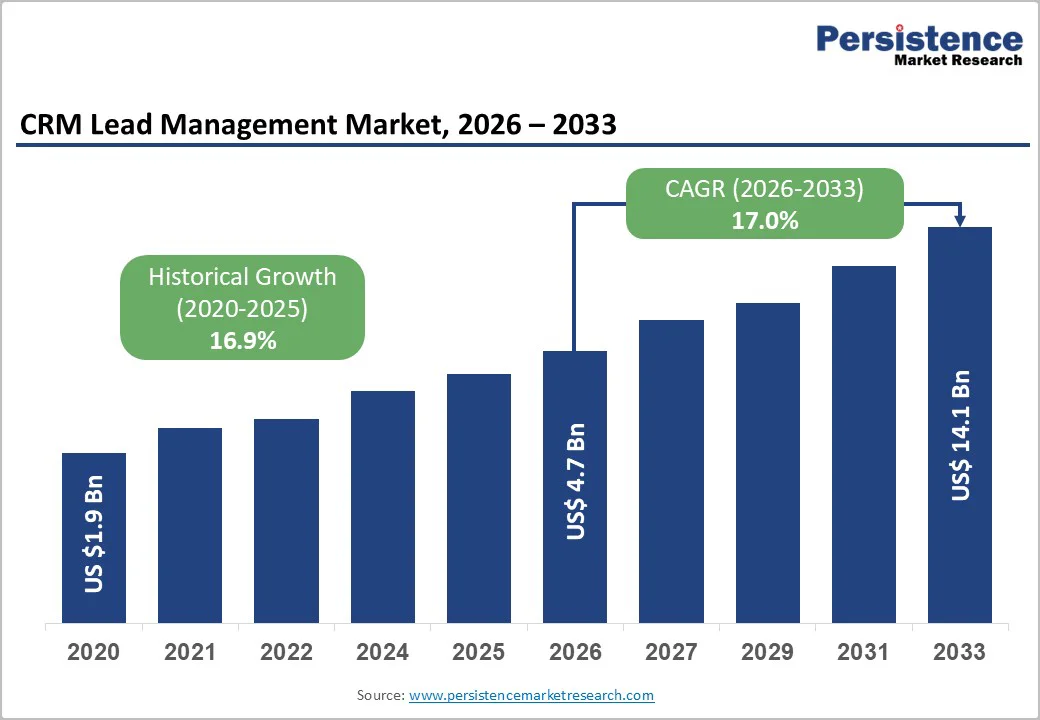
The global CRM lead management market size is likely to be valued at US$4.7 billion in 2026 and is expected to reach US$14.1 billion by 2033, growing at a CAGR of 17.0% during the forecast period from 2026 to 2033, driven by increasing adoption of CRM solutions to streamline lead capture, scoring, nurturing, and conversion amid rising digital interactions with customers.
Cloud-based deployments are gaining prominence due to scalability, flexibility, and lower IT overhead, while AI and predictive analytics integration enable smarter lead prioritization. The growing demand for sales automation, marketing optimization, and personalized customer engagement across industries such as BFSI, e-commerce, healthcare, and IT services further fuels market expansion.
Key Industry Highlights:
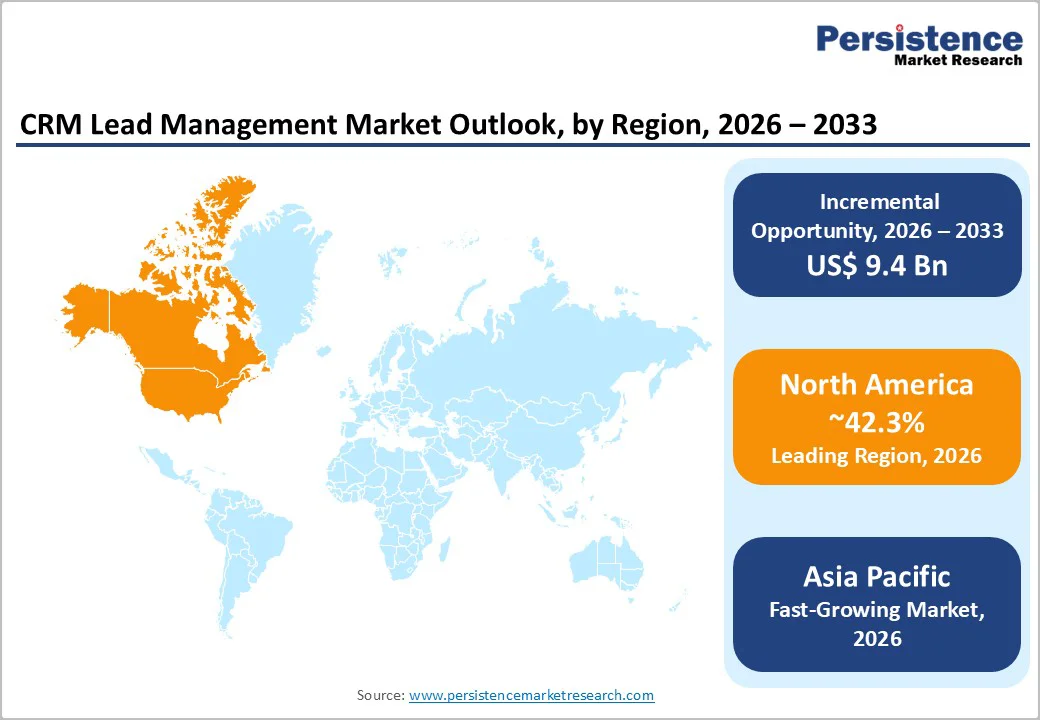
- Leading Region: North America is anticipated to be the leading region, accounting for a market share of 42.3% in 2026, driven by high adoption in the U.S. and a consolidated competitive landscape dominated by Salesforce.
- Fastest-growing Region: Asia Pacific is likely to be the fastest-growing region, driven by rapid digitization, growing SME adoption, and increasing cloud and AI integration.
- Leading Deployment Type: The cloud segment is projected to represent the leading deployment type in 2026, accounting for 72% of the market share, driven by scalability, flexibility, and reduced upfront costs.
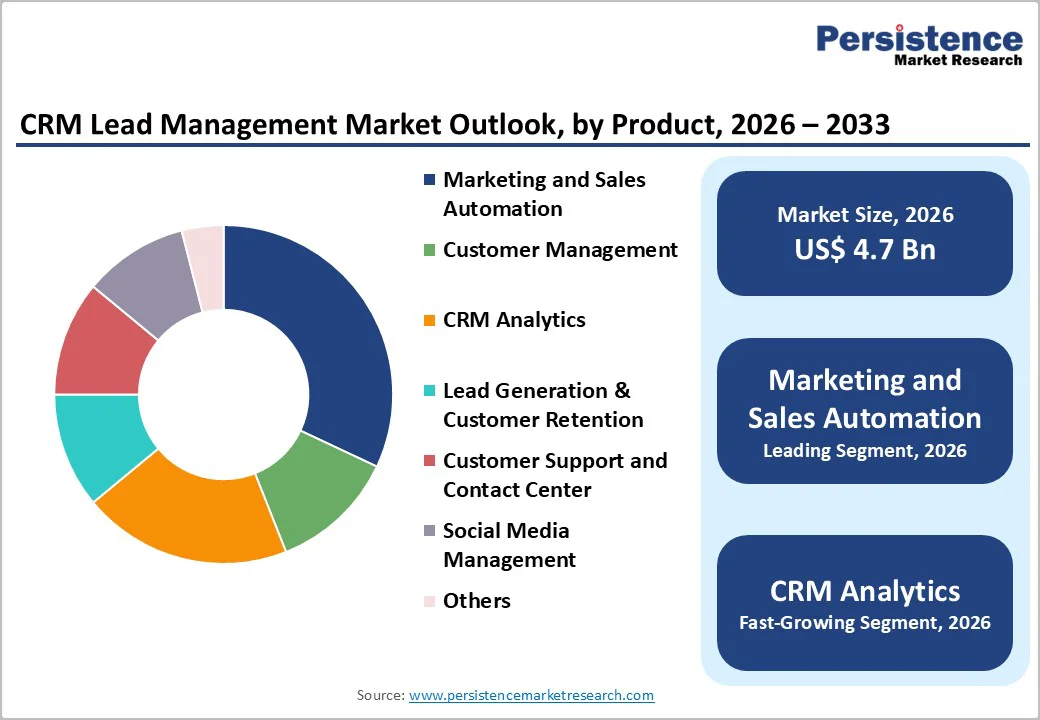
- Leading Application: Marketing and sales automation is anticipated to be the leading application type, accounting for over 30% of the revenue share in 2026, supported by automation of lead nurturing and higher conversion rates in sectors such as e-commerce and telecom.
| Key Insights | Details |
|---|---|
|
CRM Lead Management Market Size (2026E) |
US$4.7 Bn |
|
Market Value Forecast (2033F) |
US$14.1 Bn |
|
Projected Growth (CAGR 2026 to 2033) |
17.0% |
|
Historical Market Growth (CAGR 2020 to 2025) |
16.9% |
Market Factors - Growth, Barriers, and Opportunity Analysis
Digital Transformation and AI Integration
Businesses are increasingly digitizing their sales and marketing operations to manage a growing volume of customer interactions through multiple channels such as websites, social media, email campaigns, and mobile platforms. This shift enables companies to capture, track, and nurture leads more efficiently, reducing manual efforts and improving overall sales productivity. Enterprises, especially in sectors like BFSI, e-commerce, and IT services, are investing heavily in digital tools to enhance customer engagement, streamline workflows, and gain real-time insights into lead behavior.
Integration of Artificial Intelligence (AI) and predictive analytics into CRM lead management platforms. AI-powered capabilities such as lead scoring, predictive forecasting, automated follow-ups, and intelligent routing help sales teams that prioritize high-potential leads. Machine learning algorithms analyze customer interactions to identify patterns, enabling personalized marketing campaigns and proactive engagement. Combined with digital transformation initiatives, AI integration allows companies to optimize their sales pipelines, reduce operational inefficiencies, and gain a competitive edge in a fast-evolving market.
High Implementation Costs and Integration Challenges
Deploying comprehensive lead management solutions often requires significant investments in software licenses, cloud subscriptions, and infrastructure setup. Businesses incur ongoing costs for maintenance, updates, and user training. Ongoing expenses for system maintenance, updates, and employee training increase the total cost of ownership. These financial barriers are particularly challenging for small and medium enterprises (SMEs), which often operate with limited IT budgets. The high initial investment slows the adoption of sophisticated lead management solutions, even though they promise improved sales efficiency and customer engagement.
Integrating CRM solutions with existing enterprise applications and legacy systems can be complex. Many organizations run multiple disconnected platforms for sales, marketing, and customer support, making integration technically challenging. Poor integration can create data silos, inconsistencies, and workflow disruptions, undermining lead management efforts. Specialized IT expertise is often required to ensure seamless interoperability with ERP systems, marketing automation tools, and analytics platforms.
Emergence of AI-Powered Personalization in Emerging Markets
In these regions, businesses are rapidly embracing digital transformation, driving a growing need for tools that provide personalized customer experiences at scale. AI-powered CRM solutions use machine learning and predictive analytics to process vast amounts of customer data, allowing companies to accurately score leads, anticipate buying behavior, and customize engagement strategies. This functionality enables businesses to boost conversion rates, enhance customer satisfaction, and streamline marketing and sales efforts with minimal manual effort.
Emerging markets are particularly well-positioned to adopt AI-driven CRM solutions due to rapid smartphone penetration, growing e-commerce activities, and increasing investments in cloud infrastructure. Small and medium enterprises (SMEs) in these regions can leverage affordable, cloud-based AI CRM platforms to compete with larger firms by offering hyper-personalized experiences to their customers. AI-powered insights allow businesses to analyze customer behavior patterns, segment audiences more accurately, predict purchasing intent, and optimize marketing and sales campaigns in real time. Integration of AI with other emerging technologies, such as chatbots, voice assistants, and recommendation engines, empowers companies to offer seamless and interactive customer journeys.
Category-wise Analysis
Deployment Type Insights
The cloud-based segment is expected to lead the CRM lead management market, accounting for approximately 72% of total revenue in 2026, driven by its scalability, flexibility, and lower upfront costs. Cloud deployment allows businesses to access CRM platforms remotely, integrate with multiple sales and marketing tools, and adopt a pay-as-you-go model, which is particularly attractive to SMEs and rapidly growing enterprises. Cloud solutions also simplify software updates and maintenance, reducing IT overhead. For example, Salesforce’s Sales Cloud enables companies to manage leads, automate workflows, and access AI-powered insights without investing in physical infrastructure.
On-premises deployment is likely to represent the fastest-growing segment, driven by large enterprises with strict data security and compliance requirements. On-premises CRM solutions allow organizations to retain full control over sensitive customer and sales data, integrate deeply with internal ERP or legacy systems, and customize workflows without dependency on third-party cloud providers. For example, Oracle CRM On-Premises is widely used in the BFSI sector where regulatory compliance is critical. The growth is driven by organizations seeking hybrid models that combine cloud flexibility with the security and customization of on-premises deployments, particularly in regions with stringent data privacy regulations.
Application Insights
The marketing and sales automation segment is projected to lead the market, capturing around 30% of the total revenue share in 2026, driven by its streamlining of lead capture, nurturing, and conversion across multiple channels. Automated workflows reduce manual follow-ups, prioritize high-value leads, and improve sales efficiency. For example, Zoho CRM’s automation module allows SMEs to schedule email campaigns, assign leads to sales reps, and track engagement in real-time. The adoption of marketing and sales automation is especially strong in e-commerce and telecom sectors, where rapid customer engagement and timely follow-ups are critical for revenue growth.
CRM analytics is likely to be the fastest-growing application in 2026, driven by AI-powered insights to optimize lead management. Analytics tools enable lead scoring, predictive forecasting, and segmentation, helping organizations focus on high-potential prospects. For example, Microsoft Dynamics 365 Customer Insights provides AI-driven analytics to identify patterns in customer behavior and improve conversion rates by up to 25%. The growth of CRM Analytics is fueled by the demand for data-driven decision-making, enhanced customer experiences, and improved ROI in sectors like BFSI, retail, and IT services, where understanding customer intent is critical for competitive advantage.
Regional Insights
North America CRM Lead Management Market Trends
North America is anticipated to be the leading region, accounting for a market share of 42.3% in 2026, driven by organizations across the U.S. and Canada that prioritize digital transformation to enhance customer engagement and drive sales efficiency. Businesses are investing in integrated CRM platforms that combine lead capture, nurturing, and conversion workflows, enabling real-time insights and improved decision-making. For example, many U.S. retailers and financial service providers rely on Salesforce Cloud CRM to centralize customer data and automate lead management across channels, while Canadian SMEs increasingly adopt HubSpot CRM to streamline marketing automation and personalize outreach campaigns.
The region is also seeing widespread integration of AI, machine learning, and omnichannel engagement strategies into CRM lead management platforms. Organizations leverage AI-driven analytics to enhance lead scoring accuracy, predict customer behavior, and tailor messaging across email, social media, and mobile touchpoints. For instance, U.S. businesses in the BFSI sector employ predictive analytics to identify high-value prospects and optimize conversion strategies, whereas Canadian telecom companies use AI-powered CRM insights to improve customer segmentation and retention. Data privacy and compliance requirements, such as those under the CCPA, influence CRM implementations to ensure secure and trustworthy deployments.
Europe CRM Lead Management Market Trends
Europe is likely to be a significant market for CRM lead management in 2026, due to increasing digital transformation initiatives and strict regulatory compliance requirements, particularly under the General Data Protection Regulation (GDPR). European businesses across sectors such as retail, BFSI, and healthcare are prioritizing secure, compliant CRM solutions that support customer-centric strategies and protect sensitive data. This has encouraged the adoption of hybrid and cloud-enabled lead management platforms that balance flexibility with local data governance needs.
In Europe, a key trend in lead management is the integration of AI, cloud computing, and omnichannel engagement. Companies are increasingly adopting AI-enabled CRM platforms to personalize customer journeys, predict conversion potential, and automate workflows across email, social media, and mobile channels. For instance, French SMEs are implementing scalable cloud CRM solutions with built-in AI capabilities to enhance lead nurturing and campaign effectiveness. European organizations are also investing in predictive analytics and machine learning to refine lead scoring and boost conversion rates, allowing for more precise targeting of high-value prospects.
Asia Pacific CRM Lead Management Market Trends
The Asia Pacific region is expected to be the fastest-growing CRM lead management market by 2026, fueled by digital transformation, e-commerce expansion, and increasing demand for scalable CRM solutions among both SMEs and large enterprises. Rising internet and mobile penetration is driving greater online customer engagement and lead generation. Companies in markets such as China and India are adopting CRM lead management platforms to streamline multi-channel touchpoints and enhance sales efficiency amid booming digital commerce.
For example, Chinese e-commerce leaders are leveraging AI-enabled CRM tools to handle large volumes of leads and deliver personalized outreach. Cloud adoption is particularly strong, providing cost-effective, remote-accessible solutions that support hybrid work models and dynamic business needs.
Businesses are investing in AI-driven CRM capabilities to extract actionable insights from large datasets, optimize marketing campaigns, and boost conversion rates in competitive markets. Demand for omnichannel CRM experiences that connect social, mobile, email, and web channels continues to rise, enabling brands to deliver seamless customer journeys. Increasing focus on data security and cloud compliance encourages organizations to adopt robust, scalable CRM solutions for sustainable growth.
Competitive Landscape
The global CRM lead management market exhibits a moderately fragmented structure, driven by the presence of both well-established enterprises and innovative niche players competing for diverse customer segments. Leading vendors continuously invest in cloud capabilities, AI and machine learning, mobile accessibility, and omnichannel integrations to enhance lead capture, scoring, nurturing, and conversion workflows. With key leaders including Salesforce, HubSpot, Microsoft Dynamics 365, Oracle, SAP, Zoho, Pipedrive, Freshworks, and Zendesk, the competitive landscape underscores a mix of giant challengers focusing on expanding functionality and geographical reach.
These players compete through continuous product enhancements, strategic partnerships, AI-driven analytics, and expanded integration ecosystems, enabling enhanced data-driven insights and seamless workflows. Many vendors also pursue mergers, acquisitions, and alliances to strengthen their offerings and capture emerging opportunities in cloud, mobile CRM, and AI personalization. Customer support, ease of implementation, and pricing flexibility further differentiate providers in this vibrant market.
Key Industry Developments:
- In July 2025, Zendesk announced a major expansion of its AI capabilities, accelerating the evolution of its AI-first Resolution Platform. The latest enhancements include AI-powered email agents, no-code automation tools, real-time performance monitoring, customizable quality checks, and advanced generative search, all designed to deliver faster and more personalized customer support.
- In July 2025, HubSpot introduced the industry’s first CRM connector for Anthropic’s Claude, enabling go-to-market teams to bring real customer context directly into the AI platform. The new connector available to all HubSpot users with a paid Claude subscription allows businesses to ask natural-language questions, generate visualizations such as charts and graphs, and act on insights directly within HubSpot.
Companies Covered in CRM Lead Management Market
- Infor, Inc.
- Infusion Software, Inc.
- IBM Corporation
- Microsoft Corporation
- Oracle Corporation
- Salesforce, Inc.
- SAP SE
- Adobe Systems, Inc.
- Zendesk, Inc.
- HubSpot, Inc.
Frequently Asked Questions
The global CRM lead management market is projected to reach US$4.7 billion in 2026.
Rising digital customer interactions and the growing adoption of AI-powered automation to improve lead conversion and sales efficiency.
The CRM lead management market is expected to grow at a CAGR of 17.0% from 2026 to 2033.
Expansion of AI-powered personalization, growing CRM adoption among SMEs in emerging markets, and increasing demand for cloud-based, integrated sales automation solutions.
Infor, Inc., Infusion Software, Inc., IBM Corporation, Microsoft Corporation, Oracle Corporation, and Salesforce, Inc. are the leading players.


