




- Technology
- Cloud Computing Market
Cloud Computing Market Size, Share, and Growth Forecast, 2026 - 2033
Cloud Computing Market by Deployment Type (Public, Private, Hybrid), Service Type (Infrastructure as a Service (IaaS), Others), End-user (BFSI, IT and Telecommunications, Government, Others), and Regional Analysis for 2026 - 2033

Cloud Computing Market Size and Trends Analysis
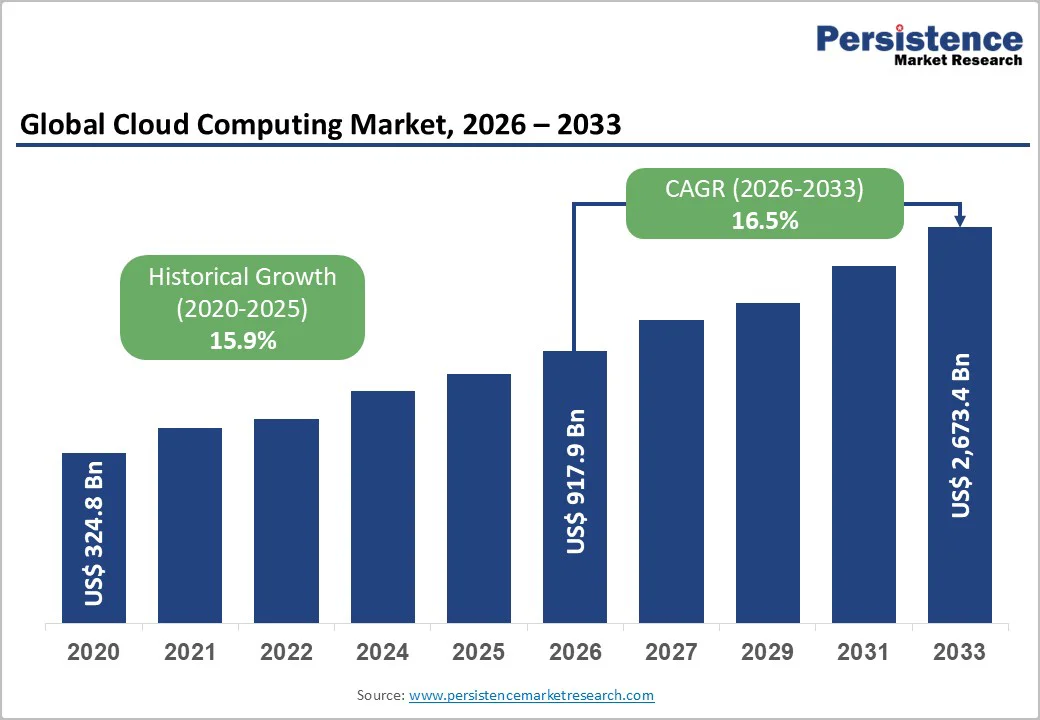
The global cloud computing market size is likely to be valued at US$917.9 billion in 2026 and is expected to reach US$2673.4 billion by 2033, growing at a CAGR of 16.5% during the forecast period from 2026 to 2033, driven by rapid enterprise digital transformation, large-scale migration from legacy on premise infrastructure, and soaring adoption of AI, machine learning, and data-intensive analytics workloads that require scalable cloud environments.
Widespread cloud adoption across key sectors, including BFSI, IT & telecommunications, manufacturing, retail, and healthcare, continues to accelerate as organizations modernize applications, improve operational efficiency, and enhance customer experience.
Key Industry Highlights:
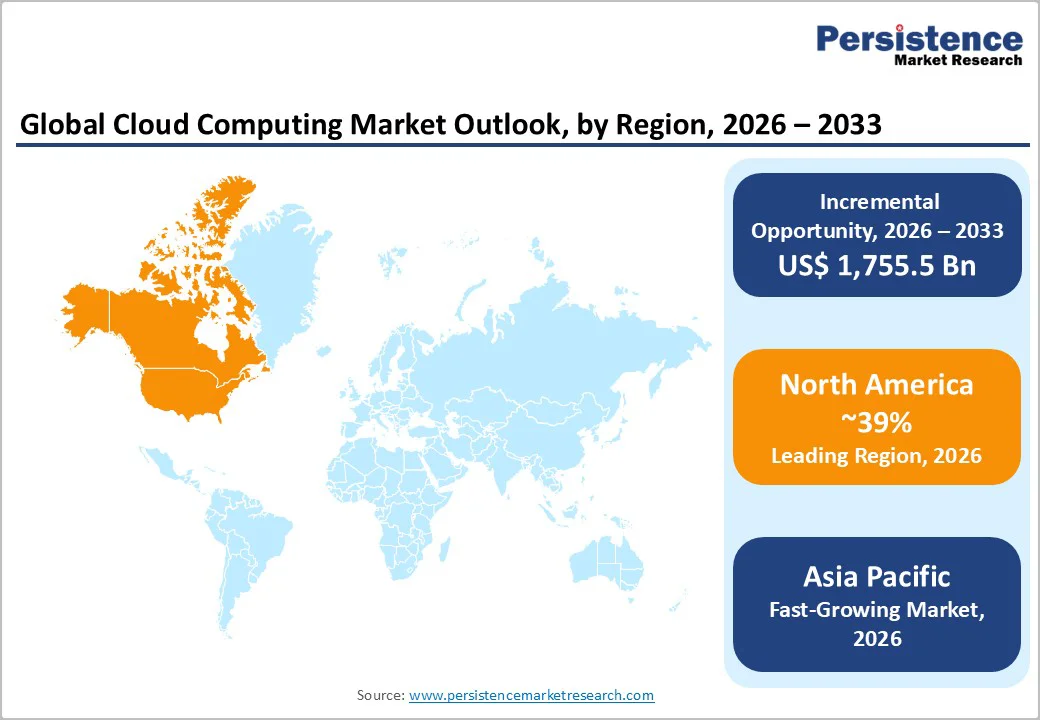
- Leading Region: North America is anticipated to be the leading region, accounting for a market share of 39% in 2026, driven by strong hyperscaler adoption, accelerating AI-driven cloud demand, high cybersecurity compliance, and expanding opportunities in sovereign cloud and edge infrastructure.
- Fastest-growing Region: Asia Pacific is likely to be the fastest-growing region in the cloud computing market in 2026, driven by rapid 5G expansion, strong mobile penetration, rising hybrid-cloud adoption, stringent data-localization rules, and the growing dominance of regional and hyperscale providers.
- Leading Deployment Type: Public cloud is projected to be the leading deployment type in 2026, accounting for 55% of the market, driven by its scalable, cost-efficient infrastructure supporting broad enterprise SaaS adoption.
- Leading Service Type: Software as a Service (SaaS) is expected to be the leading segment, accounting for over 54% of revenue in 2026, driven by widespread enterprise adoption of low-maintenance, easily upgradable cloud applications.
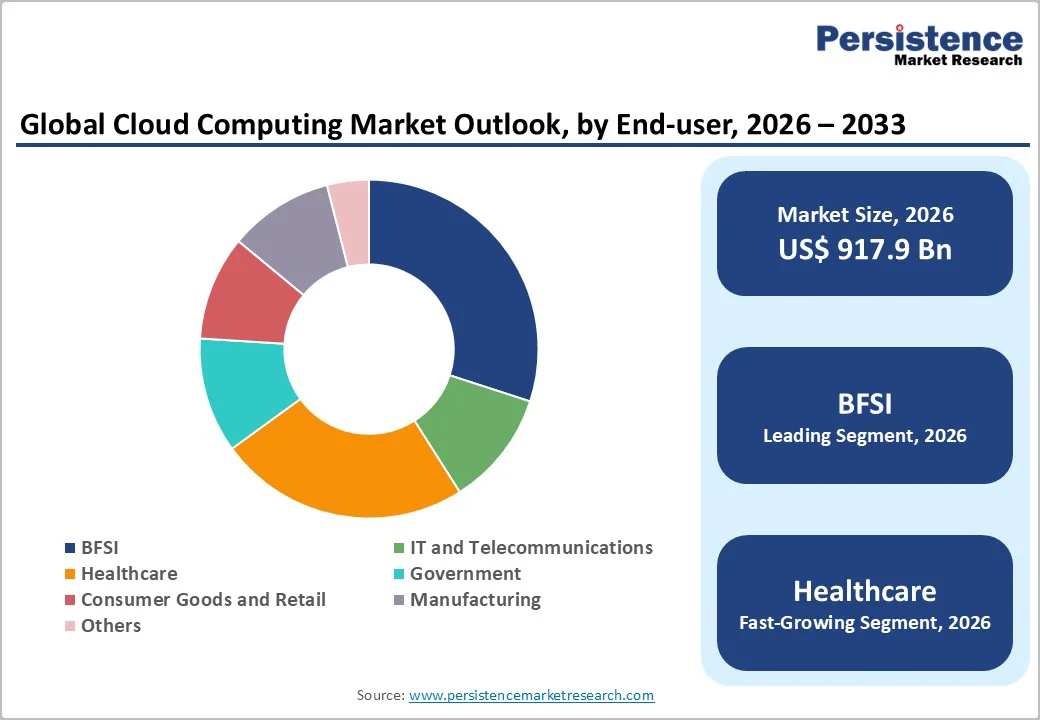
- Leading End-user: BFSI is expected to be the leading end-user, accounting for over 28% of revenue share in 2026, driven by the adoption of cloud to enhance security, analytics, and high-volume real-time transaction processing.
| Key Insights | Details |
|---|---|
|
Cloud Computing Market Size (2026E) |
US$917.9 Bn |
|
Market Value Forecast (2033F) |
US$2673.4 Bn |
|
Projected Growth (CAGR 2026 to 2033) |
16.5% |
|
Historical Market Growth (CAGR 2020 to 2025) |
15.9% |
Market Factors - Growth, Barriers, and Opportunity Analysis
Digital Transformation and AI/ML Integration
Digital transformation is a primary driver of the cloud computing market, as enterprises across industries replace rigid on-premises infrastructure with agile, scalable cloud environments. Organizations in BFSI, IT & telecom, healthcare, retail, and manufacturing are increasingly adopting cloud solutions to modernize legacy systems, automate operations, and support real-time data access. The shift toward SaaS-based business applications, the adoption of hybrid work, and the need for secure remote access are driving companies to migrate critical workloads to public and hybrid clouds.
AI and ML integration is amplifying cloud demand by requiring highly scalable compute, storage, and GPU resources that are impractical to maintain in traditional data centers. Enterprises are deploying AI-driven workloads for fraud detection, customer analytics, supply-chain optimization, healthcare diagnostics, and predictive maintenance, all of which rely heavily on IaaS and PaaS platforms. The surge in generative AI adoption is fueling additional infrastructure needs, with hyperscalers offering specialized AI chips, ML platforms, and managed model-training environments.
Data Privacy and Security Concerns
Enterprises face rising risks related to unauthorized access, data breaches, and regulatory non-compliance. Sensitive information in sectors such as BFSI, healthcare, and government requires strict control over data residency, encryption, and identity management, creating hesitation among organizations migrating mission-critical workloads to public cloud environments. Complex multi-cloud and hybrid architectures add further challenges, as each cloud provider uses different security frameworks, increasing the risk of configuration errors and exposure of sensitive data.
Evolving regulations, such as Europe’s GDPR, the U.S. CCPA, China’s Cybersecurity Law, HIPAA in healthcare, and emerging data-localization requirements across APAC, force organizations to uphold strict compliance standards, adding complexity and driving up the costs of cloud deployments. Ensuring secure API usage, protecting data in transit and at rest, and maintaining continuous monitoring across distributed architectures often strain IT teams. For many enterprises, especially SMEs, the lack of skilled cybersecurity professionals limits their ability to implement robust cloud security frameworks.
Edge Computing and 5G Convergence
The convergence of edge computing and 5G presents a significant opportunity for the cloud computing market, enabling ultra-low latency processing, real-time analytics, and high-bandwidth connectivity for next-generation applications. As 5G networks expand across North America, Europe, and the Asia Pacific, enterprises are increasingly shifting latency-sensitive workloads such as autonomous systems, smart manufacturing, AR/VR, and IoT analytics closer to the data source through edge nodes. This reduces dependency on centralized data centers and enhances performance, security, and operational efficiency.
For cloud vendors, the rise of 5G-enabled devices and IoT ecosystems unlocks substantial opportunities across sectors such as healthcare, transportation, retail, and BFSI. Edge-cloud platforms support intelligent diagnostics, real-time fraud detection, automated retail systems, and connected factory operations, driving higher adoption of IaaS and PaaS services. Hyperscalers such as AWS, Azure, Google Cloud, Alibaba, and Tencent are rapidly expanding multi-access edge computing (MEC) offerings to capture this growing demand. As enterprises pursue digital transformation with high-speed, low-latency networks, the integration of edge computing and 5G is emerging as a transformative growth positioning cloud infrastructure as the backbone for real-time, data-driven innovation.
Category-wise Analysis
Deployment Type Insights
The public cloud is projected to dominate the cloud computing market, representing around 55% of total revenue in 2026, driven by its flexibility, pay-as-you-go pricing, extensive global availability zones, and the 99.99% service uptime guaranteed by leading hyperscale providers. Sectors such as BFSI, IT & telecom, and retail rely heavily on public cloud to modernize legacy systems, deploy SaaS applications, and improve collaboration across distributed teams. Public cloud also supports rapid innovation, enabling organizations to integrate AI, analytics, and automation tools without significant upfront infrastructure investments. For example, Capital One expanded its cloud footprint on AWS to streamline fraud detection and real-time analytics, highlighting the public cloud’s role in strengthening security and performance in the BFSI sector.
Hybrid cloud is likely to represent the fastest-growing deployment type in 2026, driven by organizations seeking the flexibility of public cloud while retaining sensitive data on private infrastructure. This model is gaining traction across governments, healthcare systems, and manufacturing companies that must meet stringent data sovereignty, compliance, and latency requirements. Hybrid cloud facilitates smooth workload orchestration between on-premises infrastructure and public cloud resources, boosting operational efficiency and cutting IT costs by up to 25%. AI and ML workloads are major drivers of this adoption. For instance, Walmart implemented a hybrid cloud strategy combining Azure with its private data centers to enhance inventory analytics and in-store automation, illustrating how hybrid solutions can optimize performance and strengthen data governance at scale.
Service Type Insights
Software as a Service (SaaS) is projected to lead the cloud computing market, capturing around 54% of the total revenue share in 2026, driven by strong enterprise adoption of cloud-based productivity tools, CRM platforms, HR management systems, and collaboration applications. Organizations prefer SaaS for its subscription model, low maintenance, automatic updates, and quick deployment. It also supports hybrid work by enabling real-time access to the app from any device, boosting efficiency and reducing IT overhead.
The shift toward composable and micro services-based applications is accelerating SaaS adoption, especially among SMEs seeking scalable digital tools without heavy infrastructure costs. For instance, Salesforce recently enhanced its AI-driven CRM, helping companies such as Toyota deliver more personalized customer experiences, reinforcing SaaS’s rising strategic importance.
Platform-as-a-Service (PaaS) is likely to be the fastest-growing segment in 2026, driven by rising demand for cloud-native development, DevOps automation, and faster application deployment cycles. Enterprises are turning to PaaS platforms to modernize legacy systems, build microservice architectures, and streamline development workflows using integrated tools, APIs, and managed databases. For instance, Spotify relies on Google Cloud’s PaaS capabilities to manage micro services, enhance user recommendations, and streamline continuous delivery, showcasing how PaaS accelerates innovation in digital ecosystems. PaaS cuts development time and reduces operational complexity by abstracting infrastructure, allowing developers to focus on innovation instead of server management.
End-user Insights
The BFSI segment is projected to lead the cloud computing market, capturing around 28% of the total revenue share in 2026, driven by high demand for secure, scalable cloud infrastructure to support digital banking, fraud detection, real-time payments, and regulatory compliance. Banks and financial institutions are migrating core banking systems, analytics platforms, and customer engagement tools to cloud environments to improve operational efficiency and reduce costs. Cloud computing enables BFSI players to process billions of transactions daily while maintaining strict data governance and cybersecurity protocols. For example, Bank of America expanded its multi-cloud strategy, integrating hybrid cloud for real-time analytics and improved fraud monitoring, reinforcing BFSI’s leadership in cloud adoption.
Healthcare is likely to be the fastest-growing end-use in 2026, driven by rising adoption of telemedicine, electronic health records (EHRs), remote patient monitoring, and AI-assisted diagnostics. Cloud computing enables healthcare providers to securely store and manage vast amounts of patient data, support real-time collaboration between clinicians, and improve medical decision-making through analytics and AI. The shift toward personalized healthcare, digital therapeutics, and connected medical devices accelerates cloud demand. Example Mayo Clinic expanded its partnership with Google Cloud to deploy AI-enabled diagnostic tools and streamline clinical data management, illustrating how healthcare providers leverage cloud platforms to enhance patient outcomes.
Regional Insights
North America Cloud Computing Market Trends
The North America region is anticipated to be the leading region in the cloud computing market, accounting for a market share of 39% in 2026, driven by early adoption of digital technologies and widespread enterprise digitization. Organizations across BFSI, IT & telecom, healthcare, and retail are increasingly migrating workloads to public and hybrid cloud platforms to improve scalability, reduce infrastructure costs, and support AI-driven applications. Hyperscalers such as AWS and Microsoft Azure dominate the region, offering advanced IaaS, PaaS, and SaaS solutions that cater to the growing demand for AI, analytics, and high-performance computing.
Emerging trends in North America also highlight AI/ML integration as a key growth driver. Companies are leveraging cloud-native AI platforms to streamline operations, enhance predictive analytics, and improve customer experiences. Example: Capital One expanded its cloud footprint on AWS to accelerate real-time fraud detection and analytics. Regulatory compliance, particularly around data security and privacy, has driven enterprises to adopt secure cloud architectures, including hybrid and multi-cloud strategies, to balance performance with governance requirements. Example Mayo Clinic partnered with Google Cloud to deploy AI-driven diagnostic tools and improve patient data management, demonstrating the convergence of cloud, AI, and regulatory compliance in the region.
Europe Cloud Computing Market Trends
Europe is likely to be a significant market for cloud computing in 2026, due to digital transformation across BFSI, healthcare, manufacturing, and public sector organizations. Enterprises are increasingly adopting public and hybrid cloud models to enhance scalability, improve operational efficiency, and reduce IT infrastructure costs. Compliance with stringent regulations such as GDPR and national data-protection laws has encouraged organizations to deploy secure, privacy-focused cloud solutions. The demand for cloud-native applications, SaaS platforms, and AI/ML workloads is rising, supported by advanced IaaS and PaaS offerings from hyperscalers and regional providers.
Emerging trends include increased integration of AI and analytics into cloud services to improve business insights and customer experiences. Example Siemens leveraged AWS cloud solutions to support Industry 4.0 initiatives in its European manufacturing facilities, showcasing the role of cloud in driving automation, efficiency, and innovation across industries. The growing adoption of hybrid and multi-cloud strategies allows companies to optimize performance while meeting data sovereignty requirements. Edge computing is gaining traction in Europe, particularly in smart manufacturing and IoT applications, providing low-latency processing for real-time analytics and automation.
Asia Pacific Cloud Computing Market Trends
The Asia Pacific region is likely to be the fastest-growing region in the cloud computing market in 2026, driven by accelerated digital transformation across BFSI, IT & telecom, manufacturing, retail, and healthcare sectors. Enterprises are increasingly adopting public and hybrid cloud models to scale operations, reduce infrastructure costs, and support AI/ML workloads and big data analytics.
Rapid 5G rollout, growing mobile penetration, and government-backed digital initiatives in countries such as China, India, and Japan are further fueling cloud adoption. For instance, Tata Consultancy Services (TCS) leveraged Microsoft Azure to modernize IT systems for Indian banks, improving transaction processing and regulatory compliance, reflecting the growing role of cloud in regional digital transformation initiatives.
Data-localization laws and cybersecurity regulations are encouraging the deployment of secure hybrid and multi-cloud architectures to meet compliance requirements. SMEs are also increasingly adopting SaaS solutions to access scalable, cost-effective digital tools without heavy upfront investments, contributing to market growth. Edge computing is emerging as a key trend, enabling low-latency, real-time applications in manufacturing, healthcare, and IoT ecosystems. AI and analytics integration are transforming business operations and customer engagement across the region. For example, Alibaba Cloud has expanded its hybrid cloud services in China to support AI-driven enterprise applications and real-time analytics.
Competitive Landscape
The global cloud computing market exhibits a moderately fragmented structure, driven by a few dominant hyperscalers and a large number of smaller, specialized providers competing across infrastructure, platform, and software services. Despite many players, a small group consistently captures the bulk of market value. With key leaders including Amazon Web Services (AWS), Microsoft Azure, and Google Cloud also active but much smaller in share are providers such as Alibaba Cloud, Oracle Cloud Infrastructure, IBM Cloud, and others, which occupy niche segments or regional markets.
These players compete through continual innovation, expansion of service portfolios, global data-center investments, aggressive pricing, and focus on vertical-specific solutions. Hyperscalers differentiate via large-scale IaaS/PaaS infrastructure, machine-learning and AI services, hybrid/multi-cloud platforms, and enterprise SaaS ecosystems, while smaller providers often target specialized industries or regional compliance needs. This competition drives advances in performance, security, and cloud-native capabilities, while keeping barriers to entry high due to capital-intensive infrastructure and scale requirements.
Key Industry Developments:
- In October 2025, Google and Anthropic announced a landmark cloud-infrastructure agreement worth tens of billions of dollars. The deal provides Anthropic with access to up to one million of Google’s custom TPUs, delivering more than a gigawatt of AI compute capacity to accelerate the development and deployment of its large-scale AI models.
- In October 2025, Koog announced support for the Agent2Agent (A2A) protocol, enabling AI agents to communicate directly, securely, and seamlessly across companies and cloud platforms. Kotlin developers can now build enterprise-grade, interconnected AI agents that automatically discover and collaborate with other services, leveraging Google Cloud’s Gemini models directly within workflows. This update marks a step toward truly intelligent, cross-platform AI systems, simplifying integration and accelerating enterprise AI innovation.
Companies Covered in Cloud Computing Market
- Alibaba Cloud
- Amazon Web Services, Inc.
- CloudHesive
- Coastal Cloud
- DigitalOcean
- GroundCloud
- IBM
- Microsoft Azure
- Oracle Cloud
- Rackspace Technology, Inc.
- Salesforce, Inc.
- Tencent
- The Descartes Systems Group Inc.
- VMware LLC
Frequently Asked Questions
The global cloud computing market is projected to reach US$917.9 billion in 2026.
The key drivers include enterprise digital transformation, AI/ML adoption, and the shift from on-premise to scalable, flexible cloud infrastructure.
The cloud computing market is expected to grow at a CAGR of 16.5% from 2026 to 2033.
The key market opportunities include edge computing and 5G convergence, AI and machine learning integration, hybrid and multi-cloud adoption, and expanding demand for secure, industry-specific cloud solutions.
The key players include Alibaba Cloud, Amazon Web Services, Inc., CloudHesive, Coastal Cloud, DigitalOcean, Google, GroundCloud, IBM, and Microsoft Azure.


