




- Processed Food
- Full Service Restaurants Market
Full Service Restaurants Market Size, Share, Growth, and Regional Forecast, 2026 to 2033
Full Service Restaurants Market by Dining Type (Casual Dining Restaurants, Fine Dining Restaurants, Family-Style Restaurants, Bistro & Brasserie, Pub-Style Restaurants, and Specialty Restaurants), Service Type (Dine-In, Takeaway, and Delivery), Cuisine Type (Italian, Chinese, Indian, Japanese, Korean, Mexican, and Others) Location (Standalone, Retail, Travel, Leisure & Entertainment Venues, and Hotels & Resorts), and Regional Analysis from 2026 to 2033

Full Service Restaurants Market Share and Trend Analysis
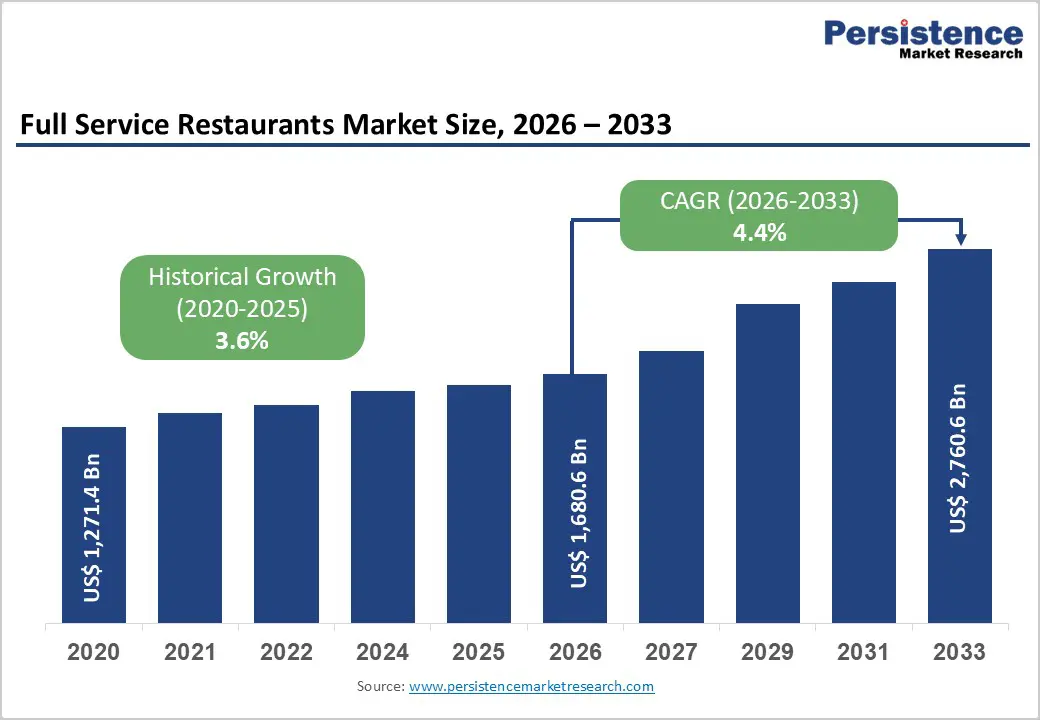
The global full service restaurants market size is estimated to grow from US$ 1,680.6 billion in 2026 to US$ 2,760.6 billion 2033. The market is projected to record a CAGR of 4.4% during the forecast period from 2026 to 2033.
The global inclination toward dining out and experience-led consumption is significantly influencing the growth trajectory of full service restaurants across key markets. Consumers increasingly seek not just meals but immersive experiences that combine ambiance, service quality, and diverse culinary offerings. This shift is particularly evident in urban centers, where busy lifestyles and higher disposable incomes are encouraging frequent restaurant visits. Additionally, evolving preferences toward global cuisines and premium dining formats are driving menu innovation and concept differentiation.
Restaurant operators are leveraging digital tools such as reservations, loyalty programs, and personalized promotions to enhance engagement and retention. The integration of dine-in with takeaway and delivery services is further expanding revenue channels and improving accessibility. Moreover, the growing influence of social media and food discovery platforms is shaping consumer choices and boosting visibility for unique dining concepts. Continuous expansion of organized restaurant chains, along with investments in infrastructure and service quality, is expected to sustain long-term market growth globally.
Key Industry Highlights:
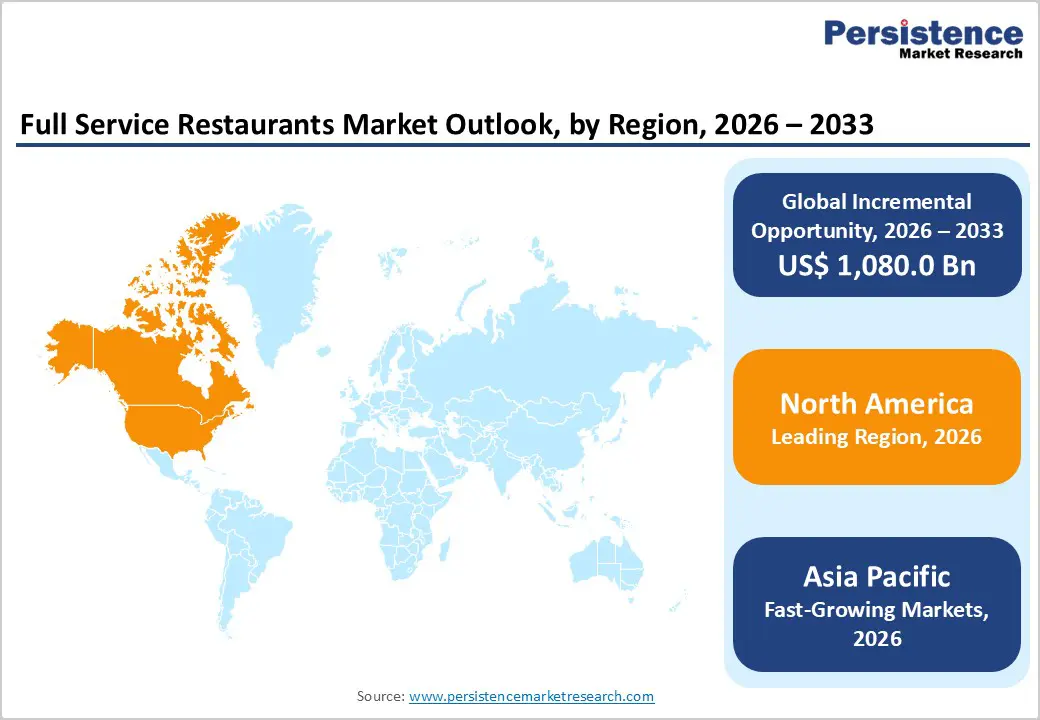
- Leading Region: North America accounts for 48.5% of global revenue, supported by strong dining-out culture, high consumer spending, and a well-established restaurant ecosystem.
- Fastest-Growing Region: Asia Pacific is emerging as the fastest-growing market, driven by rapid urbanization, rising disposable incomes, and increasing exposure to global dining trends.
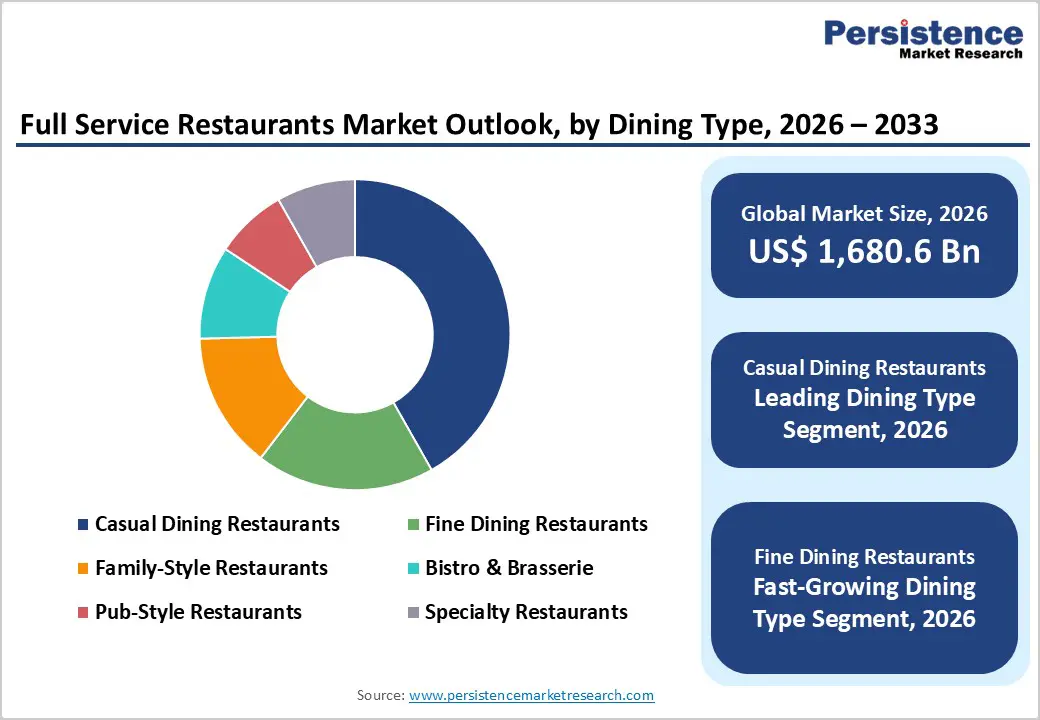
- Leading Dining Type Segment: Casual dining restaurants lead with 73.9% share, owing to their mass appeal, balanced pricing, and scalable business models.
- Fastest-Growing Dining Type Segment: Fine dining restaurants are expanding rapidly due to rising demand for premium, experience-driven dining and curated culinary offerings.
- Leading Location Segment: Standalone formats dominate due to strong brand visibility, operational flexibility, and direct consumer engagement.
- Fastest-Growing Location Segment: Retail-based restaurants are gaining traction as mall culture and integrated dining experiences continue to attract urban consumers.
| Key Insights | Details |
|---|---|
| Full Service Restaurants Market Size (2026E) | US$ 1,680.6 Bn |
| Market Value Forecast (2033F) | US$ 2,760.6 Bn |
| Projected Growth (CAGR 2026 to 2033) | 4.4% |
| Historical Market Growth (CAGR 2020 to 2025) | 3.6% |
Market Dynamics
Driver - Increasing Consumer Preference for Experiential Dining and Eating Out Culture
A major factor propelling industry growth is the rising inclination toward experiential dining combined with an evolving eating-out culture across urban populations. Consumers are no longer driven solely by food consumption but increasingly value ambiance, service quality, and unique culinary experiences. This shift is particularly evident among millennials and younger demographics who prioritize social dining, themed restaurants, and global cuisines. Rapid urbanization and higher disposable incomes have further accelerated frequent restaurant visits, especially in metropolitan areas. Additionally, the influence of social media and food-centric digital platforms has amplified awareness and demand for premium and visually appealing dining experiences.
The expansion of organized restaurant chains and franchising models has also improved accessibility and consistency in service delivery. Operators are investing in menu innovation, chef-led concepts, and immersive dining formats to attract and retain customers. Furthermore, the integration of digital technologies such as online reservations, loyalty programs, and personalized marketing has enhanced customer engagement. The growth of tourism and business travel continues to contribute to restaurant footfall globally. Collectively, these factors are reinforcing sustained demand for full service restaurants across both developed and emerging economies.
Restraint - High Operational Costs and Workforce Management Challenges
One of the critical barriers impacting industry expansion is the high cost structure associated with operating full service restaurants. Expenses related to prime real estate locations, interior design, staffing, and supply chain management significantly increase operational overheads. Labor-intensive service models require skilled staff, including chefs, servers, and management personnel, making workforce availability and retention a persistent challenge. Rising wage standards and employee turnover further strain profitability, particularly for independent operators.
Additionally, fluctuations in raw material prices and dependency on consistent ingredient quality can affect menu pricing and margins. Maintaining service standards across multiple outlets or geographies also presents operational complexities. Regulatory compliance related to food safety, hygiene, and licensing adds another layer of cost and administrative burden. Economic slowdowns or inflationary pressures can reduce discretionary consumer spending, directly impacting restaurant revenues. Moreover, intense competition within the foodservice sector forces continuous investment in marketing and innovation, limiting profit margins. These combined factors create entry barriers and can hinder scalability, particularly for small and mid-sized players operating in highly competitive markets.
Opportunity - Digital Transformation and Expansion of Hybrid Dining Models
A significant opportunity lies in the integration of digital technologies and the evolution of hybrid dining models that combine dine-in with off-premise services. Restaurants are increasingly leveraging online ordering platforms, mobile applications, and data analytics to enhance operational efficiency and customer engagement. The rise of delivery and takeaway services, even within full service formats, has opened new revenue streams and expanded customer reach beyond physical locations. Additionally, there is growing potential in premiumization and niche dining concepts, including chef-driven menus, regional specialties, and immersive themed experiences. Consumers are willing to spend more on unique and high-quality dining, creating opportunities for differentiation.
Moreover, the expansion into emerging markets presents another growth avenue, supported by rising disposable incomes, urban development, and increasing exposure to global cuisines. Sustainability is also becoming a key focus area, with restaurants adopting eco-friendly practices, locally sourced ingredients, and waste reduction initiatives to align with consumer expectations. Furthermore, strategic partnerships, franchising, and cloud kitchen integrations are enabling faster scalability and market penetration. Continuous innovation in menu offerings and service formats is expected to unlock long-term growth potential across the global full service restaurants landscape.
Category-wise Analysis
By Dining Type Insights
Casual dining restaurants are projected to hold 41.8% of the global full service restaurants market revenue in 2026, positioning them as the leading segment. Their dominance is largely attributed to balanced pricing, diverse menu offerings, and a comfortable dining environment that appeals to a wide customer base. These establishments effectively cater to families, working professionals, and social gatherings, ensuring consistent footfall across locations. Operational scalability, standardized menus, and franchise-driven expansion further strengthen their market presence. Additionally, casual dining formats are highly adaptable to evolving consumer preferences, including healthier menus and international cuisines. Integration of digital ordering, loyalty programs, and hybrid service models (dine-in with takeaway/delivery) also enhances revenue streams, reinforcing their leadership globally.
By Service Type Insights
The dine-in segment is expected to account for 63.4% of the global full service restaurants market in 2026, driven by increasing consumer inclination toward immersive and social dining experiences. Full service restaurants primarily differentiate themselves through ambiance, personalized service, and curated menus, which cannot be fully replicated through off-premise channels. Rising disposable incomes and urban lifestyles have further boosted demand for in-restaurant experiences, particularly for celebrations, business meetings, and leisure outings. Moreover, restaurants are enhancing dine-in value through themed interiors, live kitchens, and experiential concepts. While takeaway and delivery are expanding, dine-in continues to generate higher average order values and customer engagement, solidifying its dominant position within the service type segment.
By Location Insights
Standalone locations are estimated to capture 34.6% of total full service restaurants market revenue in 2026, highlighting their significance as a primary operating format. These outlets benefit from strong brand visibility, strategic high-street positioning, and the ability to create a distinct dining identity. Unlike mall-based or transit locations, standalone restaurants offer greater flexibility in space utilization, ambiance design, and customer experience customization. They also enable operators to establish long-term brand recall and loyal customer bases. Additionally, lower dependency on external footfall drivers allows businesses to implement targeted marketing strategies and community engagement initiatives. The growing trend of flagship outlets and destination dining concepts further reinforces the prominence of standalone restaurants in the global market.
Regional Insights
North America Full Service Restaurants Market Trends
North America is projected to account for 48.5% of the global full service restaurants market revenue in 2026, maintaining its position as the leading regional market. The region benefits from a highly developed foodservice industry, strong consumer spending capacity, and a well-established culture of dining out. The United States plays a pivotal role, supported by widespread presence of national and international restaurant chains, advanced supply chain systems, and continuous menu innovation. Consumers increasingly seek premium dining experiences, global cuisines, and health-conscious menu options, encouraging restaurants to diversify offerings.
Technology integration is a defining characteristic of the market, with widespread adoption of digital reservations, contactless payments, and loyalty programs enhancing customer engagement. Additionally, hybrid service models combining dine-in with delivery have expanded revenue channels. The region also witnesses strong competition, driving continuous improvements in service quality and dining concepts. Sustainability initiatives, including locally sourced ingredients and eco-friendly operations, are gaining traction among consumers. Overall, a combination of high consumer awareness, operational sophistication, and innovation-driven strategies continues to support North America’s leadership in the global full service restaurants market.
Europe Full Service Restaurants Market Trends
Europe represents a mature yet steadily evolving market for full service restaurants, supported by a rich culinary heritage and strong emphasis on quality dining experiences. Countries such as Germany, France, the United Kingdom, Italy, and Spain contribute significantly, driven by high tourism inflow and a well-established hospitality sector. Consumers in the region prioritize authenticity, premium ingredients, and traditional cooking styles, which encourages restaurants to focus on menu differentiation and regional specialties.
Regulatory standards related to food safety, sourcing, and labeling are stringent, prompting operators to maintain high operational standards and transparency. The market is also witnessing growing demand for sustainable dining practices, including organic ingredients, reduced food waste, and environmentally responsible sourcing. Additionally, experiential dining concepts such as themed restaurants and chef-driven menus are gaining popularity. While growth remains moderate compared to emerging regions, consistent innovation, strong tourism demand, and evolving consumer preferences continue to drive steady expansion across Europe’s full service restaurants market.
Asia Pacific Full Service Restaurants Market Trends
Asia Pacific is anticipated to be the fastest-growing regional market, registering a CAGR of approximately 6.0% from 2026 to 2033. Rapid urbanization, rising middle-class population, and increasing disposable incomes are key factors fueling demand for full service restaurants across the region. Countries such as China, India, Japan, and South Korea are witnessing significant growth, supported by changing lifestyles and increasing preference for dining out.
The region offers a dynamic mix of traditional and modern dining formats, with strong demand for both local cuisines and international restaurant chains. Expansion of shopping malls, urban infrastructure, and tourism is further driving restaurant footfall. Additionally, digital adoption, including online reservations and app-based ordering, is enhancing accessibility and customer convenience. Local and global players are actively investing in outlet expansion, menu innovation, and premium dining concepts to capture market share. Growing interest in experiential dining and social eating trends is also shaping consumer behavior. With favorable demographics and evolving consumption patterns, Asia Pacific continues to emerge as a high-growth market in the global full service restaurants industry.
Competitive Landscape
The global full service restaurants market is highly competitive, with strong participation from companies such as Darden Restaurants, Inc., d.ream (Dogus Restaurant Entertainment and Management), Bloomin' Brands, Inc., Haidilao International Holding Ltd., The Indian Hotels Company Limited, and Compass Group PLC. These players leverage strong brand portfolios, menu innovation capabilities, and extensive global presence. Competitive strategies focus on premium dining experiences, menu diversification, and customer-centric service models. Companies are investing in digital ordering systems, delivery integration, sustainable sourcing, and outlet expansion to cater to evolving consumer preferences, enhance operational efficiency, and capture growing demand for experiential and high-quality dining globally.
Key Developments:
- In February 2026, The Indian Hotels Company Limited (IHCL) announced the signing of a new SeleQtions hotel in Devanahalli, Bengaluru, involving the conversion of an existing standalone resort along with an expansion to 115 keys. This development reflects IHCL’s strategy to strengthen its premium portfolio while leveraging conversion opportunities to accelerate growth in key urban and travel destinations.
- In December 2025, Compass Group PLC reinforced its focus on India as a high-priority growth market, driven by strong demand from corporate cafeterias, global capability centres (GCCs), manufacturing sectors, and technology-enabled service offerings, positioning the company to outperform overall industry growth.
Companies Covered in Full Service Restaurants Market
- Darden Restaurants, Inc.
- d.ream (Doğuş Restaurant Entertainment and Management)
- Bloomin' Brands, Inc.
- Haidilao International Holding Ltd.
- The Indian Hotels Company Limited
- Compass Group PLC
- Dine Brands Global, Inc.
- TGI Fridays Franchisor, LLC
- Mitchells & Butlers plc
- Saravana Bhavan Private Limited
- Brinker International, Inc.
- Nando's Chickenland Limited
- Barbeque Nation Hospitality Limited
- The Cheesecake Factory Incorporated
- Texas Roadhouse, Inc.
- Others
Frequently Asked Questions
The global full service restaurants market is projected to be valued at US$ 1,680.6 Bn in 2026.
Rising disposable incomes, urbanization, and increasing consumer preference for experiential dining are driving demand in the global full-service restaurants market.
The global full service restaurants market is poised to witness a CAGR of 6.2 % between 2026 and 2033.
Expansion of delivery-enabled dine-in models, premium dining experiences, and global cuisine adoption presents key growth opportunities in the market.
Darden Restaurants, Inc., d.ream (Doğuş Restaurant Entertainment and Management), Bloomin' Brands, Inc., Haidilao International Holding Ltd., The Indian Hotels Company Limited, and Compass Group PLC are some of the key players in the full service restaurants market.


