Automotive Engine Oil Market Size, Share, Trends, Growth, Regional Forecasts 2026 - 2033

Automotive Engine Oil Market by Product Type (Mineral Engine Oil, Synthetic Engine Oil, Semi‑Synthetic Engine Oil, Bio‑Based Engine Oil), Viscosity Grade (0W‑20, 0W‑30, 5W‑20, 5W‑30, 5W‑40, 10W‑30, 10W‑40, 15W‑40, Others), Vehicle Type (Passenger Vehicle, Light Commercial Vehicle, Heavy Commercial Vehicle, Two Wheelers, Off‑road Vehicle), Distribution Channel, and Regional Analysis for 2026 - 2033

ID: PMRREP2838
Calendar

March 2026

235 Pages

Author : Jitendra Deviputra

Key Industry Highlights:

  • The Automotive Engine Oil market is projected to grow from about US$45.2 billion in 2026 to roughly US$60.6 billion by 2033, at around 4.3% CAGR.
  • Mineral Engine Oil leads with around 48% share, while Bio-Based Engine Oil is the fastest-growing product type at approximately 7.2% CAGR.
  • 5W-30 holds about 23% share, and 0W-20 is the fastest-growing viscosity grade, expanding at roughly 6.2% CAGR as OEMs adopt low-viscosity oils.
  • Passenger Vehicles account for around 53% of demand, while Two Wheelers show the highest growth at approximately 5.2% CAGR.
  • The Aftermarket channel commands about 72% share, with OEM distribution growing at nearly 3.9% CAGR.
  • Asia Pacific leads with around 43% share and is the fastest-growing region, while North America and Europe together account for a substantial proportion of premium oil consumption.
  • Recent developments include capacity expansions, new synthetic and bio-based formulations, and deeper OEM alliances among major oil companies.
Key Insights Details

Automotive Engine Oil Market Size (2026E)

US$ 45.2 Billion

Market Value Forecast (2033F)

US$ 60.6 Billion

Projected Growth CAGR (2026-2033)

4.3%

Historical Market Growth (2020-2025)

3.9%

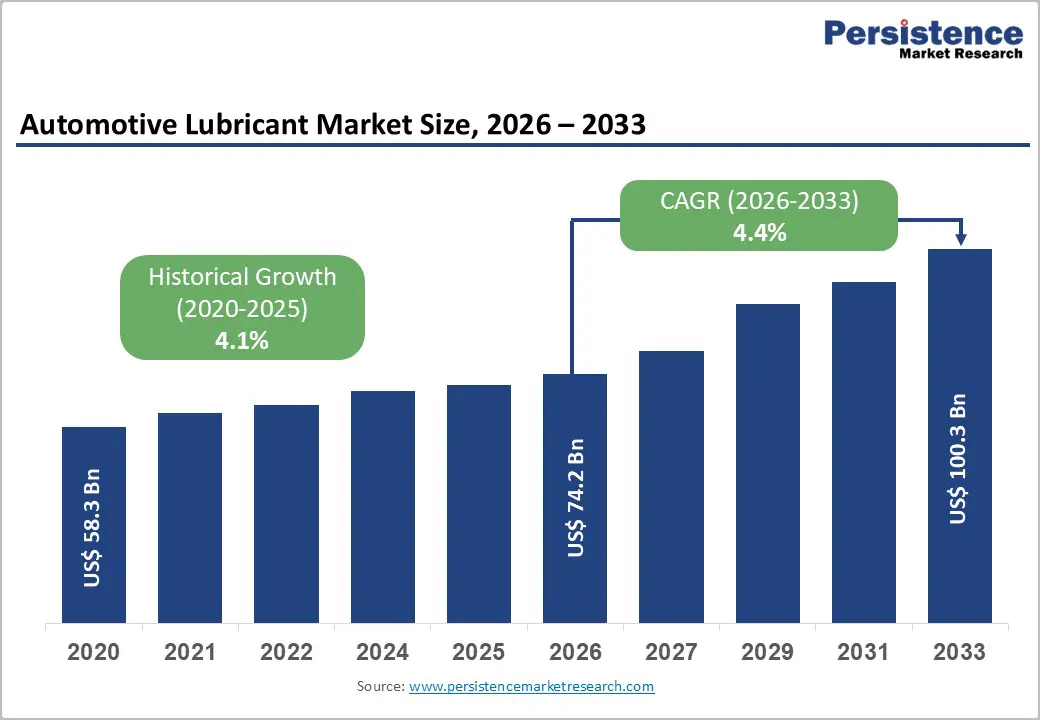
automotive-lubricant-market-size-2026-2033

Market Dynamics Analysis

Drivers - Expanding global vehicle parc and usage intensity

Global light-duty vehicle stock surpassed 1.4 billion units mid-decade, with additional growth coming from commercial vehicles and two-wheelers in emerging markets. The International Energy Agency notes that road transport continues to account for the largest share of oil demand, with developing economies contributing most of the incremental mileage. This expanding, aging vehicle parc sustains high replacement demand for engine oil, as even modest annual mileage generates frequent oil change requirements across passenger vehicles, light and heavy commercial fleets, and two-wheelers, stabilizing base-load consumption. Rising urbanization, e-commerce logistics expansion, and growing ride-sharing fleets further increase vehicle utilization rates, resulting in shorter maintenance intervals and higher recurring demand for automotive engine oils across global transportation networks.

Stringent emission and fuel-efficiency regulations

Tighter tailpipe emission and CO- standards in North America, Europe, China, and India compel OEMs to adopt advanced engine designs, turbocharging, and aftertreatment systems that require low-viscosity, high-performance lubricants. Regulatory regimes such as Euro 6 emissions standard, Corporate Average Fuel Economy standards, and China VI emissions standard demand improved fuel economy and lower particulate emissions, which are partly delivered through optimized friction characteristics and cleanliness offered by synthetic and semi-synthetic oils. This structurally shifts demand toward premium formulations, raising average value per litre even where overall volumes grow moderately. As regulatory timelines tighten toward next-generation standards, lubricant manufacturers are accelerating development of ultra-low-viscosity and additive-enhanced formulations to meet OEM approval requirements.

Restraints - Electrification and improvements in engine technology

Long-term electrification trends, particularly in Europe and China, gradually reduce demand for conventional engine oils as battery electric vehicles do not require crankcase lubricants. Even within internal combustion platforms, higher-quality synthetics and engine design improvements enable extended drain intervals, lowering per-vehicle consumption over time. These shifts cap volume growth and intensify competition in mature markets, forcing suppliers to rely more on value-added formulations and emerging-market vehicle parc expansion to offset declining fill volumes per vehicle.

Environmental pressures and waste-oil management

Stricter environmental policies around used oil collection, disposal, and carbon footprints increase compliance costs for producers and distributors. Regulators promote recycling and re-refining of waste lubricants, while consumer and fleet preferences slowly move toward lower-impact formulations, including bio-based and low-SAPs products. Producers that lag in developing sustainable portfolios risk losing share, and failure to meet evolving standards in key markets can restrict product approvals, posing structural barriers to sales growth.

Opportunity - Growth of bio-based and low-emission engine oils

Bio-based lubricants remain a small but fastest-growing niche as fleets and regulators seek lower lifecycle emissions and reduced dependence on petroleum feedstocks. With the user-provided estimate of bio-based engine oil growing at about 7.2% CAGR, incremental revenue potential can reach hundreds of millions of dollars by 2033 if penetration rises in sensitive applications and public fleets. Investments in stable base stocks, OEM endorsements, and competitive pricing could accelerate adoption beyond currently limited high-awareness segments. Advances in biodegradable additives, stronger environmental policies, and public procurement mandates are expected to further enhance demand, especially in government fleets, urban transport systems, and environmentally regulated industries worldwide.

Premium low-viscosity oils for fuel-efficient engines

Low-viscosity grades such as 0W-20 and 5W-30 are expanding rapidly as OEMs specify them to reduce friction and deliver measurable fuel-efficiency gains. The user-provided data indicates 5W-30 holds about 23% share, while 0W-20 is the fastest-growing grade with a CAGR of roughly 6.2%, reflecting OEM factory-fill trends and aftermarket pull-through. As automakers in Asia Pacific, North America, and Europe converge on such specifications, premium low-viscosity oils represent a multi-billion-dollar opportunity by 2033. Increasing hybrid vehicle adoption, stricter fuel-economy regulations, and extended oil-drain intervals will continue encouraging motorists and fleet operators to shift toward advanced synthetic low-viscosity lubricants across developed and emerging automotive markets.

Category-wise Analysis

Product Type Insights

Mineral Engine Oil is the leading product type, accounting for around 48% of the global Automotive Engine Oil market, supported by price-sensitive customers and large legacy vehicle fleets in Asia Pacific, Africa, and parts of Latin America. It remains dominant in older passenger cars, commercial vehicles, and two-wheelers where OEM requirements and usage patterns still allow conventional formulations, particularly in markets with lower average ticket sizes and limited awareness of synthetic benefits.

The Bio-Based Engine Oil segment is the fastest growing, with a user-indicated CAGR of about 7.2%, driven by corporate sustainability goals, government procurement standards, and specialized applications requiring improved biodegradability. Growth is also supported by technology advances in bio-based base oils and additive packages that close performance gaps with mineral and synthetic products.

Viscosity Grade Insights

The 5W-30 viscosity grade leads the market with an estimated 23% share, reflecting its widespread OEM recommendation for modern gasoline and light-duty diesel engines in Europe, North America, and increasingly Asia. It balances cold-start performance and high-temperature protection, making it a default choice for many factory fills and aftermarket services in passenger vehicle segments seeking fuel efficiency and durability.

The 0W-20 grade is the fastest-growing viscosity segment, expanding at an estimated CAGR of about 6.2% as OEMs prioritize fuel economy and lower emissions through ultra-low-viscosity lubricants. Its adoption is particularly strong in newer gasoline engines and hybrid vehicles, where reduced internal friction translates directly into measurable efficiency improvements.

Vehicle Type Insights

Passenger Vehicles are the leading vehicle type, contributing around 53% of Automotive Engine Oil consumption, according to user data, due to their dominant share of global vehicle parc and more frequent oil changes in many ownership models. High passenger car densities in Asia Pacific, Europe, and North America, combined with widespread reliance on internal combustion powertrains, underpin this category’s central role in the market’s revenue base.

The Two Wheelers segment is the fastest growing, with a user-indicated CAGR of about 5.2%, driven by large and expanding motorcycle and scooter fleets in Asia Pacific and parts of Latin America and Africa. Rising urbanization and affordable two-wheeler ownership maintain strong lubricant replacement cycles despite relatively low oil volumes per unit.

Distribution Channel Insighths

The Aftermarket is the leading distribution channel, representing around 72% of global Automotive Engine Oil sales, reflecting the large in-use vehicle base serviced through independent workshops, quick-lube centers, and retail outlets. This channel is especially critical in emerging markets, where vehicle owners often rely on non-dealer service points and brand choice is influenced by local availability, pricing, and mechanics’ recommendations.

The Aftermarket also shows the fastest growth momentum overall, while the OEM channel is expected to grow at a CAGR of about 3.9%, supported by rising new-vehicle sales and extended service contracts. OEM-approved oils secure early brand exposure at factory fill, with potential for long-term loyalty when combined with dealer maintenance programs.
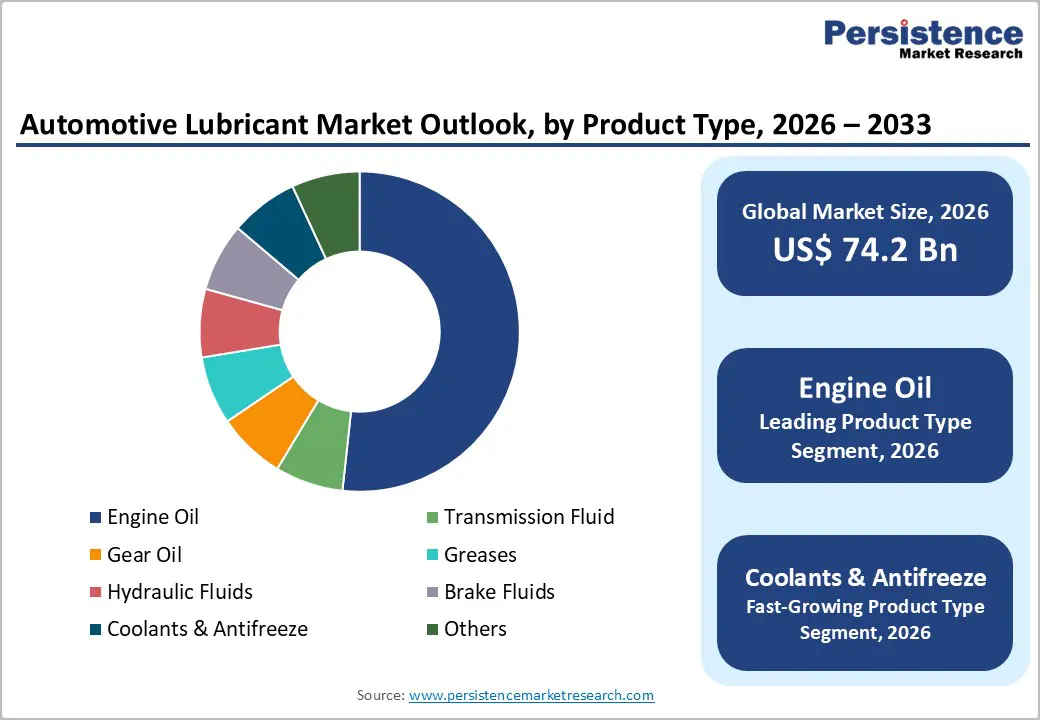
automotive-lubricant-market-outlook-by-product-type-2026-2033

Regional Market Insights

North America Automotive Engine Oil Market Trends

North America accounts for roughly 24% of the global Automotive Engine Oil market, supported by a large light truck and SUV parc in the United States and Canada and relatively high annual vehicle miles traveled. The region features strong penetration of synthetic and semi-synthetic oils, with consumers and fleets valuing extended drain intervals and cold-start performance in varied climates. Regulatory frameworks such as U.S. fuel-economy and emissions standards drive adoption of lower-viscosity OEM-specified oils, while a mature quick-lube and aftermarket service ecosystem sustains robust replacement volumes.

Growth in North America is expected to be moderate but stable, supported by continued use of internal combustion and hybrid vehicles even as battery electric vehicles gain share. Investment opportunities include premium synthetic products, OEM co-branded lines, and data-enabled service offerings that enhance customer retention and optimize oil-change timing for commercial fleets.

Europe Automotive Engine Oil Market Trends

Europe represents a significant share of global Automotive Engine Oil demand, with strong contributions from Germany, the U.K., France, Spain, and Italy, underpinned by a large passenger car parc and premium vehicle mix. The region’s stringent Euro emissions standards and widespread adoption of diesel and gasoline direct-injection technologies have long favored high-performance synthetic and low-SAPs formulations. Harmonized ACEA specifications and OEM approvals shape product qualification, while well-developed dealer networks and independent workshops provide multiple routes to market.

European demand is projected to grow at around 3.8% CAGR as provided by the user, with volume growth constrained by efficiency improvements and gradual electrification, but value supported by premium product penetration. Investment opportunities center on hybrid-ready oils, bio-based and low-carbon formulations, and advanced engine oils supporting extended-service intervals under demanding driving and regulatory conditions.

Asia Pacific Automotive Engine Oil Market Trends

Asia Pacific is the leading and fastest-growing region, holding approximately 43% of the global Automotive Engine Oil market, driven by large and expanding vehicle and two-wheeler fleets in China, India, ASEAN, and other emerging economies. Regional consumption growth is fuelled by rising incomes, urbanization, and strong new-vehicle sales, particularly in compact cars, motorcycles, and light commercial vehicles. China remains the largest market, while India and Southeast Asia provide strong incremental demand, including rapid uptake of synthetic and semi-synthetic oils.

With Asia Pacific engine oil markets expected to grow faster than global averages, investment opportunities span localized blending and packaging, tailored two-wheeler products, and OEM partnerships for new factories and service programs. The region’s manufacturing advantages and government support for automotive industries also underpin export potential and platform-led lubricant strategies.
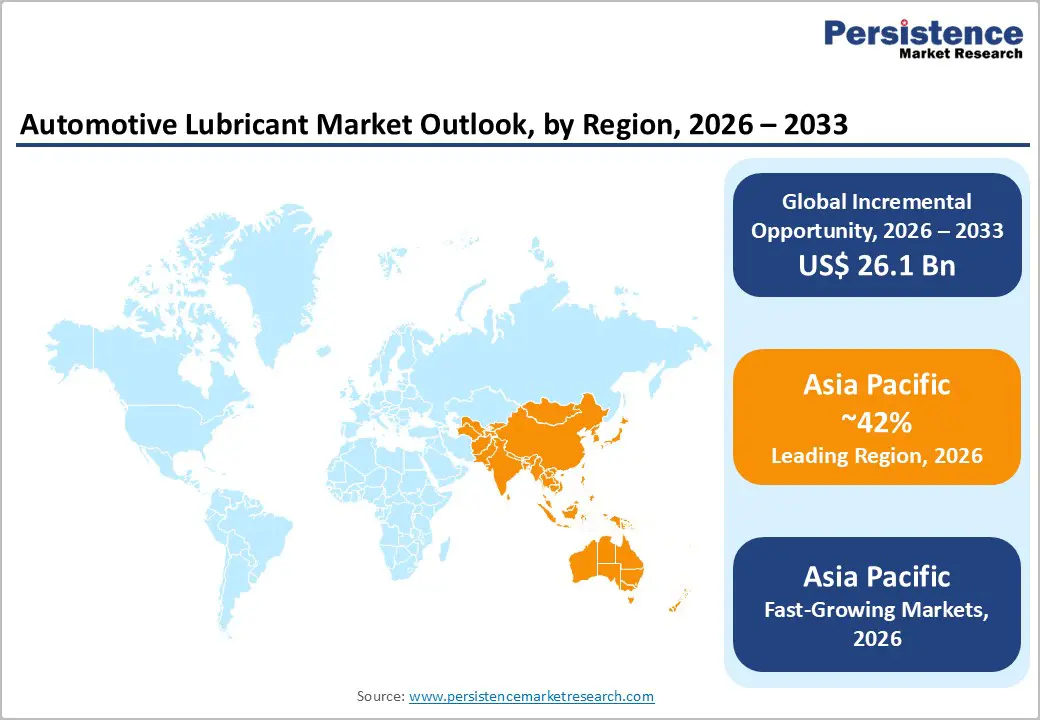
automotive-lubricant-market-outlook-by-region-2026-2033

Competitive Landscape

Leading Automotive Engine Oil companies pursue innovation-driven, cost-competitive, and regionally tailored strategies, focusing on synthetic and low-viscosity formulations, OEM approvals, and strong aftermarket branding. Key differentiators include robust global supply chains, technical service support, co-engineering with OEMs, and sustainability credentials. Emerging models emphasize digital marketing, subscription-based maintenance packages, and channel partnerships that integrate lubricants into holistic vehicle-care ecosystems.

Strategic Developments

  • In February 2024, Shell launched next-generation synthetic automotive engine oils with improved fuel-efficiency and low-emission performance, targeting OEM-approved specifications for modern passenger cars and hybrids across major markets.
  • In June 2024, BP (Castrol) introduced an upgraded range of low-viscosity engine oils aligned with evolving OEM requirements for downsized turbocharged engines, emphasizing extended drain intervals and CO- reduction benefits.
  • In June 2024, TotalEnergies introduced its Quartz EV3R and Rubia EV3R lubricant ranges, formulated using high-quality regenerated base oils. The initiative supports circular economy goals through the “Reduce, Reuse, Regenerate” approach while maintaining OEM-approved performance and using packaging made with 50% recycled plastic.


Companies Covered in Automotive Engine Oil Market

  • Shell plc
  • ExxonMobil Corporation
  • BP plc (Castrol)
  • TotalEnergies SE
  • Chevron Corporation
  • Valvoline Inc.
  • PetroChina Company Limited
  • Sinopec Limited
  • Indian Oil Corporation Limited
  • Hindustan Petroleum Corporation Limited
  • Bharat Petroleum Corporation Limited
  • Fuchs Petrolub SE
  • ENEOS Holdings Inc.
  • Phillips 66
  • Petronas Lubricants International
Frequently Asked Questions

The Automotive Engine Oil Market is projected to reach around US$45.2 billion in 2026 and approximately US$60.6 billion by 2033, reflecting steady global demand from a large and aging vehicle parc.

Growth is driven by expansion of the global vehicle parc, stricter fuel‑efficiency and emission standards requiring higher‑performance lubricants, and rising adoption of synthetic and low‑viscosity oils in both developed and emerging markets.

Between 2026 and 2033, the Automotive Engine Oil Market is anticipated to grow at around 4.3% CAGR, supported by value‑led product mix upgrades despite electrification‑related headwinds.

Key opportunities include bio‑based and low‑carbon engine oils, premium low‑viscosity grades such as 0W‑20 and 5W‑30, and expanding aftermarket and OEM programs in high‑growth Asia Pacific and other emerging regions.

Major players include Shell, ExxonMobil, BP (Castrol), TotalEnergies, Chevron, Valvoline, PetroChina, Sinopec, Indian Oil, HPCL, BPCL, and Fuchs, which collectively shape technology, branding, and supply dynamics worldwide.

Automotive Engine Oil Market Report Scope
Report Attribute Details

Historical Data/Actuals

2020 - 2025

Forecast Period

2026 - 2033

Market Analysis Units

Value: US$ Bn/Mn, Volume: As applicable

Geographical Coverage

  • North America
  • Europe
  • East Asia
  • South Asia and Oceania
  • Latin America
  • Middle East and Africa

Segmental Coverage

  • Product Type
  • Viscosity Grade
  • Vehicle Type
  • Distribution Channel
  • Region

Competitive Analysis

  • Shell plc
  • ExxonMobil Corporation
  • BP plc (Castrol)
  • TotalEnergies SE
  • Chevron Corporation
  • Valvoline Inc.
  • PetroChina Company Limited
  • Sinopec Limited
  • Indian Oil Corporation Limited
  • Hindustan Petroleum Corporation Limited
  • Bharat Petroleum Corporation Limited
  • Fuchs Petrolub SE
  • ENEOS Holdings Inc.
  • Phillips 66
  • Petronas Lubricants International

Report Highlights

  • Market Forecast and Trends
  • Competitive Intelligence & Share Analysis
  • Growth Factors and Challenges
  • Strategic Growth Initiatives
  • Pricing Analysis & Technology Roadmap
  • Future Opportunities and Revenue Pockets
  • Market Analysis Tools   
Market Segmentation

By Product Type

  • Mineral Engine Oil
  • Synthetic Engine Oil
  • Semi-Synthetic Engine Oil
  • Bio-Based Engine Oil

By Viscosity Grade

  • 0W-20
  • 0W-30
  • 5W-20
  • 5W-30
  • 5W-40
  • 10W-30
  • 10W-40
  • 15W-40
  • Others

By Vehicle Type

  • Passenger Vehicle
  • Light Commercial Vehicle
  • Heavy Commercial Vehicle
  • Two Wheelers
  • Off-road Vehicle

By Distribution Channel

  • OEM (Factory Fill)
  • Aftermarket

By Region

  • North America
  • Europe
  • East Asia
  • South Asia and Oceania
  • Latin America
  • Middle East and Africa

Related Reports

  1. Executive Summary
    1. Global Automotive Engine Oil Market Snapshot 2026 and 2033
    2. Market Opportunity Assessment, 2026-2033, US$ Bn
    3. Key Market Trends
    4. Industry Developments and Key Market Events
    5. Demand Side and Supply Side Analysis
    6. PMR Analysis and Recommendations
  2. Market Overview
    1. Market Scope and Definitions
    2. Value Chain Analysis
    3. Macro-Economic Factors
      1. Global GDP Outlook
      2. Global Vehicle Parc by Vehicle Categories
      3. Global Vehicle Production Outlook by Region
      4. Global Vehicle Sales by Country
    4. Forecast Factors – Relevance and Impact
    5. COVID-19 Impact Assessment
    6. PESTLE Analysis
    7. Porter's Five Forces Analysis
    8. Geopolitical Tensions: Market Impact
    9. Regulatory and Technology Landscape
  3. Market Dynamics
    1. Drivers
    2. Restraints
    3. Opportunities
    4. Trends
  4. Price Trend Analysis, 2020 – 2033
    1. Region-wise Price Analysis
    2. Price by Segments
    3. Price Impact Factors
  5. Global Automotive Engine Oil Market Outlook: Historical (2020 – 2025) and Forecast (2026 – 2033)
    1. Key Highlights
    2. Global Automotive Engine Oil Market Outlook: Product Type
      1. Introduction/Key Findings
      2. Historical Market Size (US$ Bn) and Volume (Tons) Analysis by Product Type, 2020-2025
      3. Current Market Size (US$ Bn) and Volume (Tons) Forecast, by Product Type, 2026-2033
        1. Mineral Engine Oil
        2. Synthetic Engine Oil
        3. Semi-Synthetic Engine Oil
        4. Bio-Based Engine Oil
      4. Market Attractiveness Analysis: Product Type
    3. Global Automotive Engine Oil Market Outlook: Viscosity Grade
      1. Introduction/Key Findings
      2. Historical Market Size (US$ Bn) and Volume (Tons) Analysis by Viscosity Grade, 2020-2025
      3. Current Market Size (US$ Bn) and Volume (Tons) Forecast, by Viscosity Grade, 2026-2033
        1. 0W-20
        2. 0W-30
        3. 5W-20
        4. 5W-30
        5. 5W-40
        6. 10W-30
        7. 10W-40
        8. 15W-40
        9. Others
      4. Market Attractiveness Analysis: Viscosity Grade
    4. Global Automotive Engine Oil Market Outlook: Vehicle Type
      1. Introduction/Key Findings
      2. Historical Market Size (US$ Bn) and Volume (Tons) Analysis by Vehicle Type, 2020-2025
      3. Current Market Size (US$ Bn) and Volume (Tons) Forecast, by Vehicle Type, 2026-2033
        1. Passenger Vehicle
        2. Light Commercial Vehicle
        3. Heavy Commercial Vehicle
        4. Two Wheelers
        5. Off-road Vehicle
      4. Market Attractiveness Analysis: Vehicle Type
    5. Global Automotive Engine Oil Market Outlook: Distribution Channel
      1. Introduction/Key Findings
      2. Historical Market Size (US$ Bn) and Volume (Tons) Analysis by Distribution Channel, 2020-2025
      3. Current Market Size (US$ Bn) and Volume (Tons) Forecast, by Distribution Channel, 2026-2033
        1. OEM (Factory Fill)
        2. Aftermarket
      4. Market Attractiveness Analysis: Distribution Channel
  6. Global Automotive Engine Oil Market Outlook: Region
    1. Key Highlights
    2. Historical Market Size (US$ Bn) and Volume (Tons) Analysis by Region, 2020-2025
    3. Current Market Size (US$ Bn) and Volume (Tons) Forecast, by Region, 2026-2033
      1. North America
      2. Europe
      3. East Asia
      4. South Asia & Oceania
      5. Latin America
      6. Middle East & Africa
    4. Market Attractiveness Analysis: Region
  7. North America Automotive Engine Oil Market Outlook: Historical (2020 – 2025) and Forecast (2026 – 2033)
    1. Key Highlights
    2. Pricing Analysis
    3. North America Market Size (US$ Bn) and Volume (Tons) Forecast, by Country, 2026-2033
      1. U.S.
      2. Canada
    4. North America Market Size (US$ Bn) and Volume (Tons) Forecast, by Product Type, 2026-2033
      1. Mineral Engine Oil
      2. Synthetic Engine Oil
      3. Semi-Synthetic Engine Oil
      4. Bio-Based Engine Oil
    5. North America Market Size (US$ Bn) and Volume (Tons) Forecast, by Viscosity Grade, 2026-2033
      1. 0W-20
      2. 0W-30
      3. 5W-20
      4. 5W-30
      5. 5W-40
      6. 10W-30
      7. 10W-40
      8. 15W-40
      9. Others
    6. North America Market Size (US$ Bn) and Volume (Tons) Forecast, by Vehicle Type, 2026-2033
      1. Passenger Vehicle
      2. Light Commercial Vehicle
      3. Heavy Commercial Vehicle
      4. Two Wheelers
      5. Off-road Vehicle
    7. North America Market Size (US$ Bn) and Volume (Tons) Forecast, by Distribution Channel, 2026-2033
      1. OEM (Factory Fill)
      2. Aftermarket
  8. Europe Automotive Engine Oil Market Outlook: Historical (2020 – 2025) and Forecast (2026 – 2033)
    1. Key Highlights
    2. Pricing Analysis
    3. Europe Market Size (US$ Bn) and Volume (Tons) Forecast, by Country, 2026-2033
      1. Germany
      2. Italy
      3. France
      4. U.K.
      5. Spain
      6. Russia
      7. Rest of Europe
    4. Europe Market Size (US$ Bn) and Volume (Tons) Forecast, by Product Type, 2026-2033
      1. Mineral Engine Oil
      2. Synthetic Engine Oil
      3. Semi-Synthetic Engine Oil
      4. Bio-Based Engine Oil
    5. Europe Market Size (US$ Bn) and Volume (Tons) Forecast, by Viscosity Grade, 2026-2033
      1. 0W-20
      2. 0W-30
      3. 5W-20
      4. 5W-30
      5. 5W-40
      6. 10W-30
      7. 10W-40
      8. 15W-40
      9. Others
    6. Europe Market Size (US$ Bn) and Volume (Tons) Forecast, by Vehicle Type, 2026-2033
      1. Passenger Vehicle
      2. Light Commercial Vehicle
      3. Heavy Commercial Vehicle
      4. Two Wheelers
      5. Off-road Vehicle
    7. Europe Market Size (US$ Bn) and Volume (Tons) Forecast, by Distribution Channel, 2026-2033
      1. OEM (Factory Fill)
      2. Aftermarket
  9. East Asia Automotive Engine Oil Market Outlook: Historical (2020 – 2025) and Forecast (2026 – 2033)
    1. Key Highlights
    2. Pricing Analysis
    3. East Asia Market Size (US$ Bn) and Volume (Tons) Forecast, by Country, 2026-2033
      1. China
      2. Japan
      3. South Korea
    4. East Asia Market Size (US$ Bn) and Volume (Tons) Forecast, by Product Type, 2026-2033
      1. Mineral Engine Oil
      2. Synthetic Engine Oil
      3. Semi-Synthetic Engine Oil
      4. Bio-Based Engine Oil
    5. East Asia Market Size (US$ Bn) and Volume (Tons) Forecast, by Viscosity Grade, 2026-2033
      1. 0W-20
      2. 0W-30
      3. 5W-20
      4. 5W-30
      5. 5W-40
      6. 10W-30
      7. 10W-40
      8. 15W-40
      9. Others
    6. East Asia Market Size (US$ Bn) and Volume (Tons) Forecast, by Vehicle Type, 2026-2033
      1. Passenger Vehicle
      2. Light Commercial Vehicle
      3. Heavy Commercial Vehicle
      4. Two Wheelers
      5. Off-road Vehicle
    7. East Asia Market Size (US$ Bn) and Volume (Tons) Forecast, by Distribution Channel, 2026-2033
      1. OEM (Factory Fill)
      2. Aftermarket
  10. South Asia & Oceania Automotive Engine Oil Market Outlook: Historical (2020 – 2025) and Forecast (2026 – 2033)
    1. Key Highlights
    2. Pricing Analysis
    3. South Asia & Oceania Market Size (US$ Bn) and Volume (Tons) Forecast, by Country, 2026-2033
      1. India
      2. Southeast Asia
      3. ANZ
      4. Rest of SAO
    4. South Asia & Oceania Market Size (US$ Bn) and Volume (Tons) Forecast, by Product Type, 2026-2033
      1. Mineral Engine Oil
      2. Synthetic Engine Oil
      3. Semi-Synthetic Engine Oil
      4. Bio-Based Engine Oil
    5. South Asia & Oceania Market Size (US$ Bn) and Volume (Tons) Forecast, by Viscosity Grade, 2026-2033
      1. 0W-20
      2. 0W-30
      3. 5W-20
      4. 5W-30
      5. 5W-40
      6. 10W-30
      7. 10W-40
      8. 15W-40
      9. Others
    6. South Asia & Oceania Market Size (US$ Bn) and Volume (Tons) Forecast, by Vehicle Type, 2026-2033
      1. Passenger Vehicle
      2. Light Commercial Vehicle
      3. Heavy Commercial Vehicle
      4. Two Wheelers
      5. Off-road Vehicle
    7. South Asia & Oceania Market Size (US$ Bn) and Volume (Tons) Forecast, by Distribution Channel, 2026-2033
      1. OEM (Factory Fill)
      2. Aftermarket
  11. Latin America Automotive Engine Oil Market Outlook: Historical (2020 – 2025) and Forecast (2026 – 2033)
    1. Key Highlights
    2. Pricing Analysis
    3. Latin America Market Size (US$ Bn) and Volume (Tons) Forecast, by Country, 2026-2033
      1. Brazil
      2. Mexico
      3. Rest of LATAM
    4. Latin America Market Size (US$ Bn) and Volume (Tons) Forecast, by Product Type, 2026-2033
      1. Mineral Engine Oil
      2. Synthetic Engine Oil
      3. Semi-Synthetic Engine Oil
      4. Bio-Based Engine Oil
    5. Latin America Market Size (US$ Bn) and Volume (Tons) Forecast, by Viscosity Grade, 2026-2033
      1. 0W-20
      2. 0W-30
      3. 5W-20
      4. 5W-30
      5. 5W-40
      6. 10W-30
      7. 10W-40
      8. 15W-40
      9. Others
    6. Latin America Market Size (US$ Bn) and Volume (Tons) Forecast, by Vehicle Type, 2026-2033
      1. Passenger Vehicle
      2. Light Commercial Vehicle
      3. Heavy Commercial Vehicle
      4. Two Wheelers
      5. Off-road Vehicle
    7. Latin America Market Size (US$ Bn) and Volume (Tons) Forecast, by Distribution Channel, 2026-2033
      1. OEM (Factory Fill)
      2. Aftermarket
  12. Middle East & Africa Automotive Engine Oil Market Outlook: Historical (2020 – 2025) and Forecast (2026 – 2033)
    1. Key Highlights
    2. Pricing Analysis
    3. Middle East & Africa Market Size (US$ Bn) and Volume (Tons) Forecast, by Country, 2026-2033
      1. GCC Countries
      2. South Africa
      3. Northern Africa
      4. Rest of MEA
    4. Middle East & Africa Market Size (US$ Bn) and Volume (Tons) Forecast, by Product Type, 2026-2033
      1. Mineral Engine Oil
      2. Synthetic Engine Oil
      3. Semi-Synthetic Engine Oil
      4. Bio-Based Engine Oil
    5. Middle East & Africa Market Size (US$ Bn) and Volume (Tons) Forecast, by Viscosity Grade, 2026-2033
      1. 0W-20
      2. 0W-30
      3. 5W-20
      4. 5W-30
      5. 5W-40
      6. 10W-30
      7. 10W-40
      8. 15W-40
      9. Others
    6. Middle East & Africa Market Size (US$ Bn) and Volume (Tons) Forecast, by Vehicle Type, 2026-2033
      1. Passenger Vehicle
      2. Light Commercial Vehicle
      3. Heavy Commercial Vehicle
      4. Two Wheelers
      5. Off-road Vehicle
    7. Middle East & Africa Market Size (US$ Bn) and Volume (Tons) Forecast, by Distribution Channel, 2026-2033
      1. OEM (Factory Fill)
      2. Aftermarket
  13. Competition Landscape
    1. Market Share Analysis, 2025
    2. Market Structure
      1. Competition Intensity Mapping
      2. Competition Dashboard
    3. Company Profiles
      1. Shell plc
        1. Company Overview
        2. Product Portfolio/Offerings
        3. Key Financials
        4. SWOT Analysis
        5. Company Strategy and Key Developments
      2. ExxonMobil Corporation
      3. BP plc (Castrol)
      4. TotalEnergies SE
      5. Chevron Corporation
      6. Valvoline Inc.
      7. PetroChina Company Limited
      8. Sinopec Limited
      9. Indian Oil Corporation Limited
      10. Hindustan Petroleum Corporation Limited
      11. Bharat Petroleum Corporation Limited
      12. Fuchs Petrolub SE
      13. ENEOS Holdings Inc.
      14. Phillips 66
      15. Petronas Lubricants International
  14. Appendix
    1. Research Methodology
    2. Research Assumptions
    3. Acronyms and Abbreviations


Research Methodology Framework for Market Research Excellence

At Persistence Market Research, we implement a comprehensive, validated, and multi-dimensional approachto market analysis that delivers actionable insights across complex market landscapes. Our methodology combines the analytical rigor of leading consulting firms with innovative research techniques, ensuring robust market assessments that guide strategic decision-making with confidence.

Core Research Philosophy

Our methodology is built on four foundational pillars:

Research Philosophy Image

At Persistence Market Research, our methodology is designed to transcend conventional market studies by combining analytical rigor, multi-source validation, and future-focused insights.

We integrate advanced research frameworks, robust data collection strategies, cutting-edge analytics, and innovative technologies to deliver a 360-degree view of complex markets.

We integrate advanced research frameworks, robust data collection strategies, cutting-edge analytics, and innovative technologies to deliver a 360-degree view of complex markets.

Each stage spanning from strategic scoping and hypothesis-building to competitive intelligence, quality validation, and actionable recommendations is engineered to provide clients with unmatched clarity, precision, and confidence in decision-making.

By embedding innovation and technology at the core, our approach ensures that insights are not only comprehensive but also predictive, empowering businesses to seize opportunities, mitigate risks, and achieve sustainable growth

Research Philosophy Image

Capturing Key Information and Events

During this phase, key research objectives focus on essential information and data points for assessing the market, including:

Research Philosophy Image

TAM-SAM-SOM Framework Implementation

We employ both top-down and bottom-up approaches to ensure accurate market sizing.

Top-Down Market SizingBottom-Up Market Sizing
Universe Definition: Total global/regional market identificationUnit Economics: Average transaction values, purchase frequencies, customer lifecycle
Segmentation Filters: Geographic, demographic, and behavioral constraintsCustomer Segmentation: Detailed buyer persona development and sizing
Market Share Analysis: Competitive landscape assessment and share allocationPenetration Analysis: Market penetration rates by segment and geography
Growth Rate Application: Historical trends and forward-looking growth assumptionsScaling Methodology: Extrapolation techniques with confidence intervals

Validation & Cross-Verification

  • Triangulation: Comparing top-down and bottom-up results for consistency
  • Sensitivity Analysis: Testing key assumptions and parameter variations
  • Peer Benchmarking: Comparison with analogous markets and industry benchmarks
  • Expert Review: External validation through industry specialist consultation

Research Philosophy Image

Forecasting & Projection Modeling

Our proprietary forecasting models incorporate multiple variables and scenarios.

Forecasting Components

  • Historical Trend Analysis: 10-year historical growth patterns and cyclical variations
  • Driver-Based Modeling: Economic indicators, demographic shifts, technology adoption
  • Scenario Planning: Base case, optimistic, and conservative projections
  • Monte Carlo Simulations: Probability-weighted outcomes and risk assessments

Model Validation

  • Back-Testing: Historical accuracy assessment over 3–5-year periods
  • Cross-Validation: Multiple modeling approaches for result comparison
  • External Benchmarking: Comparison with established market forecasts
  • Continuous Calibration: Quarterly model updates based on new data

Comprehensive Data Collection Strategy

Our secondary research phase establishes a robust knowledge base utilizing diverse, credible sources.

Secondary Data Sourcess

  • Industry Publications & Reports
  • Government & Regulatory Data
  • Financial Intelligence (filings & reports)
  • Academic Research & Digital Intelligence

Quality Assurance Protocol

  • Source credibility assessment and publication date validation
  • Data consistency checks across multiple sources
  • Bias identification and neutralization techniques
  • Information gap tracking for primary research prioritization

Research Philosophy Image

Primary Research Excellence

Our primary research methodology employs best-in-class techniques to capture unique market insights.

Quantitative Research Methods

  • Large-Scale Surveys: Statistically representative samples with 95% confidence intervals
  • Survey Methodology: Multi-channel deployment (online, telephone, in-person)
  • Question Architecture and Response Optimization

Qualitative Research Methods

  • Executive Interviews
  • Focus Groups
  • Expert Consultations

Quality Assurance & Validation Framework

Multi-Stage Validation Process

  • Source Verification and Consistency Testing
  • Outlier Detection and Bias Assessment
  • Peer Review Process and External Validation
  • Sensitivity Analysis and Confidence Intervals

Research Philosophy Image

Methodology Validation & Credibility

Our research methodology has been extensively validated through:

  • Academic Partnerships: Collaborations with top-tier business schools and research institutions
  • Client Success Stories: Documented case studies demonstrating research impact and ROI
  • Continuous Benchmarking: Performance comparison with leading global research firms

This comprehensive methodology framework positions Persistence Market Research at the forefront of market intelligence, combining the analytical sophistication of top-tier consulting firms with innovative research techniques. Our approach ensures that every market assessment delivers precise, actionable, and strategically valuable insights that drive business success in competitive market environments.

Ready to unlock your market potential? Contact our research experts to discuss how our validated methodology can transform your strategic decision-making with data-driven market intelligence.

Copyright © 2026 Persistence Market Research. All Rights Reserved

Connect With Us -