




- Transportation & Logistics
- Europe Car Rental Market
Europe Car Rental Market Size, Share, and Growth Forecast, 2026 – 2033
Europe Car Rental Market by Car Type (Economy Cars, Executive Cars, Luxury Cars, SUVs, MUVs), Power Source (Petrol, Diesel, Fully Electric, Hybrid), Duration (Short-Term Rental, Long-Term Rental) for 2026 – 2033

Europe Car Rental Market Size and Trends Analysis
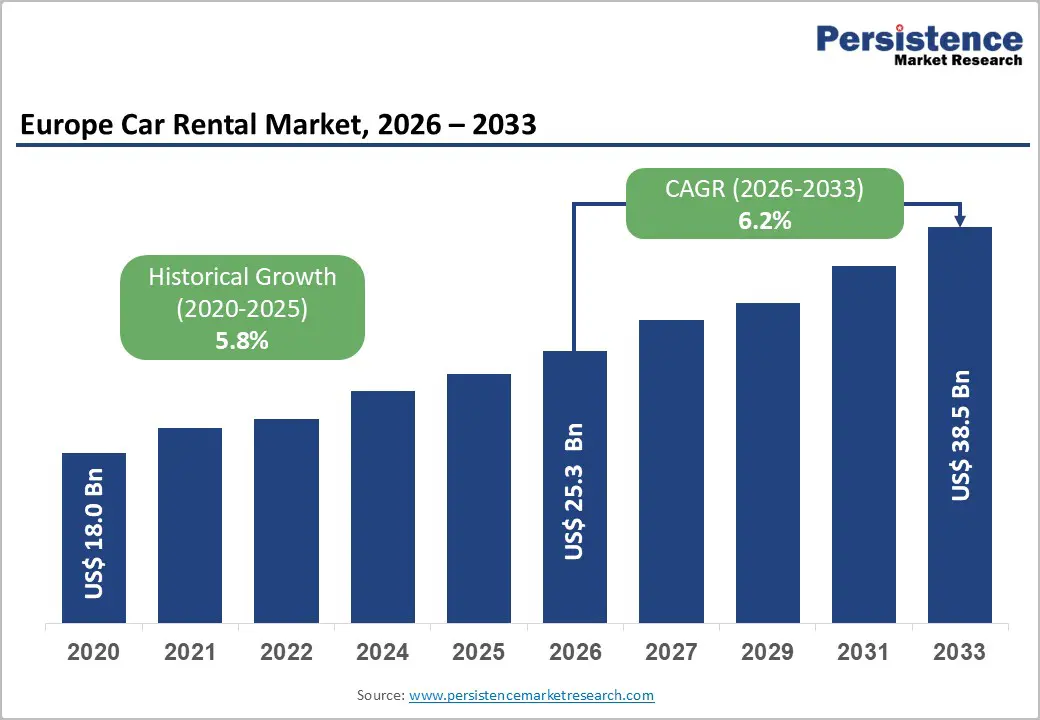
The Europe Car Rental market size is likely to be valued at US$25.3 billion in 2026 and is expected to reach US$38.5 billion by 2033, growing at a CAGR of 6.2% during the forecast period from 2026 to 2033, driven by rising tourism and business travel across Europe, with increasing numbers of international and domestic travelers seeking convenient and flexible transportation options.
The market is benefiting from a growing preference for flexible mobility solutions, including short-term rentals, subscription-based services, and app-based on-demand rentals, which provide greater convenience and accessibility to end-users. The accelerating digitalization of booking platforms has enhanced the customer experience by enabling effortless online reservations, contactless rental processes, and real-time access to fleet availability. The transition toward electric and hybrid rental fleets is also being driven by strict EU sustainability regulations and environmental initiatives aimed at promoting low-emission mobility solutions.
Key Industry Highlights:
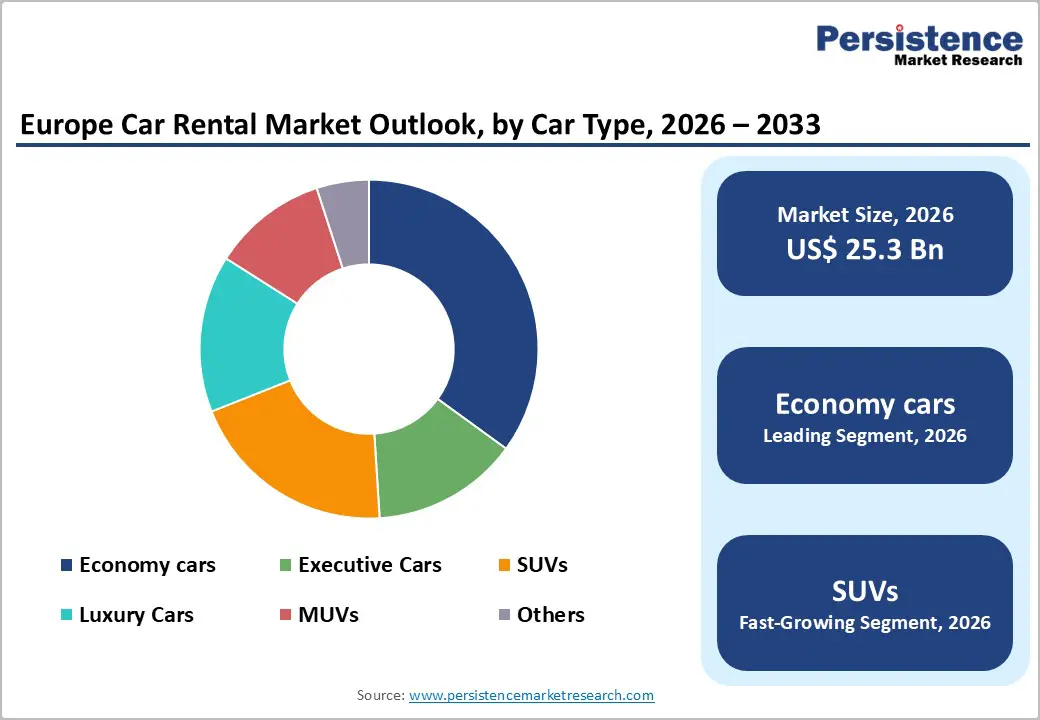
- Leading Car Type: Economy cars is anticipated to be the leading car type, accounting for a revenue share of 35% in 2026, driven by their affordability, fuel efficiency, and strong preference among budget-conscious tourists and urban commuters.
- Leading Power Source: Petrol are projected to represent the leading power source in 2026, accounting for 45% of the revenue share, driven by established refueling infrastructure, reliability for long-distance travel, and lower upfront costs compared to alternative powertrains.
- Leading Duration: Short-term rental are anticipated to be the leading duration type, accounting for over 60% of the revenue share in 2026, supported by high demand from tourists and business travelers seeking flexible, convenient, and quick-access transportation options.
| Key Insights | Details |
|---|---|
| Europe Car Rental Market Size (2026E) | US$25.3 Bn |
| Market Value Forecast (2033F) | US$38.5 Bn |
| Projected Growth (CAGR 2026 to 2033) | 6.2% |
| Historical Market Growth (CAGR 2020 to 2025) | 5.8% |
Market Factors – Growth, Barriers, and Opportunity Analysis
Rising Tourism and Business Travel Demand
Countries such as France, Spain, Italy, and the United Kingdom consistently rank among the world’s top tourist destinations, attracting millions of travelers annually. The growing preference for flexible and convenient transportation has made car rentals an attractive choice, especially for airport arrivals, city tours, and rural excursions where public transportation is limited. Economy cars dominate this segment due to affordability and fuel efficiency, while SUVs and MUVs are increasingly chosen for family and adventure tourism, reflecting evolving traveler preferences.
Seasonal peaks during summer and holiday periods amplify rental demand, with digital booking platforms enabling seamless reservations and enhancing accessibility. The rise of experiential tourism, including vineyard tours, ski trips in the Alps, and coastal drives in the Mediterranean, also contributes to consistent growth in the rental sector.
Business travel represents another significant contributor to the Europe car rental market, driven by corporate mobility needs and cross-border commerce. With the resumption of in-person meetings, conferences, and trade events across Europe, demand for executive and short-term vehicle rentals has risen sharply. Companies increasingly prefer renting vehicles over maintaining large corporate fleets, reducing operational costs and ensuring access to modern, technologically equipped vehicles.
Executive and luxury cars are often selected for business travel to project professionalism, while hybrid and electric fleets are favored for sustainability-conscious organizations. Airport-based rentals and city-center pickup points facilitate efficient transport for business travelers, supporting tight schedules. Digital solutions, such as mobile apps, real-time fleet tracking, and AI-based booking systems, streamline corporate rental processes, enhancing convenience.
Rising Vehicle Acquisition and Maintenance Costs
Automotive prices across Europe have increased steadily due to inflation, supply chain disruptions, and higher raw material costs, particularly for semiconductors, steel, and battery components. Rental operators are required to frequently renew fleets to meet safety, emission, and customer comfort standards, which significantly increases capital expenditure. The shift toward electric and hybrid vehicles, while essential for regulatory compliance, intensifies acquisition costs, as these vehicles typically carry higher upfront prices compared to conventional petrol or diesel models. Manufacturers' reduced discounts to fleet buyers post-pandemic have limited cost-saving opportunities for large rental companies. These rising acquisition expenses place pressure on rental pricing strategies, forcing operators to balance affordability with margin protection.
Maintenance and operational costs compound this restraint, adding ongoing financial pressure to Europe’s car rental providers. Modern vehicles, while technologically advanced, require specialized servicing, diagnostic tools, and trained technicians, increasing maintenance expenses. Electric vehicles introduce new cost structures, including battery health monitoring, software updates, and charging infrastructure investments, which can elevate the total cost of ownership despite lower fuel expenses.
Insurance premiums and repair costs have also risen across Europe due to higher spare part prices and longer repair cycles, increasing vehicle downtime and reducing fleet utilization rates. Stringent EU safety and environmental regulations mandate regular inspections and compliance upgrades, driving maintenance spending. Seasonal demand variations exacerbate the issue, as underutilized vehicles still incur depreciation and upkeep costs during off-peak periods.
Expansion in Electric Vehicle (EV) Rentals through Infrastructure Development
European Union initiatives aimed at achieving climate neutrality have accelerated investments in public and private charging networks, improving accessibility and convenience for EV users. Countries such as Germany, France, the Netherlands, and the Nordic nations are actively expanding fast-charging corridors along highways, airports, and urban centers, making EV rentals increasingly viable for both short-term and long-distance travel. This infrastructure growth addresses earlier concerns related to range anxiety, encouraging rental companies to integrate more fully electric vehicles into their fleets. Sustainability becomes a key consideration for travelers, especially millennial and corporate clients, and demand for low-emission transportation options is rising. EV rentals also align with stricter emission zones in major European cities, where conventional vehicles face access restrictions.
Infrastructure development supports EV adoption and improves the economic and operational viability of electric rental fleets. The increasing availability of fast and ultra-fast charging stations reduces vehicle downtime, allowing rental operators to improve fleet utilization rates. Partnerships between car rental companies, energy providers, and airport authorities are streamlining charging access at high-traffic rental locations.
Advancements in battery technology and charging speeds are extending driving ranges, making EVs suitable for a broader range of rental use cases, including intercity travel and tourism. For rental providers, EVs offer long-term cost advantages through lower fuel and maintenance expenses, offsetting higher upfront acquisition costs. Corporate customers and environmentally conscious tourists are increasingly prioritizing EV rentals to meet sustainability goals, creating opportunities for premium pricing and long-term contracts.
Category-wise Analysis
Car Type Insights
Economy cars are expected to lead the Europe car rental market, accounting for approximately 35% of revenue in 2026, driven by their affordability, fuel efficiency, and suitability for high-volume travel needs. These vehicles are widely preferred by budget-conscious tourists, solo travelers, and urban commuters seeking cost-effective and reliable transportation. Their compact size makes them ideal for navigating European city centers, where parking constraints and narrow roads are common.
Economy cars also align well with short-term rental demand at airports and railway hubs, where convenience and quick turnaround are critical. The widespread availability of economy models ensures consistent demand even during economic uncertainty, reinforcing their dominance. For example, Europcar Mobility Group maintains a strong focus on compact and economy vehicles across major European travel destinations, enabling it to serve large tourist volumes efficiently while maintaining competitive pricing and fleet scalability.
SUVs are likely to represent the fastest-growing segment in 2026, driven by changing traveler preferences and evolving tourism patterns. Demand is rising as customers increasingly seek spacious, versatile vehicles suitable for family travel, long-distance journeys, and outdoor or adventure tourism. SUVs offer higher comfort levels, enhanced safety features, and greater luggage capacity, making them attractive for road trips across diverse terrains such as coastal routes, mountain regions, and rural destinations. This shift is particularly visible among leisure travelers and groups who prioritize comfort and flexibility over cost. Rental companies are responding by expanding SUV availability to capture this growing demand while differentiating their offerings from traditional compact fleets.
Sustainability trends are also influencing this segment, with operators introducing hybrid and electric SUV options to meet environmental expectations. For example, SIXT SE has actively expanded its SUV lineup across Europe, positioning these vehicles as premium yet practical options for modern travelers.
Power Source Insights
Petrol vehicles are projected to lead the market, capturing around 45% of the revenue share in 2026, supported by their widespread refueling infrastructure and operational reliability. Petrol-powered cars are favored for their suitability in both urban and long-distance travel, offering consistent performance across varied driving conditions. Rental operators rely on petrol fleets due to ease of maintenance, predictable operating behavior, and high customer familiarity, reducing user hesitation and operational complexity. This power source is particularly dominant in short-term rentals and airport-based services, where quick vehicle turnaround and refueling convenience are essential. For example, Avis Budget Group continues to maintain a significant petrol-powered fleet across Europe to ensure operational flexibility and meet diverse customer travel requirements.
Fully electric vehicles are likely to be the fastest-growing power source in 2026, driven by strong sustainability initiatives and expanding charging infrastructure. Growing environmental awareness among travelers and corporate clients is accelerating demand for zero-emission mobility solutions. EVs are increasingly preferred in urban centers, where low-emission zones and environmental regulations encourage cleaner transportation options. Advances in battery technology and improved charging accessibility are making electric rentals more practical for daily and short-distance use. As consumer confidence in EV performance grows, rental companies are actively integrating electric models into their fleets to stay competitive. For example, Hertz Holdings has expanded its EV offerings across major European cities, supporting the transition toward cleaner mobility while meeting rising customer demand for sustainable rental options.
Duration Insights
Short-term rentals are expected to lead the Europe car rental market, accounting for approximately 60% of revenue in 2026, driven by tourism and frequent business travel. These rentals are commonly used for trips lasting a few days, offering flexibility and convenience for travelers who require immediate mobility without long-term commitments. Airport locations, city centers, and tourist hubs generate strong demand for short-term rentals, supported by high travel volumes and seasonal tourism peaks.
Customers prefer short-term rentals for city exploration, intercity travel, and business meetings, where quick access and simple booking processes are essential. Rental operators benefit from faster fleet turnover and high utilization rates within this segment. Digital booking platforms and mobile applications enhance customer accessibility, reinforcing segment dominance. For example, Enterprise Holdings operates an extensive short-term rental network across Europe, catering to both leisure and corporate travelers through flexible rental durations.
Long-term rentals are likely to represent the fastest-growing segment in 2026, supported by changing work patterns and mobility preferences. Demand is increasing among corporate clients, expatriates, and remote workers who seek flexible alternatives to vehicle ownership. Long-term rentals provide cost predictability, maintenance coverage, and access to modern vehicles without ownership responsibilities. This model is increasingly attractive to businesses aiming to reduce fleet management complexity while supporting employee mobility.
Rental companies benefit from stable revenue streams and improved fleet planning through extended rental agreements. The growing acceptance of subscription-style mobility solutions is accelerating this segment’s expansion. For example, Arval offers long-term rental and mobility solutions across Europe, supporting corporate clients and individuals seeking flexible, ownership-free vehicle access.
Competitive Landscape
The Europe car rental market exhibits a moderately fragmented structure, driven by the presence of several large multinational rental operators alongside numerous regional and niche players, creating a competitive environment where both scale and specialization matter. Large companies have extensive geographic reach, well-developed digital platforms, and strong brand recognition that help them capture a significant portion of the market across key travel corridors, airport hubs, and urban centers. Mid-sized and regional players differentiate through localized services, tailored product offerings, and niche fleet segments such as eco-friendly vehicles or luxury rentals, ensuring diverse consumer needs are met.
With key leaders including Europcar Mobility Group, Sixt SE, Hertz Holdings, Avis Budget Group, and Enterprise Holdings, the competitive battleground is shaped by fleet diversification, digital transformation, and brand experience. These players compete through extensive airport presence, loyalty programs, advanced booking technologies, and growing adoption of electric and hybrid vehicles to meet evolving regulatory and sustainability demands. Emerging competitors and mobility service platforms intensify competition, pushing traditional rental companies to adopt flexible pricing models, subscription services, and enhanced customer care features. To stay ahead, rental firms are forming strategic alliances such as partnerships for EV charging infrastructure, integrated airline booking services, and AI-enabled fleet management systems that help improve operational efficiency and customer satisfaction.
Key Industry Developments:
- In June 2025, Europcar Mobility Group UK launched a new long-term electric and plug-in hybrid vehicle rental service aimed at business customers. The new offering, branded Flex Model Choice, allows companies to rent specific BEV and PHEV models for periods ranging from three to twelve months at a fixed monthly rate. The service is designed to provide faster access to electric vehicles, with delivery typically available within five working days across the U.K. By enabling customers to select exact vehicle models, the initiative supports corporate fleet planning and salary sacrifice schemes where benefit-in-kind (BIK) costs must be accurately forecast. Europcar stated that the solution addresses growing demand for flexible EV adoption by offering access to the latest electric vehicle technology without long-term leasing commitments or early termination penalties, reinforcing its strategy to expand sustainable mobility solutions for business users.
- In October 2025, Avis Budget Group rolled out its Avis First premium car rental service in Europe, aimed at enhancing the travel experience for high-end and time-sensitive customers. The concierge-style service offers personalized airport pickup, where travelers are met on arrival by an Avis representative and escorted directly to a premium BMW vehicle, along with streamlined returns and access to a dedicated customer support line. Initially launched at major European airports, including Rome Fiumicino, Geneva International, and Zurich Kloten, the company announced plans to expand the service to additional locations across the region. The launch reflects Avis Budget Group’s strategy to strengthen its premium mobility offerings and cater to growing demand for seamless, high-quality rental experiences among business travelers and families.
Companies Covered in Europe Car Rental Market
- SIXT SE
- Europcar Mobility Group
- Hertz Holdings
- Avis Budget Group
- Enterprise Holdings
- Auto Europe
- Green Motion
- Drivalia
- OK Mobility Group
- Virtuo & Getaround
Frequently Asked Questions
The Europe car rental market is projected to reach US$25.3 billion in 2026.
The Europe car rental market is driven by rising tourism and business travel, growing demand for flexible mobility solutions, rapid digitalization of booking platforms, and increasing adoption of electric and hybrid vehicles supported by sustainability regulations.
The Europe car rental market is expected to grow at a CAGR of 6.2% from 2026 to 2033.
Expansion of electric and hybrid rental fleets supported by charging infrastructure development, growth in long-term and subscription-based rentals, rising demand for premium and luxury mobility services, and increased adoption of digital and contactless rental platforms.
SIXT SE, Europcar Mobility Group, Hertz Holdings, Avis Budget Group, and Enterprise Holdings are the leading players.


