




- Food Ingredients & Additives
- Mushroom Powder Market
Mushroom Powder Market Size, Share, and Growth Forecast, 2025 - 2032
Mushroom Powder Market By Product Form (Whole-Mushroom Powder, Extract Powder), Species (Reishi, Cordyceps, Others), Application, Distribution Channel, and Regional Analysis for 2025 - 2032

Mushroom Powder Market Size and Trends Analysis
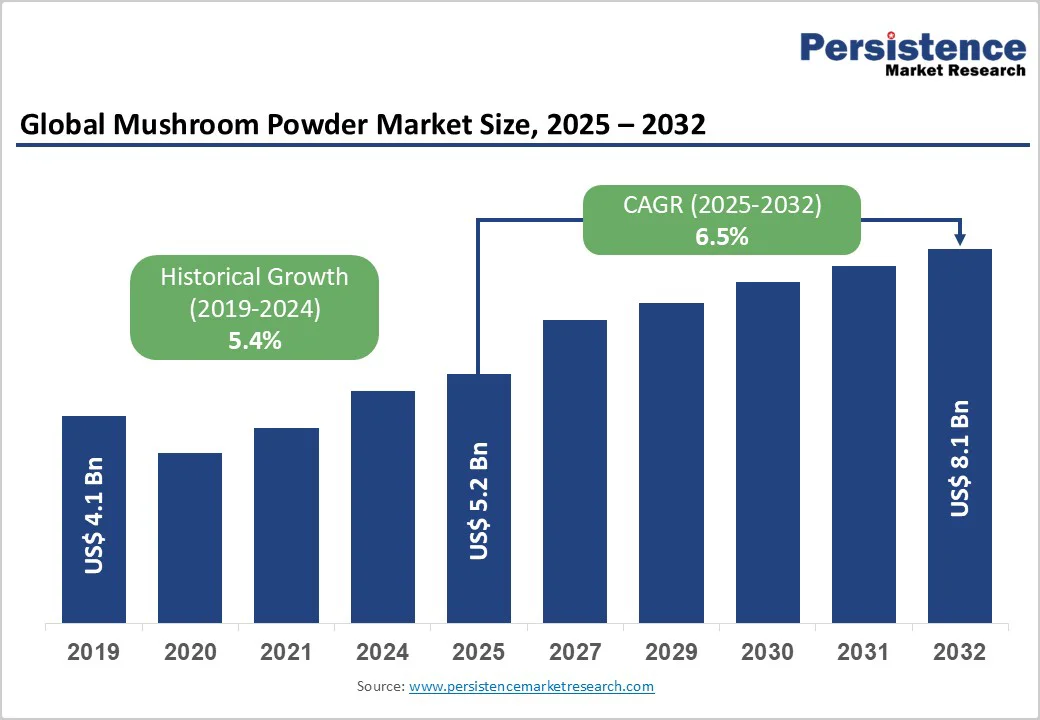
The global mushroom powder market size is likely to be valued at US$5.2 Billion in 2025 and is expected to reach US$8.1 Billion by 2032, growing at a CAGR of 6.5% during 2025 - 2032, driven by rising consumer awareness of natural immune-boosting, cognitive, and adaptogenic ingredients.
Mushroom powders, such as lion’s mane, reishi, shiitake, and cordyceps, are gaining recognition as versatile, bioactive, and supply-chain-friendly ingredients.
Advanced drying, micronization, and extraction technologies now deliver consistent, high-purity powders for beverages, supplements, and topicals.
Key Industry Highlights
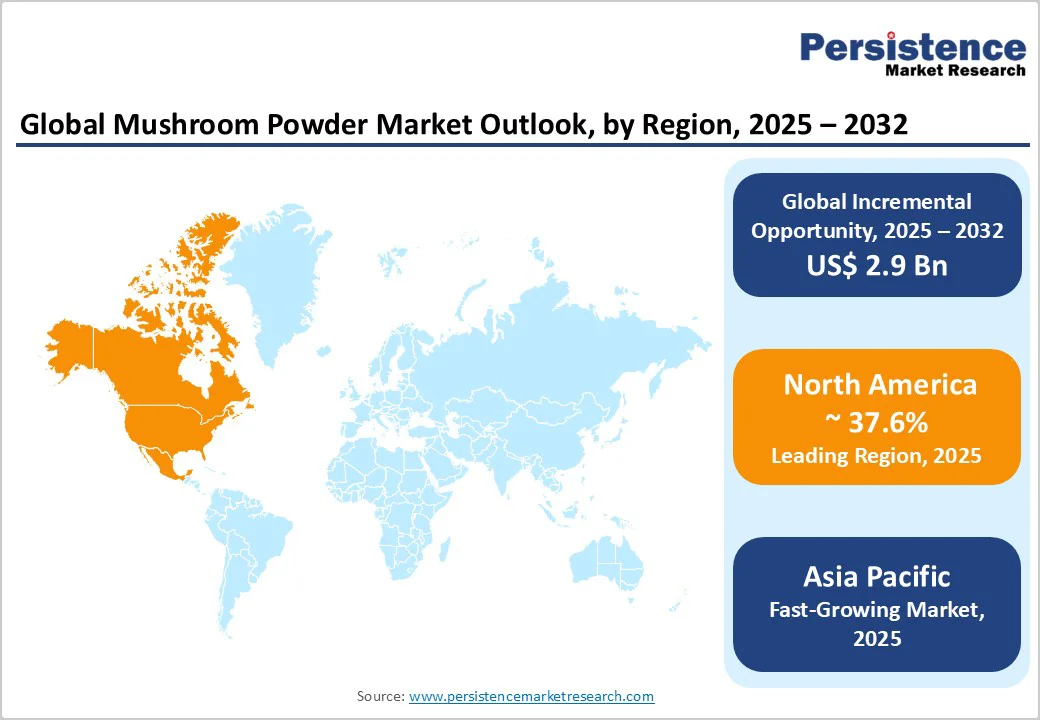
- Leading Region: North America accounts for approximately 37.6% of the market value in 2025, driven by mature retail infrastructure, high supplement consumption, and brand leadership from players such as Om Mushroom and Four Sigmatic.
- Fastest-growing Region: Asia Pacific, supported by strong cultivation bases in China, Japan, and India, expanding export networks, and increasing domestic wellness demand.
- Investment Plans: Ongoing investments in extraction capacity, organic cultivation, and co-manufacturing infrastructure are reshaping supply chains. Between 2023 and 2025, several producers expanded facilities in North America and China to scale standardized extract output by over 25%.
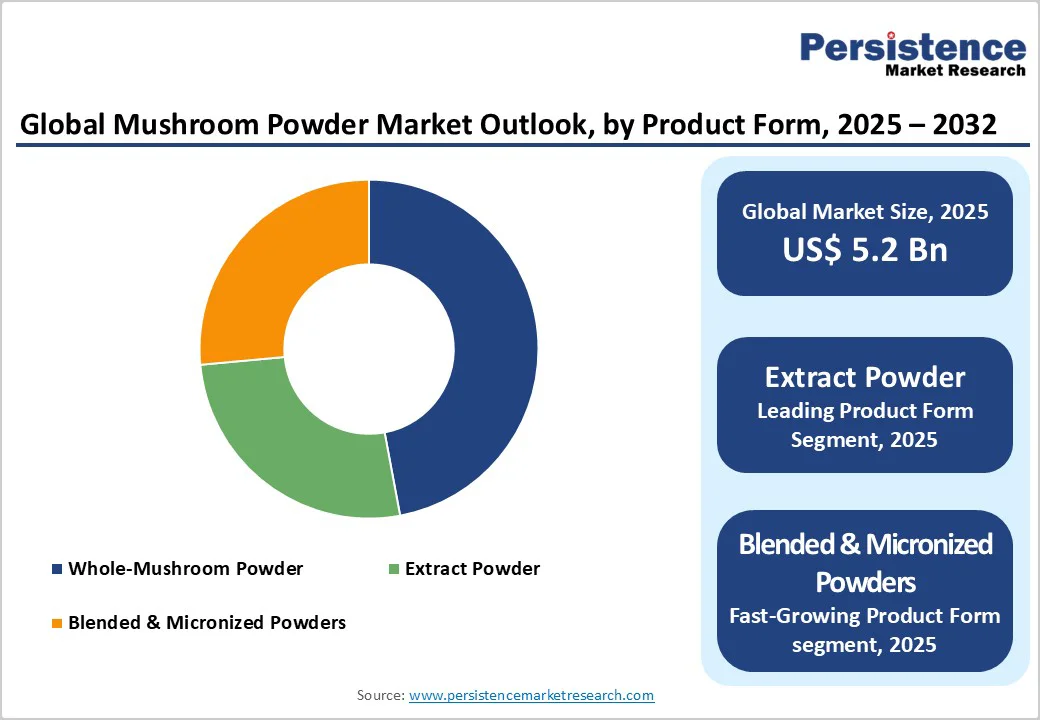
- Dominant Product Form: Extract powders hold nearly 46% of the total market revenue, preferred for their potency, traceability, and suitability for nutraceutical and fortified food formulations.
- Leading Application: Dietary supplements represent about 51.4% of end-user demand, fueled by the popularity of capsules, sachets, and powdered blends offering clinically supported functional benefits.
| Key Insights | Details |
|---|---|
| Mushroom Powder Market Size (2025E) | US$5.2 Bn |
| Market Value Forecast (2032F) | US$8.1 Bn |
| Projected Growth (CAGR 2025 to 2032) | 6.5% |
| Historical Market Growth (CAGR 2019 to 2024) | 5.4% |
Market Factors - Growth, Barriers, and Opportunity Analysis
Rising Demand for Functional Nutrition
A key driver of growth is the global shift toward functional foods and dietary supplements. Consumers increasingly link wellness to everyday consumption, encouraging brands to incorporate mushrooms into coffee, soups, snacks, and other daily products.
Functional formulations targeting cognition, immunity, and vitality, once niche, are now mainstream. Powders from lion’s mane and reishi, valued for neurotrophic and adaptogenic properties, are commonly included in ready-to-mix drinks and wellness blends. Expanding use cases have boosted ingredient consumption and improved margins, establishing mushroom powders as essential in modern functional nutrition.
Supply-chain modernization further accelerates growth. Producers have transitioned from artisanal drying to certified extraction and contract cultivation, ensuring chemical consistency and reduced batch variability. Companies such as Nammex and MycoTechnology demonstrate how vertical integration, from grower partnerships to standardized extraction, builds buyer confidence and unlocks large food and nutraceutical contracts. Third-party potency testing, GMP, and organic certifications have become standard, strengthening sourcing agreements and supporting investment in cultivation infrastructure.
Technological advancements in processing, such as spray-drying, freeze-drying, and fermentation, enhance flavor, solubility, and stability, while advanced extraction isolates bioactive compounds such as beta-glucans and triterpenes. These improvements expand applications across supplements, functional beverages, and personal care, enabling predictable sensory profiles, faster product development, and premium positioning.
Supply and Regulatory Challenges
Despite promising growth, the market faces supply-side vulnerabilities. Mushroom yields fluctuate with climate control costs, substrate quality, and labor availability. Such volatility can translate into 10-25% price swings for certain species in years of supply stress. Producers relying on third-party cultivators are more exposed to cost variation, while vertically integrated players are better positioned to manage procurement risks.
A second structural restraint stems from regulatory fragmentation. Different jurisdictions apply varying standards to labeling, permissible claims, and extract definitions. Stricter claim enforcement, especially for supplements and functional foods, increases compliance complexity.
Companies making health-related statements must invest heavily in analytical validation, safety dossiers, and documentation. This environment can extend product development cycles and impose meaningful compliance costs, particularly on smaller enterprises.
Emerging Opportunities and Growth Pathways
The incorporation of mushroom powders as certified functional ingredients in mainstream food manufacturing presents significant growth potential. Even modest adoption across global processed foods for flavor or wellness benefits could generate incremental demand worth hundreds of millions of dollars annually by 2030. Manufacturers providing technical support, standardized documentation, and ready-to-blend ingredients are well-positioned to capture this opportunity.
Emerging Asian markets offer distinct advantages in species diversity, cultivation expertise, and cost efficiency. Establishing certified processing and extraction facilities in China, India, and Southeast Asia can localize production while meeting global quality standards. Regional hubs can shorten supply chains, reduce landed costs for multinational brands, and open new channels for affordable functional food applications.
The shift from general wellness to clinically substantiated therapeutic applications also drives growth. Precision extracts enriched with specific polysaccharides or beta-glucans are being studied for targeted benefits, such as neuroprotection or metabolic support. Companies investing in controlled trials and peer-reviewed research can access higher-margin segments, elevating mushroom powders from commodity ingredients to validated functional agents.
Category-wise Analysis
Product Form Insights
Extract powders lead the market in value terms. These concentrated preparations deliver measurable bioactive content and consistent performance across batches, making them ideal for nutraceuticals and fortified food applications. Their popularity is reinforced by rising demand for standardized formulations in health products, where potency and traceability are critical.
For example, companies such as Nammex and FreshCap Mushrooms focus on producing high-quality extract powders with verified beta-glucan content, ensuring consistency and compliance with international nutraceutical standards.
Blended powders, which combine multiple mushroom species or integrate complementary botanicals, represent the fastest-growing product segment. Brands designing blends for mushroom coffee, protein mixes, and immunity beverages find these formulations convenient, marketable, and cost-efficient.
The multifunctional appeal of blended powders continues to attract consumers seeking holistic benefits and natural performance enhancement. For instance, Om Mushroom Superfood offers blends featuring reishi, cordyceps, and lion’s mane tailored for energy, focus, or immune health, while Four Sigmatic has popularized mushroom-based coffee alternatives across North American and European markets.
Application Insights
Dietary supplements dominate the market by revenue. Capsules, sachets, and ready-to-mix powders drive significant sales through e-commerce and specialty nutrition channels. Their growth is reinforced by consumer trust in standardized dosing and convenient formats.
Mushroom-based supplements have gained traction in both preventive wellness and therapeutic applications, supported by clean-label positioning. For example, Moon Juice and Nature’s Way have introduced lion’s mane and reishi-based capsules aimed at mental clarity and stress management, reflecting the segment’s diversification.
Food and beverage applications are emerging as one of the fastest-expanding market avenues. Mushroom coffee, plant-based protein bars, and savory seasoning blends are transitioning from niche wellness cafes to mainstream retail spaces.
Brands such as RYZE and MUD/WTR have successfully integrated functional mushroom blends into beverage products targeting energy and focus, bridging the gap between nutrition and lifestyle consumption. As consumer awareness of functional foods deepens, mushroom powders are being incorporated as both flavor enhancers and functional ingredients, enabling food manufacturers to enrich their portfolios with natural, immunity-supportive offerings.
Regional Insights
North America Mushroom Powder Market Trends - Functional Wellness & Retail Expansion Fuel Market Leadership
North America, led by the U.S., remains the largest market for mushroom powders in terms of value and product innovation. The region has witnessed a shift from niche supplement applications to widespread integration across functional foods, beverages, and nutraceutical formulations.
This expansion is underpinned by a mature retail infrastructure, strong e-commerce penetration, and high consumer expenditure on natural wellness products. Supplement aisles in major retail chains and online platforms now feature mushroom-enriched coffee, protein powders, and ready-to-drink beverages, signaling mainstream adoption. Regulatory clarity in the U.S. has also supported market confidence.
The FDA’s established frameworks for dietary supplements and food labeling ensure compliance pathways for mushroom-based ingredients, while GMP certification and transparent sourcing are increasingly becoming baseline requirements. Companies operating under vertically integrated models, controlling cultivation, extraction, and packaging, are securing a competitive edge through traceability and quality assurance.
Recent developments underscore the region’s growth trajectory. In March 2025, Om Mushroom Superfood introduced a new line of organic mushroom protein powders formulated with pea and brown rice protein, targeting fitness-conscious consumers. In June 2024, MycoTechnology completed a facility expansion in Colorado to scale up fermentation-based mushroom ingredient production.
Europe Mushroom Powder Market Trends - Science-Backed Innovation & Sustainability Define Market Growth
Europe represents a mature yet steadily expanding market for mushroom powders, distinguished by its focus on safety, sustainability, and scientific validation. Key countries, Germany, the U.K., France, and Spain, are driving demand through consumer interest in adaptogenic and immune-supporting ingredients.
European consumers are notably more discerning, favoring quality certifications, proven efficacy, and environmental responsibility. As a result, mushroom powders are finding applications not only in dietary supplements and functional foods but also in cosmeceuticals, where bioactive ingredients are valued for their antioxidant and anti-aging properties.
The integration of mushroom ingredients into beauty and wellness categories has been a defining trend. For example, in April 2025, a UK-based wellness brand introduced a lion’s mane-infused collagen drink marketed for cognitive and skin health, combining adaptogenic and nutritional claims within permissible limits.
In January 2024, French nutraceutical companies expanded their portfolios to include reishi and cordyceps blends targeting stress resilience and energy enhancement.
Germany’s expanding network of organic certification programs and sustainable farming cooperatives is enhancing local supply chains for high-quality mushroom ingredients. Investment in traceability technologies and clean-label innovations continues to rise across Europe. For instance, several Scandinavian firms are developing digital verification systems to track mushroom sourcing from cultivation to final packaging.
Asia Pacific Mushroom Powder Market Trends -Traditional Expertise & Industrial Scale Drive Global Dominance
The Asia Pacific region stands as the largest production base and the fastest-growing market for mushroom powders, combining traditional cultivation expertise with expanding industrial capabilities. Countries such as China, Japan, India, and South Korea, along with emerging ASEAN markets, are driving both supply and demand growth.
The region’s longstanding association with medicinal mushrooms, such as reishi (Ganoderma lucidum), cordyceps, and shiitake, underpins its global leadership in production and export.
China dominates cultivation and processing, supported by large-scale integrated mushroom parks and export-oriented facilities. Several provinces, including Fujian and Zhejiang, have established dedicated industrial zones for mushroom extraction and drying technologies. In February 2025, a major Chinese manufacturer announced a new processing plant for organic reishi and maitake powders, aiming to double its export volume by 2026.
Japan, with its deep-rooted functional food culture, continues to integrate mushroom powders into beverages, soups, and health tonics. Notably, Japanese beverage manufacturers introduced mushroom-infused teas and tonics in 2024, emphasizing traditional health benefits aligned with modern wellness trends. Manufacturers are increasingly adopting Good Manufacturing Practices (GMP), ISO standards, and organic labeling to gain access to Western markets.
Competitive Landscape
The global mushroom powder market is moderately fragmented, with three tiers: large B2B ingredient processors, mid-sized consumer-focused brands, and regional suppliers of culinary powders. Ingredient houses are increasingly vertically integrating cultivation, extraction, and distribution to capture value and reduce reliance on intermediaries.
Strategic developments include consumer brands expanding into ready-to-drink beverages and hybrid functional snacks. Ingredient specialists are scaling fermentation and extraction capacities and securing long-term supply agreements with global manufacturers.
Market leaders pursue innovation through blended and convenient formats, integration for consistent quality and supply, and validation via testing and documentation, with some exploring co-branded or private-label programs.
Key Industry Developments
- In April 2025, singer-entrepreneur Ellie Goulding co-founded a wellness brand called Everystate that launched a powdered “functional mushrooms” pouch subscription (200 g per month for £36) with retail placement in select outlets such as Daylesford Organic.
- In February 2025, Om Mushroom Superfood introduced a new range of organic mushroom powder blends targeting immunity and cognitive health, expanding its footprint across major U.S. retail chains.
Companies Covered in Mushroom Powder Market
- Nammex
- Om Mushroom Superfood
- Four Sigmatic
- MycoTechnology Inc.
- GanoHerb Group
- Real Mushrooms
- FreshCap Mushrooms Ltd.
- Hokkaido Reishi Co. Ltd.
- Mushroom Wisdom Inc.
- Aloha Medicinals Inc.
- Half Hill Farm
- BioFinest
- Naturealm
- Laird Superfood
- Fungi Perfecti LLC
- Oriveda BV
- Chaga Mountain Inc.
- Mitoku Co. Ltd.
- Nature’s Way Products LLC
- Bristol Botanicals Ltd.
Frequently Asked Questions
The mushroom powder market is valued at US$5.2 Billion in 2025.
By 2032, the mushroom powder market is expected to reach US$8.1 Billion.
Key trends include the rise of multifunctional blends, growth in adaptogenic formulations, clean-label sourcing, and integration of mushroom powders into everyday food and drink products such as coffee, protein bars, and smoothies.
Extract powders hold the leading market share due to their standardized potency, clinical credibility, and consistent quality, making them the preferred choice for nutraceutical and functional food manufacturers.
The mushroom powder market is projected to grow at a CAGR of 6.5% between 2025 and 2032.
Major companies include Om Mushroom Superfood, Four Sigmatic, Nammex, MycoTechnology Inc., and GanoHerb Group.


