




- Food Ingredients & Additives
- Fluid Lecithin Market
Fluid Lecithin Market Size, Share, and Growth Forecast, 2026 - 2033
Fluid Lecithin Market by Source Type (Soybean Lecithin, Sunflower Lecithin, Rapeseed Lecithin, Egg Yolk Lecithin, Corn Lecithin), Application (Food Industry, Pharmaceuticals, Cosmetics and Personal Care, Animal Feed), and Regional Analysis for 2026 - 2033

Fluid Lecithin Market Size and Trends Analysis
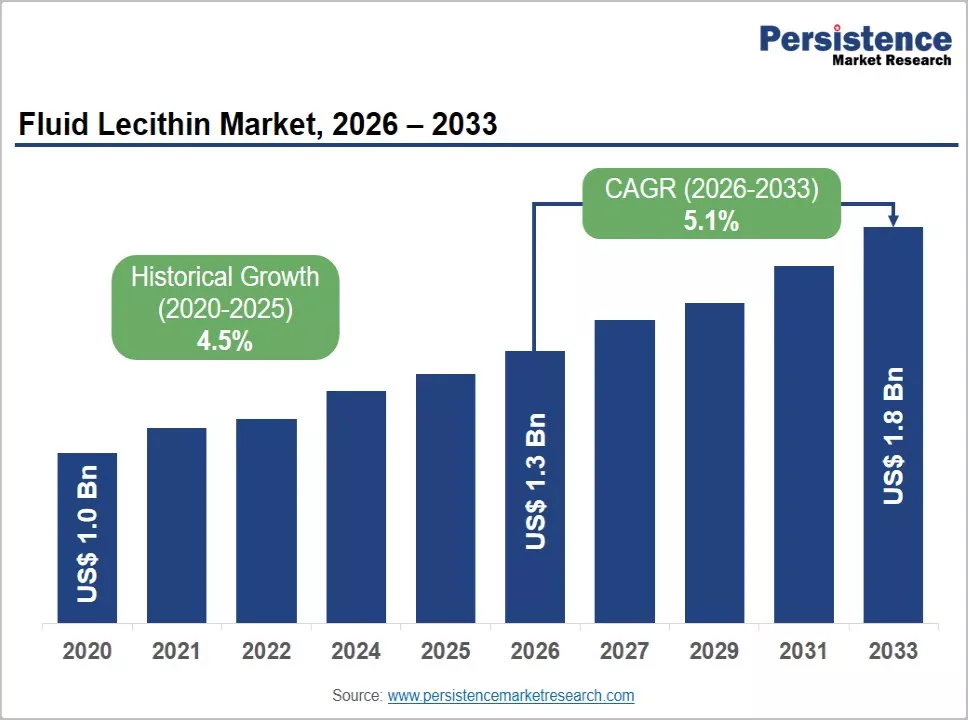
The global fluid lecithin market size is likely to be valued at US$1.3 billion in 2026 and is expected to reach US$1.8 billion by 2033, growing at a CAGR of 5.1% during the forecast period from 2026 to 2033, driven by growing use of natural phospholipid-based emulsifiers across food, pharmaceutical, cosmetics, and animal-feed formulations.
Demand is strengthened by clean-label, plant-based, and non-GMO ingredient preferences, particularly for sunflower and rapeseed lecithin. In February 2026, the FDA issued a “no questions” letter for a sunflower lecithin GRAS notice intended for use as an emulsifier, surfactant, and dispersing agent.
Key Industry Highlights:
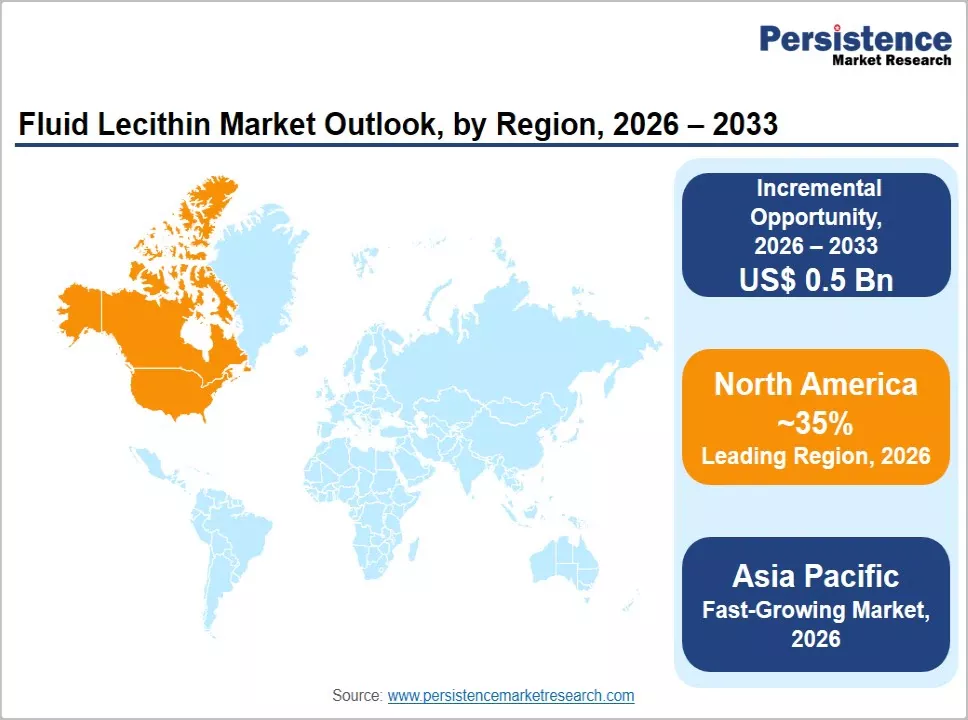
- Leading Region: North America is anticipated to be the leading region, accounting for a market share of 35% in 2026, driven by established food processing, pharmaceutical manufacturing, clean-label demand, and strong adoption of non-GMO and organic fluid lecithin grades.
- Fastest-growing Region: Asia Pacific is likely to be the fastest-growing region, supported by expanding food processing, animal feed, aquaculture, and pharmaceutical applications.
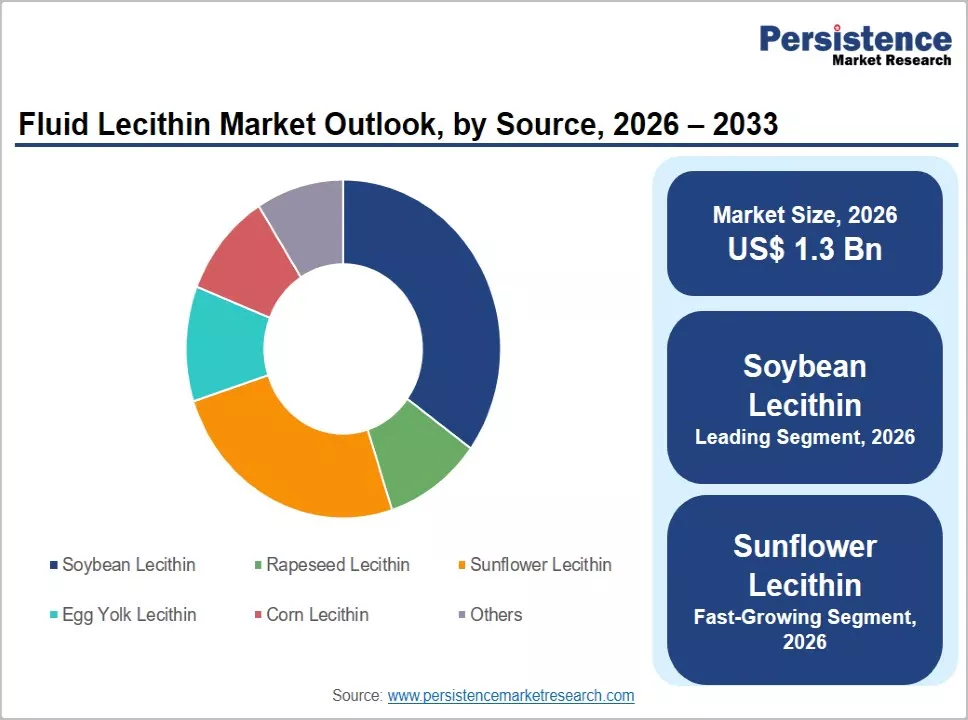
- Leading Source Type: Soybean is projected to represent the leading source type in 2026, accounting for 60% of the revenue share, due to abundant availability, established processing infrastructure, cost efficiency, and broad use across food, feed, and industrial applications.
- Leading Application: The food industry is anticipated to be the leading application, accounting for over 45% of the revenue share in 2026, supported by extensive use of fluid lecithin in bakery, confectionery, margarine, dairy alternatives, and processed foods.
- Key Opportunity: Growing demand for specialty and plant-based fluid lecithin, particularly non-GMO sunflower, modified, and application-specific grades, across food, nutraceutical, pharmaceutical, animal feed, and personal-care applications creates significant opportunities for product innovation and premium-value expansion.
DRO Analysis
Driver - Rising Demand for Clean-Label and Natural Emulsifiers in Food Processing
Clean-label food formulation is a major driver for the fluid lecithin market as manufacturers seek recognizable, naturally derived ingredients that support emulsification, dispersion, and texture. Fluid lecithin is widely used in bakery products, confectionery, chocolate, margarine, dressings, and dairy alternatives because it can improve processing performance while reducing formulation complexity.
Demand is also supported by growing interest in minimally processed and plant-derived ingredients, particularly soybean and sunflower lecithin. Food producers increasingly prioritize ingredient functionality alongside consumer expectations for simpler labels. This trend encourages lecithin suppliers to develop traceable, non-GMO, organic, and identity-preserved grades for mainstream and premium food applications worldwide.
The expansion of plant-based foods strengthens demand for fluid lecithin as manufacturers require effective emulsifiers for formulations containing vegetable oils, proteins, and alternative dairy ingredients. Lecithin helps maintain uniformity, improve mouthfeel, control viscosity, and support stable processing across diverse recipes. Its compatibility with chocolate, bakery fats, nutritional beverages, and convenience foods creates broad application potential.
Restraint - Regulatory and Allergen Documentation Requirements
Lecithin sourced from soybeans or other allergen-associated materials may require careful labeling, traceability, and documentation depending on the destination market and application. Producers must maintain specifications covering source, purity, processing methods, contaminants, and applicable food safety requirements. These obligations can lengthen approval procedures and increase administrative costs, particularly for suppliers serving multiple countries.
Compliance complexity also becomes more significant when fluid lecithin is supplied for pharmaceutical, infant nutrition, cosmetics, or specialized food applications, where customers may demand detailed certificates, allergen statements, and batch-level traceability. Variations in regulatory expectations between regions can require customized documentation and product specifications, complicating international distribution. Soy-derived lecithin may also face customer restrictions where allergen avoidance or non-GMO requirements are important. Suppliers therefore need robust quality control, traceable sourcing, and consistent testing procedures.
Opportunity - Non-GMO and Sunflower/Rapeseed Grade Expansion
Expansion of non-GMO and sunflower or rapeseed fluid lecithin grades presents an important opportunity for suppliers to capture premium consumer demand in clean-label markets. Sunflower lecithin is attractive as it is naturally non-GMO and avoids the allergen concerns associated with soy, making it suitable for specialty foods, nutritional products, and formulations targeting ingredient-conscious food consumers.
Rapeseed lecithin also offers diversification beyond soybean-based supply and can benefit from established oilseed processing networks, particularly in Europe. Developing consistent liquid grades with reliable functionality, traceability, and suitable certifications can help manufacturers serve customers seeking plant-based emulsifiers while reducing dependence on conventional soybean lecithin.
The opportunity extends into pharmaceutical, cosmetics, sports nutrition, and premium food formulations where customers increasingly value source transparency and differentiated ingredient profiles. Suppliers can strengthen competitiveness by expanding sunflower and rapeseed processing capacity, improving purification, and offering organic or identity-preserved grades. Regional production can also reduce supply-chain complexity and improve responsiveness to customers requiring specific sourcing requirements.
Category-wise Analysis
Source Type Insights
Soybean lecithin is expected to lead, accounting for 60% of revenue in 2026, due to extensive soybean availability, mature oilseed-crushing infrastructure, competitive production economics, and established use across food, feed, and industrial formulations. Its strong emulsification, dispersion, and wetting properties make it suitable for chocolate, bakery products, margarine, dressings, and nutritional formulations. ADM offers lecithin derived from soybean sources for food and nutrition applications.
Sunflower lecithin is likely to represent the fastest-growing segment, supported by rising preference for non-GMO, allergen-conscious, and clean-label ingredients. It provides effective emulsification and dispersion while offering manufacturers an alternative to conventional soybean lecithin. Growing adoption in chocolate, bakery, sports nutrition, dietary supplements, and plant-based foods is expanding its application base.
Application Insights
The food industry is projected to lead the market, capturing around 45% of the revenue share in 2026, supported by extensive fluid lecithin consumption in chocolate, bakery, confectionery, margarine, dressings, processed foods, and dairy alternatives. Lecithin functions primarily as an emulsifier, dispersing agent, release aid, and texture-supporting ingredient, helping manufacturers improve processing efficiency and formulation stability. Growing clean-label positioning and demand for plant-derived ingredients further support its use across mainstream and specialty food products.
The pharmaceuticals segment is likely to be the fastest-growing application due to increasing utilization of high-purity phospholipids in lipid-based formulations, soft-gel products, nutritional preparations, and advanced drug-delivery systems. Fluid lecithin provides emulsifying and dispersing functionality while serving as a source of phospholipids for specialized formulations. Increasing interest in lipid-based delivery technologies and higher-quality excipients is encouraging pharmaceutical manufacturers to evaluate lecithin-based ingredients with consistent purity and traceability.
Regional Insights
North America Fluid Lecithin Market Trends
North America is anticipated to be the leading region, accounting for a market share of 35% in 2026, supported by strong demand from bakery, confectionery, beverages, dietary supplements, and processed foods, where fluid lecithin provides emulsification, wetting, dispersibility, and release functionality. Demand is also benefiting from interest in plant-based, non-GMO, and clean-label emulsifiers, particularly sunflower and canola-based alternatives.
U.S. Fluid Lecithin Market Trends
The U.S. is expected to dominate the regional market, accounting for approximately 80% of the market share in 2026, driven by its large processed-food, bakery, confectionery, and dietary-supplement industries. Lecithin is widely used as an emulsifier, dispersing agent, humectant, release agent, and texturizer in food formulations. The FDA recognizes lecithin for multiple technical functions in foods, supporting continued formulation use. Clean-label and plant-derived emulsifiers are encouraging manufacturers to evaluate soy, sunflower, and canola lecithins.
Canada Fluid Lecithin Market Trends
Canada is likely to be a significant market for fluid lecithin, holding approximately 20% of the market share in 2026, supported by demand from bakery, dairy, confectionery, processed foods, and nutritional products. Health Canada permits lecithin as an emulsifying, stabilizing, and thickening agent across several food categories. Its permitted uses include bread, chocolate and cocoa products, dairy products, margarine, and other foods. This regulatory acceptance supports continued use of lecithin in commercial food formulations.
Europe Fluid Lecithin Market Trends
Europe is likely to be a significant market for fluid lecithin in 2026, due to demand for clean-label, non-GMO, allergen-conscious, and sustainably sourced emulsifiers. Food manufacturers are using fluid lecithin across chocolate, bakery, spreads, dairy alternatives, dietary products, and animal nutrition, while specialty grades are gaining importance for improved functionality.
U.K. Fluid Lecithin Market Trends
The U.K. is likely to be a significant market for fluid lecithin, accounting for 15% of Europe market share in 2026, supported by its large bakery, confectionery, processed-food, supplement, and plant-based food sectors. Lecithins are particularly relevant where manufacturers require natural emulsification and improved processing performance. Demand is also being supported by interest in clean-label and plant-derived ingredients. Soybean remains an important source, while sunflower and rapeseed alternatives can address non-GMO and allergen-management requirements.
Germany Fluid Lecithin Market Trends
Germany is anticipated to dominate the regional market, accounting for around 37% of the Europe market share in 2026, due to its established food-processing, confectionery, bakery, pharmaceutical, and animal-feed industries. Fluid lecithin is valued for improving emulsification, stabilization, texture, and processing performance. Demand is increasingly influenced by clean-label formulations and interest in natural alternatives to synthetic emulsifiers. Sunflower and rapeseed lecithins are gaining relevance alongside conventional soybean lecithin.
Asia Pacific Fluid Lecithin Market Trends
The Asia Pacific region is likely to be the fastest-growing region, driven by its expanding food processing, bakery, confectionery, animal feed, nutraceutical, and pharmaceutical industries. The region benefits from substantial soybean-processing capacity and growing demand for functional, low-viscosity, modified, and specialty lecithins. Increasing adoption of lecithin in animal nutrition is creating an additional growth avenue beyond food applications.
China Fluid Lecithin Market Trends
China is estimated to account for around 30% of the regional market in 2026, supported by its large food-processing, soybean-processing, livestock, poultry, and aquaculture industries. Soy lecithin remains widely used due to its availability, cost efficiency, and well-established supply chain. Demand is also expanding beyond conventional food emulsification toward specialty animal nutrition applications. Manufacturers are developing enzymatically treated and low-viscosity lecithin products to enhance nutrient absorption and enable direct blending into animal feed.
India Fluid Lecithin Market Trends
India is expected to emerge as a significant market, accounting for approximately a 22% share in 2026, due to its soybean-processing base and expanding food, bakery, confectionery, pharmaceutical, nutraceutical, and animal-feed industries. Soy lecithin remains the principal source because India has substantial domestic soybean availability and established oil-crushing infrastructure. Sunflower lecithin is gaining attention as manufacturers seek non-GMO and alternative plant-based emulsifiers.
Competitive Landscape
The global fluid lecithin market exhibits a moderately fragmented structure, driven by the presence of integrated agribusiness companies, specialized lecithin manufacturers, and ingredient suppliers competing across food, feed, nutraceutical, pharmaceutical, and personal care applications.
With key leaders, including Cargill, ADM, Bunge, Lipoid, and Louis Dreyfus Company, large suppliers benefit from integrated oilseed-processing networks and broad geographic distribution. These players compete through portfolio expansion, customized formulations, sustainable sourcing, specialty grades, application-specific functionality, and strategic acquisitions.
Key Industry Developments:
- In May 2025, Louis Dreyfus Company (LDC) inaugurated a new automated specialty feed lecithin production line in Tianjin, China, producing enzymatically treated and low-viscosity lecithin for animal-feed applications. The facility operates using 100% renewable electricity and reflects growing demand for higher-functionality lecithin.
Companies Covered in Fluid Lecithin Market
- Renova
- Jiusan Group
- Cargill
- Louis Dreyfus
- China Grain Reserves
- Shandong Bohi
- Danisco
- ADM
- COFCO Corporation
- Bunge
- Anqing ZhongChuang
- Wilmar International
- Aceitera General Deheza
- Herun Group
- Lipoid GmbH
Frequently Asked Questions
The global fluid lecithin market is projected to reach US$1.3 billion in 2026.
Rising demand for clean-label, plant-based emulsifiers across food, bakery, confectionery, nutraceutical, and animal-feed applications.
The fluid lecithin market is expected to grow at a CAGR of 5.1% from 2026 to 2033.
Growing demand for sunflower, non-GMO, specialty, and application-specific fluid lecithin products offering improved emulsification and functionality.
Renova, Jiusan Group, Cargill, Louis Dreyfus, China Grain Reserves, Shandong Bohi, and Danisco are the leading players.


