




- HVAC
- Portable Fluid Chiller Market
Portable Fluid Chiller Market Size, Share, and Growth Forecast, 2026 - 2033
Portable Fluid Chiller Market By Product Type (Water Cooled, Air Cooled, Portable, Split Systems), Application (Oil & Gas, Power Generation, Paper Industry, Automotive Industry, Steel Industry, Plastic Injection & Molding, Others), and Regional Analysis for 2026 - 2033

Portable Fluid Chiller Market Size and Trends Analysis
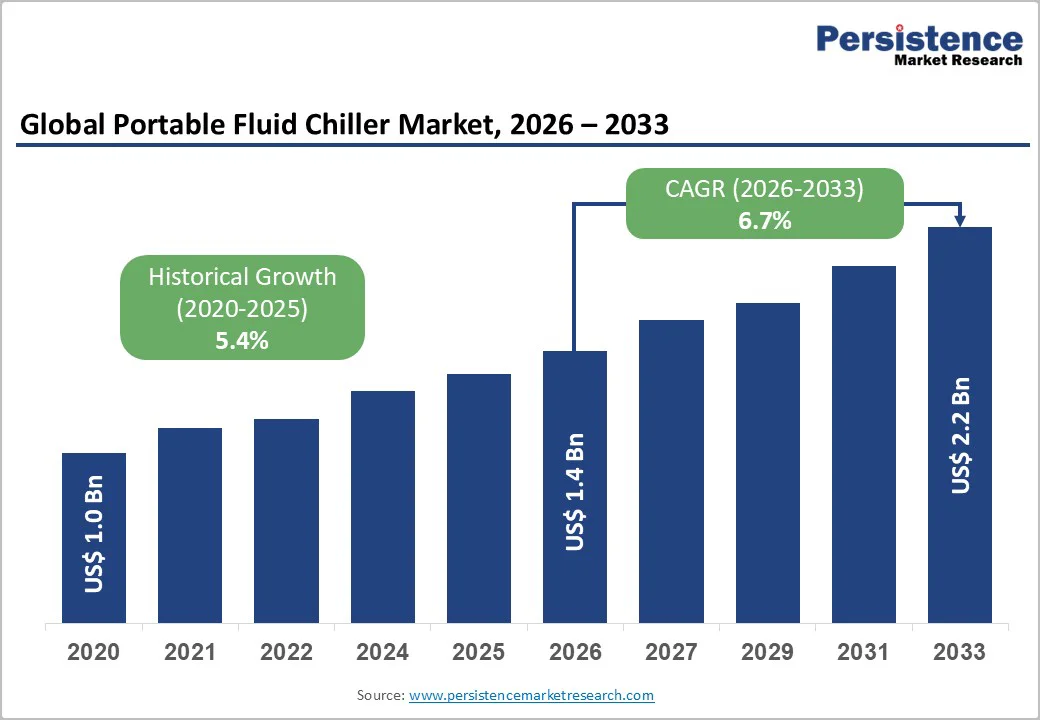
The global portable fluid chiller market size is likely to be valued at US$1.4 billion in 2026, is expected to reach US$2.2 billion by 2033, growing at a CAGR of 6.7% during the forecast period from 2026 to 2033, driven by the increasing prevalence of precision cooling in industrial processes, rising demand for mobile temperature control in oil & gas, and advancements in compact refrigeration technologies.
The demand for reliable on-site cooling in automotive, plastic molding, and power generation is driving the adoption of portable fluid chillers. Market growth is fueled by energy-efficient air- and water-cooled systems, which and easy to deploy, making them essential for uninterrupted operations.
Key Industry Highlights:
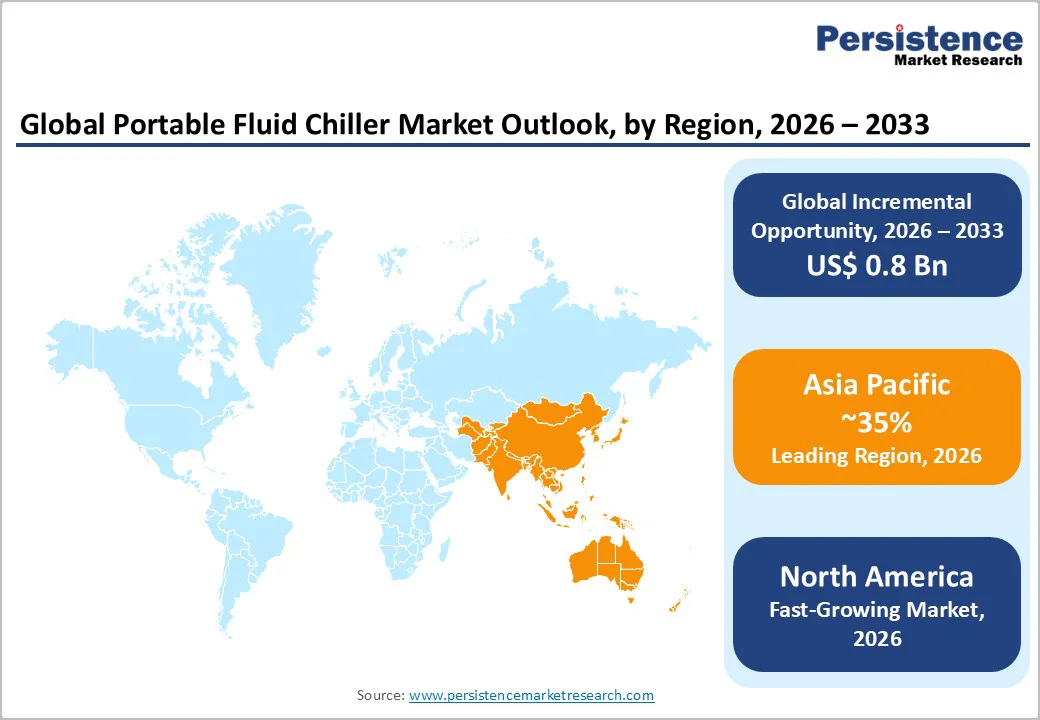
- Leading Region: Asia Pacific, to command a 35% market share in 2026, driven by rapid industrialization, high prevalence of automotive manufacturing, and strong infrastructure activities in China.
- Fastest-growing Region: North America, fueled by increasing shale oil extraction, rising awareness of precision cooling, and growing investments in plastic processing in the U.S.
- Dominant Product Type: Air-cooled, to hold approximately 50% of the market share, driven by their easy installation, low maintenance needs, and independence from water infrastructure, making them well-suited for a wide range of industrial environments.
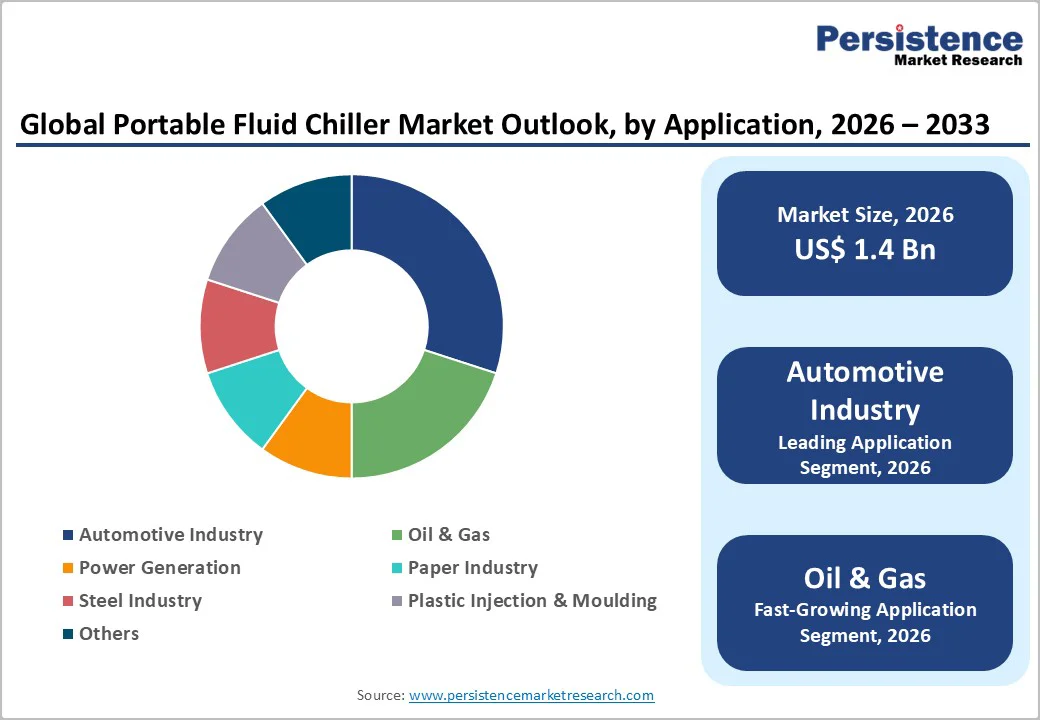
- Leading Application: The automotive industry segment, to account for over 30% of market revenue in 2026, as fluid chillers are essential for engine, battery, and component testing, ensuring precise temperature control during manufacturing.
| Key Insights | Details |
|---|---|
|
Portable Fluid Chiller Market Size (2026E) |
US$1.4 Bn |
|
Market Value Forecast (2033F) |
US$2.2 Bn |
|
Projected Growth (CAGR 2026 to 2033) |
6.7% |
|
Historical Market Growth (CAGR 2020 to 2025) |
5.4% |
Market Factors - Growth, Barriers, and Opportunity Analysis
Rising Prevalence of Precision Cooling In Industrial Processes and Demand for Mobile Temperature Control
The rising prevalence of precision cooling in industrial processes and the growing demand for mold temperature control have become major drivers of the portable fluid chiller market. As industries increasingly rely on high-performance equipment, robotics, automated systems, and advanced manufacturing tools, maintaining strict temperature ranges has become essential for operational stability and product quality. Precision cooling ensures consistent thermal management for sensitive applications such as turbine systems, medical devices, semiconductor fabrication, and automotive test benches. Any deviation in temperature can lead to equipment damage, production inefficiency, or compromised output, making portable chillers indispensable across these environments.
Industries are shifting toward mobile and flexible cooling solutions to support decentralized operations, remote worksites, and temporary installations. Oil & gas rigs, field laboratories, mobile power units, and construction sites rely on portable chillers to deliver reliable temperature control without permanent infrastructure. The mobility, ease of deployment, and compact footprint of portable systems allow companies to respond quickly to changing operational needs. This growing preference for flexible cooling also aligns with the expansion of renewable energy projects and distributed industrial setups.
High Development and Maintenance Costs
High development and maintenance costs remain a significant constraint in the portable fluid chiller market, limiting adoption, especially among small and mid-sized industries. Developing advanced chillers with energy-efficient components, IoT integration, durable materials, and precision cooling technologies requires substantial investment in R&D, engineering expertise, and testing. Manufacturers must also comply with stringent safety, performance, and environmental regulations, adding to certification and development expenses. These high upfront costs often translate into elevated product prices, slowing penetration in cost-sensitive sectors and emerging markets.
Maintenance costs further intensify the challenge. Portable chillers operate in demanding environments such as oil fields, power plants, and automotive testing facilities, where continuous exposure to vibration, dust, pressure fluctuations, and thermal stress accelerates wear. Regular servicing of pumps, compressors, sensors, refrigerant lines, and control systems becomes essential to ensure reliable performance. While beneficial, advanced digital features require specialized technicians and software updates, adding complexity and expense. Unexpected breakdowns lead to high repair costs and operational downtime, discouraging long-term use among budget-constrained end-users.
Emerging Innovations in Energy-Efficient and IoT-enabled Chillers
Emerging innovations in energy-efficient and IoT-enabled chillers are transforming the portable fluid chiller market by delivering smarter, cleaner, and more adaptive cooling solutions across industries. Manufacturers are increasingly integrating variable-speed compressors, intelligent load-adjustment algorithms, and advanced refrigerants to reduce energy consumption while maintaining stable thermal performance significantly. These technologies enable chillers to automatically optimize power usage based on real-time operational needs, lowering operational costs and supporting global sustainability targets.
IoT connectivity is further reshaping system functionality by allowing remote monitoring, predictive maintenance, and seamless integration with industrial automation platforms. Sensors continuously collect data on temperature, flow rates, vibration, and pressure, enabling early identification of performance deviations before they lead to equipment failure. This enhances system reliability and reduces downtime, a key advantage for industries such as power generation, automotive testing, and oil & gas operations. Cloud-based dashboards, mobile applications, and AI-driven analytics provide users with actionable insights, making maintenance more strategic and less reactive. Modular and compact chiller designs are emerging to support flexible deployment in remote or dynamic environments.
Category-wise Analysis
Product Type Insights
The automotive industry is anticipated to lead the market, holding approximately 30% of the market share in 2026, driven by its heavy reliance on fluid chillers for engine testing, component validation, and thermal management in manufacturing plants. Their widespread use in battery cooling, durability testing, and precision machining boosts demand. As EV production accelerates, the need for reliable temperature-control solutions continues to rise. For example, EV manufacturers such as Tesla and Nissan use industrial chillers to maintain optimal battery temperatures during testing, simulating extreme driving conditions and ensuring battery longevity and safety before mass production.
Oil & gas is the fastest-growing segment, driven by rising rig activity and expanding drilling operations that require reliable heat-removal systems. Rugged, portable chillers are preferred for their ability to withstand harsh environments and ensure continuous equipment cooling. Their convenience, mobility, and performance under extreme conditions accelerate adoption across upstream and midstream applications. For example, drilling companies operating in offshore rigs and desert oil fields use portable chillers to cool hydraulic systems and compressors, preventing equipment overheating and minimizing downtime under extreme environmental conditions.
Application Insights
Air-cooled is projected to dominate the market, accounting for approximately 50% of market share in 2026. Its dominance is driven by no water required, ease of setup, and versatility, making it preferred for automotive applications. Air-cooled chillers provide ambient heat rejection, ensuring reliable performance. For example, companies such as Mokon supply air-cooled chillers for automotive testing facilities, where they maintain precise temperature control for engines and components, offering simplicity, reliability, and reduced operational costs.
Portable is likely to be the fastest-growing segment, driven by rising mobility needs and expanding use in oil & gas operations. Its easy transportability makes it ideal for remote and shifting project sites. Advances in compact, high-capacity designs further accelerated adoption across North America and the Middle East, where field operations and temporary setups require flexible, reliable cooling solutions. For example, oilfield operators use portable chillers to cool hydraulic systems and compressors on offshore rigs or in deserts, ensuring continuous operation and preventing equipment overheating during critical field activities.
Regional Insights
North America Portable Fluid Chiller Market Trends
North America is projected to account for 30% of the market share in 2026, influenced by strong industrial activity, technological adoption, and a growing focus on operational efficiency across sectors. The U.S. and Canada saw rising demand for portable chillers in manufacturing, laboratories, food processing, medical facilities, plastics production, and automotive component manufacturing. These industries increasingly require precise and stable cooling solutions to maintain product quality, ensure equipment longevity, and support high-throughput operations. The region’s well-established industrial infrastructure enabled rapid integration of advanced temperature-control systems, contributing to consistent market growth.
A major trend shaping the market was the shift toward energy-efficient and environmentally compliant cooling technologies. Companies favored portable chillers equipped with high-efficiency compressors, optimized refrigerant cycles, and improved heat-exchange components to reduce operating costs and meet sustainability goals. Digital controls, smart diagnostics, and remote monitoring became standard expectations, driven by North America’s emphasis on automation and real-time performance tracking.
Europe Portable Fluid Chiller Market Trends
Europe is estimated to 25% of the share in 2026, driven by steady industrial modernization, strong regulatory frameworks, and the region’s shift toward high-efficiency cooling technologies. Manufacturing hubs across Germany, Italy, France, and the U.K. increasingly adopted portable chillers to support precision-critical processes in automotive, pharmaceuticals, food processing, metalworking, and plastics operations. Growth has also been driven by facility upgrades, where portable systems offered a flexible and cost-efficient alternative to large centralized chillers, especially for short-term projects, testing environments, and production scaling.
Europe’s emphasis on environmental sustainability played a major role in market trends. Companies sought chillers that complied with stringent EU guidelines on refrigerants, emissions, and energy consumption. This encouraged the integration of advanced heat-exchange systems, eco-friendly refrigerants, and high-efficiency compressors designed to reduce energy use while maintaining precise temperature control.
Digitalization accelerated adoption as industries increasingly implemented chillers with advanced controllers, automated alarms, and improved monitoring capabilities. The rise in smart manufacturing and Industry 4.0 practices further boosted demand for systems offering reliability, low maintenance, and remote operability.
Asia Pacific Portable Fluid Chiller Market Trends
Asia Pacific is dominating, projected to account for 35% of the market in 2026, driven by rapid industrialization, expanding manufacturing capacity, and rising demand for precision cooling across multiple sectors. Countries such as China, India, South Korea, and Southeast Asian nations have significantly increased investment in automotive production, electronics manufacturing, plastics processing, and metalworking, all of which require reliable temperature-control systems. This has elevated the need for portable chillers that offer flexibility, mobility, and energy-efficient operation.
Growing infrastructure development and the expansion of small and mid-scale industrial facilities also supported adoption, as portable chillers provided a cost-effective alternative to fixed cooling systems. The region saw a shift toward higher-efficiency units, driven by rising electricity costs and government emphasis on sustainable industrial practices. Manufacturers introduced systems with improved refrigerant management, advanced compressors, and lower operating footprints to meet these expectations. Technological advancements such as digital temperature controllers, automated diagnostics, and remote monitoring further enhanced system performance and reliability.
Competitive Landscape
The global portable fluid chiller market features competition among established engineering leaders and specialized manufacturers. In North America and Europe, Fluid Chillers and Thermonics lead with strong R&D, extensive distribution, and advanced precision cooling products. In Asia Pacific, rapid industrial growth drives demand for localized, energy-efficient chillers. Regional players focus on manufacturing, plastics, and automotive sectors, innovating with IoT-enabled chillers offering smart monitoring, predictive maintenance, and remote diagnostics.
Partnerships and acquisitions expand production, geography, and aftermarket services. Sustainability advances include eco-friendly refrigerants, high-efficiency compressors, and low-carbon designs.
Key Industry Developments
- In February 2025, Star Refrigeration launched the Azanechiller 3.0. This low-charge ammonia, air-cooled industrial chiller is highly efficient, exceeding EcoDesign regulations by up to 110%, and is designed for robust industrial refrigeration across a wide temperature range.
- In November 2025, MHI Thermal Systems introduced the ETI-N series of magnetic bearing centrifugal chillers in Japan. The oil-free design eliminates the need for a lubrication system, significantly reducing maintenance and enabling quick startup.
Companies Covered in Portable Fluid Chiller Market
- Fluid Chillers
- Thermonics
- Advantage Engineering
- Koolance
- Mokon
- Bemco
- Cooling Technology
- Berg Chilling Systems
- G&D Chillers
- BV Thermal Systems
Frequently Asked Questions
The global portable fluid chiller market is projected to reach US$1.4 billion in 2026.
The rising prevalence of precision cooling in industrial processes and demand for mobile temperature control are key drivers.
The portable fluid chiller market is poised to witness a CAGR of 6.7% from 2026 to 2033.
Advancements in energy-efficient and IoT-enabled chillers are key opportunities.
Fluid Chillers, Thermonics, Advantage Engineering, Koolance, and Mokon are the key players.


