




- Hardware & Software IT Services
- Digital Education Market
Digital Education Market Size, Share, and Growth Forecast 2026 - 2033
Digital Education Market by Learning Type (Self-paced Online Education, Instructor Led Online Education), by Course Type (Science & Technology Courses, Entrepreneurship & Business Management Courses, Other Courses), End-user (Academic Institutions, Individual Learners, Enterprises), by Regional Analysis, 2026 - 2033

Digital Education Market Size and Trend Analysis
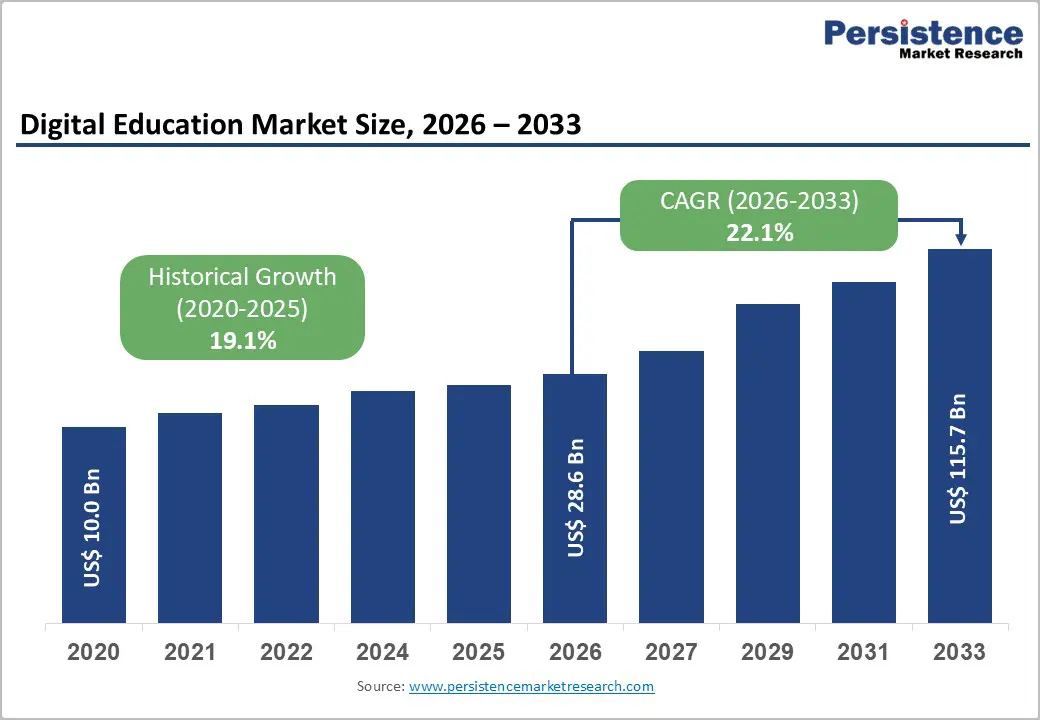
The global Digital Education Market size is expected to be valued at US$ 28.6 billion in 2026 and projected to reach US$ 115.7 billion by 2033, growing at a CAGR of 22.1% between 2026 and 2033.
The market is expanding rapidly due to the accelerated digital transformation of education systems and the growing demand for flexible and remote learning solutions. The COVID-19 pandemic significantly boosted adoption, with UNESCO reporting disruptions to 1.6 billion learners worldwide. Increasing internet penetration, highlighted by the International Telecommunication Union with 5.4 billion global users, and advancements in AI-driven personalized learning further support widespread digital education adoption across institutions.
Key Industry Highlights:
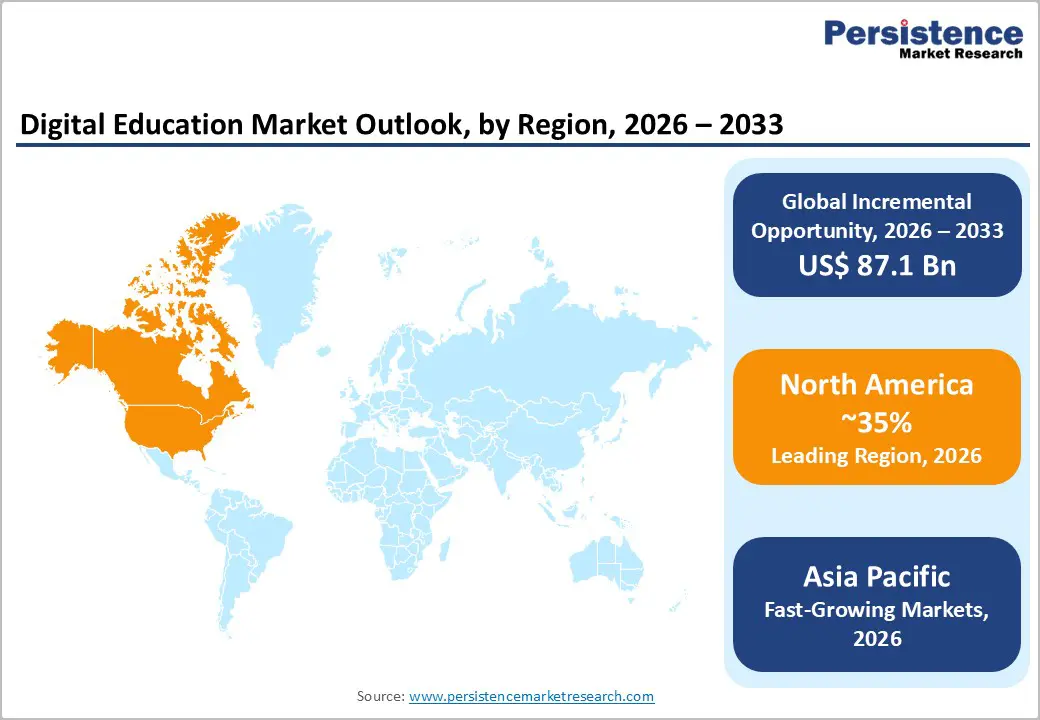
- Leading Region: North America dominates the Digital Education market with 35% share in 2025, supported by strong digital infrastructure, advanced edtech adoption, and widespread integration of online learning tools across educational institutions.
- Fastest Growing Region: Asia Pacific is the fastest-growing region in the Digital Education market, holding 32% share in 2025, driven by expanding internet access, rising smartphone penetration, and large-scale government-led digital learning initiatives.
- Leading Learning Type: Self-paced online education leads the market with 62% share in 2025, as flexible, on-demand learning models attract professionals and students seeking convenient and accessible education formats.
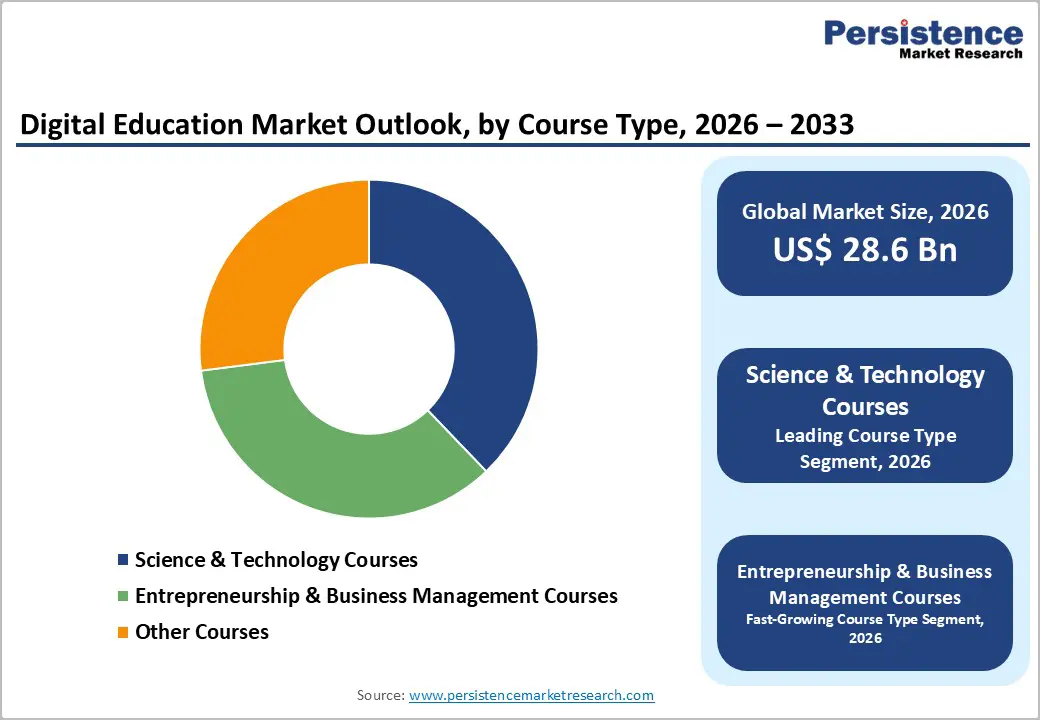
- Leading Course Category: Science & Technology courses account for 45% share in 2025, fueled by strong demand for STEM skills, coding, artificial intelligence, and data science training.
- Key Market Opportunity: Expanding corporate AI and digital skills training programs presents a major opportunity as organizations prioritize large-scale workforce upskilling through online education platforms.
| Key Insights | Details |
|---|---|
|
Digital Education Size (2026E) |
US$ 28.6 billion |
|
Market Value Forecast (2033F) |
US$ 115.7 billion |
|
Projected Growth CAGR(2026-2033) |
22.1% |
|
Historical Market Growth (2020-2025) |
19.1% |
Market Dynamics
Drivers - Rapid Expansion of Remote Learning and AI-Driven Educational Technologies Accelerating Global Digital Education Adoption
The sustained shift toward remote and flexible learning models has significantly accelerated the adoption of digital education platforms worldwide. Educational institutions, corporate training providers, and individual learners increasingly rely on online learning environments that offer accessibility and scheduling flexibility. According to Organisation for Economic Co-operation and Development, nearly one-third of global jobs are now impacted by artificial intelligence, increasing the need for continuous digital upskilling and reskilling across industries.
At the same time, strong mobile connectivity is enabling broader participation in digital learning ecosystems. Data from GSMA highlights that mobile penetration in many emerging economies has reached around 70%, expanding access to online education platforms. Growing enrollment in platforms such as Coursera demonstrates how scalable digital education models can reach millions of learners worldwide.
Integration of Artificial Intelligence and Immersive Technologies Enhancing Learning Outcomes and Engagement
Artificial intelligence and immersive technologies such as virtual reality and augmented reality are transforming digital education by enabling highly personalized and interactive learning experiences. These technologies allow platforms to adapt content based on learner behavior, improving engagement and knowledge retention. Research from Consortium for School Networking indicates that the majority of education technology leaders view AI as a critical tool for improving instructional efficiency and learner outcomes.
Furthermore, collaborative initiatives in AI-based education are expanding globally. Programs supported by UNESCO through its international AI education initiatives have introduced specialized training courses across multiple countries. Such programs help educators integrate emerging technologies into digital classrooms, encouraging deeper engagement, extended learning time, and broader adoption of advanced digital education solutions.
Restraints - Limited Connectivity Infrastructure and Unequal Digital Access Restricting Inclusive Digital Education Adoption
Despite rapid digital education growth, persistent connectivity gaps continue to restrict access for many learners, particularly in rural and low-income regions. According to World Bank, billions of people still lack reliable internet connectivity, creating a significant barrier to accessing online education platforms. This digital divide results in uneven learning opportunities between high-income and developing regions.
In many underserved communities, limited infrastructure, device shortages, and affordability challenges reduce the effectiveness of digital learning initiatives. Research from NORRAG highlights that students from lower-income backgrounds often rely on minimal digital tools and basic online tasks, restricting engagement with advanced interactive learning resources and slowing equitable digital education expansion.
Rising Data Privacy and Cybersecurity Concerns Affecting Trust in Digital Education Platforms
The rapid expansion of digital education platforms has increased concerns around data privacy and cybersecurity risks. Online learning systems collect large volumes of personal and academic data, making them potential targets for cyberattacks and data breaches. According to IBM security research, the average cost of a data breach remains significant, emphasizing the financial and reputational risks for education technology providers.
Additionally, strict global data protection frameworks such as General Data Protection Regulation require companies to implement strong compliance and data governance measures. While these regulations enhance user protection, they can increase operational complexity for digital education providers and may slow innovation if organizations struggle to balance rapid technological development with strict privacy safeguards.
Opportunities - Rapid Mobile Connectivity Growth in Emerging Economies Creating Large-Scale Digital Learning Opportunities
The expansion of mobile connectivity across emerging economies is creating major opportunities for digital education providers to reach new learners. According to GSMA, mobile penetration in many Asia Pacific and developing regions continues to rise, enabling millions of users to access education through smartphones. This trend supports the development of mobile-first learning platforms designed for affordability and accessibility.
Government-led initiatives are also accelerating adoption. Programs such as SWAYAM have already reached tens of millions of learners by offering free or low-cost digital courses. Pilot projects supported by UNESCO further highlight growing demand for digital skills training, encouraging localized education apps and scalable freemium learning models.
Rising Demand for Corporate AI and Digital Skills Training Expanding Enterprise Learning Platforms
The increasing impact of artificial intelligence across industries is creating strong demand for corporate digital training and reskilling programs. Data from Organisation for Economic Co-operation and Development shows that a significant portion of global jobs are influenced by AI technologies, yet only a small share of existing courses currently focus on AI and advanced digital skills. This gap creates major opportunities for enterprise-focused digital education platforms.
Businesses are increasingly investing in workforce development to remain competitive in the digital economy. According to Deloitte, a large majority of executives plan to expand investments in digital training initiatives. Programs such as Google Career Certificates demonstrate how industry-recognized online courses can improve employability and support large-scale workforce reskilling initiatives.
Category-wise Analysis
Learning Type Insights
Self-paced online education dominates the digital education market, accounting for approximately 62% of the share in 2025 due to its flexibility and learner autonomy. This format allows individuals to access courses at their own pace, making it highly suitable for working professionals and students managing diverse schedules. Research from Pew Research Center indicates that many adult learners prefer flexible digital learning models, supporting the strong adoption of self-paced platforms.
Instructor-led online learning is emerging as the fastest-growing format as learners increasingly seek structured guidance and real-time interaction. Virtual classrooms enable direct engagement with instructors, collaborative discussions, and immediate feedback. As educational institutions and corporate training providers adopt interactive digital teaching models, demand for instructor-led sessions is expanding to enhance learning effectiveness and completion rates.
Course Type Insights
Science and technology courses hold the leading position in the digital education market, capturing around 45% of the share in 2025 due to strong demand for STEM-related skills. Growing employment opportunities in technology-driven sectors continue to encourage learners to pursue subjects such as programming, artificial intelligence, and data science. According to U.S. Bureau of Labor Statistics, technology-focused occupations are expected to experience steady employment growth.
Business and professional development courses are the fastest-growing category as organizations and individuals prioritize leadership, digital marketing, and management skills. Rapid digital transformation across industries is pushing professionals to continuously upgrade their expertise. As a result, digital education platforms are expanding course offerings in entrepreneurship, finance, and strategic management to support career advancement and workforce development.
End-user Insights
Enterprises represent the leading end-user segment in the digital education market, accounting for approximately 38% of the share in 2025. Organizations increasingly invest in digital learning platforms to train employees, improve productivity, and address emerging technology skill gaps. According to LinkedIn workplace learning insights, the vast majority of companies consider employee learning and development a strategic priority.
Individual learners are emerging as the fastest-growing end-user group as digital platforms provide accessible and affordable education opportunities worldwide. Professionals, freelancers, and students are increasingly enrolling in online programs to enhance career prospects and develop specialized skills. The availability of flexible courses, certification programs, and micro-credentials is encouraging continuous learning across diverse age groups and career stages.
Regional Insights
North America Digital Education Market Trends and Insights
North America leads the global digital education market, accounting for approximately 35% of the market share in 2025. The region benefits from strong digital infrastructure, high technology adoption, and extensive integration of online learning tools across schools and universities. According to Consortium for School Networking, the majority of K–12 institutions have incorporated digital technologies into teaching environments, strengthening the region’s leadership in advanced learning platforms.
Government initiatives and research investments further support innovation across the digital education ecosystem. Programs supported by the U.S. Department of Education and research funding from the National Science Foundation encourage the development of AI-driven learning tools and adaptive platforms. Additionally, strong data privacy frameworks such as Family Educational Rights and Privacy Act help institutions scale digital learning while maintaining secure student data management.
Europe Digital Education Market Trends and Insights
Europe is experiencing steady growth in digital education, supported by coordinated regional policies and technology-driven learning initiatives. The region is projected to grow at a CAGR of around 18.6% during the forecast period, driven by strong institutional adoption and investments in digital skills development. Strategic initiatives such as the Digital Education Action Plan 2021–2027 aim to strengthen digital competencies and integrate advanced technologies into education systems across member states.
Several European countries are actively expanding digital education programs through national policies and institutional collaborations. The Organisation for Economic Co-operation and Development continues to promote AI literacy and digital skill development across the region. Universities and technical institutes in countries such as Germany, France, and the United Kingdom are also exploring immersive learning technologies, including virtual reality and online degree programs, to modernize higher education.
Asia Pacific Digital Education Market Trends and Insights
Asia Pacific represents one of the largest and most dynamic regions in the digital education market, accounting for approximately 32% of the global share in 2025. Rapid internet expansion, growing smartphone penetration, and a large student population are key factors supporting adoption across the region. Governments are increasingly promoting national digital learning platforms to expand access to education and skill development.
Large-scale government programs have significantly accelerated digital learning participation. Platforms supported by the Ministry of Education of the People's Republic of China and India’s DIKSHA and SWAYAM have enrolled tens of millions of learners. With strong investments in technology infrastructure and workforce training, Asia Pacific is emerging as a major hub for scalable digital education solutions.
Competitive Landscape
The digital education market is characterized by a highly fragmented competitive environment with the presence of numerous global platforms, regional providers, and emerging startups. Companies compete by expanding digital course libraries, enhancing platform capabilities, and improving learner engagement through advanced technologies. Continuous innovation in learning management systems, mobile learning applications, and interactive content delivery remains central to maintaining competitive advantage in the rapidly evolving education technology landscape.
Market participants are increasingly focusing on strategic collaborations, acquisitions, and technology investments to strengthen their offerings. Integration of artificial intelligence, personalized learning paths, gamification features, and subscription-based models are becoming key differentiators. These strategies help providers attract a wider learner base while improving user retention, scalability, and long-term platform adoption across academic and corporate learning environments.
Key Developments:
- In June 2025, Duolingo launched AI-powered adaptive learning courses designed to personalize training for enterprise users. The new system analyzes learner progress and behavior to adjust content difficulty, helping organizations improve engagement and achieve around 25% higher course completion and retention rates.
- In March 2024, Coursera partnered with Google Cloud to introduce advanced artificial intelligence certification programs. The collaboration focuses on workforce reskilling initiatives and aims to train nearly five million learners globally in high-demand cloud and AI skills.
- In October 2024, Khan Academy collaborated with Meta Platforms to integrate virtual reality experiences into STEM learning modules. The initiative enables immersive science and engineering lessons, helping students interact with complex concepts through simulations and interactive virtual environments.
Companies Covered in Digital Education Market
- Pearson plc
- Microsoft
- Coursera
- Udacity
- Duolingo
- Chegg
- Instructure
- Blackboard Inc.
- BYJU'S
- upGrad
- Eruditus
- Snapplify
- CYPHER Learning
- Twinkl
Frequently Asked Questions
US$ 28.6 billion, driven by pandemic adoption and growing online learning demand.
Remote learning flexibility, AI personalization, and expanding internet access to 5.4 billion users.
North America leads with 35% share in 2025, supported by strong infrastructure and advanced edtech adoption.
Corporate AI and digital skills training to reskill workforces, addressing 1/3 of jobs impacted by technology.
Global platforms such as Coursera, edX, and Udemy lead with innovations in AI, adaptive learning, and digital content.


