




- Healthcare Services
- Healthcare Digital Market
Healthcare Digital Marketing Outsourcing Market Size, Share, and Growth Forecast, 2026 – 2033
Healthcare Digital Marketing Outsourcing Market by Product Type (SEO, PPC Advertising, Content Marketing, Social Media Marketing, Email Marketing, Others), Healthcare Providers (Hospitals & Clinics, Pharmaceutical Companies, Healthcare Technology Companies, Insurance Providers, Medical Practices, Others), Technology (AI & ML, Chatbots & Virtual Assistants, Big Data Analytics, Cloud Computing, Mobile Applications), and Regional Analysis for 2026-2033

Healthcare Digital Marketing Outsourcing Market Share and Trends Analysis
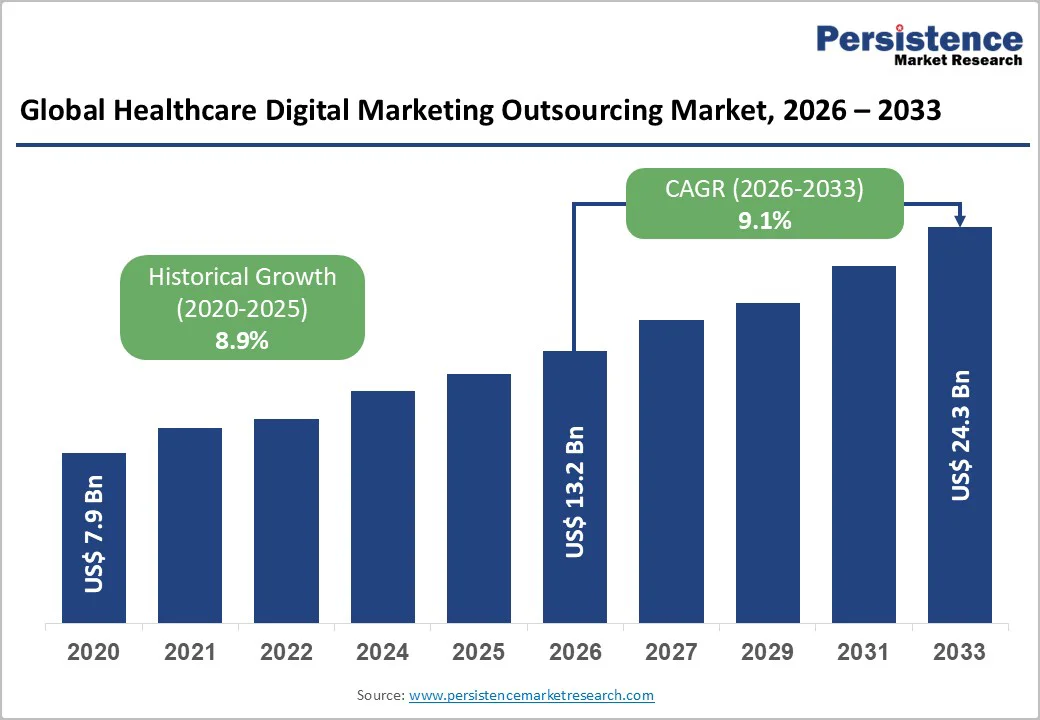
The global healthcare digital marketing outsourcing market size is likely to be valued at US$ 13.2 billion in 2026 and is estimated to reach US$ 24.3 billion by 2033, growing at a CAGR of 9.1% during the forecast period 2026−2033. Growth is driven primarily by rising adoption of digital health services, increasing demand for patient engagement via online channels, and broader digital transformation across healthcare systems. As providers seek cost?effective ways to manage marketing and outreach, outsourcing to specialized agencies becomes increasingly attractive, supported by growth in digital health infrastructure, regulatory emphasis on compliance, and expansion of telehealth
Key Industry Highlights
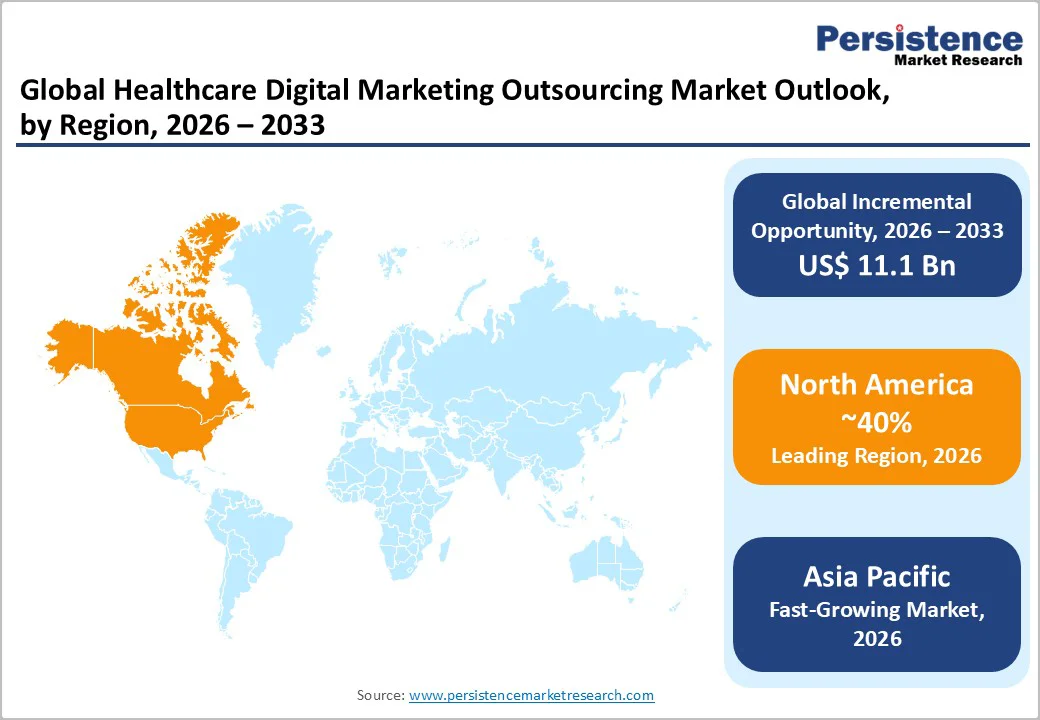
- Dominant Region: North America is projected to hold 40% of the market in 2026, driven by a mature digital health ecosystem and online patient engagement.
- Fastest-growing Regional Market: Asia Pacific is likely to be the fastest-growing market through 2033 due to rapid digital health adoption and telemedicine expansion.
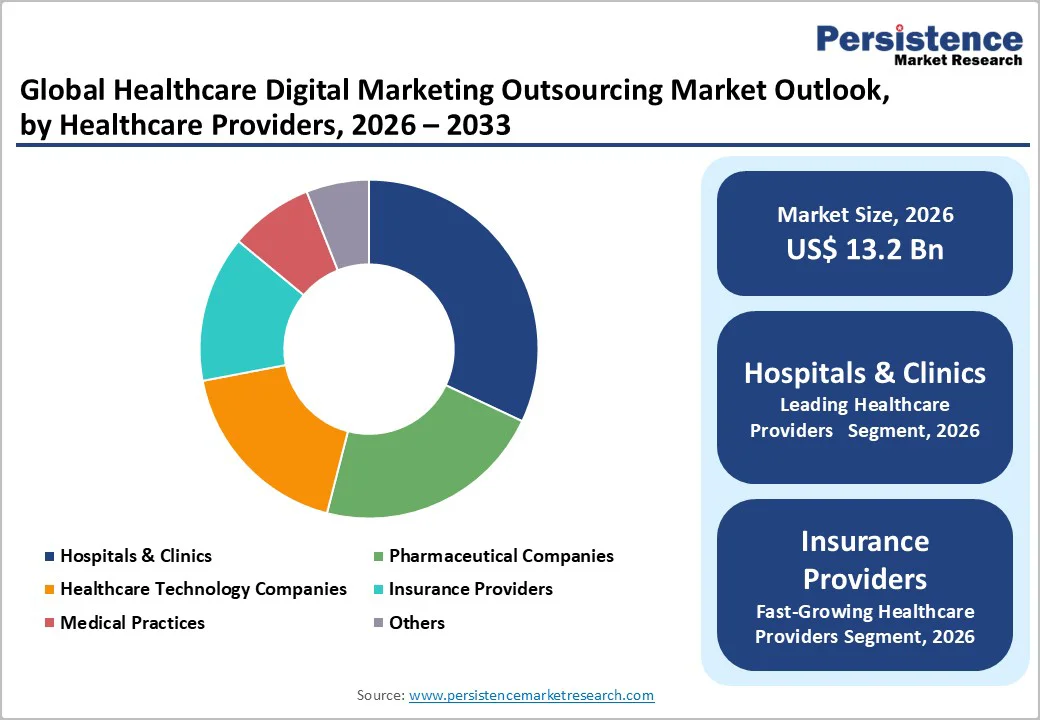
- Leading Healthcare Providers: Hospitals & clinics are projected to hold 32% of the revenue share in 2026, driven by telehealth adoption and growing demand for digital marketing services.
- Fastest-growing Healthcare Providers: Insurance providers are set to grow the fastest from 2026 to 2033, owing to heavy investments in digital marketing and personalized outreach.
| Key Insights | Details |
|---|---|
| Healthcare Digital Marketing Outsourcing Market Size (2026E)) | US$ 13.2 Bn |
| Market Value Forecast (2033F) | US$ 24.3 Bn |
| Projected Growth (CAGR 2026 to 2033) | 9.1% |
| Historical Market Growth (CAGR 2020 to 2025) | 8.9% |
Market Factors – Growth, Barriers, and Opportunity Analysis
Increasing Digital Adoption in Healthcare
Rising digital adoption in healthcare has reshaped patient interaction and engagement strategies. Today, most hospitals provide comprehensive digital services, including telehealth, online scheduling, and electronic health record access. This rapid integration of digital tools increases the volume of patient touchpoints and demands targeted communication across multiple online channels. Managing these interactions internally requires specialized expertise in content strategy, search engine optimization, and platform-specific engagement, which many providers do not possess.
Outsourcing marketing to specialized agencies enables healthcare organizations to address this complexity efficiently. Agencies deliver expertise in patient-centric messaging, compliance with healthcare regulations, and performance analytics, ensuring campaigns are effective and measurable. By leveraging external capabilities, providers can focus on clinical operations while scaling digital engagement efforts, driving patient satisfaction, retention, and brand visibility. Strategic partnerships with agencies allow healthcare organizations to respond swiftly to evolving digital trends and patient expectations, creating a competitive advantage in a landscape increasingly defined by online interaction.
Data Privacy Concerns and Security Risks
Data privacy concerns and security risks serve as a critical restraint due to the highly sensitive nature of healthcare information. Patient records, medical histories, and personal identifiers require stringent protection under global regulations such as the Health Insurance Portability and Accountability Act (HIPAA) and the General Data Protection Regulation (GDPR). Any breach or mishandling of such data can result in severe legal penalties, financial losses, and reputational damage. Outsourcing digital marketing involves sharing access to databases, communication channels, and analytics platforms with third-party vendors, which introduces potential vulnerabilities. Ensuring that external agencies maintain robust cybersecurity measures, encryption protocols, and compliance frameworks becomes a complex challenge for healthcare providers.
The risk landscape is further intensified by the growing adoption of digital health tools, telemedicine platforms, and online patient engagement systems. Cyberattacks, phishing schemes, and unauthorized access attempts are increasingly sophisticated, making data security management a high-priority concern. Organizations must continuously invest in monitoring, auditing, and enforcing strict access controls to mitigate exposure. The perception of data vulnerability can also affect patient trust and engagement, directly influencing the effectiveness of outreach initiatives. Consequently, the balance between leveraging external expertise for digital engagement and safeguarding sensitive information becomes a pivotal consideration in strategic planning.
Expansion in Telehealth and Remote Care Marketing
The surge in telehealth and remote care services has created a transformative shift in how healthcare providers connect with patients. Digital marketing agencies can capitalize on this trend by designing campaigns that highlight convenience, accessibility, and personalized care experiences. As patients increasingly rely on virtual consultations, targeted outreach through search engines, social media, and email platforms becomes critical to building trust and driving engagement. Agencies skilled in healthcare compliance can help providers navigate regulatory requirements while effectively promoting services, creating a significant competitive advantage.
Remote care solutions demand consistent communication and patient education, which opens opportunities for content-driven strategies such as video tutorials, interactive chat tools, and patient-centric apps. By managing these initiatives, specialized agencies enable healthcare providers to maintain high engagement levels and nurture long-term patient relationships. The scalability of digital campaigns aligns with the rapid growth of telehealth, making outsourced marketing an efficient solution for reaching geographically dispersed audiences while optimizing cost and resource allocation. This alignment positions marketing as a strategic driver for adoption and utilization of remote healthcare services.
Category-wise Analysis
Product Type Insights
Pay per click (PPC) advertising is projected to remain the leading revenue generator in 2026, capturing a significant market share of approximately 28%. Its dominance stems from the ability to deliver immediate visibility and measurable results, allowing healthcare providers to target specific patient demographics efficiently. Providers benefit from optimized campaigns that drive appointment bookings, telehealth consultations, and service awareness. The precise targeting, real-time performance tracking, and cost-controlled model make PPC an indispensable tool for providers seeking rapid return on investment (ROI) while maintaining regulatory compliance.
Social media marketing is anticipated to be the fastest-growing segment through 2033, due to the increasing reliance of patients on digital platforms for health information and engagement. Healthcare providers are leveraging social channels to build brand authority, educate patients, and promote virtual services in an interactive manner. The segment is expected to expand rapidly as personalized content campaigns, video engagement, and community-focused initiatives gain traction. Outsourced agencies are uniquely positioned to manage these platforms, ensuring compliance while maximizing patient interaction, retention, and long-term engagement.
Healthcare Providers Insights
Hospitals & clinics are forecasted to hold an estimated 32% of the healthcare digital marketing outsourcing market revenue share in 2026. Their leadership is driven by the rapid adoption of telehealth and virtual care services, which require targeted marketing to attract and retain patients. Outsourced agencies support these providers in executing efficient digital campaigns, managing patient acquisition, and ensuring compliance. The increasing reliance on virtual consultations and remote patient engagement reinforces their position as the primary driver of demand for outsourced marketing services.
Insurance providers are anticipated to be the fastest-growing segment between 2026 and 2033, attributable to their expanding investment in digital marketing for patient education, preventive-care initiatives, and telehealth-enabled services. Outsourced marketing helps insurers communicate complex healthcare plans, engage policyholders through interactive campaigns, and drive enrollment in digital health programs. The adoption of personalized content, automated communication tools, and data-driven outreach strategies allows them to reach broader audiences efficiently.
Technology Insights
AI& machine learning are projected to capture the largest market share of approximately 30% in 2026 within healthcare digital marketing outsourcing. Their leadership is driven by the ability to deliver predictive targeting, personalized content, and automated patient-engagement workflows at scale. AI enables providers to optimize campaigns, improve patient conversion rates, and tailor communication based on behavioral insights. The integration of machine learning into marketing strategies allows healthcare organizations to efficiently manage large datasets, enhance decision-making, and achieve higher ROI while maintaining compliance.
Chatbots & virtual assistants are anticipated to be the fastest-growing technology segment during the 2026-2033 forecast period due to the increasing demand for 24/7 patient interaction, appointment scheduling, and support services. These conversational AI tools enhance patient experience by providing instant responses, guidance, and reminders, reducing operational burden on staff. Their adoption is expanding rapidly among telehealth and remote-care providers seeking scalable solutions for patient engagement. Outsourced agencies leverage these technologies to improve outreach, foster patient retention, and streamline communication, positioning chatbots and virtual assistants as key growth drivers in healthcare digital marketing.
Regional Insights
North America Healthcare Digital Marketing Outsourcing Market Trends
North America is projected to hold around 40% of the healthcare digital marketing outsourcing market share in 2026, driven by its highly developed digital health ecosystem and strong emphasis on data-driven patient engagement. The region’s leadership is anchored in a competitive healthcare landscape where providers prioritize digital visibility, differentiated service portfolios, and superior patient experience. In 2026, a substantial share of patient interactions is expected to originate online through search platforms, patient portals, and virtual-care interfaces, increasing demand for specialized outsourced marketing services. Providers are projected to rely heavily on outsourcing for compliant content creation, precision targeting, and performance-focused campaigns that strengthen telehealth utilization and chronic-care management programs. The stringent regulatory framework continues to elevate the need for agencies proficient in evidence-aligned messaging and compliant digital outreach.
North America’s dominance in 2026 is further reinforced by accelerated adoption of analytics, automation, and AI within healthcare marketing operations. Providers increasingly seek advanced segmentation, predictive insights, and omnichannel optimization to meet rising expectations for personalized digital health interactions. High patient-acquisition costs in the region make outsourcing an efficient model, enabling healthcare organizations to deploy conversion-driven strategies that maximize ROI. The mature presence of healthcare technology innovators, insurers, and integrated delivery networks sustains strong demand for outsourced support in brand positioning, digital reputation management, and multi-platform engagement.
Europe Healthcare Digital Marketing Outsourcing Market Trends
Europe is foreseen to unlock high-value opportunities in the healthcare digital marketing outsourcing landscape, supported by its steady shift toward integrated digital health systems and rising adoption of patient-centric communication strategies. Healthcare providers across the region are focusing more on digital engagement to address aging populations, chronic disease management, and increasing demand for remote care solutions. The expansion of electronic health records, teleconsultation platforms, and regulated digital therapeutics strengthens the need for outsourced marketing expertise capable of navigating stringent compliance frameworks and multilingual communication requirements. This creates a favorable environment for agencies specializing in precision targeting, compliant content development, and multi-market campaign execution.
Regional market growth is further supported by increasing investments from hospitals, pharmaceutical companies, and medical technology firms seeking to enhance digital visibility and strengthen patient trust. European consumers display a high preference for research-driven health information, encouraging providers to outsource content marketing, search optimization, and data-driven outreach strategies. Rising competition among private healthcare networks, expansion of cross-border healthcare services, and a structured regulatory landscape elevate the demand for sophisticated marketing solutions that ensure accuracy, transparency, and consistent patient engagement.
Asia Pacific Healthcare Digital Marketing Outsourcing Market Trends
Asia Pacific is projected to be the fastest-growing regional market for healthcare digital marketing outsourcing, powered by rapid digitalization of healthcare systems and a significant rise in consumer engagement through online health platforms. Providers in the region are accelerating the adoption of telemedicine, mobile health applications, and digital appointment systems, creating strong demand for outsourced marketing expertise. Healthcare organizations are increasingly shifting toward data-driven communication, localized content strategies, and social-media-based patient outreach to address diverse linguistic and cultural landscapes. This momentum is further strengthened by government initiatives promoting digital health ecosystems and broader access to virtual care services.
Growth in Asia Pacific is also fueled by expanding internet penetration, rising mobile device usage, and a young, digitally active population that relies heavily on online channels for health information and service decisions. Providers are turning to specialized agencies to manage brand visibility, optimize patient acquisition, and deliver compliant digital communication across multiple platforms. The presence of emerging healthcare technology companies, growing private healthcare investments, and rising competition among providers drives the need for scalable, performance-focused marketing solutions.
Competitive Landscape
The global healthcare digital marketing outsourcing market structure remains moderately fragmented, with a blend of global agencies and niche firms offering specialized healthcare-focused services. This structure allows providers to choose partners with deep expertise in regulatory compliance, patient engagement strategies, and data-driven campaign execution. Specialized agencies play a critical role by addressing the sector’s unique communication challenges, including accuracy, privacy requirements, and evidence-based messaging.
Prominent players such as Cardinal Health Inc., PatientPop, Meditwitt India Pvt Ltd, Hootsuite Inc., ClickDealer, Refersion Inc., SEMGeeks Digital Agency, and The SEO Works Ltd contribute significantly to global outsourcing activity. Their capabilities span SEO, PPC, content marketing, social media management, and analytics-driven optimization, enabling healthcare providers to strengthen digital visibility and enhance patient acquisition.
Key Industry Developments
- In December 2025, DKSH Business Unit Healthcare launched a three-part whitepaper series highlighting how commercial outsourcing is transforming go-to-market strategies for healthcare and life science companies across Asia Pacific.
- In October 2025, Cardinal Digital Marketing hosted the third annual “Scaling Up: The Healthcare Performance Marketing Summit”, a free virtual event for healthcare marketers focusing on performance-driven patient acquisition strategies. The summit also debuted the Flockie Awards, which recognize the most innovative healthcare marketing campaigns of 2025 and highlight organizations that are redefining how they connect patients to care.
- In July 2025, Deerfield purchased TTC, a healthcare-focused strategic marketing agency, strengthening its digital, creative, and communications offerings for pharma and life-sciences clients.
Companies Covered in Healthcare Digital Market
- Cardinal Health Inc.
- PatientPop, Inc.
- Meditwitt India Pvt Ltd
- Hootsuite Inc.
- ClickDealer
- Refersion Inc.
- SEMGeeks Digital Agency
- The SEO Works Ltd
- Medibrandox, Practis, LLC
- CMI Media Group
- The Brains (agency)
- WebToMed, L.L.C.
Frequently Asked Questions
The global healthcare digital marketing outsourcing market is projected to reach US$ 13.2 billion in 2026.
Rising digital health adoption, changing patient behavior, and the need for cost-effective, compliance-aware marketing are driving the market.
The market is poised to witness a CAGR of 9.1% from 2026 to 2033
Expanding adoption of advanced technologies such as AI and analytics, and increasing regulatory complexity are creating new opportunities in the market.
Some of the key market players include Cardinal Health Inc, PatientPop, Inc., Meditwitt India Pvt Ltd, Hootsuite Inc., ClickDealer, Refersion Inc., and SEMGeeks Digital Agency.


