




- Technology
- Digital Market
Digital Marketing Services Market Size, Share, and Growth Forecast, 2026 - 2033
Digital Marketing Services Market by Service Type (Content Marketing, Social Media Marketing, Email Marketing, Search Engine Optimization (SEO)), End-User (Retail & E-Commerce, BFSI, IT & Telecommunications, Healthcare), Component (Service, Software), and Regional Analysis for 2026-2033

Digital Marketing Services Market Share and Trends Analysis
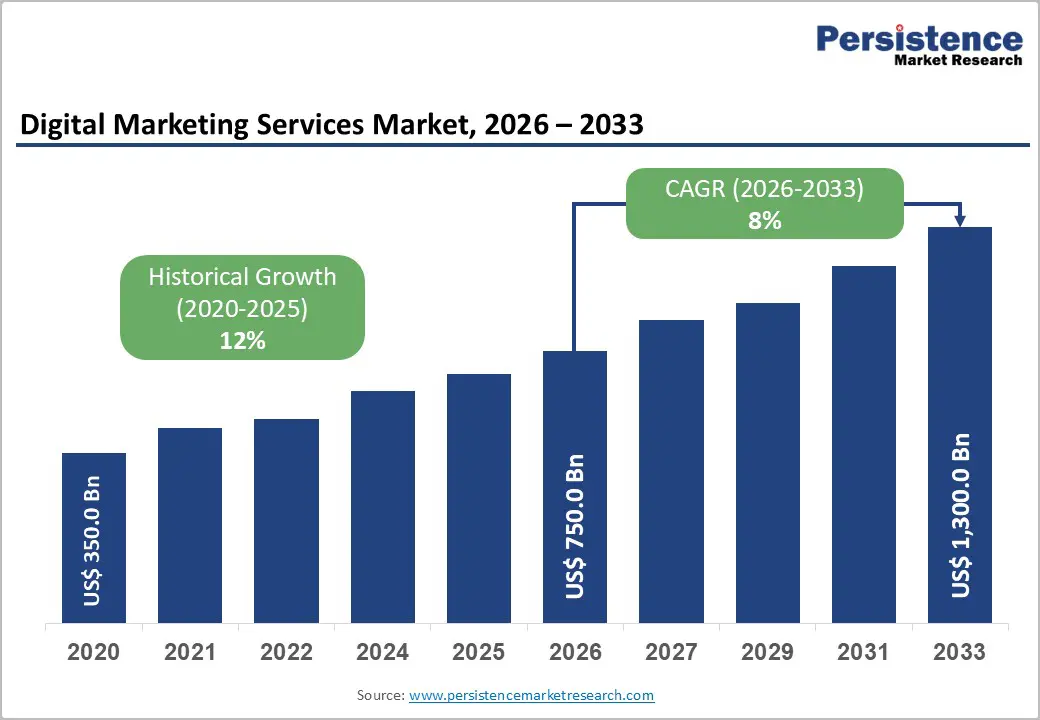
The global digital marketing services market size is likely to be valued at US$ 750.0 billion in 2026, and is projected to reach US$ 1,300.0 billion by 2033, growing at a CAGR of 8% during the forecast period 2026−2033. This growth is occurring as enterprises across sectors accelerate digital transformation initiatives and steadily reallocate marketing budgets toward online customer acquisition and engagement channels. Businesses are increasingly prioritizing measurable performance, scalable outreach, and real-time consumer insights, which are strengthening the strategic importance of digital marketing within overall corporate spending plans.
Technology adoption is continuing to reshape service demand, particularly through the integration of artificial intelligence (AI) and machine learning (ML) within marketing automation and analytics platforms. These capabilities are improving targeting accuracy, personalization depth, and campaign optimization, thereby raising return on investment and reinforcing long-term client commitments to digital service providers. As a result, organizations are gradually reducing reliance on traditional media and are shifting resources toward data-driven digital ecosystems such as search, social media, programmatic advertising, and content marketing.
Key Industry Highlights
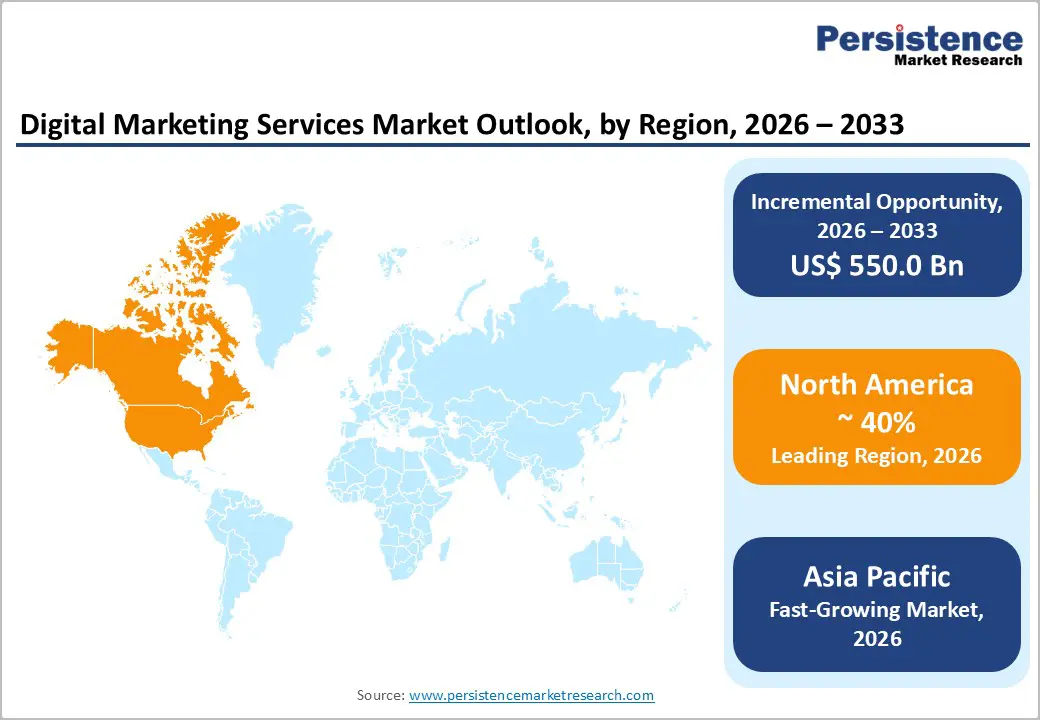
- Dominant Region: North America is anticipated to capture a market share of approximately 40% in 2026, supported by a wide presence of large agency networks and a broad base of enterprises adopting cutting-edge marketing technologies.
- Fastest-growing Market: The Asia Pacific market is set to be the fastest-growing through 2033, driven by its integrated e-commerce and digital payment ecosystems.
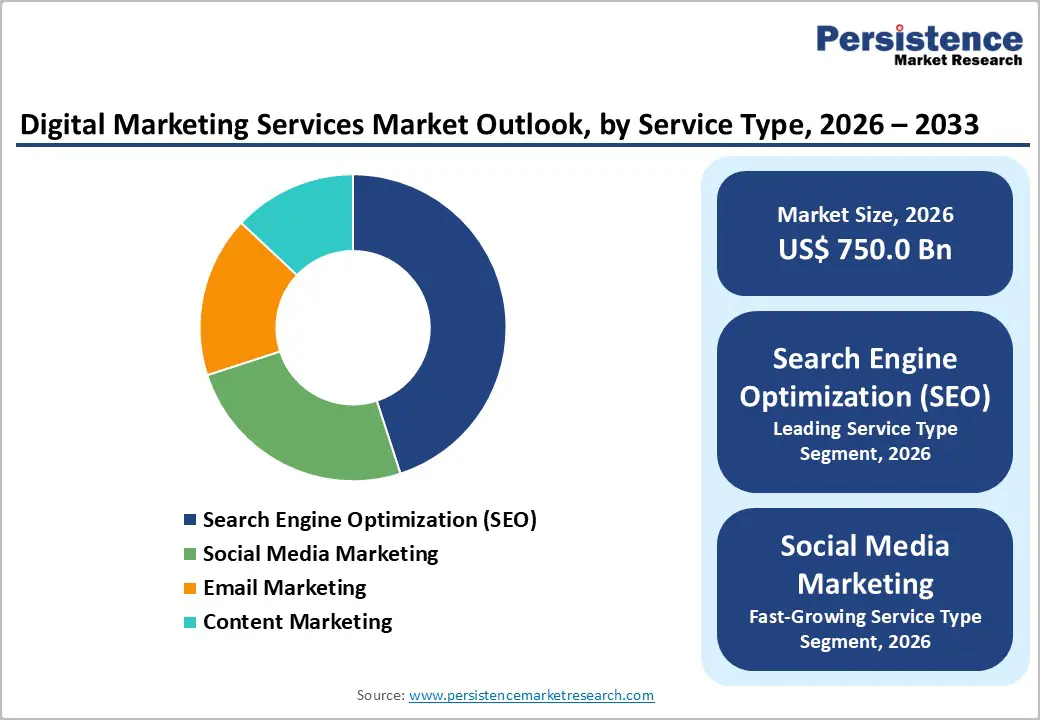
- Leading Service Type: Search engine optimization (SEO) is slated to lead with an estimated 2026 share of 40%, driven by the foundational role that search engines play in driving website traffic.
- Fastest-growing Service Type: Social media marketing is likely to be the fastest-growing segment through 2033, fueled by the skyrocketing popularity and usage of platforms such as Instagram, TikTok, and YouTube.
- December 2025: Alloy acquired Atlanta-based digital marketing agency Hot Sauce to deepen its marketing technology (martech) and data-driven digital marketing capabilities, especially for business-to-business (B2B) clients.
| Key Insights | Details |
|---|---|
| Digital Marketing Services Market Size (2026E) | US$ 750.0 Bn |
| Market Value Forecast (2033F) | US$ 1,300.0 Bn |
| Projected Growth (CAGR 2026 to 2033) | 8% |
| Historical Market Growth (CAGR 2020 to 2025) | 12.0% |
Market Factors – Growth, Barriers, and Opportunity Analysis
Widespread Adoption of Marketing Automation and Analytics Technologies
Marketing leaders are aggressively increasing investment in marketing technology to support more rigorous, data-driven decision-making and to align customer engagement with broader business objectives. Modern analytics platforms now give teams an integrated view of customer journeys across channels such as web, mobile, email, and social, which helps them understand behavior at each stage of the funnel and refine strategy accordingly. When organizations use these capabilities effectively, they can connect marketing initiatives to commercial outcomes, which strengthens credibility with finance and executive stakeholders and supports more strategic budgeting discussions. This shift also requires upgraded skills, operating models, and governance so that tools genuinely enhance performance rather than add complexity.
Marketing automation software enables organizations to design and deliver highly relevant experiences at scale while freeing teams from repetitive execution tasks. By orchestrating personalized journeys, automated lead nurturing, and progressively refined segmentation, practitioners can devote more time to strategy, creative development, and continuous program improvement. When combined with predictive analytics and AI, these platforms support forward-looking use cases such as proactive offer design, smarter bidding decisions, and dynamic budget reallocation across channels. For digital marketing service providers, this evolution means that clients increasingly expect technical mastery of these ecosystems, consultative guidance on operating model transformation, and measurable impact on pipeline quality and customer lifetime value.
Skills Gap and Talent Shortage in Digital Marketing Expertise
Many organizations face a persistent skills gap in digital marketing as technology, platforms, and channels evolve faster than workforce capabilities. The shift toward advanced tools, such as marketing automation, customer data platforms, and AI engines, requires practitioners who combine technical proficiency with strategic thinking and strong measurement discipline. Frequent changes in search, social, and media algorithms, along with the emergence of channels such as voice search and augmented reality, create an environment where continuous learning becomes essential rather than optional. Traditional education providers often struggle to update curricula at the same pace as industry innovation, which leaves many graduates with basic conceptual grounding but limited exposure to current tools and real-world implementation scenarios.
This talent mismatch has direct financial and operational implications for agencies and in-house teams. Organizations face rising people costs as they compete for scarce expertise while also investing in structured training and career development to retain critical talent. High turnover in specialist roles disrupts client relationships, slows delivery, and erodes institutional knowledge, thereby undermining consistent campaign performance and weakening long-term strategic execution. Leadership teams benefit from treating digital talent as a core strategic asset, redesigning roles around clear competency frameworks, and building systematic learning paths aligned with priority platforms and capabilities, rather than relying solely on opportunistic hiring or tool-specific short courses.
Growth in Video Marketing and Short-Form Content Platforms
Video is becoming the dominant format for digital content consumption and is reshaping how audiences discover, evaluate, and engage with brands across platforms such as TikTok, YouTube, and Instagram Reels. As attention spans shorten and mobile viewing becomes the norm, short-form and vertical video formats now sit at the center of many customer journeys, from initial awareness through to consideration and purchase. This shift means that video should not be treated as a one-off campaign asset but should be embedded in the core content strategy, media planning, and customer experience design. It also requires closer coordination among creative teams, data specialists, and channel strategists to ensure video assets are both engaging and measurable, with clear links to business outcomes such as brand lift, lead generation, and conversion.
The rise of video-first engagement gives marketing organizations a clear mandate to build stronger capabilities in areas such as concept development, production, collaboration with creators and influencers, and live or interactive experiences. Advanced formats such as interactive video, shoppable streams, and in-platform commerce experiences require both creative excellence and robust technical integration across analytics, attribution, and ecommerce systems. Providers that help clients test, learn, and scale video programs in a structured way, while advising on governance, brand safety, and return on investment, are better positioned to justify premium fees and deepen strategic relationships.
Category-wise Analysis
Service Type Insights
SEO is slated to maintain its dominant position in 2026, with an estimated 40% share of the digital marketing services market. This dominance reflects the foundational role that search engines play in driving website traffic and acting as primary discovery channels for products and services. The growing complexity of search algorithms, rising competition for valuable keywords, and deeper integration of AI into ranking models have all increased the level of technical sophistication required for effective execution. Both organic search optimization and paid search advertising deliver clearly measurable return on investment, which is why SEO and search engine marketing (SEM) typically receive the highest share of performance marketing budgets across most industries.
Social media marketing is likely to be the fastest-growing segment over the 2026-2033 forecast period. The creator economy has fundamentally reshaped how brands and consumers interact, as authentic influencer partnerships often generate deeper engagement and stronger conversion than traditional advertising formats. Social commerce capabilities now enable customers to complete purchases directly within social platforms, reducing friction in the journey and shortening the path from discovery to transaction. The rapid expansion of short-form video and live-streaming commerce creates new, high-impact touchpoints for brand storytelling and real-time interaction.
End-User Insights
Retail and e-commerce are set to secure the highest revenue share, reaching 35% in 2026. The competitive intensity of online retail, combined with rising customer acquisition costs and the need for continuous engagement across the entire customer lifecycle, is driving substantial investment in marketing services. E-commerce businesses depend on paid search, shopping advertisements, social commerce, email campaigns, and structured retention programs to attract new buyers and strengthen existing relationships. The continued shift toward direct-to-consumer (D2C) business models across many product categories has further intensified demand for advanced digital marketing expertise, as brands bypass traditional retail intermediaries to build and control direct customer relationships.
IT and telecommunications are estimated to be the fastest-growing segment during the 2026-2033 forecast period, due to software-as-a-service (SaaS) companies and technology platforms investing heavily in digital customer acquisition. The subscription-based business models common in this sector require sophisticated marketing strategies focused on free trial conversions, customer lifetime value optimization, and retention marketing. The technical sophistication of technology sector marketers drives demand for advanced analytics, account-based marketing, and marketing automation services, demonstrating clear return on investment.
Component Insights
Services is well-positioned to lead with an approximate 65% market share in 2026. This segment includes consulting, campaign management, creative services, content production, and managed services that require human expertise and strategic guidance. The labor-intensive nature of digital marketing execution, combined with the need for continuous campaign optimization and strategic advisory, creates sustained demand for professional services. Human creativity, strategic thinking, and client relationship management remain irreplaceable despite technological advances in automation. Professional services also include specialized offerings such as conversion rate optimization, marketing strategy development, and performance analytics consulting that command premium pricing.
Software is expected to be the fastest-growing segment during the 2026-2033 forecast period, driven by as marketing automation, analytics platforms, and AI-powered tools achieve widespread adoption. The integration of artificial intelligence, predictive analytics, and machine learning capabilities is creating entirely new software categories focused on automated content generation, customer data platforms, and real-time personalization engines. Subscription-based software models provide vendors with scalable, recurring revenue opportunities while enabling continuous platform innovation and feature enhancement.
Regional Insights
North America Digital Marketing Services Market Trends
At an estimated 40%, North America is anticipated to dominate the digital marketing services market share in 2026. The United States anchors regional performance because it hosts major technology platforms, large agency networks, and a broad base of enterprises that adopt new marketing technologies early in their lifecycle. Organizations in the region benefit from high internet and smartphone penetration, which supports sophisticated omnichannel strategies across search, social media, video, and emerging formats such as connected television and retail media. Evolving guidance from regulators such as the Federal Trade Commission on transparency and data privacy is reshaping how campaigns are designed, measured, and optimized, which in turn is increasing demand for advisory and compliance-focused digital marketing services.
Canada plays an important supporting role in regional growth, with notable strengths in content development, marketing automation, and data-driven program design. The competitive landscape across North America includes global holding company agencies, independent digital specialists, consulting firms that deliver end-to-end transformation services, and large brands that are building in-house marketing organizations. This diversity of participants intensifies competition for talent and differentiation, which encourages service providers to focus on capabilities such as AI-powered campaign optimization, first-party data strategy, and privacy-resilient targeting approaches.
Europe Digital Marketing Services Market Trends
Europe plays a central role in the digital marketing services landscape, supported by a mature advertising ecosystem, strong enterprise demand, and a sophisticated regulatory environment that shapes global best practices. Germany, the United Kingdom, France, and Spain form the core of regional activity, with Germany standing out in industrial and B2B digital marketing, while the United Kingdom continues to excel in creative services and programmatic media. The General Data Protection Regulation (GDPR) has reshaped digital marketing across Europe by setting strict standards for consent, data processing, and cross-border transfers, which now influence how global brands design their data strategies and customer engagement models.
Across the region, the competitive landscape brings together multinational agency networks, regional specialists, and an expanding set of martech platforms developed by European startups. Investment priorities increasingly center on privacy-compliant technologies, robust first-party data platforms, contextual and non-cookie-based targeting, and sustainable marketing practices that align with European environmental and social objectives. Growth in cross-border ecommerce within the European Union (EU) rewards service providers that can manage multi-jurisdictional compliance while still delivering integrated, customer-centric campaigns.
Asia Pacific Digital Marketing Services Market Trends
Asia Pacific market is anticipated to emerge as the fastest-growing market for digital marketing services. China, Japan, India, and the ASEAN underpin the role of Asia Pacific as a growth engine for digital marketing services, with China leading through its integrated ecommerce and digital payment ecosystems. The region’s mobile-first internet usage supports always-on, omnichannel engagement across formats such as social media, messaging applications, super-app environments, and mobile commerce, which makes customer journeys more fluid and harder to manage without advanced capabilities. India stands out with particularly rapid expansion, supported by public digital infrastructure, broad-based digital payment adoption, and a young, digitally confident consumer base that is highly receptive to new formats and shopping journeys.
Manufacturing strengths and competitive labor costs have established Asia Pacific as a preferred hub for digital marketing delivery, with offshore centers in India, the Philippines, and Vietnam supporting campaign operations, analytics, and creative production for global clients. Japan’s mature market shows particular depth in mobile marketing, gaming-related advertising, and the integration of digital engagement with in-store experiences, while Southeast Asian markets such as Indonesia, Vietnam, Thailand, and the Philippines offer significant upside as middle-income segments expand and ecommerce adoption accelerates.
Competitive Landscape
The global digital marketing services market structure is remaining moderately fragmented, with large multinational holding companies such as Publicis Groupe, WPP, Omnicom Group, Interpublic Group, and Dentsu collectively accounting for an estimated 39% of total revenues. These organizations are maintaining their competitive positions by offering integrated, end to end service portfolios that combine creative development, media planning, data analytics, and technology enabled marketing solutions. Their scale, global delivery capabilities, and long standing enterprise relationships are allowing them to secure multi- year contracts and manage complex, cross regional campaigns for large clients.
The competitive landscape is increasingly building itself across three distinct tiers that are serving different client needs. Global holding companies are continuing to lead in full service delivery, while specialized digital agencies are focusing on specific channels such as search engine marketing, social media marketing, or performance advertising, and on vertical specific expertise. Boutique consultancies are expanding their roles in strategic advisory, particularly in areas such as customer experience design, data strategy, and marketing transformation. At the same time, mid-tier regional agencies are gaining incremental share by delivering localized market insights, faster execution, and flexible engagement models, which are appealing to small & mid-sized enterprises (SMEs) seeking cost efficiency and market responsiveness.
Key Industry Developments
- In September 2025, Brick Marketing introduced three AI-based B2B services to embed AI into strategy, search, and execution for more efficient, measurable growth. The offerings help organizations streamline workflows, improve geo- and intent-based search performance, and offload repetitive tasks to AI agents so internal teams can focus on higher-value strategic work.
- In August 2025, Accenture acquired Superdigital, a U.S.-based social and influencer marketing agency, to strengthen Accenture Song’s end-to-end social marketing capabilities across audience strategy, content, commerce, and measurement.
- In July 2025, LTIMindtree launched BlueVerse CraftStudio, a next-generation marketing agency built in partnership with Adobe to help brands accelerate AI-driven marketing ROI using tools such as Creative Cloud, Firefly, GenStudio and Workfront. The agency aims to boost revenue, cut time-to-market by over 50%, and let clients adopt advanced AI marketing without building their own in-house stack.
Companies Covered in Digital Market
- Publicis Groupe
- WPP plc
- Omnicom Group
- Dentsu Group
- Interpublic Group (IPG)
- Accenture Interactive
- Deloitte Digital
- IBM iX
- PwC Digital Services
- Havas Group
- MDC Partners
- S4 Capital
- BlueFocus Communication Group
- Cheil Worldwide
- Hakuhodo
Frequently Asked Questions
The global digital marketing services market is projected to reach US$ 750.0 billion in 2026.
The shift of advertising budgets to data-driven online channels as internet, smartphone, and e-commerce usage expand globally is mainly driving the market.
The market is poised to witness a CAGR of 8% from 2026 to 2033.
Capitalizing on emerging areas such as AI-enabled personalization, social and video commerce, and first-party data solutions in high-growth regions and verticals can open lucrative market opportunities.
Publicis Groupe, WPP, Omnicom Group, Interpublic Group, and Dentsu. are some of the key players in the market.


