




- Food Ingredients & Additives
- U.S. Food Trucks Services Market
U.S. Food Trucks Services Market Size, Share, and Growth Forecast, 2026 – 2033
U.S. Food Trucks Services Market by Offering Type (Food, Beverages, Dessert and Ice creams), Cuisine (American, Chinese, Japanese, Mexican, Italian), Platform (Mobile Vending, Online Delivery, Catering & Event Services) for 2026 – 2033

U.S. Food Trucks Services Market Size and Trends Analysis
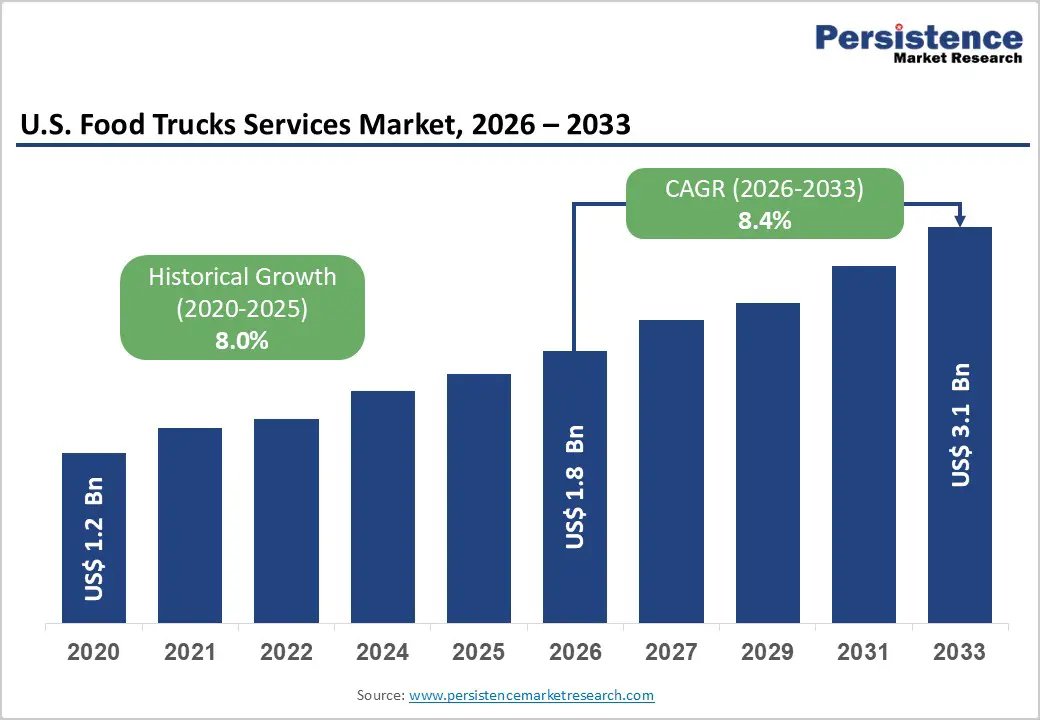
The U.S. food trucks services market size is likely to be valued at US$1.8 billion in 2026 and is expected to reach US$3.1 billion by 2033, growing at a CAGR of 8.4% during the forecast period from 2026 to 2033, driven by rising consumer demand for convenient, on-the-go dining options amid busy urban lifestyles and growing preference for experiential food experiences. Urbanization and higher foot traffic in metropolitan areas have boosted the adoption of mobile food services, with millennials and Gen Z forming a significant share of the customer base. The integration of digital platforms and mobile ordering has expanded market reach, with a growing portion of revenues coming from app-based orders and online promotions. Food trucks are increasingly diversifying their offerings, including fast food, vegan and plant-based meals, desserts, and gourmet options, catering to evolving consumer tastes. Event catering and festival services support revenue growth, providing trucks with access to high-volume and premium-paying customers.
Key Industry Highlights:
- Leading Offering Type: The food segment is projected to represent the leading offering type in 2026, accounting for 55% of the revenue share, driven by strong consumer demand for full meals, wide menu variety, and consistent daily consumption across urban locations.
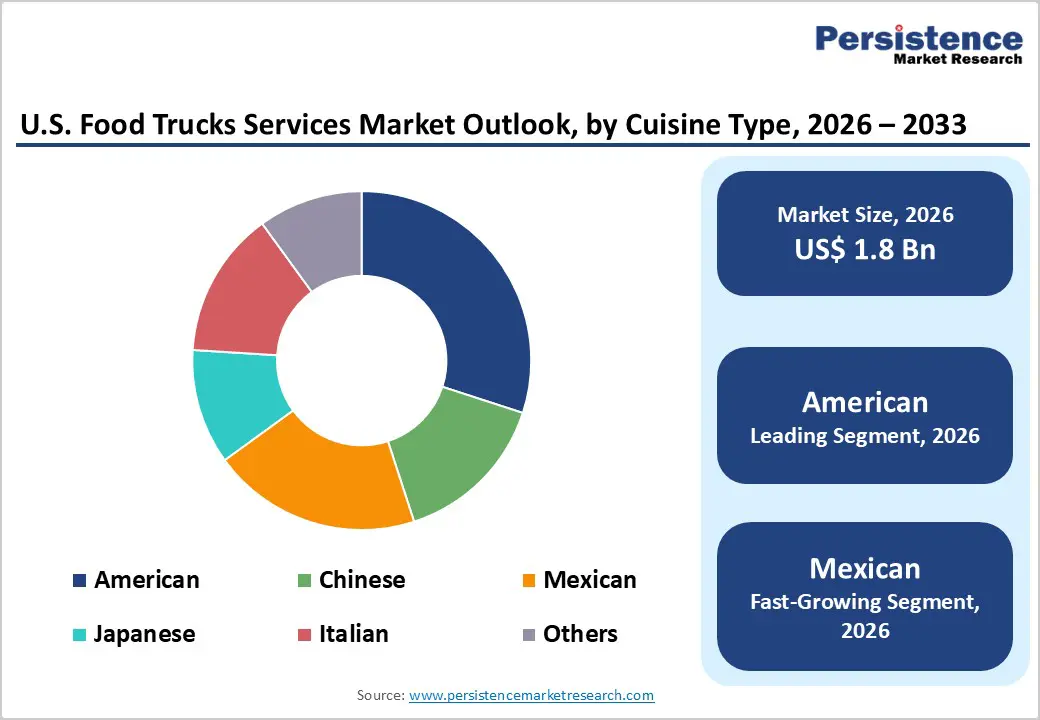
- Leading Cuisine: American is anticipated to be the leading cuisine type, accounting for over 40% of the revenue share in 2026, supported by high demand for burgers, sandwiches, fries, and other familiar fast-food offerings.
- Leading Platform: Mobile vending is estimated to represent the leading platform type in 2026, accounting for 55% of the revenue share, driven by its flexibility in location selection, high foot traffic access, and direct customer engagement.
| Key Insights | Details |
|---|---|
| U.S. Food Trucks Services Market Size (2026E) | US$1.8 Bn |
| Market Value Forecast (2033F) | US$3.1 Bn |
| Projected Growth (CAGR 2026 to 2033) | 8.4% |
| Historical Market Growth (CAGR 2020 to 2025) | 8.0% |
Market Factors – Growth, Barriers, and Opportunity Analysis
Urbanization and Changing Consumer Lifestyles
Cities with high population density create ideal conditions for mobile food services, where limited space, heavy foot traffic, and fast-paced routines favor flexible dining formats over traditional sit-down restaurants. Food trucks thrive in central business districts, transit hubs, campuses, and entertainment zones, offering convenient access to meals without long wait times. As urban development expands mixed-use neighborhoods and outdoor public spaces, food trucks are increasingly integrated into city culture through street markets, food parks, and seasonal events. This trend supports consistent daily demand while also enabling operators to relocate quickly based on consumer movement patterns, maximizing revenue opportunities across multiple locations.
Changing consumer lifestyles reinforce market expansion, as modern consumers prioritize convenience, variety, and experiential dining. Busy work schedules, longer commute times, and the rise of freelance and hybrid work models have increased demand for quick-service food options that fit flexible routines. Food trucks cater effectively to these preferences by offering affordable, freshly prepared meals with diverse menu options, including fast food, ethnic cuisines, and plant-based offerings. Younger demographics, particularly millennials and Gen Z, favor informal dining experiences and value authenticity, social engagement, and novelty qualities strongly associated with food truck culture. Digital adoption has transformed consumption habits, enabling customers to locate trucks, pre-order meals, and engage through social media.
Regulatory Hurdles and Permitting Variability
Food trucks are subject to multiple layers of approval, including health permits, parking licenses, zoning permissions, fire safety inspections, and vehicle compliance standards. These requirements vary widely across states and municipalities, creating operational uncertainty and increasing administrative burdens for vendors. In major cities, restrictions on where and when food trucks can operate such as distance rules from brick-and-mortar restaurants, time-based parking limits, and capped permit numbers can significantly limit revenue potential. Lengthy approval timelines and high permit fees raise entry barriers, particularly for small and first-time operators. Regulatory fragmentation slows market expansion and discourages scalability, especially for food truck owners seeking to operate across multiple cities or regions.
Permitting variability also impacts long-term planning and investment decisions within the market. Food truck operators often face sudden regulatory changes, such as revised zoning laws or permit renewals tied to lotteries, which disrupt business continuity. In some cities, limited permit availability leads to intense competition and informal operating practices, increasing the risk of penalties or shutdowns. Compliance costs associated with meeting evolving health, environmental, and safety standards can strain margins, particularly for independent vendors with limited capital. These challenges are further amplified for customized or eco-friendly trucks, which may face additional inspections and certification requirements. While regulations are intended to ensure public safety and fair competition, the lack of standardized policies across jurisdictions remains a critical constraint, hindering the full growth potential of the U.S. food trucks services market.
Expansion into Online Delivery and Hybrid Models
Growing consumer reliance on food delivery apps has transformed purchasing behavior, encouraging food trucks to integrate with third-party platforms and proprietary ordering systems. Online delivery allows vendors to serve customers outside peak foot-traffic hours and access residential neighborhoods where physical parking may be restricted. This digital channel also supports demand stability during adverse weather or seasonal fluctuations. By leveraging online visibility, food trucks can strengthen brand recognition, improve order predictability, and generate recurring revenue. The increasing acceptance of mobile payments, digital menus, and real-time tracking enhances customer convenience and operational efficiency, positioning delivery-enabled food trucks as competitive alternatives to quick-service restaurants.
Hybrid business models combining mobile vending with online delivery and catering services further expand revenue potential across multiple consumer touchpoints. Food trucks adopting hybrid strategies can operate on streets during peak hours while fulfilling online orders or catering contracts during off-peak periods. This flexibility improves asset utilization and reduces dependency on single-location foot traffic. Hybrid models also support participation in corporate events, private functions, and pop-up collaborations, allowing operators to capture higher-margin opportunities. Data analytics from digital platforms help vendors optimize menus, pricing, and inventory planning. Consumer demand increasingly favors convenience and omnichannel food access, food trucks that successfully integrate mobile, delivery, and event-based services are well positioned to achieve sustained growth within the evolving U.S. foodservice landscape.
Category-wise Analysis
Offering Type Insights
The food segment is projected to remain the dominant force in the U.S. food truck services market, contributing roughly 55% of total revenue in 2026. This leadership is fueled by strong consumer demand for filling, complete meals across both urban and suburban settings. Food-focused trucks benefit from steady, everyday consumption patterns, particularly during lunch and dinner, making them the most dependable revenue drivers in the industry. Vendors specializing in fast food, ethnic cuisines, and gourmet offerings are well positioned to cater to office workers, students, and event-goers seeking convenient yet flavorful meal options. The ability to tailor menus to regional tastes further enhances this segment’s strength. For instance, The Halal Guys exemplify this model through food-centric truck operations that emphasize generous portions and familiar flavors, encouraging repeat visits and high customer traffic. Overall, the food segment’s capacity to handle large order volumes, maintain efficient preparation, and appeal to a broad customer base continues to solidify its leading position within the U.S. food truck landscape.
The dessert and ice cream segment is expected to be the fastest-growing category, driven by experiential dining preferences and impulse purchasing behavior. This segment thrives at festivals, entertainment hubs, and social events, where consumers gravitate toward indulgent and visually appealing treats. Dessert-focused food trucks benefit significantly from social media exposure, as eye-catching and creative offerings tend to generate strong engagement and brand awareness. A notable example is Coolhaus, which has established a successful mobile presence built around premium dessert concepts that appeal strongly to younger demographics. Rising demand for specialty desserts, seasonal options, and customizable products continues to accelerate growth. As consumers increasingly associate food trucks with novelty and enjoyment, dessert and ice cream vendors are emerging as a high-growth segment within the market.
Cuisine Insights
American cuisine is expected to dominate the U.S. food truck services market, accounting for approximately 40% of total revenue in 2026. This leadership is supported by widespread consumer familiarity and steady demand for traditional comfort foods. Popular menu items such as burgers, sandwiches, and fries are ideally suited to mobile food service operations due to their ease of preparation, speed of service, and broad consumer appeal. Food trucks specializing in American cuisine enjoy strong acceptance across all age groups and demographics, making them a common presence in urban areas, business hubs, and public events. Roxy’s Grilled Cheese exemplifies this success by leveraging classic American flavors to generate consistent customer traffic and foster strong brand loyalty. The simplicity, scalability, and affordability of American cuisine continue to underpin its market leadership, positioning it as a core revenue driver within the U.S. food truck ecosystem.
Mexican cuisine, meanwhile, is projected to be the fastest-growing segment through 2026, fueled by consumer enthusiasm for bold flavors and street-style dining experiences. Menu offerings such as tacos and burritos align well with food truck models, providing speed, customization, and value. Mexican food trucks perform particularly well in urban environments and at large-scale events, where high-volume service and flexible menus are essential. A notable example is Kogi BBQ, which combines Mexican street food with innovative flavor profiles to create a distinctive and scalable food truck brand. The cuisine’s adaptability to fusion trends and evolving consumer preferences continues to drive rapid expansion, making it one of the most dynamic segments in the market. Additionally, the vibrant presentation and visually appealing nature of Mexican dishes enhance social media engagement, further boosting brand visibility and customer loyalty.
Platform Type Insights
Mobile vending is estimated to lead the U.S. food trucks services market, accounting for approximately 55% of revenue in 2026, due to its direct engagement with customers in high-traffic environments. This platform enables food trucks to capitalize on spontaneous purchases at business districts, public gatherings, and outdoor events. Mobility enables vendors to rapidly adapt to demand shifts, weather variability, and seasonal opportunities. For example, Cousins Maine Lobster leverages mobile vending to serve a wide range of locations while preserving consistent brand standards. Operating independently of fixed infrastructure provides a clear competitive advantage, enhancing both visibility and customer access. As a result, mobile vending remains a core pillar of the food truck business model, sustaining its dominance across urban and suburban markets.
Online delivery is likely to represent the fastest-growing segment in 2026, driven by increasing digital adoption and changing food consumption habits. Integration with delivery platforms allows food trucks to reach customers beyond physical locations, including residential and remote areas. This model supports revenue generation during non-peak hours and adverse weather conditions. For example, Roaming Hunger illustrates this trend by integrating food truck discovery with digital ordering and catering coordination. Online delivery platforms enhance customer convenience while allowing operators to utilize data insights for demand forecasting and menu optimization. As consumers increasingly prioritize accessibility and digital engagement, online delivery is emerging as the fastest-growing platform within the U.S. food truck ecosystem.
Competitive Landscape
The U.S. food trucks services market exhibits a moderately fragmented structure, driven by a wide mix of independent operators, niche culinary concepts, and established brand-oriented fleets competing across street vending, catering, and mobile events. Unlike highly consolidated industries dominated by a few giants, the food truck services landscape features many regional players targeting local tastes, as well as franchise or brand-led operators that have scaled nationally. Independent ventures and specialty trucks flourish alongside operators that have leveraged social media and experiential branding to build loyal followings. This blend of localized differentiation and innovative positioning creates competitive tension while enabling diverse market participation, reflecting the fragmented but dynamic nature of the sector.
With key leaders including The Halal Guys, Cousins Maine Lobster, Roaming Hunger, Coolhaus, and Roxy’s Grilled Cheese, the market sees competition through strategic differentiation, strong brand identity, and diversification into events, franchising, and digital engagement. These players compete through menu innovation that appeals to evolving consumer preferences, location strategies that maximize high-traffic exposure, and partnerships with event organizers or delivery platforms to broaden reach. Competitive success increasingly hinges on the ability to blend traditional street presence with online visibility, diversified service platforms, and distinctive cuisine offerings, allowing leading vendors to sustain relevance in a crowded marketplace.
Key Industry Developments:
- In January 2026, Cousins Maine Lobster expanded its U.S. food truck footprint with the launch of its fourth food truck in North Carolina, marking its return to the Charlotte market. The new truck debuted with a grand opening event at Town Brewing Co., reinforcing the brand’s strategy of strengthening presence in high-demand urban locations through mobile kitchens. Led by franchise owners Savas and Victoria Alkoc, the expansion reflects sustained consumer demand for premium seafood offerings delivered through food truck formats.
- In December 2025, Whataburger reported continued success of its food truck program and announced plans to add two additional trucks, expanding its fleet to three units by 2026. The expansion highlights the growing role of food trucks as strategic tools for marketing, community engagement, and experiential dining, supporting brand promotion ahead of new restaurant openings.
Companies Covered in U.S. Food Trucks Services Market
- Kogi BBQ
- The Halal Guys
- Cousins Maine Lobster
- Coolhaus
- Roaming Hunger
- Waffle House Inc.
- Roxy's Grilled Cheese
- Stoked Wood Fired Pizza
Frequently Asked Questions
The U.S. food trucks services market is projected to reach US$1.8 billion in 2026.
Rising urbanization, changing consumer lifestyles favoring convenient and diverse dining options, and growing adoption of mobile and digital food service platforms.
The U.S. food trucks services market is expected to grow at a CAGR of 8.4% from 2026 to 2033.
Key market opportunities include expansion into online delivery and hybrid service models, growth in plant-based and gourmet offerings, increasing demand for event catering, and adoption of sustainable and technology-enabled food truck solutions.
Kogi BBQ, The Halal Guys, Cousins Maine Lobster, Coolhaus, Roaming Hunger, Waffle House Inc, Roxy's Grilled Cheese, and Stoked Wood Fired Pizza, are the leading players.


