




- Technology
- Mobile Applications Market
Mobile Applications Market Size, Share, and Growth Forecast 2026 - 2033
Mobile Applications Market by Store Type (Google Play Store, Apple App Store, Other Stores, Progressive Web Apps (PWAs)), Monetization Model (Paid Apps, Freemium and In-App Purchases (IAP), Subscription-Based, Advertising-Supported), Operating System (Android, iOS, HarmonyOS, Others), by Application, and Regional Analysis, 2026 - 2033

Mobile Applications Market Size and Trend Analysis
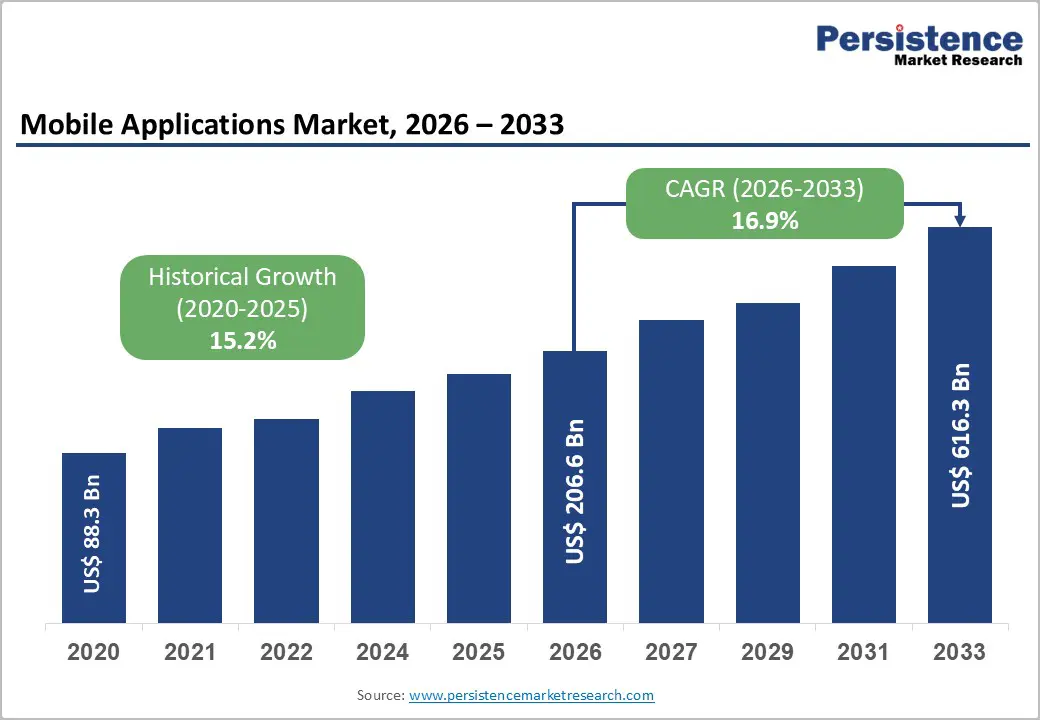
The global mobile applications market size is likely to be valued at US$ 206.6 billion in 2026 and is projected to reach US$ 616.4 billion by 2033, growing at a CAGR of 16.9% between 2026 and 2033. The rapid expansion stems from increasing smartphone penetration and integration of advanced technologies such as 5G and AI, which enhance app functionalities and user experiences worldwide.
Key Market Highlights
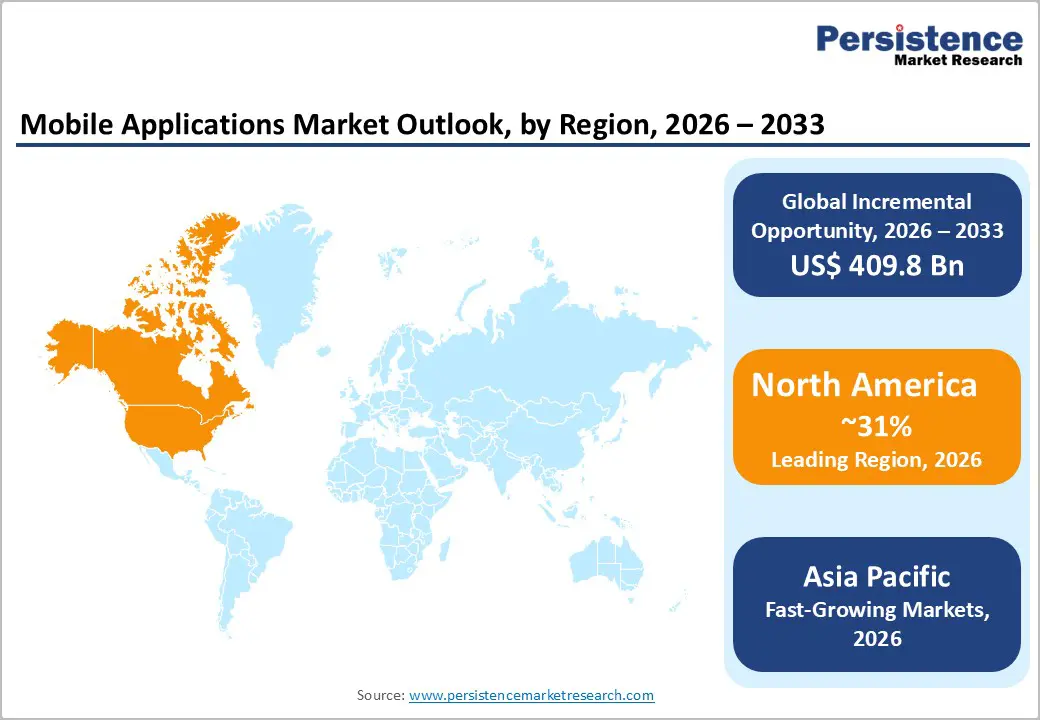
- Leading Region: North America dominates the mobile applications market due to innovation hubs and high spending, holding 31% share with strong U.S. leadership.
- Fastest-Growing Region: Asia Pacific emerges as the fastest-growing region, propelled by 5G adoption and demographics in China and India at 18% CAGR.
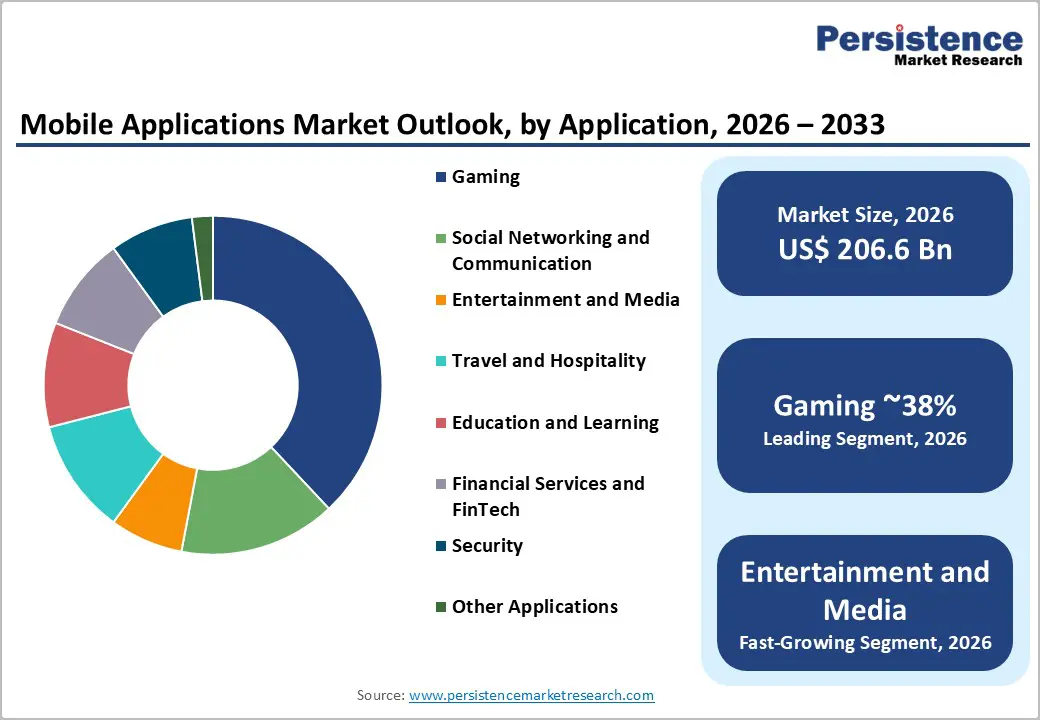
- Leading Segment: Gaming leads application segments with 38% revenue share, driven by high downloads and monetization in entertainment.
- Fastest-Growing Segment: Freemium and IAP models grow fastest in monetization, capturing 50% share through user upgrades and AI personalization.
- Key Opportunity: 5G integrations offer key opportunities for AR/VR apps, potentially adding $500 billion in revenue by 2030.
| Key Insights | Details |
|---|---|
|
Mobile Applications Market Size (2026E) |
US$ 206.6 Bn |
|
Market Value Forecast (2033F) |
US$ 616.4 Bn |
|
Projected Growth CAGR(2026-2033) |
16.9% |
|
Historical Market Growth (2020-2025) |
15.2% |
Market Dynamics
Drivers - Expanding Global Smartphone Usage is Driving Massive Growth and Accessibility in the Mobile Applications Market
The continuous rise in global smartphone usage remains one of the strongest drivers for the mobile applications market. With over 6.8 billion smartphone users in 2024, accounting for more than 85% of the global population, app accessibility and adoption have increased substantially. Emerging economies like India, Brazil, and Indonesia are witnessing exponential app downloads, reaching 110 billion. Platforms such as the Google Play Store enable seamless app distribution to vast audiences.
As smartphones become essential for daily communication, entertainment, and commerce, businesses increasingly rely on mobile applications to strengthen customer engagement. Companies across retail, healthcare, and banking are developing dedicated apps to drive loyalty and convenience. This rapid proliferation of connected users is creating strong revenue opportunities, significantly propelling global market expansion.
Integration of AI and ML is Revolutionizing Mobile Apps with Smarter, More Personalized User Experiences
Artificial Intelligence (AI) and Machine Learning (ML) integration are transforming the mobile applications market, serving as key enablers of smarter, more personalized experiences. Generative AI and ML tools are reshaping app functionalities, ranging from virtual assistants and chatbots to predictive analytics and recommendation systems. According to GSMA, AI-powered apps improve user retention by up to 30%, while monetization forecasts show a 4.1% increase in app revenues due to AI-driven upgrades.
Developers are embedding intelligent automation to streamline processes in sectors such as e-commerce, healthcare, and finance, making apps more intuitive and data-responsive. For example, healthcare apps now predict user needs and offer real-time insights, while retail apps personalize shopping journeys. This growing integration enhances performance, boosts user satisfaction, and attracts developers and investors, collectively fostering long-term market growth.
Restraints - Increasing Data Privacy Laws and Security Risks are Limiting App Adoption and Innovation
Growing data privacy concerns and cybersecurity threats are major challenges limiting mobile application market expansion. As of 2025, around 82% of the world’s population is covered by at least one data protection regulation, such as GDPR or CCPA. These strict frameworks increase compliance costs and discourage aggressive data-driven innovations. Data breaches and high-profile hacks have also caused significant user distrust, resulting in a 15% drop in app downloads for non-compliant developers in Europe and North America.
Fines under GDPR can reach €20 million, forcing companies to invest heavily, often 20–30% more in data protection and encryption technologies. These added expenses slow innovation and complicate app launches. Privacy concerns, especially in regions with high regulatory scrutiny, continue to challenge developers’ ability to collect and use data effectively, restricting the market’s full potential.
Evolving Global Regulations and High Compliance Costs are Creating Obstacles for Developers and Startups
Evolving global regulations, including the EU Cyber Resilience Act and California Consumer Privacy Act (CCPA), are creating significant barriers for app developers. Compliance with these frameworks often increases development budgets by up to 25%, as companies must include robust data protection measures and transparent privacy policies. Around 81% of app users report concerns about how their personal data is collected and used, making compliance crucial for customer trust but expensive to maintain.
Smaller developers, particularly in emerging markets, face additional hurdles such as localization, multiple jurisdictional requirements, and delayed app approvals. These factors collectively slow product launches and innovation cycles. Inconsistent enforcement of data laws further complicates global scalability, increasing operational costs and limiting market participation for startups, ultimately constraining the overall growth of the mobile applications industry.
Opportunity - The Rollout of 5G Networks is Unlocking New Opportunities for Advanced, High-Performance Mobile Applications
The global rollout of 5G networks is creating exciting opportunities for mobile app developers by enabling advanced, high-performance applications. By 2025, 5G connections are expected to reach 2.5 billion, offering ultra-low latency and higher bandwidth for technologies such as AR/VR, cloud gaming, telemedicine, and industrial IoT. This next-generation connectivity enhances app responsiveness, making real-time experiences more immersive and reliable.
The GSMA projects that 5G-enabled services could generate over $500 billion in new revenue by 2030, particularly across entertainment, healthcare, and smart cities. Developers can leverage these networks to create feature-rich apps that deliver instant interactions, video streaming, and collaborative virtual experiences. With Asia-Pacific leading in 5G adoption, mobile applications are poised to capture strong demand, supporting new business models and propelling sustained global market expansion.
Super-App Ecosystems in Emerging Markets are Driving Monetization and User Engagement Growth
Emerging economies represent significant growth potential for mobile applications, particularly through the rise of super-app ecosystems. These all-in-one platforms, popular in Asia-Pacific markets such as India, Indonesia, and Vietnam, integrate services like ride-hailing, payments, shopping, and social media under a single app. Companies like Grab and Gojek have pioneered this trend, driving strong user engagement and monetization opportunities.
According to GSMA, mobile technologies could add $1 trillion to emerging markets’ GDP by 2030, supported by affordable 4G and 5G smartphones. In India alone, app user growth reached 20% in 2024, highlighting increasing digital inclusion. Developers focusing on localized content, payment solutions, and regional language interfaces are well-positioned to capture this momentum. Super-app models, combined with pragmatic regulatory environments, are enabling scalable, multi-layered revenue streams and long-term market sustainability.
Category-wise Analysis
Store Type Insights
The Google Play Store leads the mobile applications market, holding nearly 45% of the total market share due to its open ecosystem and easy accessibility. With over 3.6 million apps available, it caters to Android’s 72.59% global device base, allowing developers to reach billions of users without strict approval barriers. According to GSMA Intelligence, app downloads reached 110 billion in Q1 2025, far exceeding other platforms. Its flexible policies, lower entry costs, and diverse monetization options make it especially dominant in emerging markets, where Android usage continues to rise.
Monetization Model Insights
The Freemium and In-App Purchase (IAP) model dominates mobile app monetization, accounting for around 50% of total revenue. This model allows users free access with optional paid upgrades for premium features, driving continuous revenue growth. In 2025, IAP spending increased by 25% year-over-year, reflecting rising user willingness to pay for convenience and personalization. As per Business of Apps, freemium generates 70% of non-gaming app income, supported by AI-driven personalization that lifts conversion rates by 30%. Its affordability, scalability, and long-term customer value make it the preferred model across industries.
Operating System Insights
Android continues to lead the global mobile applications market with an impressive 73% market share. Backed by 6.8 billion smartphone users, its popularity is driven by affordability, open-source flexibility, and a vast range of device options. Android’s dominance is particularly strong in China, India, and Southeast Asia, where it holds about 66% share, alongside growing adoption of HarmonyOS. Its fragmented ecosystem enables developers to tailor apps for various markets, ensuring wider accessibility and higher engagement, especially across price-sensitive regions.
Application Insights
Gaming remains the top-performing application segment, accounting for roughly 38% of the global mobile app revenue. In 2024, it generated over $196.1 billion, driven by strong demand for simulation, puzzle, and casual games. Around 9.8 billion downloads, while GSMA reports that gaming apps make up 25% of total app downloads worldwide. The rise of 5G networks and cloud gaming has improved play quality and engagement levels. On average, users spend about $120 annually on iOS gaming, making this category the most profitable in the mobile ecosystem.
Regional Insights
North America Mobile Applications Market Trends
North America leads the global mobile applications market, contributing around 31.2% of worldwide revenue, driven by technological innovation and regulatory stability. The presence of tech giants like Apple and Google fosters continuous app development across categories such as AI, finance, and healthcare. The U.S. Federal Communications Commission (FCC) ensures secure 5G infrastructure, with network coverage expected to reach 80% by 2025, enhancing real-time mobile experiences.
According to GSMA, collaborations around mobile finance and digital payments have strengthened the region’s fintech ecosystem, contributing nearly $6.5 trillion to its digital economy. High consumer spending, combined with enterprise adoption of productivity and IoT apps, continues to position North America as a global leader in innovation and profitability within the mobile applications sector.
Europe Mobile Applications Market Trends
Europe’s mobile applications market is characterized by strong regulatory alignment, consumer trust, and steady technological innovation. The region’s 13.1% CAGR growth is driven by demand for secure and privacy-compliant apps under frameworks like GDPR and the EU Cyber Resilience Act. Major economies such as Germany, France, and the U.K. lead in app adoption, with social networking and productivity apps showing robust performance.
In 2025, France and Spain recorded a 15% increase in in-app purchases, while the U.K. saw growth in premium mobile gaming. Harmonized regulations are promoting investment in education and enterprise apps, particularly those emphasizing security and user transparency. Supported by initiatives from GDMA and GSMA, Europe continues to develop a resilient digital ecosystem that balances innovation with strict privacy standards, ensuring sustainable long-term growth.
Asia Pacific Mobile Applications Market Trends
The Asia-Pacific region represents the fastest-growing market for mobile applications, driven by large populations, affordable smartphones, and expanding 5G networks. Countries such as China, India, Japan, and Indonesia lead in app development and consumption. In 2025, HarmonyOS captured 17% of China’s market, while India experienced 20% growth in app users. According to GSMA, the region’s mobile application market is growing at an impressive 18.5% CAGR, supported by strong demand for e-commerce, gaming, and fintech apps.
Japan’s mobile gaming industry thrives on AR and cloud-based experiences, while ASEAN nations benefit from localized apps catering to youth demographics. The combination of digital innovation, favorable regulations, and rising income levels makes Asia-Pacific a powerhouse for app-driven economic expansion and developer opportunities.
Competitive Landscape
The global mobile applications market exhibits a consolidated structure dominated by tech giants, with Google Inc. and Apple Inc. controlling over 95% of app distribution. Companies pursue expansion through R&D in AI and 5G, as evidenced by Huawei's HarmonyOS ecosystem investments. Key differentiators include seamless integrations and privacy features, while emerging models like super-apps promote cross-selling. This concentration fosters innovation but challenges smaller players in a fragmented developer landscape.
Key Market Developments
- In August 2022, The FSSAI launched a dedicated mobile application to strengthen food safety monitoring and enhance real-time communication between consumers and operators, improving transparency and compliance in India’s food sector.
- In May 2025, Huawei announced that HarmonyOS achieved a 17% market share in China, surpassing iOS and significantly strengthening domestic app ecosystems and developer engagement across key verticals
- In March 2025, The GSMA Mobile Economy Report 2025 emphasized the accelerating impact of 5G networks on app innovation, forecasting robust growth across entertainment, healthcare, and industrial applications.
Companies Covered in Mobile Applications Market
- Google Inc.
- Microsoft
- CA
- Cognizant
- Hewlett Packard Enterprise Development LP
- SAP SE
- China Mobile Limited
- Samsung Electronics Co. Ltd.
- Apple Inc.
- Opera Software
- Meta Platforms Inc.
- Amazon.com Inc.
- Tencent Holdings Ltd.
- Others
Frequently Asked Questions
The mobile applications market is expected to reach US$ 616.4 Bn by 2033, growing from US$ 206.6 Bn in 2026 at a 16.9% CAGR.
Key drivers include rising smartphone penetration with 6.8 billion users and AI integrations boosting personalization, alongside 5G enabling new experiences.
Gaming dominates with 38% revenue share, driven by 9.8 billion simulation downloads and high in-app spending.
North America holds leadership with 31% share, supported by U.S. innovation and $21.2 billion App Store revenue.
5G rollouts offer opportunities for AR/VR apps, projecting $500 billion revenue through real-time features in emerging sectors.
Major players include Google Inc., Apple Inc., Microsoft, and Samsung Electronics Co. Ltd., focusing on AI and ecosystem expansions.


