ID: PMRREP3639| 220 Pages | 11 Dec 2025 | Format: PDF, Excel, PPT* | Healthcare
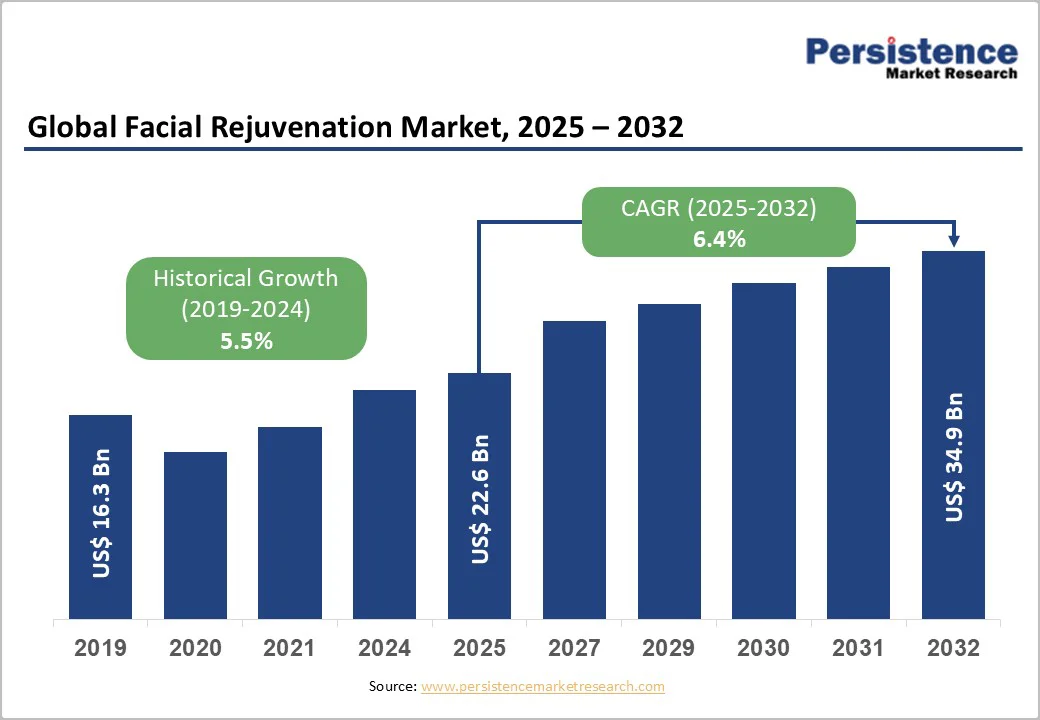
The global facial rejuvenation market size is valued at US$ 22.6 billion in 2025 and is projected to reach US$ 34.9 billion by 2032, growing at a CAGR of 6.4% between 2025 and 2032. Facial rejuvenation has evolved into a mainstream, trusted option for individuals seeking youthful, natural-looking enhancement without the risks or downtime of invasive surgery.
The market increasingly favors minimally invasive solutions-particularly dermal fillers, neuromodulators, and energy-based devices-that deliver visible, targeted corrections for common age-related concerns. These treatments help restore facial volume, smooth fine lines and wrinkles, refine contours, and enhance symmetry while preserving each patient’s unique features. As consumer preference shifts toward subtle, personalized aesthetic outcomes and preventive anti-aging care, non-surgical facial rejuvenation has emerged as a dominant segment within the global aesthetics industry, supported by rapid advancements in materials, techniques, and treatment planning technologies.
| Key Insights | Details |
|---|---|
|
Global Facial Rejuvenation Market Size (2025E) |
US$ 22.6 Billion |
|
Market Value Forecast (2032F) |
US$ 34.9 Billion |
|
Projected Growth (CAGR 2025 to 2032) |
6.4% |
|
Historical Market Growth (CAGR 2019 to 2024) |
5.5% |
The global facial rejuvenation market is experiencing strong momentum, driven by rising procedure volumes, rapid product innovation, and increasing patient preference for minimally invasive treatments. According to the International Society of Aesthetic Plastic Surgery (ISAPS) Global 2024 Survey released at the ISAPS Olympiad World Congress in Singapore, more than 17.4 million surgical and 20.5 million non-surgical procedures were performed globally, reflecting a 42.5% increase over four years. Botulinum toxin and hyaluronic acid fillers (14.1 million) continue to dominate demand, with the United States, Brazil, and Japan leading in total procedures.
Advanced technologies are further accelerating market growth. In November 2025, Lumenis Be. Ltd. introduced its upgraded Stellar M22™ with XPL™ (Extended Pulse Light) Technology, demonstrating ≥70% improvement in a single session at the American Society for Dermatologic Surgery (ASDS) Meeting. Innovations such as AI-powered dermatology, personalized skin analysis, regenerative therapies, and biostimulatory fillers are expanding treatment possibilities and improving outcomes. Responding to rising global demand for enhanced skin quality, Allergan Aesthetics also launched the AA Signature™ program in January 2025 and expanded SKINVIVE® by JUVÉDERM® to 57 markets by September 2025, reinforcing worldwide adoption of injectable skin-quality solutions.
Global facial rejuvenation market growth is increasingly restrained by post-procedure healing complexities and patient recovery challenges. Full-face laser resurfacing often leads to heightened skin sensitivity, where friction from facial coverings can trigger inflammation, acne flare-ups, or secondary infections. Similarly, post-facelift patients may experience delayed healing, as elastic supports can disrupt or irritate stitches behind the ear, prolonging downtime and limiting patient satisfaction.
These issues are further compounded by growing uptake of advanced energy-based devices, which—while effective—require strict adherence to recovery protocols to avoid complications. Clinical guidance from surgical recovery literature emphasizes strict post-procedure protocols—such as controlled cleansing, reduced friction, and limited sun exposure—but inconsistent adherence across regions continues to heighten complication rates and limit optimal outcomes.
Additionally, fear of adverse effects, uneven practitioner expertise, and regional disparities in post-procedure support collectively reduce patient willingness to opt for high-intensity rejuvenation procedures. Together, these factors continue to temper the overall expansion of the global facial rejuvenation market.
The global facial rejuvenation market is entering a high-opportunity phase as consumer demand shifts decisively toward treatments that deliver subtle, natural-looking results rather than dramatic alterations. Opportunities are further amplified by continuous innovation in non-invasive technologies.
In September 2025, Bausch Health Companies Inc. and its aesthetic arm Solta Medical, spotlighted high-demand devices such as Thermage® FLX (radiofrequency-based skin tightening), Clear + Brilliant® Touch (fractional laser for early aging signs), and Fraxel FTX™ (next-generation fractional laser) on The Balancing Act, reflecting rising consumer appetite for energy-based skin revitalization.
Breakthrough device launches also broaden the market’s revenue potential. In May 2025, DEKA (El.En. Group) introduced Physiq 360—combining laser and electrical muscle stimulation—and TORO, a hybrid nano/picosecond laser unveiled at the SIME Congress (Italian Society of Aesthetic Medicine), expanding opportunities in full-body contouring and advanced resurfacing.
Growing clinical evidence strengthens these opportunities. In July 2024, STRATA Skin Sciences’ TheraClear®X demonstrated significant acne improvement, while an October 2025 trial confirmed enhanced vitiligo outcomes using its 308 nm Excimer laser combined with Janus kinase (JAK) inhibitors. Together, demand for natural aesthetics, rapid device innovation, and expanding clinical validation create strong growth headroom across the global facial rejuvenation market.
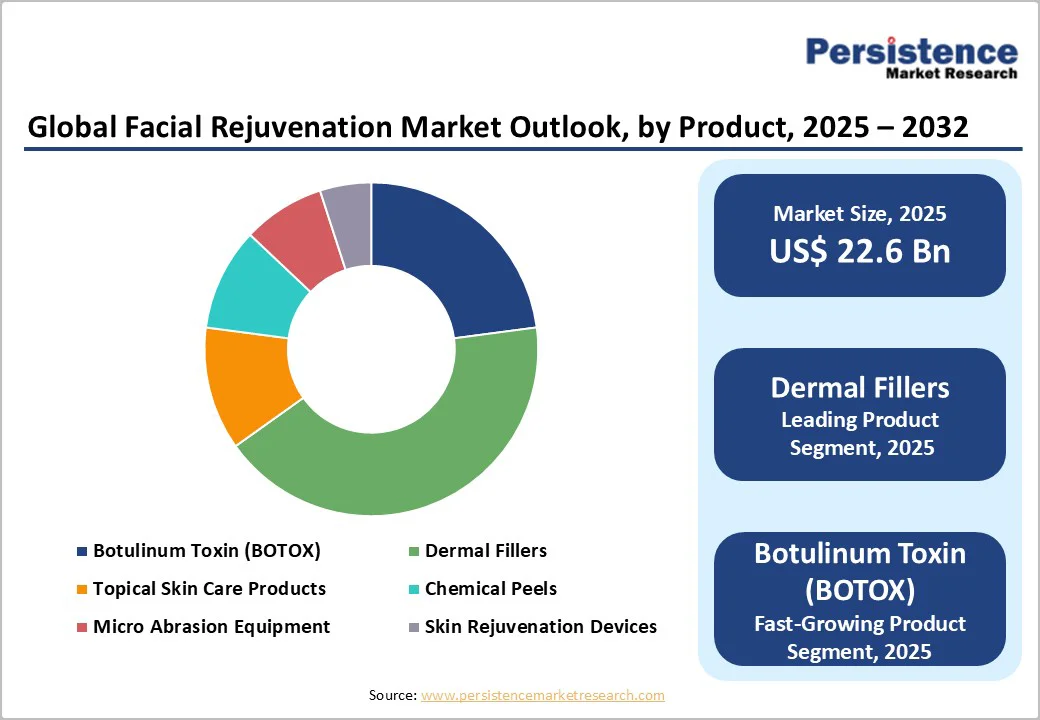
Dermal fillers are expected to capture 42.4% of the global facial rejuvenation market by 2025, driven by their versatility, immediate improvements, and predictable outcomes in volume restoration and contour enhancement. Growing consumer preference for minimally invasive treatments and natural-looking results further strengthens demand.
Combination procedures using dermal fillers with botulinum toxin continue to rise, offering superior facial harmonization and longer-lasting aesthetic benefits. Botulinum toxin also remains the fastest-growing segment, supported by its expanding applications in wrinkle relaxation, skin-quality enhancement, and preventive anti-aging treatments.
Dermatology clinics are projected to command 58.4% of the global facial rejuvenation market in 2025, supported by their strong clinical credibility, experienced practitioners, and access to advanced injectables and energy-based devices. Patients increasingly prefer physician-led settings for safe, customized treatments with proven outcomes.
These clinics also integrate evidence-based skincare to support recovery and enhance procedure durability, creating a seamless continuum of care. As medical-aesthetic standards rise globally, dermatology clinics remain the primary destination for precision-driven, results-oriented rejuvenation procedures.
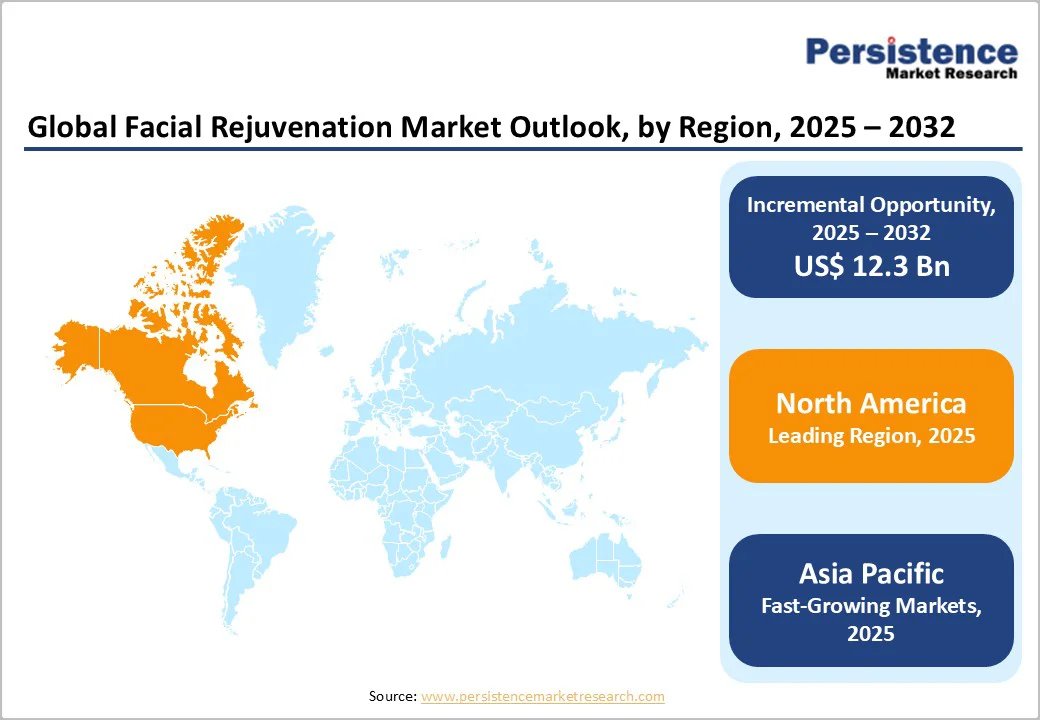
By 2025, North America is projected to account for 61.1% of the global facial rejuvenation market, primarily driven by high adoption of aesthetic and age-defying solutions, strong consumer willingness to undergo cosmetic procedures, and early regulatory frameworks governing cosmetic and aesthetic practices.
According to the 2025 American Society for Dermatologic Surgery (ASDS) Consumer Survey, 70% of respondents reported considering a cosmetic procedure, with nearly 50% influenced by a provider’s social-media presence and 94% relying on rating and review platforms—reflecting strong digital-driven demand.
Growth in the United States is further supported by rising procedure volumes and the broad penetration of minimally invasive facial rejuvenation products aimed at achieving a youthful appearance. Market momentum accelerated after January 14, 2025, when Galderma reported positive interim results from a U.S. phase IV trial evaluating Restylane® Lyft™, Restylane® Contour™, and Sculptra® for facial volume restoration in patients experiencing medication-driven weight loss.
The trial, presented at the 43rd Annual J.P. Morgan (JPM) Healthcare Conference, demonstrated improved facial aesthetic outcomes and high satisfaction using the SHAPE Up Holistic Individualized Treatment (HIT™) methodology—reinforcing clinical validation and expanding clinical-aesthetic adoption across the region.
By 2025, Europe is projected to account for 19.8% of the global facial rejuvenation market, fueled by its rapidly aging population, strong preference for minimally invasive and non-invasive procedures, and wider acceptance of affordable, low-downtime aesthetic treatments over surgical interventions.
Consumers across Germany, France, the United Kingdom, Italy, and Spain continue to adopt injectables, energy-based devices, and medical-grade skincare as part of preventive and age-management routines, supported by the region’s mature dermatology ecosystem and highly skilled practitioner base.
A major accelerator of regional demand is Europe’s shift over the past two decades from surgical facelifts toward non-surgical facial rejuvenation. This trend aligns with rising interest in personalized cosmetic solutions and broader access to advanced treatment platforms across medical-aesthetic clinics.
Technology-led innovation further strengthens Europe’s position. On January 26, 2023, Galderma introduced FACE by Galderma™, an augmented reality (AR) tool showcased at the International Master Course on Aging Science (IMCAS) World Congress in Paris. Developed with Crisalix, a leader in 3D, virtual reality (VR), and AR simulation, the platform enables real-time “before-and-after” visualization using the Five Facet Assessment framework, improving planning accuracy and patient confidence.
Collectively, demographic aging, adoption of less invasive solutions, and rapid integration of digital visualization technologies reinforce Europe’s role as the second-largest global facial rejuvenation market.
The Asia Pacific (APAC) region is among the fastest-growing facial rejuvenation markets, projected to expand at a CAGR of 8.0% over the forecast period. Growth is mainly fueled by a large young-to-middle-aged population, rising beauty awareness, increasing acceptance of minimally invasive procedures, and rapid penetration of advanced aesthetic technologies across China, Japan, South Korea, India, Australia, and Southeast Asia. While chemical peels were historically popular, regional demand has shifted toward botulinum toxin and dermal fillers due to their quick, natural-looking results and minimal downtime—aligned with busy urban lifestyles and premium beauty expectations.
Market expansion is reinforced by active industry participation. In May 2025, U.S.-based 7e Wellness showcased microcurrent-driven dermaceutical innovations at the Aesthetic Medicine India Conference & Exhibition 2025 in Mumbai, reflecting growing demand for science-backed, holistic rejuvenation solutions. South Korea continues to lead clinical innovation. In October 2024, Daewoong Pharmaceutical introduced its “360° full contouring treatment” using Nabota, extending botulinum toxin use beyond wrinkle correction to skin texture and facial/body contouring. Regulatory confidence also strengthened when Daewoong’s NULOOK clinic earned the highest PARIPURNA accreditation from Indonesia’s Ministry of Health in February 2025.
The competitive landscape is shaped by a mix of global aesthetic technology developers, biotechnology innovators, and skincare-focused medical device providers. Competition centers on advanced non-invasive rejuvenation systems, next-generation injectable solutions, and clinically validated dermatology platforms. Market players increasingly prioritize regulatory expansion, digital treatment planning tools, and integrated skincare–aesthetic portfolios to strengthen positioning. Continuous innovation in energy-based devices and combination therapies further intensifies market rivalry.
The global facial rejuvenation market is valued at US$ 22.6 Billion in 2025.
Rising aesthetic awareness, aging demographics, technological innovation, and increasing demand for minimally invasive cosmetic procedures drive market growth.
The global market is poised to witness a CAGR of 6.4% between 2025 and 2032.
Expanding non-surgical solutions, personalized treatment planning, device–injectable synergies, and strong demand for natural-looking, long-lasting results offer major growth opportunities.
Major players in the global are Merz Pharma, Anika Therapeutics, Inc., Lumenis Be Ltd., Galderma, Contura International Ltd., Allergen (AbbVie Inc.), and others.
| Report Attribute | Details |
|---|---|
|
Historical Data/Actuals |
2019 - 2024 |
|
Forecast Period |
2025 - 2032 |
|
Market Analysis |
Value: US$ Bn |
|
Geographical Coverage |
|
|
Segmental Coverage |
|
|
Competitive Analysis |
|
|
Report Highlights |
|
By Product
By End-user
By Region
Delivery Timelines
For more information on this report and its delivery timelines please get in touch with our sales team.
About Author