
Disc Cutter Market Size, Share, and Growth Forecast for 2025 - 2032

Disc Cutter Market by Cutting Capacity (Up to 100 Kg/Hr, 101 to 200 Kg/Hr, 201 to 300 Kg/Hr, Above 300 Kg/Hr), by Type of Meat (Chicken, Beef, Pork, Turkey, Others), by Operation Type (Semi-Automatic, Automatic), and Regional Analysis

ID: PMRREP33437
Calendar

July 2025

281 Pages

Author : Jitendra Deviputra

Disc Cutter Market Size and Share Analysis

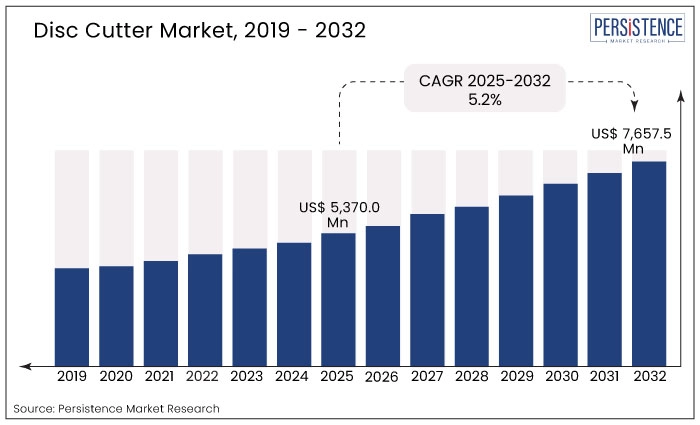
According to Persistence Market Research, the Global Disc Cutter Market was valued at US$ 5,119.20 million in 2024 and is projected to reach US$ 7,657.5 million by the end of 2032, expanding at a CAGR of 5.2% from 2025 to 2032.

Disc cutters are safer than conventional cutting techniques. They help avoid workplace mishaps such as cuts and injuries, which can happen frequently while using conventional cutting instruments. Increasing emphasis on efficiency, productivity, and safety in the industry is reflected in the high demand for disc cutters equipped with safety measures to help prevent workplace mishaps.

  • Sales of disc cutters currently account for 5% to 8% share of global meat processing equipment market revenue.

Increasing consumption of meat and growth of the food service industry have fuelled the demand for disc cutters across the world. These machines are commonly used in the food processing industry to slice and cut meat, produce, and other food products. Disc cutters can assist companies in reducing their capital expenditure if manufacturers emphasize efficiency and productivity.

Demand for disc cutters is expected to continue increasing as more businesses seek to improve their safety protocols and operational efficiency. This trend is expected to be particularly noticeable in emerging economies where the meat processing industry is experiencing rapid growth. In developed countries where food safety and quality are becoming increasingly important, there is also expected to be a rise in demand for high-quality disc cutters that meet stringent regulatory standards.

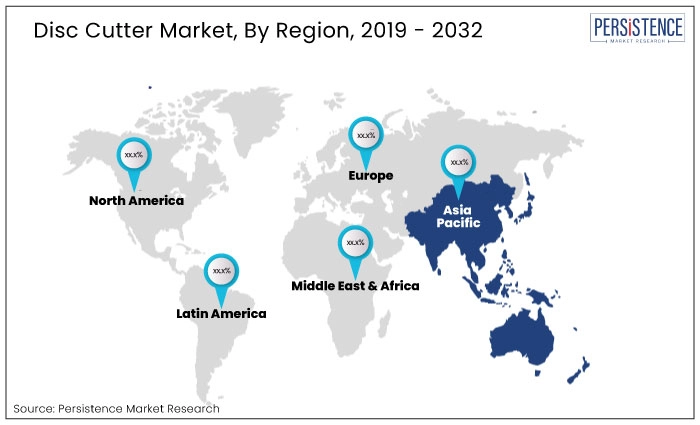
  • East Asia is projected to account for 29.6% share of the global disc cutter market by 2032.
disc-cutter-market-2019-2032

Attribute Key Insights

Disc Cutter Market Size (2024A)

US$ 5,119.20 Million

Estimated Market Value (2025E)

US$ 5,370.0 Million

Projected Market Value (2032F)

US$ 7,657.5 Million

Global Market Growth Rate (2025 to 2032)

5.2%

Collective Value Share of Top 3 Countries (2024)

54%

Sales Analysis of Disc Cutters (2019 to 2024) Vs. Market Outlook (2025 to 2032)

Sales of disc cutters increased at a CAGR of 4.9% from 2019 to 2024. Using meat processing equipment such as a disc cutter can significantly reduce the risk of damage compared to traditional cutting techniques. Conventional methods involving sharp tools for cutting meat or other materials can result in muscle pain, fatigue, and other repetitive motion injuries for employees.

Operators who use their hands and wrists repeatedly are more likely to develop carpal tunnel syndrome. It can impair a worker's ability to do their job by causing discomfort, numbness, and tingling in their hands and fingers. Repetitive actions that may cause such injuries can be avoided by using a disc-cutting machine. Utilizing a disc cutter can boost productivity and efficiency in meat processing plants in addition to lowering the risk of physical damage.

These tools are designed to rapidly and precisely chop meat, which can assist businesses in exceeding their production targets and increasing profitability. Sales of disc cutters are expected to increase at a CAGR of 5.2% over the forecast period (2025 to 2032).

What are the Market Factors Driving Demand for Disc Cutters?

It is anticipated that the need for meat processing machinery, especially meat-cutter machines, will rise as a result of the expansion of the fast-food industry and the increasing popularity of meat-based fast food. As the demand for meat-based products increases, companies are looking for solutions to efficiently and rapidly handle large quantities of meat while also maintaining strict hygienic standards.

Businesses can meet the growing demand for meat-based products while maintaining the safety and quality of their products using disc cutters. End users are investing in automation, especially meat-cutter machines, to increase productivity and lower operational costs as a result of the rising demand for meat-based products.

Meat-cutting equipment can assist businesses in adhering to hygienic and food safety regulations. These machines can precisely cut meat and lower the risk of contamination by using cutting technologies including high-pressure water jets and ultrasonics. All such prominent parameters are expected to boost the demand for disc cutters and create an absolute dollar opportunity of US$ 28.3 million over the forecast period.

Country-wise Analysis

How is the Demand for Disc Cutters Shaping Up in China?

China accounts for 82% share of the East Asia disc cutter market in 2025. Meat consumption in China, one of the largest consumers of beef globally, has exhibited a significant increase, particularly in pork and poultry, in recent years. This trend can be attributed to the growth of the country's middle class and the subsequent rise in disposable income.

China's meat processing business is expanding quickly along with the country's rising demand for meat products. Numerous Chinese meat processing businesses are investing in cutting-edge machinery, such as meat-cutter machines, to increase production and efficiency to fulfill the rising demand for meat products. This is expected to boost sales of disc cutters in China over the forecast period.

Region-wise Insights

Which Region is Expected to Account for High Sales of Disc Cutters?

Demand for disc cutters in the meat processing industry is anticipated to rise throughout Europe. Several sizable meat processing facilities in the region provide meat for both domestic and foreign markets. These businesses are coming under more and more pressure to increase productivity, reduce expenditure, and uphold strict standards for food safety and hygiene.

Disc cutters may assist businesses in meeting these objectives. They are made to swiftly and accurately cut meat into a variety of shapes and sizes, which can save waste and boost output. Disc cutters are an appealing alternative for meat processing businesses of all sizes since they are simple to use and can be tailored to fit certain processing.

Several European countries such as Spain are focusing on meat processing equipment due to rising meat consumption across the region. Europe is estimated to occupy 26% share of the global market in 2025 and create an absolute dollar opportunity of US$ 8.7 million over the forecast period.

Why is South Asia Pacific a Lucrative Market for Disc Cutter Manufacturers?

With a sizable and expanding population and rising disposable incomes, South Asia & Pacific is exhibiting an increase in demand for processed meat products.

In India, the market for processed meat is anticipated to expand rapidly over the next few years as a result of factors including consumers’ evolving preferences, escalating urbanization, and growing health concerns.

  • For instance, the Indian government has launched several initiatives to expand the processed meat sector in the nation to meet the rising demand for meat. This entails giving small- and medium-sized businesses (SMEs) in the meat processing industry subsidies and incentives as well as encouraging investments in R&D to enhance the quality and safety of processed meat products. This in turn will boost the demand for cutting machines.

Production and consumption of processed meat products in the country are anticipated to rise significantly as a result of the Indian government's attempts to expand the processed meat sector. This would not only satisfy the rising demand for meat products but also open up new economic prospects for companies in the meat processing sector.

Meat processing businesses across the globe are under pressure to expand their production capabilities while maintaining high standards of effectiveness and quality due to the rising demand for meat products. Companies can accomplish this by using disc-cutting machines to process beef, pork, and chicken. Disc-cutting equipment can assist meat processing businesses in adapting to changing consumer demands, such as those for smaller quantities of meat or more uniform sizes and shapes.

In the food service sector, where clients would expect consistent meat products across several locations or menu items, this can be particularly crucial. The need for disc-cutting machines and other meat processing equipment is expected to increase as demand for meat products rises in South Asia & Pacific. This creates profitable opportunities for both the producers of these machines and businesses engaged in the meat processing sector.
disc-cutter-market-by-region-2019-2032

Category-wise Insights

Which Meat-based Segment is Anticipated to Exhibit Significant Growth?

Disc cutters for chicken hold a prominent share of the global market. Chicken is one of the most widely consumed meat types in the world, and over the past few decades, its ubiquity has been rising gradually. This is partly because it is more readily available and less expensive than other meats like beef or pork. The chicken segment is expected to grow at a CAGR of 5.2% through 2032.

Which Cutting-Capacity-based Disc Cutters are Most Widely Used?

Disc cutters with a cutting capacity of 101 to 300 kg/hr are expected to generate high demand throughout several locations and create an absolute dollar opportunity of about US$ 15.9 million over the forecast period. This machine can help businesses enhance their production capacities, lower labor costs, and boost overall efficiency by processing larger amounts of meat in less time.

Meat processing businesses may be able to fulfill the rising demand for meat products while maintaining quality and portion sizes thanks to the improved processing capacity of disc cutters ranging from 100 to 300 kg/hr. In the food service sector, where customers expect consistent goods across many locations or menu items, this can be especially crucial.

Greater flexibility in processing various types of meat, such as chicken, beef, pork, and other meats, may be provided by disc cutters. This can be especially helpful for market participants who create a variety of meat products and need to rapidly and effectively swap between different types of meat.

Competitive Landscape

Disc cutter manufacturers are continuously under pressure to boost the performance of these machines due to their design and safety features. In this relatively fragmented industry, a large number of companies-most notably Frontmatec Group, Marel Industries, Poultry Processing Equipment Worldwide Ltd., Maragatham Enterprises, and Longer Machinery-are dominant players in the market.

Manufacturing companies want to increase their supply of disc cutters through the introduction of new products and collaborations.

  • In April 2022, Marel acquired Sleegers Technique, a Dutch provider of interleaving, under-leaving, and loading solutions. This acquisition allows Marel to expand its offerings to include more comprehensive line solutions for the processing of prepared foods.

Companies Covered in Disc Cutter Market

  • Marel
  • Frontmatec Group
  • Poultry Processing Equipment Worldwide Ltd.
  • Maragatham Enterprises
  • Longer Machinery
  • Henan Joyshine machinery
  • Hebei QIQIANG Metal products Co. Ltd
  • Guardian
  • Jiazou Newest machinery Co. Ltd
  • Green City Company
Frequently Asked Questions

As of 2024, the global disc cutter market is valued at US$ 5,119.20 million.

The market is expected to reach US$ 7,657.5 million by 2032.

The market is projected to expand at a CAGR of 5.2% from 2025 to 2032.

Disc cutters reduce the risk of injuries compared to conventional cutting tools, enhancing workplace safety.

East Asia is projected to hold a 29.6% share of the global market by 2032.

Disc Cutter Industry Report Scope
Attributes Details

Forecast Period

2025 to 2032

Historical Data Available for

2019 to 2024

Market Analysis

Value: US$ Bn/Mn, Volume: As applicable 

Key Regions Covered

  • North America
  • Latin America
  • Europe
  • East Asia
  • South Asia & Pacific
  • The Middle East & Africa

Key Countries Covered

  • United States
  • Canada
  • Brazil
  • Mexico
  • Germany
  • United Kingdom
  • France
  • Italy
  • Spain
  • Russia
  • Nordic Countries
  • China
  • Japan
  • South Korea
  • India
  • ASEAN Countries
  • Australia
  • New Zealand
  • Gulf Co-operation Council Countries
  • Türkiye
  • North African Countries
  • South Africa

Key Market Segments Covered

  • Product Type
  • Cutting Capacity
  • Cutter Diameter
  • Operation Type
  • Type of Meat
  • Region

Key Companies Profiled

  • Marel
  • Frontmatec Group
  • Poultry Processing Equipment Worldwide Ltd.
  • Maragatham Enterprises
  • Longer Machinery
  • Henan Joyshine machinery
  • Hebei QIQIANG Metal Products Co. Ltd.
  • Guardian
  • Jiazou Newest Machinery Co. Ltd.
  • Green City Company

Pricing

Available upon Request

Key Segments of Disc Cutter Industry Research

By Cutting Capacity:

  • Up to 100 Kg/Hr
  • 101 to 200 Kg/Hr
  • 201 to 300 Kg/Hr
  • Above 300 Kg/Hr

By Type of Meat:

  • Chicken
  • Beef
  • Pork
  • Turkey
  • Others

By Operation Type:

  • Semi-Automatic
  • Automatic

By Cutter Diameter:

  • Below 8 Inches
  • 8 Inches & Above

By Product Type:

  • Individual Units
  • Disc-shaped Components

By Region:

  • North America
  • Latin America
  • Europe
  • East Asia
  • South Asia & Pacific
  • Middle East & Africa

Related Reports

1. Executive Summary

    1.1. Global Disc Cutter Market Outlook

    1.2. Demand Side Trends

    1.3. Supply Side Trends

    1.4. Technology Roadmap

    1.5. Analysis and Recommendations

2. Market Overview

    2.1. Market Coverage / Taxonomy

    2.2. Market Definition / Scope / Limitations

3. Key Market Trends

    3.1. Key Trends Impacting the Market

    3.2. Product Innovation / Development Trends

4. Key Success Factors

    4.1. Product Adoption / Usage Analysis

    4.2. Product USPs / Features

    4.3. Strategic Promotional Strategies

5. Global Disc Cutter Market Demand Analysis 2019–2024 and Forecast, 2025-2032

    5.1. Historical Market Volume (Units) Analysis, 2019–2024

    5.2. Current and Future Market Volume (Units) Projections, 2025-2032

    5.3. Y-o-Y Growth Trend Analysis

6. Global Disc Cutter Market - Pricing Analysis

    6.1. Regional Pricing Analysis

    6.2. Global Average Pricing Analysis Benchmark

7. Global Disc Cutter Market Demand (in Value or Size in US$ Mn) Analysis 2019–2024 and Forecast, 2025-2032

    7.1. Historical Market Value (US$ Mn) Analysis, 2019–2024

    7.2. Current and Future Market Value (US$ Mn) Projections, 2025-2032

        7.2.1. Y-o-Y Growth Trend Analysis

        7.2.2. Absolute $ Opportunity Analysis

8. Market Background

    8.1. Macro-Economic Factors

        8.1.1. Global GDP Overview

        8.1.2. Industry-Value-Added Overview

        8.1.3. Food and Beverages Industry Value Added Overview

        8.1.4. Global Population Outlook

        8.1.5. Global Urbanization Outlook

        8.1.6. Global Pork Production Overview

        8.1.7. Global Meat Production Overview

        8.1.8. Global Beef Meat Production Outlook

        8.1.9. Parent Market Analysis

    8.2. Forecast Factors - Relevance & Impact

        8.2.1. GDP Growth

        8.2.2. Urban Population Growth Outlook

        8.2.3. Increasing Production capacities

        8.2.4. Key Technology Development

        8.2.5. Meat Consumption Outlook

        8.2.6. New product Launches

    8.3. Value Chain

        8.3.1. Raw Material Suppliers

        8.3.2. Product Manufacturers

        8.3.3. List of Dealer/ Distributors

    8.4. COVID-19 Crisis – Impact Assessment

        8.4.1. Current Statistics

        8.4.2. Short-Mid-Long Term Outlook

        8.4.3. Likely Rebound

    8.5. Market Dynamics

        8.5.1. Drivers

        8.5.2. Restraints

        8.5.3. Opportunity Analysis

9. Global Disc Cutter Market Analysis 2019–2024 and Forecast 2025-2032, By Cutting Capacity

    9.1. Introduction / Key Findings

    9.2. Historical Market Size (US$ Mn) and Volume Analysis By Cutting Capacity, 2019–2024

    9.3. Current and Future Market Size (US$ Mn) and Volume Analysis and Forecast By Cutting Capacity, 2025-2032

        9.3.1. Upto 100 Kg/Hr

        9.3.2. 101 - 200 Kg/Hr

        9.3.3. 201-300 Kg/Hr

        9.3.4. Above 300 Kg/Hr

    9.4. Market Attractiveness Analysis By Cutting Capacity

10. Global Disc Cutter Market Analysis 2019–2024 and Forecast 2025-2032, By Product Type of Meat

    10.1. Introduction / Key Findings

    10.2. Historical Market Size (US$ Mn) and Volume Analysis By Product Type of Meat, 2019–2024

    10.3. Current and Future Market Size (US$ Mn) and Volume Analysis and Forecast By Product Type of Meat, 2025-2032

        10.3.1. Chicken

        10.3.2. Beef

        10.3.3. Pork

        10.3.4. Turkey

        10.3.5. Others

    10.4. Market Attractiveness Analysis By Product Type of Meat

11. Global Disc Cutter Market Analysis 2019–2024 and Forecast 2025-2032, By Operation Type

    11.1. Introduction / Key Findings

    11.2. Historical Market Size (US$ Mn) and Volume Analysis By Operation Type, 2019–2024

    11.3. Current and Future Market Size (US$ Mn) and Volume Analysis and Forecast By Operation Type, 2025-2032

        11.3.1. Semi-Automatic

        11.3.2. Automatic

    11.4. Market Attractiveness Analysis By Operation Type

12. Global Disc Cutter Market Analysis 2019–2024 and Forecast 2025-2032, by Cutter Diameter

    12.1. Introduction / Key Findings

    12.2. Historical Market Size (US$ Mn) and Volume Analysis By Cutter Diameter, 2019–2024

    12.3. Current and Future Market Size (US$ Mn) and Volume Analysis and Forecast By Cutter Diameter, 2025-2032

        12.3.1. Below 8 Inch

        12.3.2. 8 Inch and Above

    12.4. Market Attractiveness Analysis By Cutter Diameter

13. Global Disc Cutter Market Analysis 2019–2024 and Forecast 2025-2032, By Product Type

    13.1. Introduction / Key Findings

    13.2. Historical Market Size (US$ Mn) and Volume Analysis By Product Type, 2019–2024

    13.3. Current and Future Market Size (US$ Mn) and Volume Analysis and Forecast By Product Type 2025-2032

        13.3.1. Standalone Unit

        13.3.2. Disc Shaped Component

    13.4. Market Attractiveness Analysis By Product Type

14. Global Disc Cutter Market Analysis 2019–2024 and Forecast 2025-2032, by Region

    14.1. Introduction

    14.2. Historical Market Size (US$ Mn) and Volume Analysis By Region, 2019–2024

    14.3. Current Market Size (US$ Mn) and Volume Analysis and Forecast By Region, 2025-2032

        14.3.1. North America

        14.3.2. Latin America

        14.3.3. Europe

        14.3.4. East Asia

        14.3.5. South Asia and Pacific

        14.3.6. Middle East and Africa

    14.4. Market Attractiveness Analysis By Region

15. North America Market Analysis 2019–2024 and Forecast 2025-2032

    15.1. Introduction

    15.2. Pricing Analysis

    15.3. Historical Market Size (US$ Mn) and Volume Trend Analysis By Market Taxonomy, 2019–2024

    15.4. Market Size (US$ Mn) and Volume Forecast By Market Taxonomy, 2025-2032

        15.4.1. By Country

            15.4.1.1. U.S.

            15.4.1.2. Canada

        15.4.2. By Cutting Capacity

        15.4.3. By Type of Meat

        15.4.4. Operation Type

        15.4.5. By Region

        15.4.6. By Product Type

    15.5. Market Attractiveness Analysis

        15.5.1. By Country

        15.5.2. By Cutting Capacity

        15.5.3. By Type of Meat

        15.5.4. Operation Type

        15.5.5. By Cutter Diameter

        15.5.6. By Product Type

16. Latin America Market Analysis 2019–2024 and Forecast 2025-2032

    16.1. Introduction

    16.2. Pricing Analysis

    16.3. Historical Market Size (US$ Mn) and Volume Trend Analysis By Market Taxonomy, 2019–2024

    16.4. Market Size (US$ Mn) and Volume Forecast By Market Taxonomy, 2025-2032

        16.4.1. By Country

            16.4.1.1. Brazil

            16.4.1.2. Mexico

            16.4.1.3. Rest of Latin America

        16.4.2. By Cutting Capacity

        16.4.3. By Type of Meat

        16.4.4. Operation Type

        16.4.5. By Cutter Diameter

        16.4.6. By Product Type

    16.5. Market Attractiveness Analysis

        16.5.1. By Country

        16.5.2. By Cutting Capacity

        16.5.3. By Type of Meat

        16.5.4. Operation Type

        16.5.5. By Cutter Diameter

        16.5.6. By Product Type

17. Europe Market Analysis 2019–2024 and Forecast 2025-2032

    17.1. Introduction

    17.2. Pricing Analysis

    17.3. Historical Market Size (US$ Mn) and Volume Trend Analysis By Market Taxonomy, 2019–2024

    17.4. Market Size (US$ Mn) and Volume Forecast By Market Taxonomy, 2025-2032

        17.4.1. By Country

            17.4.1.1. Germany

            17.4.1.2. Italy

            17.4.1.3. France

            17.4.1.4. U.K.

            17.4.1.5. Spain

            17.4.1.6. BENELUX

            17.4.1.7. Russia

            17.4.1.8. Rest of Europe

        17.4.2. By Cutting Capacity

        17.4.3. By Type of Meat

        17.4.4. Operation Type

        17.4.5. By Cutter Diameter

        17.4.6. By Product Type

    17.5. Market Attractiveness Analysis

        17.5.1. By Country

        17.5.2. By Cutting Capacity

        17.5.3. By Type of Meat

        17.5.4. Operation Type

        17.5.5. By Cutter Diameter

        17.5.6. By Product Type

18. East Asia Market Analysis 2019–2024 and Forecast 2025-2032

    18.1. Introduction

    18.2. Pricing Analysis

    18.3. Historical Market Size (US$ Mn) and Volume Trend Analysis By Market Taxonomy, 2019–2024

    18.4. Market Size (US$ Mn) and Volume Forecast By Market Taxonomy, 2025-2032

        18.4.1. By Country

            18.4.1.1. China

            18.4.1.2. Japan

            18.4.1.3. South Korea

        18.4.2. By Cutting Capacity

        18.4.3. By Type of Meat

        18.4.4. Operation Type

        18.4.5. By Cutter Diameter

        18.4.6. By Product Type

    18.5. Market Attractiveness Analysis

        18.5.1. By Country

        18.5.2. By Cutting Capacity

        18.5.3. By Type of Meat

        18.5.4. Operation Type

        18.5.5. By Cutter Diameter

        18.5.6. By Product Type

19. South Asia and Pacific Market Analysis 2019–2024 and Forecast 2025-2032

    19.1. Introduction

    19.2. Pricing Analysis

    19.3. Historical Market Size (US$ Mn) and Volume Trend Analysis By Market Taxonomy, 2019–2024

    19.4. Market Size (US$ Mn) and Volume Forecast By Market Taxonomy, 2025-2032

        19.4.1. By Country

            19.4.1.1. India

            19.4.1.2. ASEAN

            19.4.1.3. Oceania

            19.4.1.4. Rest of South Asia & Pacific

        19.4.2. By Cutting Capacity

        19.4.3. By Type of Meat

        19.4.4. Operation Type

        19.4.5. By Cutter Diameter

        19.4.6. By Product Type

    19.5. Market Attractiveness Analysis

        19.5.1. By Country

        19.5.2. By Cutting Capacity

        19.5.3. By Type of Meat

        19.5.4. Operation Type

        19.5.5. By Cutter Diameter

        19.5.6. By Product Type

20. Middle East and Africa Market Analysis 2019–2024 and Forecast 2025-2032

    20.1. Introduction

    20.2. Pricing Analysis

    20.3. Historical Market Size (US$ Mn) and Volume Trend Analysis By Market Taxonomy, 2019–2024

    20.4. Market Size (US$ Mn) and Volume Forecast By Market Taxonomy, 2025-2032

        20.4.1. By Country

            20.4.1.1. GCC Countries

            20.4.1.2. Türkiye

            20.4.1.3. Northern Africa

            20.4.1.4. South Africa

            20.4.1.5. Rest of Middle East and Africa

        20.4.2. By Cutting Capacity

        20.4.3. By Type of Meat

        20.4.4. Operation Type

        20.4.5. By Cutter Diameter

        20.4.6. By Product Type

    20.5. Market Attractiveness Analysis

        20.5.1. By Country

        20.5.2. By Cutting Capacity

        20.5.3. By Type of Meat

        20.5.4. Operation Type

        20.5.5. By Cutter Diameter

        20.5.6. By Product Type

21. Country Wise Market Analysis 2025-2032

    21.1. Introduction

        21.1.1. Market Value Proportion Analysis, By Key Countries

        21.1.2. Global Vs. Country Growth Comparison

    21.2. U.S. Market Analysis

        21.2.1. By Cutting Capacity

        21.2.2. By Type of Meat

        21.2.3. Operation Type

        21.2.4. By Cutter Diameter

        21.2.5. By Product Type

    21.3. Canada Market Analysis

        21.3.1. By Cutting Capacity

        21.3.2. By Type of Meat

        21.3.3. Operation Type

        21.3.4. By Cutter Diameter

        21.3.5. By Product Type

    21.4. Mexico Market Analysis

        21.4.1. By Cutting Capacity

        21.4.2. By Type of Meat

        21.4.3. Operation Type

        21.4.4. By Cutter Diameter

        21.4.5. By Product Type

    21.5. Brazil Market Analysis

        21.5.1. By Cutting Capacity

        21.5.2. By Type of Meat

        21.5.3. Operation Type

        21.5.4. By Cutter Diameter

        21.5.5. By Product Type

    21.6. Germany Market Analysis

        21.6.1. By Cutting Capacity

        21.6.2. By Type of Meat

        21.6.3. Operation Type

        21.6.4. By Cutter Diameter

        21.6.5. By Product Type

    21.7. Italy Market Analysis

        21.7.1. By Cutting Capacity

        21.7.2. By Type of Meat

        21.7.3. Operation Type

        21.7.4. By Cutter Diameter

        21.7.5. By Product Type

    21.8. France Market Analysis

        21.8.1. By Cutting Capacity

        21.8.2. By Type of Meat

        21.8.3. Operation Type

        21.8.4. By Cutter Diameter

        21.8.5. By Product Type

    21.9. U.K. Market Analysis

        21.9.1. By Cutting Capacity

        21.9.2. By Type of Meat

        21.9.3. Operation Type

        21.9.4. By Cutter Diameter

        21.9.5. By Product Type

    21.10. Spain Market Analysis

        21.10.1. By Cutting Capacity

        21.10.2. By Type of Meat

        21.10.3. Operation Type

        21.10.4. By Cutter Diameter

        21.10.5. By Product Type

    21.11. BENELUX Market Analysis

        21.11.1. By Cutting Capacity

        21.11.2. By Type of Meat

        21.11.3. Operation Type

        21.11.4. By Cutter Diameter

        21.11.5. By Product Type

    21.12. Russia Market Analysis

        21.12.1. By Cutting Capacity

        21.12.2. By Type of Meat

        21.12.3. Operation Type

        21.12.4. By Cutter Diameter

        21.12.5. By Product Type

    21.13. China Market Analysis

        21.13.1. By Cutting Capacity

        21.13.2. By Type of Meat

        21.13.3. Operation Type

        21.13.4. By Cutter Diameter

        21.13.5. By Product Type

    21.14. Japan Market Analysis

        21.14.1. By Cutting Capacity

        21.14.2. By Type of Meat

        21.14.3. Operation Type

        21.14.4. By Cutter Diameter

        21.14.5. By Product Type

    21.15. S. Korea Market Analysis

        21.15.1. By Cutting Capacity

        21.15.2. By Type of Meat

        21.15.3. Operation Type

        21.15.4. By Cutter Diameter

        21.15.5. By Product Type

    21.16. India Market Analysis

        21.16.1. By Cutting Capacity

        21.16.2. By Type of Meat

        21.16.3. Operation Type

        21.16.4. By Cutter Diameter

        21.16.5. By Product Type

    21.17. ASEAN Market Analysis

        21.17.1. By Cutting Capacity

        21.17.2. By Type of Meat

        21.17.3. Operation Type

        21.17.4. By Cutter Diameter

        21.17.5. By Product Type

    21.18. Australia and New Zealand Market Analysis

        21.18.1. By Cutting Capacity

        21.18.2. By Type of Meat

        21.18.3. Operation Type

        21.18.4. By Cutter Diameter

        21.18.5. By Product Type

    21.19. GCC Countries Market Analysis

        21.19.1. By Cutting Capacity

        21.19.2. By Type of Meat

        21.19.3. Operation Type

        21.19.4. By Cutter Diameter

        21.19.5. By Product Type

    21.20. Türkiye Market Analysis

        21.20.1. By Cutting Capacity

        21.20.2. By Type of Meat

        21.20.3. Operation Type

        21.20.4. By Cutter Diameter

        21.20.5. By Product Type

    21.21. Northern Africa Market Analysis

        21.21.1. By Cutting Capacity

        21.21.2. By Type of Meat

        21.21.3. Operation Type

        21.21.4. By Cutter Diameter

        21.21.5. By Product Type

    21.22. South Africa Market Analysis

        21.22.1. By Cutting Capacity

        21.22.2. By Type of Meat

        21.22.3. Operation Type

        21.22.4. By Cutter Diameter

        21.22.5. By Product Type

22. Market Structure Analysis

    22.1. Market Analysis by Tier of Companies Market Share Analysis of Top Players

    22.2. Market Presence Analysis

23. Competition Analysis

    23.1. Competition Dashboard

    23.2. Competition Benchmarking

    23.3. Competition Deep Dive

        23.3.1. Marel

            23.3.1.1. Overview

            23.3.1.2. Product Portfolio

            23.3.1.3. Profitability by Market Segments (Product/Channel/Region)

            23.3.1.4. Sales Footprint

            23.3.1.5. Strategy Overview

        23.3.2. Frontmatec Group

            23.3.2.1. Overview

            23.3.2.2. Product Portfolio

            23.3.2.3. Profitability by Market Segments (Product/Channel/Region)

            23.3.2.4. Sales Footprint

            23.3.2.5. Strategy Overview

        23.3.3. Poultry Processing Equipment Worldwide Ltd.

            23.3.3.1. Overview

            23.3.3.2. Product Portfolio

            23.3.3.3. Profitability by Market Segments (Product/Channel/Region)

            23.3.3.4. Sales Footprint

            23.3.3.5. Strategy Overview

        23.3.4. Maragatham Enterprises

            23.3.4.1. Overview

            23.3.4.2. Product Portfolio

            23.3.4.3. Profitability by Market Segments (Product/Channel/Region)

            23.3.4.4. Sales Footprint

            23.3.4.5. Strategy Overview

        23.3.5. Longer Machinery

            23.3.5.1. Overview

            23.3.5.2. Product Portfolio

            23.3.5.3. Profitability by Market Segments (Product/Channel/Region)

            23.3.5.4. Sales Footprint

            23.3.5.5. Strategy Overview

        23.3.6. Henan Joyshine machinery

            23.3.6.1. Overview

            23.3.6.2. Product Portfolio

            23.3.6.3. Profitability by Market Segments (Product/Channel/Region)

            23.3.6.4. Sales Footprint

            23.3.6.5. Strategy Overview

        23.3.7. Hebei QIQIANG Metal products Co. Ltd

            23.3.7.1. Overview

            23.3.7.2. Product Portfolio

            23.3.7.3. Profitability by Market Segments (Product/Channel/Region)

            23.3.7.4. Sales Footprint

            23.3.7.5. Strategy Overview

        23.3.8. Guardian

            23.3.8.1. Overview

            23.3.8.2. Product Portfolio

            23.3.8.3. Profitability by Market Segments (Product/Channel/Region)

            23.3.8.4. Sales Footprint

            23.3.8.5. Strategy Overview

        23.3.9. Jiazou Newest machinery Co. Ltd

            23.3.9.1. Overview

            23.3.9.2. Product Portfolio

            23.3.9.3. Profitability by Market Segments (Product/Channel/Region)

            23.3.9.4. Sales Footprint

            23.3.9.5. Strategy Overview

        23.3.10. Green City Company

            23.3.10.1. Overview

            23.3.10.2. Product Portfolio

            23.3.10.3. Profitability by Market Segments (Product/Channel/Region)

            23.3.10.4. Sales Footprint

            23.3.10.5. Strategy Overview

24. Assumptions and Acronyms Used

25. Research Methodology

Research Methodology Framework for Market Research Excellence

At Persistence Market Research, we implement a comprehensive, validated, and multi-dimensional approachto market analysis that delivers actionable insights across complex market landscapes. Our methodology combines the analytical rigor of leading consulting firms with innovative research techniques, ensuring robust market assessments that guide strategic decision-making with confidence.

Core Research Philosophy

Our methodology is built on four foundational pillars:

Research Philosophy Image

At Persistence Market Research, our methodology is designed to transcend conventional market studies by combining analytical rigor, multi-source validation, and future-focused insights.

We integrate advanced research frameworks, robust data collection strategies, cutting-edge analytics, and innovative technologies to deliver a 360-degree view of complex markets.

We integrate advanced research frameworks, robust data collection strategies, cutting-edge analytics, and innovative technologies to deliver a 360-degree view of complex markets.

Each stage spanning from strategic scoping and hypothesis-building to competitive intelligence, quality validation, and actionable recommendations is engineered to provide clients with unmatched clarity, precision, and confidence in decision-making.

By embedding innovation and technology at the core, our approach ensures that insights are not only comprehensive but also predictive, empowering businesses to seize opportunities, mitigate risks, and achieve sustainable growth

Research Philosophy Image

Capturing Key Information and Events

During this phase, key research objectives focus on essential information and data points for assessing the market, including:

Research Philosophy Image

TAM-SAM-SOM Framework Implementation

We employ both top-down and bottom-up approaches to ensure accurate market sizing.

Top-Down Market SizingBottom-Up Market Sizing
Universe Definition: Total global/regional market identificationUnit Economics: Average transaction values, purchase frequencies, customer lifecycle
Segmentation Filters: Geographic, demographic, and behavioral constraintsCustomer Segmentation: Detailed buyer persona development and sizing
Market Share Analysis: Competitive landscape assessment and share allocationPenetration Analysis: Market penetration rates by segment and geography
Growth Rate Application: Historical trends and forward-looking growth assumptionsScaling Methodology: Extrapolation techniques with confidence intervals

Validation & Cross-Verification

  • Triangulation: Comparing top-down and bottom-up results for consistency
  • Sensitivity Analysis: Testing key assumptions and parameter variations
  • Peer Benchmarking: Comparison with analogous markets and industry benchmarks
  • Expert Review: External validation through industry specialist consultation

Research Philosophy Image

Forecasting & Projection Modeling

Our proprietary forecasting models incorporate multiple variables and scenarios.

Forecasting Components

  • Historical Trend Analysis: 10-year historical growth patterns and cyclical variations
  • Driver-Based Modeling: Economic indicators, demographic shifts, technology adoption
  • Scenario Planning: Base case, optimistic, and conservative projections
  • Monte Carlo Simulations: Probability-weighted outcomes and risk assessments

Model Validation

  • Back-Testing: Historical accuracy assessment over 3–5-year periods
  • Cross-Validation: Multiple modeling approaches for result comparison
  • External Benchmarking: Comparison with established market forecasts
  • Continuous Calibration: Quarterly model updates based on new data

Comprehensive Data Collection Strategy

Our secondary research phase establishes a robust knowledge base utilizing diverse, credible sources.

Secondary Data Sourcess

  • Industry Publications & Reports
  • Government & Regulatory Data
  • Financial Intelligence (filings & reports)
  • Academic Research & Digital Intelligence

Quality Assurance Protocol

  • Source credibility assessment and publication date validation
  • Data consistency checks across multiple sources
  • Bias identification and neutralization techniques
  • Information gap tracking for primary research prioritization

Research Philosophy Image

Primary Research Excellence

Our primary research methodology employs best-in-class techniques to capture unique market insights.

Quantitative Research Methods

  • Large-Scale Surveys: Statistically representative samples with 95% confidence intervals
  • Survey Methodology: Multi-channel deployment (online, telephone, in-person)
  • Question Architecture and Response Optimization

Qualitative Research Methods

  • Executive Interviews
  • Focus Groups
  • Expert Consultations

Quality Assurance & Validation Framework

Multi-Stage Validation Process

  • Source Verification and Consistency Testing
  • Outlier Detection and Bias Assessment
  • Peer Review Process and External Validation
  • Sensitivity Analysis and Confidence Intervals

Research Philosophy Image

Methodology Validation & Credibility

Our research methodology has been extensively validated through:

  • Academic Partnerships: Collaborations with top-tier business schools and research institutions
  • Client Success Stories: Documented case studies demonstrating research impact and ROI
  • Continuous Benchmarking: Performance comparison with leading global research firms

This comprehensive methodology framework positions Persistence Market Research at the forefront of market intelligence, combining the analytical sophistication of top-tier consulting firms with innovative research techniques. Our approach ensures that every market assessment delivers precise, actionable, and strategically valuable insights that drive business success in competitive market environments.

Ready to unlock your market potential? Contact our research experts to discuss how our validated methodology can transform your strategic decision-making with data-driven market intelligence.

Copyright © 2026 Persistence Market Research. All Rights Reserved

Connect With Us -