




- Hardware & Software IT Services
- Thin Client Market
Thin Client Market Size, Share, and Growth Forecast 2026 – 2033
Thin Client Market by Product Type (Zero Clients, Thin Clients, Hybrid Thin Clients), by Operating System (Windows-based, Linux-based, Android-based, Proprietary OS), by Deployment Model (On-Premises, Cloud-based, Hybrid), by End-User (BFSI, Healthcare, IT & Telecom, Retail, Manufacturing, Energy & Utilities, Transportation & Logistics, Others), by Regional Analysis, 2026–2033

Thin Client Market Size and Trend Analysis
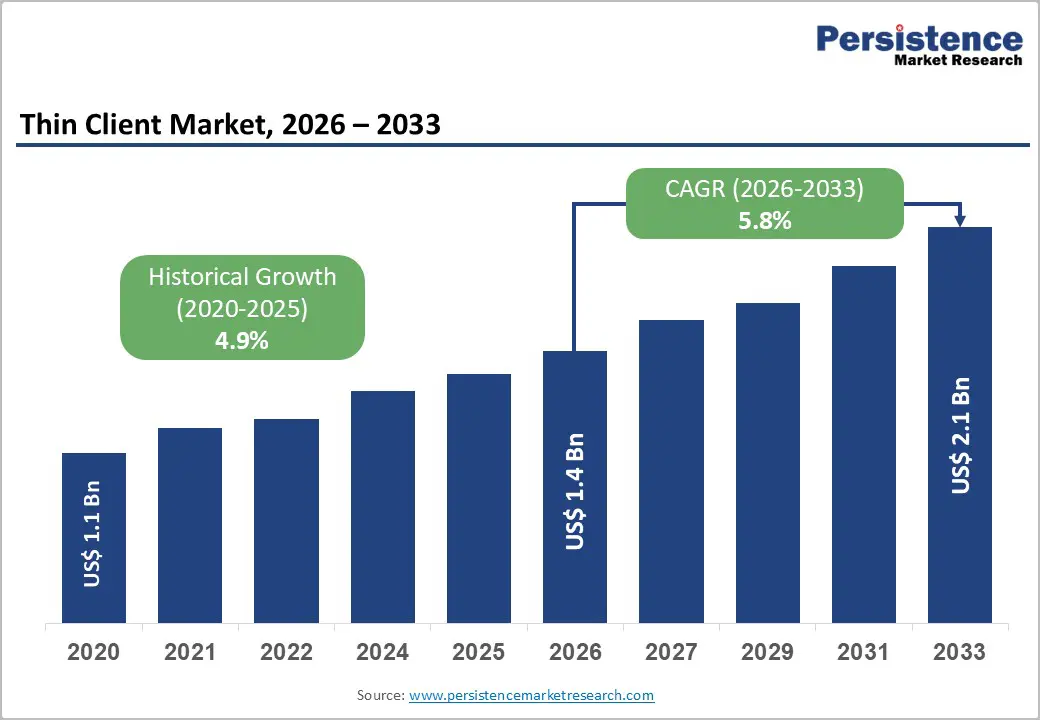
The global Thin Client Market size is likely to be valued at US$ 1.4 Billion in 2026 and is expected to reach US$ 2.1 Billion by 2033, growing at a CAGR of 5.8% during the forecast period from 2026 and 2033. The market's sustained expansion is driven by accelerating adoption of Virtual Desktop Infrastructure (VDI), proliferation of remote and hybrid work models, and stringent regulatory compliance requirements across regulated industries.
Key Market Highlights
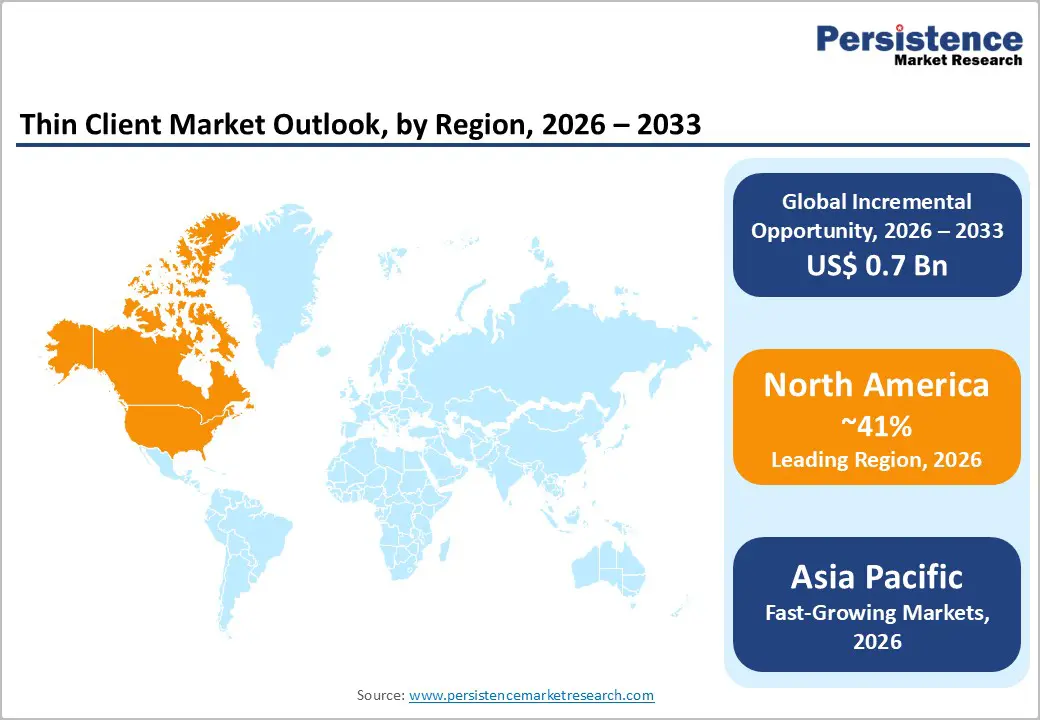
- Leading region: North America leads the Thin Client Market with approximately 41% market share, supported by mature cloud infrastructure, high enterprise IT spending, advanced security frameworks, and widespread VDI adoption across BFSI, government, and technology sectors.
- Fastest-growing region: Asia Pacific represents the fastest-growing Thin Client Market, expanding at 11.4% CAGR, driven by rapid digital transformation in China, India, Japan, burgeoning e-commerce ecosystems, and strong government digitalization initiatives across the region.
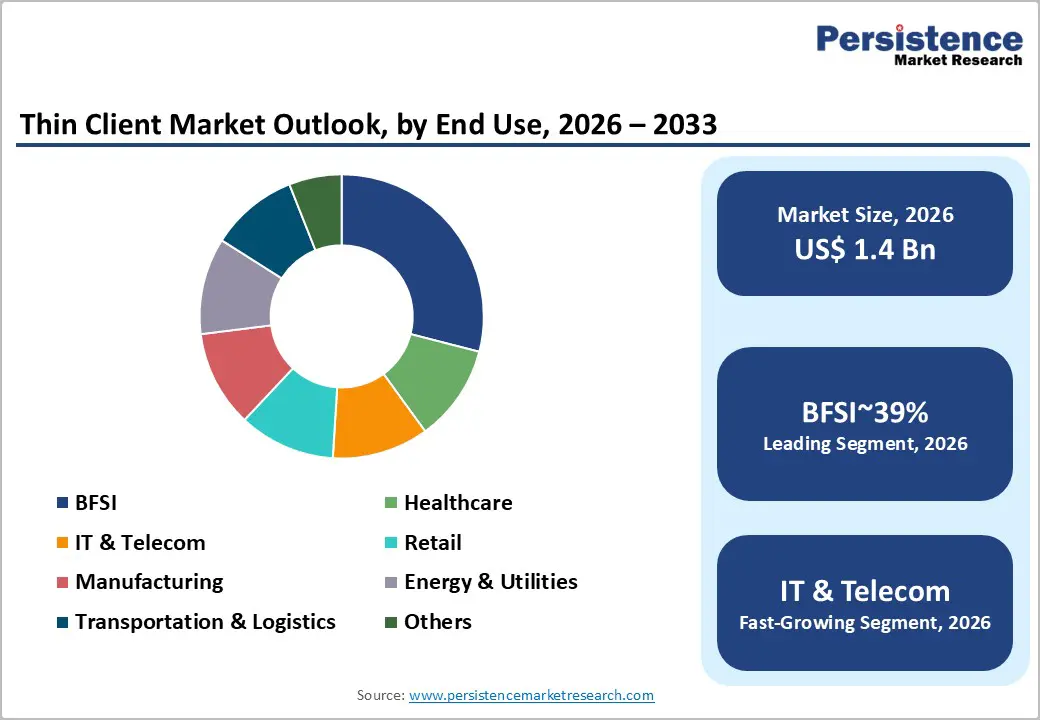
- Dominant segment: By End-User, BFSI is the leading segment, leveraging thin clients for secure, compliant transaction processing, real-time risk analytics, and strict regulatory adherence to PCI-DSS and financial sector frameworks.
- Fastest-growing segment: Healthcare is the fastest-growing End-User vertical, expanding at 11.3% CAGR, propelled by telemedicine adoption, cloud-based EHR systems, HIPAA compliance requirements, and simplified clinician access to patient records.
- Key market opportunity: Healthcare digitalization initiatives, Industry 4.0 manufacturing transformation, and edge computing infrastructure buildout create substantial opportunities for vendors offering specialized thin client solutions with industry-specific configurations and managed security services.
| Key Insights | Details |
|---|---|
| Thin Client Market Size (2026E) | US$ 1.4 Billion |
| Market Value Forecast (2033F) | US$ 2.1 Billion |
| Projected Growth CAGR (2026–2033) | 5.8% |
| Historical Market Growth (2020–2025) | 4.9% |
Market Dynamics
Market Growth Drivers
Rising Adoption of Virtual Desktop Infrastructure and Cloud-Based Computing
Virtual Desktop Infrastructure (VDI) deployment is accelerating as enterprises modernize endpoint strategies, driving strong demand for thin client infrastructure as the optimal access device for centralized computing. Market analyses indicate that VDI market growth exceeds 12.6% CAGR, creating substantial pull-through demand for compatible thin client endpoints. Cloud-based computing models, coupled with Device-as-a-Service (DaaS) offerings, enable organizations to shift from capital-intensive hardware procurement to operational expense models, reducing long-term total cost of ownership.
Small and medium-sized enterprises are particularly attracted to cloud-based thin client deployments that eliminate complex on-premise infrastructure management. Additionally, integration of thin clients with advanced virtualization platforms, containerized workloads, and edge computing architectures strengthens the fundamental appeal of lightweight endpoints for enterprises pursuing infrastructure simplification and cost optimization.
Expansion of Remote and Hybrid Work Models Coupled with Security Compliance Requirements
The structural shift toward remote and hybrid work arrangements is fundamentally reshaping endpoint computing demand, with 60% of remote-capable employees preferring hybrid models according to Gallup 2024 data, and hybrid positions appearing in 24% of new job postings in 2025. Thin clients address the unique requirements of distributed workforces by delivering secure, manageable, and consistent access to enterprise applications from any location without locally storing sensitive data.
Simultaneously, stringent regulatory frameworks such as GDPR, HIPAA, and PCI-DSS compel organizations in BFSI, healthcare, and government sectors to deploy single-tenant, centrally-managed infrastructure that thin clients provide. Zero-trust security principles increasingly mandate continuous authentication and micro-segmentation, capabilities that thin client architectures enable through centralized policy enforcement. This convergence of workforce distribution trends and compliance imperatives creates sustained, multi-year demand for thin client solutions across regulated enterprises.
Market Restraints
High Implementation Complexity and Skill Gaps in Deployment
Transitioning to thin client environments demands specialized expertise in VDI configuration, network architecture, hypervisor management, and end-user computing optimization—capabilities that many IT organizations lack in-house. Hybrid deployments combining thin clients with legacy systems introduce integration complexities that can extend implementation timelines and increase project costs.
Mid-market organizations with limited IT budgets often struggle to justify thin client investments when lower-cost, commodity-based virtual machine instances are readily available from hyperscalers. The absence of comprehensive managed services in certain geographies further constrains adoption, particularly among resource-constrained organizations that require turnkey solutions including implementation, optimization, and ongoing support.
Capital and Operational Cost Considerations Among Price-Sensitive Organizations
While thin clients reduce long-term operational expenses through lower power consumption and reduced support costs, upfront procurement costs and infrastructure investments can deter budget-conscious enterprises. Server infrastructure investments required to support thin client deployments represent a barrier for smaller organizations that cannot amortize these costs across large user populations. Furthermore, licensing costs for specialized thin client operating systems, virtualization platforms, and management software add to the total cost of ownership, particularly in deployments requiring proprietary or highly customized configurations.
Market Opportunities
Acceleration of Healthcare Digitalization and Telemedicine Infrastructure Buildout
The healthcare sector represents the fastest-growing vertical within the thin client market, driven by accelerating adoption of telemedicine, cloud-based electronic health records (EHR), and AI-driven diagnostics requiring secure, HIPAA-compliant computing infrastructure. Healthcare organizations prioritize thin client deployments to achieve rapid log-on times (as fast as three seconds in documented implementations), simplified patient data access protocols, and rigorous compliance with data protection mandates.
Thin clients enable healthcare providers to repurpose aging PC endpoints into compliant thin terminals, reducing capital expenses while extending asset lifecycles. Emerging use cases in remote patient monitoring, distributed clinical analytics, and multi-site healthcare networks create substantial addressable market opportunities for vendors offering healthcare-specific thin client solutions bundled with compliance tooling and managed security services.
Expansion into Industrial and Manufacturing Digital Transformation Initiatives
Manufacturing and industrial sectors increasingly deploy thin clients to support Industry 4.0 initiatives, digital twins, real-time production monitoring, and advanced analytics platforms that benefit from centralized, secure computing infrastructure. Edge-proximate thin client deployments enable low-latency access to production data and control systems while maintaining strict isolation from operational technology networks.
Specialized thin client configurations optimized for harsh manufacturing environments, featuring fanless operation, extended temperature ranges, and ruggedized form factors, address unmet demand in industrial settings. As manufacturers accelerate digital transformation, driven by supply chain resilience imperatives and advanced analytics requirements, demand for customized thin client solutions tailored to manufacturing workflows is expected to generate significant revenue opportunities for specialized vendors and solution integrators.
Category-wise Insights
Product Type Analysis
Within product types, traditional Thin Clients remain the dominant category, accounting for an estimated around 58% of market revenue, reflecting their maturity and widespread deployment across enterprises. Thin Clients deliver the optimal balance between performance, cost-efficiency, and simplicity for centralized computing architectures, supporting the majority of virtual desktop infrastructure and cloud workspace deployments.
Zero Clients, representing approximately 22% of the market, are specialized devices emphasizing maximum security through firmware-only operation and eliminated local storage, gaining adoption in highly regulated environments such as BFSI and government. Hybrid Thin Clients, estimated at 20% market share, are emerging devices combining thin and full-client capabilities, enabling organizations to balance flexibility with security and cost efficiency. The sustained dominance of traditional thin clients reflects their proven compatibility with existing virtualization platforms, extensive vendor ecosystem support, and proven operational reliability across diverse deployment scenarios.
Operating System Analysis
By operating system, Linux-based thin client platforms, particularly proprietary distributions such as IGEL OS, represent the fastest-growing segment at an estimated 12.8% CAGR through 2033. Linux-based solutions offer vendors and enterprises greater flexibility, enhanced security through open-source transparency, freedom from licensing constraints, and seamless integration with cloud-native architectures and containerized workloads.
Windows-based thin clients remain the largest segment by installed base at approximately 55%, reflecting decades of enterprise familiarity and integration with legacy Microsoft environments. However, Windows-based growth is moderating as organizations recognize Linux-based advantages in security posture, total cost of ownership, and compatibility with modern cloud infrastructure. Android-based thin clients are emerging for specialized mobile and edge computing use cases, while proprietary OS solutions are declining as commoditization pressures and vendor consolidation accelerate in the market.
Deployment Model Analysis
By deployment model, On-Premises thin client infrastructure remains dominant with approximately 62% market share, particularly prevalent in highly regulated industries requiring strict data control, network isolation, and compliance with sector-specific mandates. Organizations in BFSI, healthcare, and government continue to prefer on-premise deployments to maintain complete control over infrastructure, ensure regulatory compliance, and avoid cross-border data transfer complications.
Cloud-based deployment models represent the fastest-growing segment, expanding at an estimated 11.2% CAGR as enterprises migrate to Software-as-a-Service (SaaS) platforms and cloud-native architectures. Cloud-based thin client solutions, delivered via Device-as-a-Service (DaaS) models, offer compelling value propositions for mid-market organizations and distributed enterprises seeking operational simplicity and reduced capital expenditure. Hybrid deployment architectures, enabling organizations to combine on-premise and cloud-based resources, are emerging as an important category for enterprises pursuing multi-cloud strategies and gradual infrastructure modernization.
Regional Insights
North America Thin Client Market Trends
North America dominates the global Thin Client Market with an estimated 41% market share, underpinned by advanced cloud infrastructure maturity, high IT spending intensity, and widespread VDI adoption across enterprise segments. The United States leads regional demand, driven by large-scale deployments in BFSI, government agencies, and technology companies that prioritize security, compliance, and operational efficiency. The U.S. Thin Client Market reached approximately US$ 0.40 Billion in 2023 and is expanding at an estimated 2.91% CAGR, supported by strong virtualization technology adoption and rising demand for energy-efficient computing solutions.
Regulatory frameworks emphasizing data protection and sector-specific cybersecurity requirements, including Executive Order 14028 mandating zero-trust security in federal IT systems, reinforce thin client adoption across government and critical infrastructure sectors. The region's mature ecosystem of vendors, integrators, and managed service providers, combined with widespread enterprise cloud adoption, sustains North America's market leadership position. Organizations across healthcare, financial services, and professional services are increasingly standardizing on thin client architectures to support hybrid workforce arrangements, enhance security posture, and optimize infrastructure costs.
Europe Thin Client Market Trends
Europe's Thin Client Market is characterized by stringent data protection regulations and growing emphasis on digital sovereignty, with countries such as Germany, the United Kingdom, France, and Spain driving regional adoption. GDPR compliance requirements mandate that organizations implement robust data protection controls, centralized management capabilities, and audit logging, attributes strongly aligned with thin client infrastructure. European enterprises in BFSI, healthcare, and public administration sectors leverage thin clients to achieve compliance while reducing operational complexity. The region benefits from established virtualization ecosystems, strong security culture, and vendor investments by leading global providers such as IGEL, HP, and Dell, which maintain substantial European operations and support localized service delivery.
Manufacturing sectors in Germany and France are increasing thin client deployments to support Industry 4.0 initiatives, digital transformation, and shop-floor modernization programs. Regulatory harmonization across the European Union and initiatives promoting trusted, federated cloud infrastructures further strengthen the market opportunity. Infrastructure investment programs and digital transformation initiatives across public sectors in United Kingdom, Spain, and France are generating substantial demand for secure, compliant, centrally-managed computing infrastructure that thin clients provide.
Asia Pacific Thin Client Market Trends
The Asia Pacific Thin Client Market is the fastest-growing regional market, expanding at an estimated 11.4% CAGR through 2033, driven by rapid digital transformation, accelerating cloud adoption, and rising demand for energy-efficient and secure computing infrastructure. China dominates the Asia Pacific market, leveraging its expanding IT and telecom infrastructure, government digitalization initiatives, and growing enterprise adoption of VDI and cloud-based solutions across BFSI, education, healthcare, and IT sectors. Japan is an important market characterized by early virtualization adoption, stringent security culture, and strong demand for low-latency, high-performance computing infrastructure. India is witnessing rapid thin client adoption among IT services companies, digital payment platforms, and software-as-a-service providers seeking cost-effective, secure computing infrastructure.
Across ASEAN nations, governments and enterprises are modernizing IT infrastructure to support smart city projects, 5G network deployments, and advanced manufacturing initiatives. Thin client deployments in regional data centers enable customers to achieve low-latency access to applications and comply with data residency regulations, addressing critical concerns in countries implementing digital sovereignty requirements. Cost-competitive data center construction, abundant skilled IT workforce resources, and substantial government investments in digital transformation initiatives position Asia Pacific as the highest-growth region for thin client solutions through 2033.
Competitive Landscape
Market Structure Analysis
The Thin Client Market exhibits moderate consolidation, with established hardware vendors such as Dell, HP, Lenovo, and Samsung competing alongside specialized thin client vendors including IGEL, Ncomputing, Centerm, and 10Zig. IGEL emerges as the dominant software-based thin client provider, having transitioned from hardware manufacturing to focus exclusively on operating system software and endpoint management solutions. Competition is increasingly focused on software-defined endpoints, integrated management platforms, and service delivery models rather than hardware differentiation alone.
Leading vendors are investing heavily in partnerships with hyperscalers, virtualization software companies, and system integrators to strengthen market position. Emerging business models emphasize consumption-based pricing, managed services, and bundled solutions combining hardware, software, and support. Strategic partnerships, such as collaborations between IGEL and HP, Lenovo, Dell, and LG, are reshaping competitive dynamics by enabling hardware vendors to offer software-optimized thin client solutions.
Key Market Developments
- In November, 2024: IGEL expanded its IGEL Ready program to include over 100 technology partners, strengthening interoperability and ecosystem compatibility across heterogeneous hardware platforms and enterprise software environments.
- In January, 2025: Dell, HP, and Lenovo showcased next-generation thin client and workstation solutions at CES 2025, emphasizing AI-integrated processors, enhanced security features, and improved performance for demanding workloads.
- In March, 2025: IGEL and Lenovo announced expanded partnership to deliver IGEL OS pre-loaded on Lenovo thin client devices globally, strengthening market coverage and customer accessibility to enterprise-grade thin client solutions.
Companies Covered in Thin Client Market
- Samsung
- Lenovo
- LG Electronics
- Dell
- HP
- Ncomputing
- Centerm
- IGEL
- 10Zig
- Fujitsu
- Praim Srl
Frequently Asked Questions
The global Thin Client Market is projected to grow from US$ 1.4 Billion in 2026 to approximately US$ 2.1 Billion by 2033, expanding at a compound annual growth rate of 5.8% during the forecast period.
Key demand drivers include accelerating Virtual Desktop Infrastructure (VDI) adoption, proliferation of remote and hybrid work models, stringent regulatory compliance requirements in BFSI, healthcare, and government sectors, energy efficiency imperatives, and zero-trust security architecture mandates requiring centralized endpoint management.
BFSI is the leading End-User segment, commanding substantial market share through deployments supporting secure transaction processing, real-time analytics, fraud detection, and strict regulatory compliance with frameworks including PCI-DSS, SOX, and banking sector mandates.
North America leads the global Thin Client Market with approximately 41% market share, supported by mature virtualization ecosystems, strong presence of major vendors including Dell, HP, Lenovo, and IGEL, widespread cloud adoption, and advanced regulatory frameworks.
The most significant growth opportunity exists in healthcare digitalization, driven by telemedicine expansion, cloud-based electronic health records (EHR) systems, HIPAA compliance requirements, and clinician demand for rapid application access, positioning healthcare as the fastest-growing End-User vertical.
Key market players include hardware vendors Samsung, Lenovo, LG Electronics, Dell, HP, Fujitsu, and IBM, software-focused vendors IGEL, Ncomputing, Centerm, and 10Zig, along with specialized providers Praim Srl, ClearCube Technology, and Citrix Systems.


