




- Clothing, Footwear, & Accessories
- Sports-Inspired Clothing Market
Sports-Inspired Clothing Market Size, Share, and Growth Forecast, 2026 – 2033
Sports-Inspired Clothing Market by Product Type (T-Shirts & Jerseys, Hoodies & Sweatshirts, Joggers & Track Pants, Leggings & Tights, Jackets, Others), Material (Cotton, Polyester, Nylon, Spandex, Blended Fabrics), End-User (Men, Women, Kids), and Regional Analysis for 2026-2033

Sports-Inspired Clothing Market Share and Trends Analysis
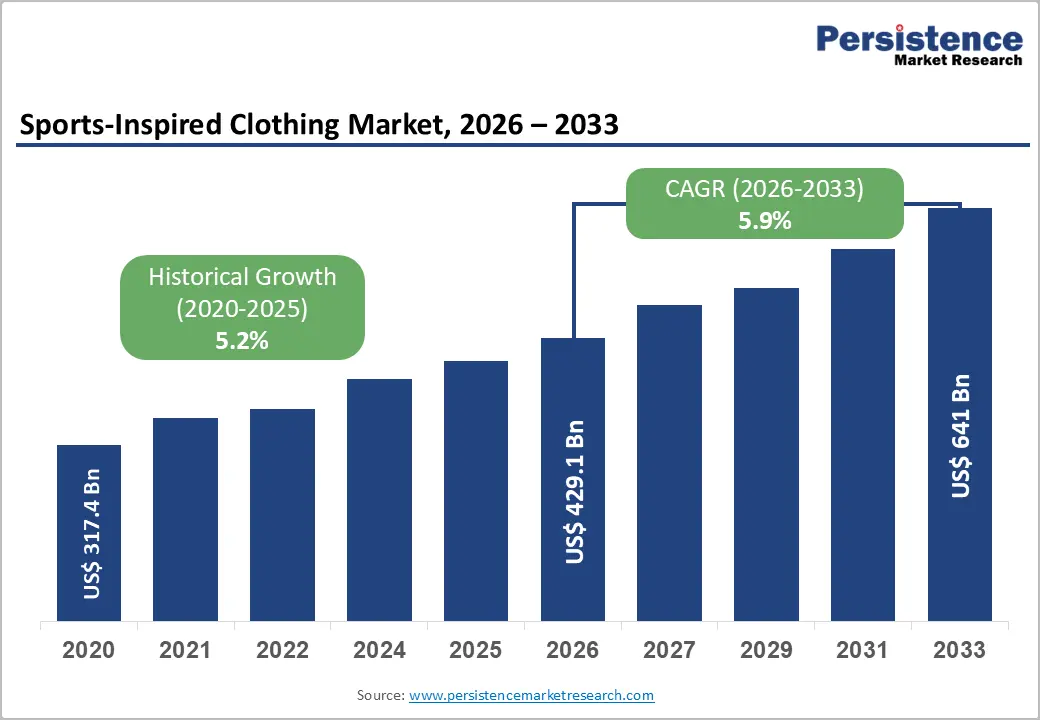
The global sports-inspired clothing market size is likely to be valued at US$ 429.1 billion in 2026, and is projected to reach US$ 641.0 billion by 2033, growing at a CAGR of 5.9% during the forecast period 2026−2033. Growth is primarily driven by evolving consumer lifestyles emphasizing fitness and wellness, increasing participation in recreational and professional sports, and rising preference for athleisure attire as daily wear.
Urbanization and rising disposable income levels create a conducive environment for adoption across diverse demographics. Technological advancements in fabric engineering, such as moisture-wicking and sustainable materials, enhance product functionality and appeal. Integration with e-commerce and digital retail platforms increases market accessibility and consumer reach. Expansion of organized sports leagues, wellness programs, and public health initiatives promotes demand by shaping consumer preferences toward performance-oriented yet fashionable clothing.
Key Industry Highlights
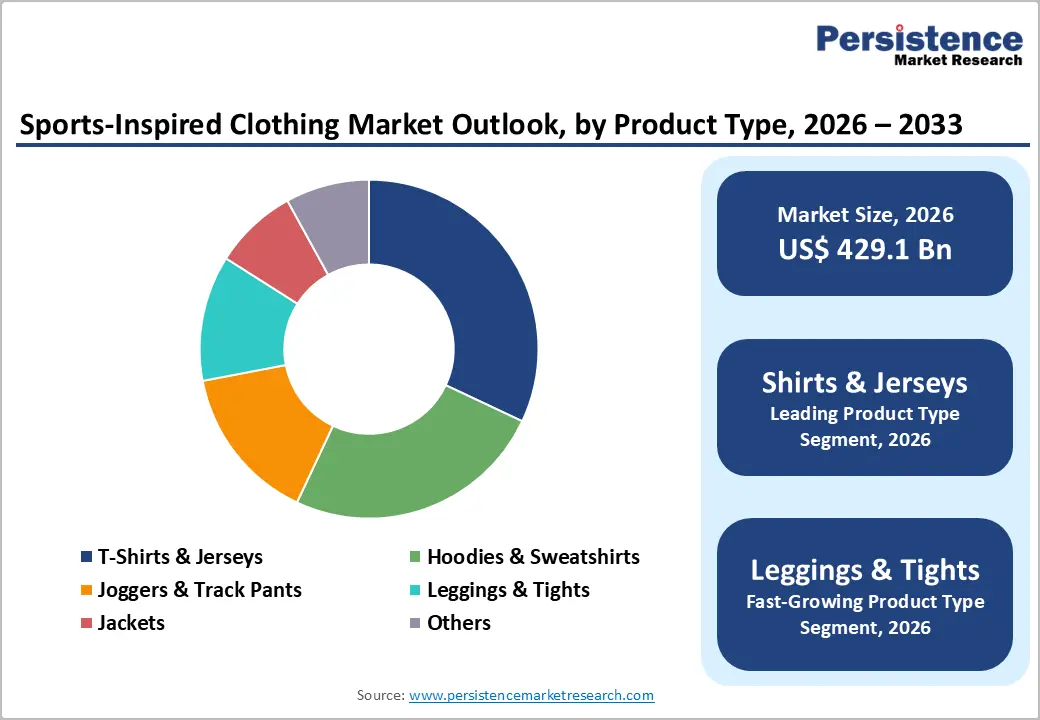
- Product Dominance: T-shirts and jerseys are likely to dominate, accounting for about 32% of revenue in 2026, driven by their broad appeal, versatility, and retail accessibility.
- Fastest-growing Product Type: Leggings and tights are expected to witness the fastest growth between 2026 and 2033, driven by the expansion of women's activewear and multifunctional styling.
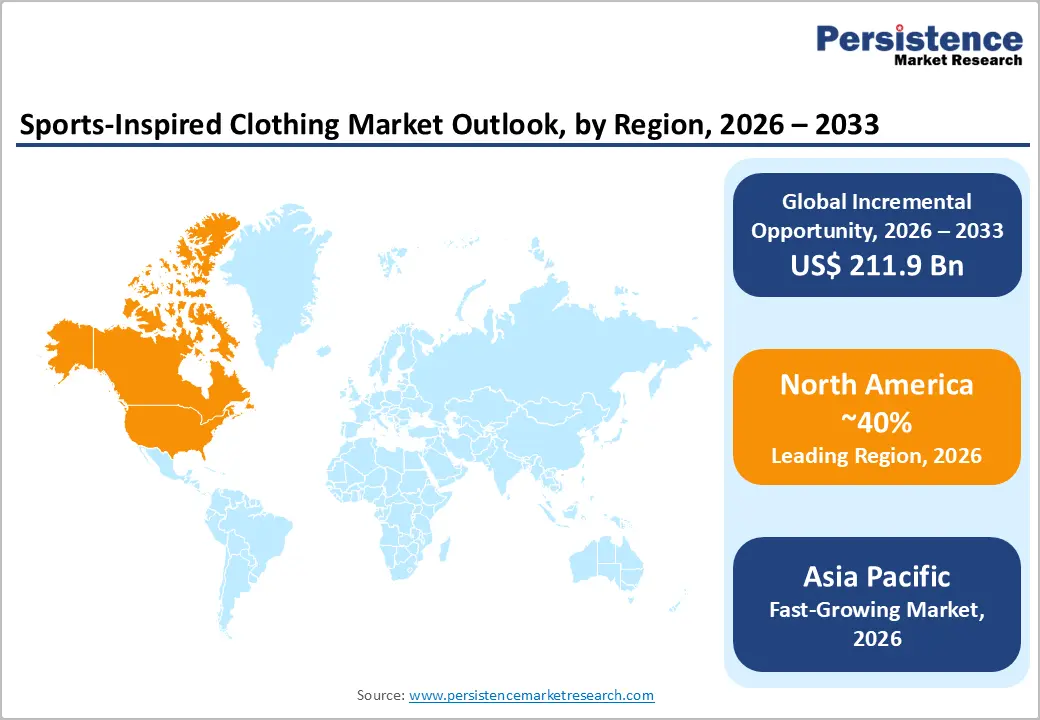
- Leading Region: North America is expected to capture nearly 40% of the market in 2026, owing to extensive sports participation, strong consumer demand, and established brand networks.
- Fastest-growing Market: Asia Pacific is forecasted to be the fastest-growing market through 2033, supported by e-commerce proliferation and high demand for performance-oriented and influencer-endorsed apparel.
- December 2025: adidas Originals and Brain Dead introduced a limited-edition 2000s-inspired capsule, featuring retro-futuristic Climacool 2 and Taekwondo Mei sneakers, Climacool track suits, metallic jerseys, accessories, and raffle-only video game collectibles.
| Key Insights | Details |
|---|---|
| Sports-Inspired Clothing Market Size (2026E) | US$ 429.1 Bn |
| Market Value Forecast (2033F) | US$ 641.0 Bn |
| Projected Growth (CAGR 2026 to 2033) | 5.9% |
| Historical Market Growth (CAGR 2020 to 2025) | 5.2% |
Market Factors – Growth, Barriers, and Opportunity Analysis
Rising Fitness and Wellness Awareness
Awareness of fitness and wellness is driving a profound shift in consumer behavior, influencing apparel demand that aligns with active lifestyles. Structured physical activity, including gym workouts, outdoor training, and wellness routines, now features prominently in daily schedules, prompting preference for clothing that combines comfort, performance, and style. Academic research indicates 83% of millennials engage in some form of exercise in a typical week, highlighting consistent adoption of fitness practices among a critical consumer segment. Apparel that enables unrestricted movement, manages moisture, and adapts to diverse environments meets both functional and aesthetic expectations, making it an essential element of health-focused lifestyles. Consumers increasingly consider clothing an extension of personal wellness, shaping purchasing decisions across active and casual wear categories.
Wellness-driven consumer behavior fosters innovation in fabrics, design, and brand positioning. Materials engineered for stretch, breathability, and moisture regulation respond to expectations for versatile, performance-oriented apparel, while visually appealing designs reinforce lifestyle identity. Social media and wellness communities amplify these preferences by showcasing active routines and clothing that complements healthy living. This dynamic extends the audience beyond traditional sports participants to everyday individuals seeking comfort, performance, and style. Brands that align product offerings with this lifestyle mindset secure differentiation and sustained engagement, capturing the attention of a growing segment that prioritizes well-being in both activity and daily attire.
Intense Competition and Market Fragmentation
The sports-inspired clothing industry faces pressure from a crowded competitive landscape, with numerous global and regional players targeting overlapping consumer segments. Brands frequently compete on price, design innovation, and endorsement strategies, which drives margin compression and reduces profitability. Rapid product launches and trend-driven collections increase operational costs and inventory risks, forcing companies to invest heavily in marketing and distribution channels to maintain visibility. Regional players often leverage local consumer insights and cost advantages, creating differentiation challenges for established global brands. This environment intensifies the need for constant innovation and strategic positioning to sustain market share, while market fragmentation makes it harder to achieve economies of scale.
Consumer loyalty remains volatile as brand switching is prevalent, driven by evolving fashion preferences and social media influence. Small and emerging brands can quickly capture attention through niche marketing or influencer partnerships, disrupting established brand positioning. Fragmented supply chains and varying regional distribution capabilities limit operational efficiency and can delay response to changing demand patterns. Strategic collaborations, targeted product differentiation, and agile manufacturing are necessary to navigate these challenges. The cumulative effect of high competition and fragmentation constrains revenue growth and increases risk exposure, requiring companies to focus on efficiency, brand equity development, and market intelligence to maintain a competitive advantage.
Sustainable Materials Adoption and Integration
Rising consumer awareness regarding environmental impact and ethical production is reshaping demand in the sports-inspired clothing sector. Brands that incorporate sustainable materials such as recycled polyester, organic cotton, and bio-based fabrics are positioned to capture a segment of environmentally conscious buyers seeking functional yet responsible apparel. Sustainable materials enhance brand credibility and support corporate social responsibility initiatives, thereby influencing purchasing decisions in both mature and emerging markets. Suppliers adopting eco-friendly production processes can optimize resource efficiency, reduce waste, and align with regulatory trends targeting environmental compliance.
Integration of sustainable materials also stimulates innovation in product design and performance enhancement. Advanced fibers and manufacturing techniques enable lightweight, durable, and moisture-wicking apparel that meets athletic performance standards while reducing carbon footprint. Collaboration with material science startups accelerates access to novel fabrics and eco-efficient technologies, creating differentiation in a competitive landscape. Companies leveraging sustainability as a design principle can expand market reach through partnerships with retailers emphasizing green credentials, tapping into premium pricing potential. The convergence of consumer preference, regulatory pressure, and technological advancement positions sustainable materials adoption as a strategic lever for growth, enhancing profitability and market relevance in an evolving sports-inspired clothing ecosystem.
Category-wise Analysis
Product Type Insights
T-Shirts & jerseys are likely to be the leading segment with roughly 32% of the sports-inspired clothing market revenue share in 2026, due to their broad consumer appeal, versatility across casual and athletic use, and high production efficiency. The segment benefits from integration with branding, sponsorship, and team apparel requirements, creating recurring demand that spans professional sports teams, collegiate programs, and fan merchandise. Material innovations such as performance cotton blends enhance comfort, durability, and moisture management, meeting the expectations of both athletes and everyday users. Retail and e-commerce penetration ensures wide accessibility, while collaborations with influencers and digital marketing campaigns strengthen visibility. Consumer adoption is reinforced by the combination of functionality, style, and brand affiliation, driving consistent revenue generation.
Leggings & tights are expected to witness the fastest growth between 2026 and 2033, as women’s activewear adoption expands in professional, recreational, and lifestyle contexts. Material innovations offering stretchability, moisture management, and compression support performance while accommodating diverse body types, making products suitable for intense workouts and every day wear. Online platforms facilitate global reach, direct-to-consumer engagement, and size inclusivity, creating scalable market opportunities. Cross-category styling with casual and formal wear enhances utility, encouraging multiple-use adoption. Increasing participation in yoga, fitness classes, and recreational sports creates a large, addressable consumer base.
Material Insights
Cotton is poised to dominate, with a forecasted market share of about 45% in 2026, owing to widespread consumer trust, comfort, and cultural acceptance of the material. Its natural breathability and durability support diverse activities, ranging from casual wear to moderate-intensity workouts, while minimizing skin irritation and enhancing overall user experience. Supply chain efficiency ensures stable availability, reducing cost volatility and facilitating predictable production planning. Cotton-based apparel benefits from adherence to quality and safety regulations, reassuring both retailers and consumers. Retail penetration across urban, semi-urban, and emerging markets maximizes accessibility.
Spandex is anticipated to be the fastest-growing segment between 2026 and 2033, driven by demand for stretchable, form-fitting clothing enhancing performance and aesthetic appeal. Integration with blended fabrics improves product durability, moisture-wicking, and thermal regulation, meeting the requirements of active consumers. Rising awareness of functional activewear and lifestyle trends accelerates adoption across recreational and professional contexts. Online platforms enable direct access to niche consumer segments while facilitating size inclusivity and customization. Advances in spandex recycling and sustainable production allow entry into environmentally conscious markets. Cross-application in leggings, joggers, and compression wear further drives growth, addressing diverse consumer preferences and supporting a broad spectrum of physical activities.
End-User Insights
The men's segment is positioned as the leading segment with nearly 50% of the sports-inspired clothing market share in 2026, supported by their higher participation in recreational sports, professional training programs, and lifestyle adoption of athleisure. Male consumers show strong preference for functional apparel that prioritizes comfort, durability, and brand association, influencing purchasing decisions across casual and athletic categories. Digital engagement through e-commerce platforms and mobile applications improves accessibility, while personalized offerings enhance customer loyalty. Product innovation in material performance, such as moisture-wicking fabrics and stretchable blends, along with customization options, strengthens adoption.
The women's segment is expected to be the fastest-growing between 2026 and 2033, driven by increased participation in fitness, recreational sports, and urban lifestyle activities. Growth is supported by targeted digital marketing campaigns, social media engagement, and endorsements from fitness influencers, which amplify visibility among female consumers. Material innovations enhancing comfort, flexibility, and aesthetic appeal create versatile offerings suitable for active and casual wear. Broad availability across online and offline retail channels accelerates adoption. Social and cultural trends favoring health-conscious, active lifestyles expand the addressable market, enabling scalable penetration.
Regional Insights
North America Sports-Inspired Clothing Market Trends
North America is expected to capture nearly 40% of the sports-inspired clothing market value in 2026, reflecting strong consumer demand, mature retail infrastructure, and high disposable income levels. The dominance is supported by widespread engagement in recreational and professional sports, with 55% of people aged 15 and older in Canada reporting participation in activities such as soccer, ice hockey, swimming, and running in 2023. This broad active consumer base creates consistent demand for performance-oriented apparel. Advanced material innovation, including moisture-wicking fabrics, compression blends, and sustainable textiles, enhances product performance, encouraging frequent replacement cycles. Established brand networks leverage strategic partnerships with sports leagues, fitness programs, and lifestyle influencers, strengthening market visibility and consumer trust. Digital commerce adoption supports seamless access to premium and mid-tier offerings, while personalized customization options improve engagement and repeat purchases.
Operational efficiency contributes to sustained market control, with vertically integrated supply chains reducing production costs and ensuring product availability across diverse channels. Marketing strategies focus on experience-based engagement, including in-store events, athlete endorsements, and loyalty programs, driving consumer retention. Regulatory alignment in quality, safety, and environmental standards reduces risk for manufacturers and distributors, creating stable market conditions. Brand positioning that emphasizes performance, style, and lifestyle compatibility resonates with core consumer segments, ensuring consistent revenue contribution. Access to advanced logistics and distribution networks allows rapid response to evolving trends, minimizing lead times and supporting scalability.
Europe Sports-Inspired Clothing Market Trends
Europe is anticipated to maintain a strong position in the market for sports-inspired clothing through 2033, powered by high consumer awareness of fitness, lifestyle trends, and fashion integration in activewear. A Eurobarometer survey in 2022 reported that 38% of Europeans engage in sport or exercise at least once a week, reflecting a broad active consumer base that fuels demand for functional, stylish, and performance-oriented apparel. Urbanization and increasing participation in recreational and professional sports create recurring demand for T-shirts, jerseys, leggings, and performance jackets. Advanced material innovations, including moisture-wicking fabrics, compression blends, and sustainable textiles, enhance comfort, durability, and versatility, supporting adoption across casual and athletic use. Established brand networks leverage strategic partnerships with fitness programs, sports leagues, and influencers, reinforcing visibility and consumer trust. Expansion of e-commerce and digital marketing allows seamless access to mid-tier and premium offerings, while personalized customization options improve engagement and repeat purchases.
Technological integration in apparel design and production also drives market growth. Investment in sustainable and lightweight materials supports environmental compliance and appeals to increasingly eco-conscious consumers. Cross-category styling enhances utility, enabling use in professional, recreational, and lifestyle contexts. Product diversification, including adaptive sizing, performance leggings, and multifunctional tops, broadens market reach and drives adoption across demographics. Social trends favoring health-conscious and active lifestyles amplify visibility and consumer preference, creating a scalable addressable market. Strategic focus on quality, innovation, and brand positioning ensures steady revenue streams and positions the market for sustained expansion across both mature and emerging urban centers.
Asia Pacific Sports-Inspired Clothing Market Trends
Asia Pacific is forecasted to be the fastest-growing market for sports-inspired clothing between 2026 and 2033, stimulated by rapid urbanization, rising disposable incomes, and a shift toward active and health-conscious lifestyles among younger demographics. Expanding participation in recreational sports, fitness programs, and outdoor activities is creating a sizable addressable consumer base with increasing demand for performance-oriented and athleisure apparel. E-commerce proliferation and mobile retail adoption enable wide-reaching distribution, making premium and mid-tier offerings accessible to both metropolitan and semi-urban populations. Growing awareness of functional apparel benefits, including moisture management, stretchability, and thermal regulation, is driving adoption across professional training, casual workouts, and lifestyle wear. Rising interest in branded and influencer-endorsed apparel further accelerates market penetration, as aspirational marketing resonates with tech-savvy consumers seeking style, comfort, and performance in a single product.
Innovation in materials and manufacturing is strengthening market growth, with the integration of sustainable fibers and smart textiles differentiating offerings and attracting environmentally conscious consumers. Cross-category applications, including leggings, compression wear, active jackets, and multifunctional casual apparel, are expanding use cases beyond fitness, creating recurring demand cycles. Strategic partnerships between local and global brands facilitate market entry and scale operations efficiently, while targeted marketing campaigns leverage social media platforms to engage niche consumer segments. Infrastructure improvements, including logistics networks and retail modernization, reduce lead times and support rapid response to trend shifts.
Competitive Landscape
The global sports-inspired clothing market structure is moderately consolidated, with leading players such as Nike, Inc, adidas India Marketing Pvt. Ltd, PUMA India Ltd, lululemon HK Limited, Under Armour®, Inc., and Reebok hold significant influence. Market dominance is supported by strong brand recognition, extensive retail and e-commerce distribution networks, and established global supply chains. Competitive advantage is largely driven by continuous product innovation, including performance fabrics, sustainable materials, and multifunctional designs that appeal to both athletic and lifestyle consumers. Geographic expansion into emerging and mature urban markets strengthens market presence, while strategic collaborations with sports leagues, fitness programs, and influencers enhance visibility and consumer engagement. Leading players leverage differentiated offerings to maintain loyalty and capture premium segments, with marketing campaigns emphasizing functionality, style, and lifestyle integration.
Operational and strategic positioning of these companies ensures resilience in a competitive landscape. Investment in digital platforms enables personalized customization and direct-to-consumer engagement, fostering repeat purchases and brand retention. Supply chain optimization, including vertical integration and localized production, reduces lead times and enhances product availability. Innovation in material technology, product design, and brand collaboration continues to drive competitive differentiation. With increasing consumer focus on performance, comfort, and sustainability, key players maintain advantage through high-quality offerings, brand equity, and market penetration strategies.
Key Industry Developments
- In January 2026, Lauren Kyle McDavid launched Sports Club Atelier x Hockey Canada collection, inspired by vintage hockey and Canadian winter heritage ahead of 2026 Olympics, featuring timeless apparel blending sport and style. The brand emphasizes thoughtful design, following successes such as CFR rodeo collaboration and Oilers-inspired lines.
- In December 2025, Lululemon announced plans to enter Greece, Poland, Hungary, Romania, Austria, and India markets in 2026 via franchise partnerships, including Tata CLiQ in India. The strategy builds on strong international growth in the Middle East, Africa, and Asia Pacific, offering full product ranges online with community events and ambassador networks.
- In November 2025, Nike and Converse launched a limited-edition Stranger Things collection for season 5, featuring distressed Nike Dunk Low, Field General High, Air Max 1, LD-1000, Converse Chuck 70, and Weapon sneakers with Hawkins-themed details such as Upside Down logos and packaging.
Companies Covered in Sports-Inspired Clothing Market
- Nike, Inc.
- adidas India Marketing Pvt. Ltd
- PUMA India Ltd
- lululemon HK Limited
- Under Armour®, Inc.
- Reebok
- ASICS India Pvt. Ltd.
- New Balance
- Skechers India.
- Fila
- Columbia Sportswear India
- ANTA SPORTS
Frequently Asked Questions
The global sports-inspired clothing market is projected to reach US$ 429.1 billion in 2026.
Rising consumer focus on health, fitness, and athleisure lifestyle, coupled with innovation in performance fabrics and digital retail, drives the market.
The market is poised to witness a CAGR of 5.9% from 2026 to 2033.
Key market opportunities include adoption of sustainable materials, digital customization, expansion into emerging urban markets, and integration with fitness and lifestyle trends.
Some of the key market players include Nike, Inc, adidas India Marketing Pvt. Ltd, PUMA India Ltd, lululemon HK Limited, Under Armour®, Inc., and Reebok.


