




- Hardware & Software IT Services
- Design Thinking Market
Design Thinking Market Size, Share, and Growth Forecast, 2026 - 2033
Design Thinking Market by Component Type (Software, Services), Application (Education, Healthcare, IT & Telecommunication, BFSI), End-User (Academic Institutions, Corporates, Startups, Consulting Firms), and Regional Analysis for 2026 - 2033

Design Thinking Market Share and Trends Analysis
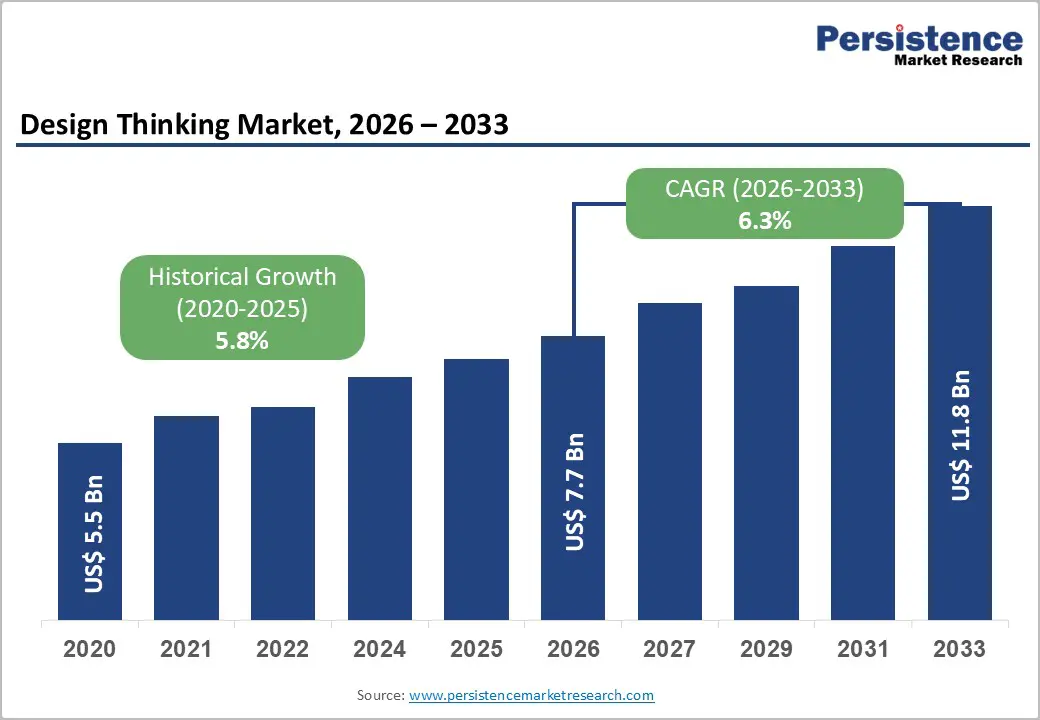
The global design thinking market size is likely to be valued at US$ 7.7 billion in 2026, and is projected to reach US$ 11.8 billion by 2033, growing at a CAGR of 6.3% during the forecast period 2026−2033.
Market expansion is driven primarily by the institutionalization of human-centered innovation frameworks across enterprises, particularly in digital transformation, product innovation, and service redesign initiatives. Large corporations increasingly integrate design thinking into organizational strategy, agile development, and customer experience (CX) management, supported by investments in digital collaboration platforms and innovation consulting services.
Key Industry Highlights
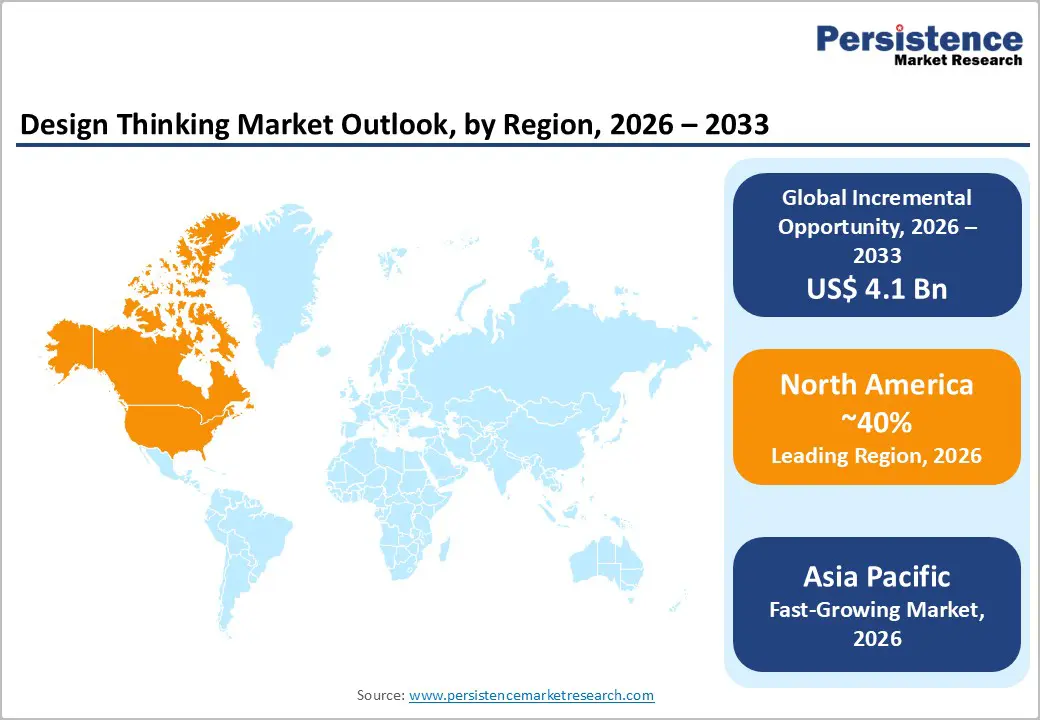
- Dominant Region: North America is projected to hold 40% of the design thinking market share in 2026, supported by the widespread presence of world’s largest multinational corporations.
- Fastest-growing Regional Market: Asia Pacific is forecasted to be the fastest-growing market from 2026 to 2033, powered by digital transformation and expanding startup ecosystems.
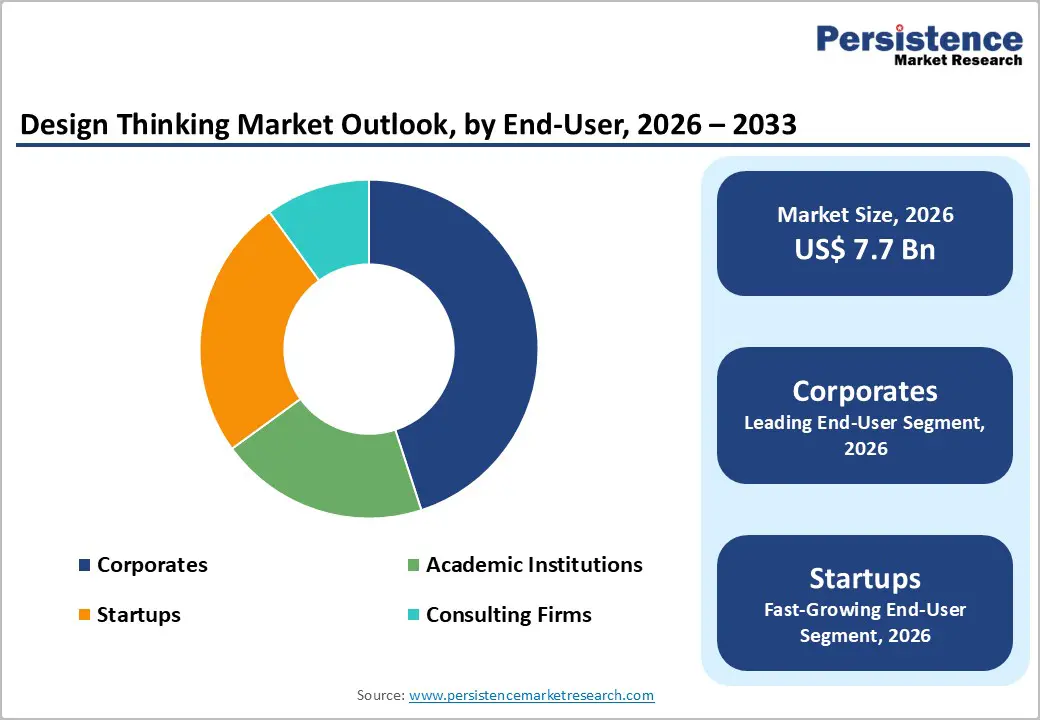
- Leading End-User: Corporates are set to lead with a projected 45% market share in 2026, driven by design thinking adoption to boost innovation, customer experience, and operational efficiency.
- Fastest-growing End-User: Startups are slated to grow the fastest from 2026 to 2033, fueled by rapid prototyping, product-market fit validation, and investor readiness.
- July 2025: Raphe mPhibr adopted Dassault Systèmes’ 3DEXPERIENCE platform to slash UAV prototype development from years to three months, enabling organic 3D designs, integrated simulation, and superior performance for India's self-reliant aerospace goals.
| Key Insights | Details |
|---|---|
|
Design Thinking Market Size (2026E) |
US$ 7.7 Bn |
|
Market Value Forecast (2033F) |
US$ 11.8 Bn |
|
Projected Growth (CAGR 2026 to 2033) |
6.3% |
|
Historical Market Growth (CAGR 2020 to 2025) |
5.8% |
Market Factors - Growth, Barriers, and Opportunity Analysis
Technological Advancements and Digital Integration
Technological advancements and digital integration have been playing a pivotal role in strengthening the design thinking market by enhancing the collaborative and iterative nature of the approach. Modern organizations have been increasingly relying on cloud-based platforms, artificial intelligence (AI) driven analytics, and digital prototyping tools to speed up ideation, experimentation, and refinement cycles. These technologies have been enabling cross-functional teams to collaborate across regions, capture real-time user insights, and translate feedback into tangible design improvements with greater speed and accuracy. In a consultative context, enterprises are being advised to view these tools not as stand-alone investments but as enablers that embed design thinking into everyday workflows and decision-making.
The widespread use of such technologies has been delivering measurable improvements in innovation efficiency and risk management outcomes. Digital integration has been streamlining end-to-end workflows, which has been reducing time-to-market and lowering the likelihood of failure at launch by validating concepts earlier and more rigorously. As organizations continue to mature their innovation capabilities, design thinking will have evolved from a conceptual framework into a repeatable, data-informed methodology supported by advanced digital infrastructure. This evolution has been positioning enterprises to consistently create high-impact products and services, while consultants have been guiding them to align technology choices with strategic goals, governance structures, and cultural readiness to capture the full value of design thinking.
Lack of Skilled Professionals and Resource Constraints
The shortage of skilled professionals and resource constraints act as a key restraint due to the specialized competencies required to implement complex innovation approaches effectively. Nearly 74 % of employers worldwide report difficulty finding the skilled talent they need in 2025, reflecting the global challenge organizations face in acquiring expertise for structured problem-solving processes. Organizations often struggle to recruit individuals who possess the blend of analytical, creative, strategic, and facilitation skills necessary for guiding projects from ideation through validation. The scarcity of qualified talent results in longer recruitment cycles and higher compensation costs, diverting budget and management attention away from core initiatives.
Resource limitations further compound the talent hurdle as organizations allocate funding toward technology investments or traditional delivery functions, leaving insufficient budget for training, coaching, and dedicated human-centered process leadership. Smaller enterprises and mid-sized firms may lack the financial capacity to establish internal capability-building programs or to engage external expertise, causing superficial adoption of structured methodologies and inconsistent outcomes. This constrained environment inhibits sustained capability development, leading to uneven application, diminished confidence among stakeholders, and slower integration into organizational workflows.
Unification of AI with Emerging Technologies
The blending of AI and other emerging technologies creates a significant opportunity by enabling deeper insights and smarter decision-making throughout innovation processes. Advanced algorithms can process large datasets to uncover patterns in user behavior, preferences, and unmet needs, supporting more accurate problem framing and solution development. Predictive analytics accelerates scenario evaluation, reducing reliance on manual interpretation and enabling teams to focus efforts where value potential is highest. For example, InnoEdge, a cybersecurity company, developed Design Thinking 3.0 (DT 3.0), an AI-integrated evolution of human-centric innovation that employs dedicated AI agents across stages such as challenge determination, discovery, ideation, and execution to boost efficiency by up to 95% and decision precision. Digital automation of routine tasks such as user feedback synthesis and prototype testing frees skilled practitioners to engage in higher-value strategy and creative work. AI-enabled tools also support rapid experimentation through virtual simulations, improving the efficiency of iteration cycles.
Emerging technologies such as augmented reality (AR), virtual reality (VR), and Internet of Things (IoT) extend opportunities to simulate real-world contexts and gather experiential data that enriches user understanding. For instance, in June 2025, third-grade mini researchers at the University of Florida co-designed the AR Expeditions app, powered by AI tools such as ChatGPT for rapid development of immersive ocean-themed literacy games, as part of the New Worlds Reading Initiative to boost reading motivation among Florida elementary students struggling with literacy. Immersive tools allow stakeholders to visualize concepts, interact with prototypes in controlled environments, and refine designs before committing resources to physical development. Generative systems can explore a broader range of design alternatives and surface creative possibilities that may not emerge through traditional methods. Collaboration platforms enhanced with AI facilitate seamless coordination across distributed teams, ensuring alignment and reducing friction in cross-functional workstreams.
Category-wise Analysis
Component Insights
Services are likely to be the leading segment with a projected 62% of total revenue share in 2026 due to high reliance on expert guidance for implementing human-centered innovation frameworks. Consulting, training, and facilitation services are critical for embedding design thinking into organizational processes, particularly during digital transformation and product innovation initiatives. Enterprises seek specialized support to ensure alignment between strategy, culture, and operational execution, minimizing risks associated with adoption. The depth of expertise provided by service providers enables organizations to accelerate capability development, improve user-centric decision-making, and achieve measurable outcomes.
Software is anticipated to be the fastest-growing segment in 2026, fueled by the rising demand for cloud-based collaboration platforms, remote innovation tools, and AI-enabled ideation software. Enterprises are increasingly shifting toward scalable digital solutions that support distributed teams and real-time co-creation. These tools enhance workflow efficiency, streamline communication across functions, and facilitate rapid prototyping. Software solutions provide measurable impact through automation, analytics, and virtual collaboration capabilities, allowing organizations to scale innovation practices more consistently and extend human-centered design principles across multiple projects and geographies.
Application Insights
Education is anticipated to secure around 30% of the design thinking market revenue share in 2026, reflecting the widespread integration of design thinking in academic and professional learning environments. Universities, professional training institutes, and online education providers leverage these frameworks to address workforce skill gaps and cultivate critical thinking, creativity, and problem-solving capabilities. Structured curricula and practical workshops equip students and professionals with tools to navigate complex challenges, enabling institutions to deliver measurable outcomes. Adoption of design thinking in education strengthens talent pipelines and aligns skill development with industry requirements.
Healthcare is expected to be the fastest-growing segment during the 2026–2033 forecast period, propelled by increasing focus on patient-centric care models, digital health adoption, and regulatory emphasis on service quality and accessibility. Providers leverage design thinking to redesign care pathways, improve patient experiences, and optimize operational efficiency. Digital platforms and telemedicine solutions support remote care and real-time monitoring, enhancing engagement. Structured innovation initiatives empower healthcare teams to co-create solutions with patients and implement scalable improvements across multiple facilities and care models.
End-User Insights
Corporates are poised to dominate with a forecasted market share of 45% in 2026, powered by their extensive adoption of design thinking to enhance innovation outcomes, customer experience, and operational efficiency. Large enterprises implement structured frameworks to align cross-functional teams, streamline product development, and drive strategic initiatives. Investment in training, consulting, and digital tools ensures consistent application of human-centered approaches. Corporates benefit from improved decision-making, faster time-to-market, and optimized processes, making them the leading end-user segment with the highest market share.
Startups are estimated to be the fastest-growing segment from 2026 to 2033, fueled by the need for rapid prototyping, product-market fit validation, and investor readiness. Early-stage companies in technology, healthcare, and digital services rely on design thinking to accelerate experimentation and mitigate development risks. Agile frameworks and customer-centric insights enable startups to iterate quickly, attract funding, and scale efficiently. In August 2025, for example, Samsung partnered with the Startup India program via a Memorandum of Understanding (MoU) under its 'Solve for Tomorrow' initiative to nurture young innovators from Tier 2 and Tier 3 cities, offering incubation, mentorship, funding, and market access aligned with Skill India and Digital India.
Regional Insights
North America Design Thinking Market Trends
North America is expected to dominate with an estimated 40% of the design thinking market share in 2026, reflecting the high concentration of multinational corporations and innovation-driven enterprises that integrate human-centered frameworks into strategic operations. The regional market leadership is supported by companies leveraging design thinking to accelerate digital transformation, optimize customer experience, and improve product and service innovation. Access to a mature ecosystem of specialized consulting firms, professional training providers, and technology vendors enables organizations to implement structured methodologies at scale, enhancing adoption rates and delivering measurable business outcomes. Corporations also benefit from well-established venture capital networks that incentivize experimentation and rapid iteration, reinforcing a culture of innovation across industries.
Another key factor contributing to the dominance of North America is its advanced technology infrastructure, including AI-enabled analytics, cloud-based collaboration platforms, and digital prototyping tools. These tools allow enterprises to streamline iterative processes, integrate cross-functional teams, and make data-driven decisions efficiently. The availability of highly skilled talent, particularly in creative, analytical, and design roles, ensures effective execution of complex innovation initiatives. Strong regulatory frameworks and a culture that prioritizes customer-centric solutions support widespread adoption and application of design thinking.
Europe Design Thinking Market Trends
Europe is predicted to hold a significant position in the market through 2033, supported by the strong integration of structured innovation practices among large enterprises, government agencies, and research institutions. Organizations across Germany, France, the UK, and the Nordics actively implement design thinking into digital transformation, customer experience, and product development initiatives to maintain competitiveness in mature markets. The region benefits from well-established consulting and professional training ecosystems that provide expertise in human-centered frameworks, facilitating consistent application across multiple sectors. Investment in collaboration platforms, prototyping tools, and innovation labs enables enterprises to streamline workflows and improve decision-making, supporting continuous improvement in operational and customer-centric outcomes.
Corporations and public institutions in Europe leverage regulatory frameworks, sustainability mandates, and digitalization policies to drive structured innovation initiatives. Sectors such as automotive, financial services, and healthcare increasingly rely on design thinking to enhance service quality, accelerate product launches, and reduce inefficiencies. Cross-industry partnerships, co-innovation spaces, and academic collaborations create opportunities to test and refine solutions at scale. Advanced talent availability and widespread familiarity with agile and human-centered approaches allow enterprises to apply methodologies efficiently.
Asia Pacific Design Thinking Market Trends
Asia Pacific is forecasted to be the fastest-growing regional market for design thinking between 2026 and 2033, stimulated by rapid adoption of digital transformation initiatives, expanding startup ecosystems, and increasing demand for user-centric innovation across industries. Corporations across China, India, and Southeast Asia are embedding design thinking into strategic projects to enhance operational efficiency, improve product relevance, and accelerate market responsiveness. Expansion of regional innovation hubs, coupled with rising availability of local consulting expertise, enables organizations to implement structured frameworks without relying entirely on service providers from outside the country. Policy incentives for skill development and digital ecosystem growth accelerate adoption, giving enterprises the tools and talent required to execute large-scale design thinking initiatives across multiple sectors.
Startups and mid-sized enterprises in fintech, healthcare, and e-commerce are increasingly adopting design thinking to validate products, iterate rapidly, and compete with global players. Integration of AI, cloud collaboration, and digital prototyping platforms enables scalable experimentation and faster feedback loops. Regional accelerators and co-innovation spaces foster collaboration between corporates, academic institutions, and technology vendors, ensuring practical application of human-centered methodologies. Cross-border talent exchange and digital literacy programs enhance execution capabilities across markets, creating an environment where design thinking adoption expands quickly throughout the regional market.
Competitive Landscape
The global design thinking market structure showcases moderate fragmentation, with rivalry extending across multinational consulting firms, specialized design studios, and emerging digital solution creators. The leading five participants have been collectively representing roughly 35% of global revenue, with prominent names such as IDEO, Accenture, Deloitte AG, McKinsey & Company, and International Business Machines (IBM) Consulting commanding the space. These enterprises have been reinforcing their dominance through extensive project delivery, strategic collaborations, and forward-thinking service suites, preserving strong presence and impact across diverse verticals.
Mid-tier advisory firms, regional design boutiques, and technology suppliers have been holding the remaining share, illustrating competitive variety. This configuration has been generating openings for newcomers and focused specialists to seize prospects in developing industries and territories, while incumbent leaders have been prioritizing the expansion of their solution catalogs, assimilation of digital capabilities, and fortification of client bonds to uphold their authority.
Key Industry Developments
- In November 2025, Wharton Online launched a new Innovation Strategy and Design Thinking Certificate, aimed at equipping professionals with the skills to drive transformation in their organizations.
- In September 2025, the World Health Organization (WHO) designated the Ulysseus Innovation Hub on Ageing and Well-being at Université Côte d’Azur, France, as a new Collaborating Centre to advance systems thinking and innovation for preventing non-communicable diseases (NCDs) through capacity building, research, and technical collaboration..
- In August 2025, REC Limited received the Best Design Thinking Award for its innovative approach in enhancing customer-centric solutions and operational efficiency.
Companies Covered in Design Thinking Market
- IDEO
- Accenture.
- Deloitte AG
- McKinsey & Company
- IBM Consulting
- PwC.
- Capgemini
- SAP SE
- Miro
- Adobe
Frequently Asked Questions
The global design thinking market is projected to reach US$ 7.7 billion in 2026.
Increasing demand for human-centered innovation in product development, digital transformation, and customer experience optimization across industries is driving the market.
The market is poised to witness a CAGR of 6.3% from 2026 to 2033.
Key market opportunities for design thinking include emerging market adoption, AI and data analytics integration, and healthcare service innovation.
Key players in the market include IDEO, Accenture, Deloitte AG, McKinsey & Company, IBM Consulting, and PwC.


