




- Specialty & Fine Chemicals
- High Pressure Seals Market
High Pressure Seals Market Size, Share, and Growth Forecast, 2026 - 2033
High Pressure Seals Market by Material Type (Metal, TPU, HNBR, Others), End-user (Automotive, Electrical & Electronics, Marine & Rail, Industrial & Manufacturing, Aerospace, Oil & Chemicals & Petrochemicals, Others), and Regional Analysis for 2026 – 2033

High Pressure Seals Market Size and Trends Analysis
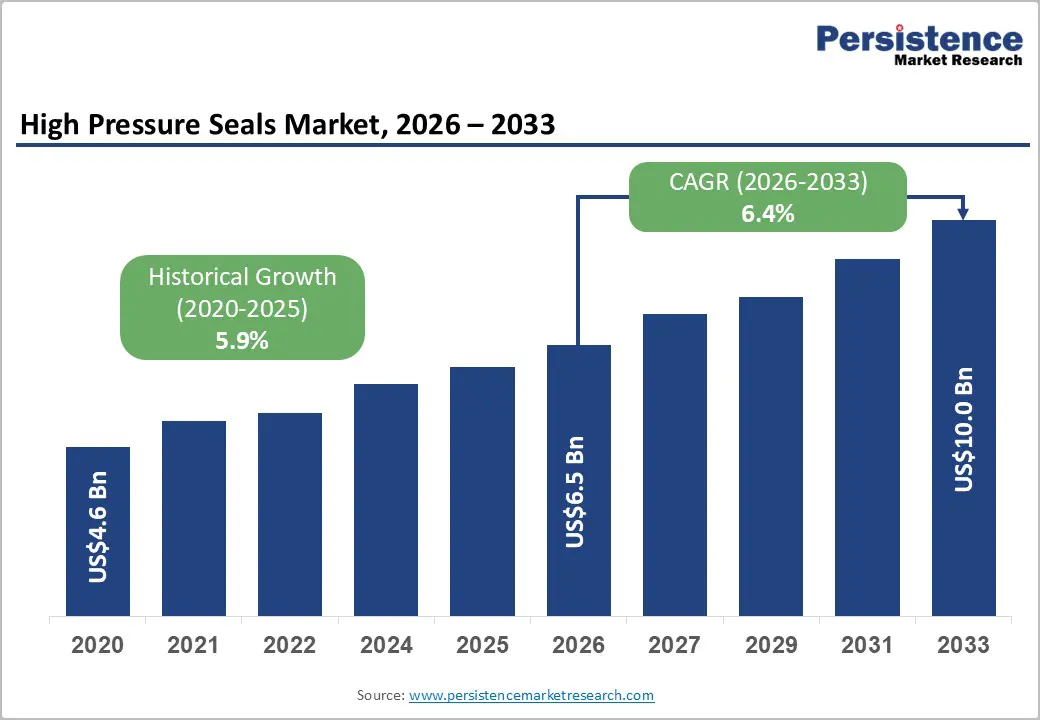
The global high pressure seals market size is likely to be valued at US$6.5 billion in 2026, and is expected to reach US$6.4 billion by 2033, growing at a CAGR of 6.4% during the forecast period from 2026 to 2033, driven by increasing demand for reliable sealing solutions in high-pressure hydraulic and pneumatic systems, rapid growth in oil & gas exploration and petrochemical processing, rising adoption in electric vehicle powertrains and aerospace hydraulics, and expanding industrial automation requiring leak-proof performance under extreme pressures.
Growing demand for fluoroelastomers in oil & chemicals & petrochemicals end-use is accelerating adoption across equipment manufacturers and operators. Advances in low-friction coatings, composite-reinforced seals, and high-temperature formulations are further boosting uptake by offering extended service life, reduced fugitive emissions, and compliance with API, ISO, and ASME standards. Increasing recognition of high-pressure seals as critical for preventing leaks, ensuring safety, and improving equipment efficiency in emerging energy transition, EV, and deep-sea exploration markets remains a major driver of market growth.
Key Industry Highlights:
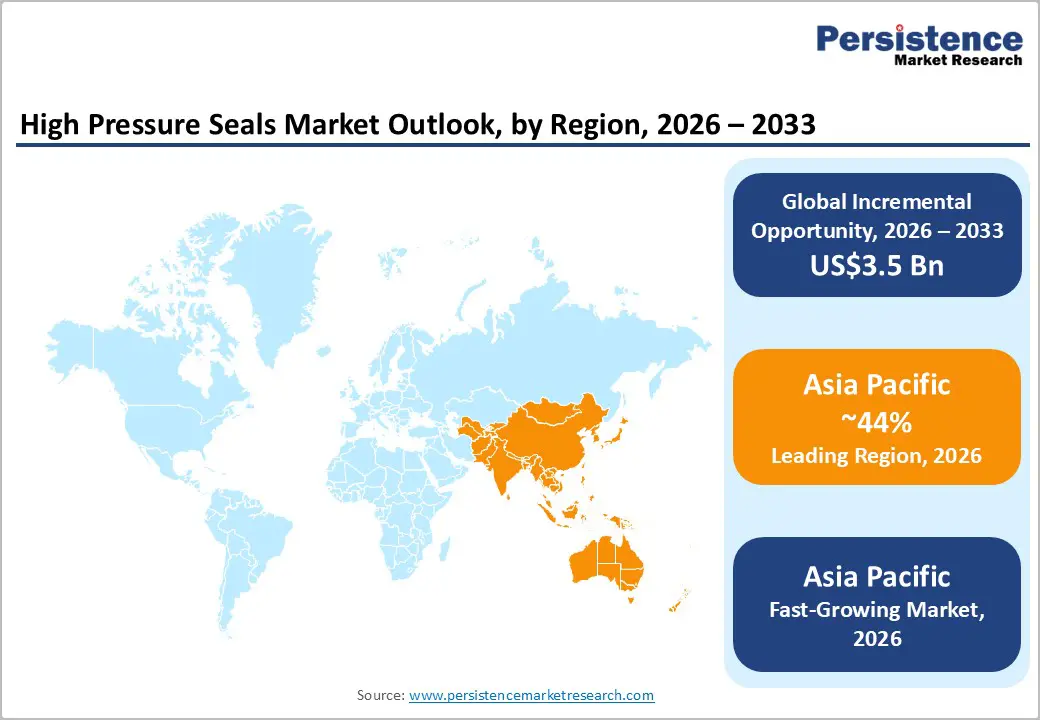
- Leading Region: Asia Pacific, anticipated to account for a 44% market share in 2026, driven by massive industrial manufacturing, oil & gas activity, and strong demand in China and India.
- Fastest-growing Region: Asia Pacific, fueled by rapid industrialization, expanding petrochemical capacity, and increasing EV & aerospace component production.
- Dominant Material Type: Fluoroelastomers, to hold approximately 38% of the market share, as they remain the preferred choice for extreme temperature and chemical resistance.
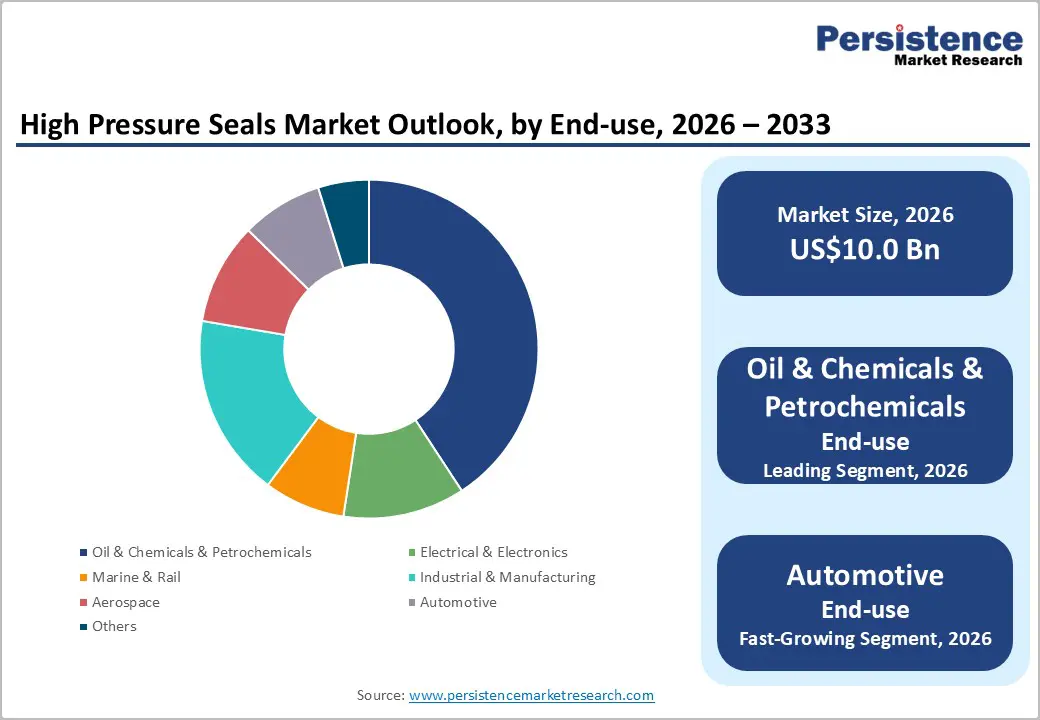
- Leading End-user: The oil, chemicals, and petrochemicals sector is projected to account for 42% of the market in 2026, driven by high-pressure, high-temperature processing needs.
| Key Insights | Details |
|---|---|
| High Pressure Seals Market Size (2026E) | US$6.5 Bn |
| Market Value Forecast (2033F) | US$10.0 Bn |
| Projected Growth CAGR (2026-2033) | 6.4% |
| Historical Market Growth (2020-2025) | 5.9% |
Market Factors – Growth, Barriers, and Opportunity Analysis
Growth Analysis – Oil & Gas and Petrochemical Capacity Expansion
Expansion of refining, petrochemical, and upstream oil & gas processing facilities is significantly increasing the demand for high-pressure sealing solutions. Modern refining and petrochemical plants operate under extremely high pressures and temperatures to process hydrocarbons, making reliable sealing components essential for maintaining operational safety and efficiency. High-pressure seals are widely used in pumps, compressors, valves, and reactors, where preventing leakage of hazardous fluids and gases is critical. As companies upgrade existing infrastructure and construct new processing units such as hydrocrackers, catalytic reformers, and ethylene production plants, the need for durable sealing technologies continues to grow.
For example, Saudi Aramco has been expanding its refining and petrochemical integration projects to increase downstream capacity and produce higher-value chemical products. These large-scale facilities rely on high-pressure pumps, compressors, and pipeline systems that require advanced sealing materials capable of withstanding aggressive chemicals and extreme operating conditions.
Electric Vehicle Powertrain and Aerospace Hydraulics Growth
The increasing adoption of electric mobility and the expansion of advanced aerospace systems are creating strong demand for high-pressure sealing technologies. Electric vehicles use complex powertrain architectures such as e-axles, electric motors, battery cooling circuits, and high-speed gear systems that require reliable sealing to maintain lubrication separation and prevent fluid leakage. Electric motors in EVs often operate at significantly higher rotational speeds than conventional internal combustion engines, placing greater thermal and mechanical stress on sealing components.
The aerospace sector heavily relies on hydraulic systems for critical operations such as landing gear deployment, braking systems, and flight control mechanisms. These systems often operate at pressures of several thousand psi, requiring high-strength sealing materials capable of resisting extreme pressure and temperature conditions. For instance, Parker Hannifin supplies aerospace hydraulic seals and sealing systems designed to withstand high-pressure aircraft environments.
Barrier Analysis – Raw Material Price Volatility and Supply Chain Disruptions
Fluctuating prices of key raw materials such as elastomers, thermoplastics, and specialty metals create cost uncertainties for manufacturers of high-pressure seals. Materials like fluoroelastomers, polytetrafluoroethylene (PTFE), and high-performance polymers are widely used to produce seals capable of withstanding extreme pressure, temperature, and chemical exposure. The prices of these materials are influenced by changes in crude oil prices, petrochemical supply, and global trade conditions.
When raw material costs rise sharply, seal manufacturers often face pressure on profit margins and may need to adjust pricing strategies or sourcing methods. Supply chain disruptions further intensify this challenge. Events such as transportation delays, geopolitical tensions, and limited availability of specialty compounds can interrupt the steady supply of materials required for seal production.
Stringent Certification and Qualification Cycles
Sealing components used in critical systems must meet rigorous performance and safety standards to ensure they can withstand extreme pressure, temperature, and chemical exposure without failure. Before being approved for use, seals often undergo extensive laboratory testing, durability assessments, and validation under real operating conditions. These procedures can take significant time and financial investment, slowing product development and market entry for new sealing technologies.
Companies supplying seals for aircraft hydraulic systems must comply with certification requirements set by organizations such as the Federal Aviation Administration and the European Union Aviation Safety Agency. Sealing components used in oil and gas equipment must meet strict industrial standards and reliability benchmarks.
Opportunity Analysis – Growth in Fluoroelastomer and Composite High-Pressure Seals
Increasing demand for durable sealing solutions in harsh industrial environments is encouraging the adoption of advanced materials such as fluoroelastomers and composite-based high-pressure seals. These materials are specifically engineered to perform reliably under extreme temperatures, aggressive chemicals, and high mechanical loads, which are common in sectors such as oil & gas, automotive, chemical processing, and aerospace. Fluoroelastomers are widely used because they maintain flexibility and sealing performance even at temperatures around 200–230 °C while also resisting fuels, lubricants, and corrosive chemicals. The Chemours Company supplies well-known fluoroelastomer materials such as Viton™, which are commonly used in demanding sealing applications.
Composite seals combining materials such as PTFE with elastomers or reinforcing fillers are also gaining popularity. These hybrid structures provide advantages such as low friction, high wear resistance, and strong chemical stability, making them suitable for high-pressure pumps, compressors, and hydraulic systems. PTFE-based sealing materials can operate across very wide temperature ranges and maintain sealing integrity under harsh process conditions, improving equipment reliability and service life.
Expansion in Gas and EV Sectors
Rapid development in natural gas infrastructure and the accelerating adoption of electric vehicles are creating new opportunities for high-pressure sealing technologies. Natural gas production, processing, and transportation systems operate under high pressure to efficiently move gas through pipelines, storage facilities, and liquefaction plants. Components such as compressors, valves, and pumps require reliable seals to prevent gas leakage and ensure operational safety. As countries expand liquefied natural gas (LNG) terminals and pipeline networks to meet growing energy demand, the requirement for durable high-pressure seals capable of withstanding aggressive gases and fluctuating pressures continues to increase.
The rapid growth of electric vehicle manufacturing is generating demand for specialized sealing components used in electric drivetrains, battery cooling systems, and high-speed gearboxes. Electric powertrains operate at high rotational speeds and generate significant thermal loads, requiring seals that can maintain lubrication while preventing contamination. Automotive manufacturers such as Tesla, Inc. are continuously developing advanced EV platforms that incorporate high-performance motors and thermal management systems, increasing the need for precision high-pressure sealing solutions.
Category-wise Analysis
Material Type Insights
Fluoroelastomers are anticipated to dominate the market, accounting for 38% of the market share in 2026, driven by their exceptional resistance to heat, aggressive chemicals, oils, and fuels. These materials maintain elasticity and sealing performance even under extreme temperatures and high mechanical stress, making them highly suitable for demanding industrial environments. Industries such as oil & gas, chemical processing, and automotive manufacturing rely heavily on fluoroelastomer seals to prevent leakage in pumps, valves, compressors, and hydraulic systems.
Viton™ fluoroelastomer seals are produced by The Chemours Company. Viton™ is widely used in high-pressure pumps, valves, and piping systems in chemical processing plants because it can withstand high temperatures, aggressive chemicals, and fuels while maintaining sealing integrity.
Composite materials represent the fastest-growing material type, as they combine the strengths of multiple materials to achieve superior durability and performance. These seals often integrate polymers such as PTFE with reinforcing fillers like carbon fiber, glass fiber, or elastomers to improve strength, wear resistance, and chemical stability. As a result, composite seals can withstand extreme pressures, high temperatures, and aggressive fluids while maintaining low friction and longer service life.
Double-acting composite PTFE piston seal manufactured by Parker Hannifin Corporation. This sealing solution combines PTFE with reinforcing fillers and elastomer energizers, creating a composite structure that provides high wear resistance, low friction, and excellent chemical stability.
End-user Insights
The oil & chemicals & petrochemicals segment is expected to dominate the market, contributing nearly 42% of revenue in 2026, supported by the fact that many of its processing operations occur under extremely high pressure and temperature conditions. Equipment such as pumps, compressors, reactors, and pipelines requires reliable sealing solutions to prevent leakage of hazardous fluids and gases. High-pressure seals play a critical role in maintaining operational safety, improving equipment efficiency, and minimizing downtime in refining and chemical production facilities.
John Crane for petrochemical and refining facilities. The company provides advanced mechanical seals such as the Type 48 and Type 8600 series, which are widely used in pumps and compressors that handle volatile hydrocarbons and hazardous chemicals in refineries and chemical processing plants.
The automotive segment represents the fastest-growing end-user, propelled by increasing vehicle production and the rapid shift toward advanced powertrain technologies. Modern vehicles rely on numerous high-pressure systems, including fuel injection units, braking systems, transmissions, and thermal management systems, all of which require reliable sealing to prevent fluid leakage and maintain efficiency. The growth of electric vehicles has further increased demand for specialized seals used in e-axles, battery cooling circuits, and high-speed electric motors.
Parker Hannifin Corporation. The company manufactures fluid port seals used in automatic transmissions, which are designed to handle high-pressure fluid systems in modern vehicles. These seals are engineered to prevent leakage in transmission components and have been tested to operate at pressures of up to 365 PSI and temperatures ranging from 40°C to 148°C, while enduring millions of pressure cycles during vehicle operation.
Regional Insights
North America High Pressure Seals Market Trends
North America is experiencing steady growth due to strong industrial activity, advanced manufacturing capabilities, and large investments in energy and process industries. The region has a well-established oil and gas sector where high-pressure equipment, such as drilling systems, compressors, and pumps, requires durable sealing technologies to maintain operational safety and prevent leakage. Companies such as Halliburton Company supply sealing and pressure control solutions used in drilling and hydraulic fracturing operations across major shale basins in the U.S.
The expansion of petrochemical and chemical production facilities. Large integrated chemical complexes require high-performance seals for reactors, pipelines, and processing equipment operating under extreme pressure and temperature conditions. The growing automotive and electric vehicle manufacturing sector in the region is increasing demand for precision sealing components used in transmissions, braking systems, and electric drivetrains.
Europe High Pressure Seals Market Trends
Europe market is strongly influenced by the region’s advanced industrial base, strict environmental regulations, and continuous investment in energy and manufacturing infrastructure. Industries such as chemical processing, oil refining, and power generation rely heavily on high-pressure equipment that requires reliable sealing technologies to ensure operational safety and minimize leakage of hazardous substances. European regulations related to emissions control and industrial safety have encouraged companies to adopt high-performance sealing systems that improve equipment efficiency and reduce environmental risks.
Strong presence of the automotive and advanced engineering sectors. European automotive manufacturers are investing heavily in electric mobility and next-generation powertrain technologies, which require precision sealing solutions for high-speed motors, battery cooling circuits, and transmission systems. For instance, Volkswagen AG is expanding electric vehicle production in several European plants, increasing demand for specialized sealing components that can handle high thermal loads and complex drivetrain systems.
Asia Pacific High Pressure Seals Market Trends
Asia Pacific is projected to dominate and be the fastest growing, capturing 44% of the revenue in 2026, with strong industrialization, large-scale manufacturing activity, and increasing investment in energy and infrastructure projects. Countries such as China, India, Japan, and South Korea are major hubs for automotive production, heavy machinery manufacturing, and petrochemical processing, all of which require high-performance sealing technologies. High-pressure seals are widely used in pumps, compressors, hydraulic equipment, and processing systems to prevent leakage and ensure safe operations under demanding pressure conditions.
For example, Reliance Industries Limited operates one of the world’s largest refining and petrochemical complexes in India, where advanced sealing systems are required to support high-pressure refining and chemical processing operations.
Rapid expansion of automotive and electric vehicle manufacturing. Many global and regional automakers have established large production facilities across Asia Pacific to meet growing vehicle demand. Companies such as Toyota Motor Corporation continue to expand manufacturing and develop hybrid and electric vehicles, increasing the need for precision sealing solutions used in powertrains, braking systems, and thermal management units.
Competitive Landscape
The global high pressure seals market is characterized by strong competition between specialized sealing technology providers and large diversified materials companies. Leading manufacturers focus on developing advanced materials and engineered sealing systems capable of performing under extreme pressure, temperature, and chemical exposure. Companies such as DuPont, Saint-Gobain, and Parker Hannifin Corporation maintain strong positions in North America and Europe due to their extensive material science expertise, global supply networks, and long-standing relationships with oil & gas, aerospace, and industrial equipment manufacturers.
These companies continue to invest in high-performance materials such as fluoroelastomers, PTFE composites, and advanced polymers that improve chemical resistance, reduce leakage risks, and extend equipment service life. In the Asia Pacific region, several regional manufacturers are strengthening their presence by offering cost-competitive sealing solutions that meet the growing demand from automotive, petrochemical, and heavy industrial sectors.
Key Industry Developments:
- In July 2025, HeroX launched the Seal Team Fix Challenge for the U.S. Bureau of Reclamation, with support from the NASA Tournament Lab (NTL). The competition called on innovators to design a rapid-deploying, high-pressure seal to control failed dam conduits, protecting critical water supplies and power infrastructure across the American West. The challenge offered a total prize of $575,000, guiding participants from concept proposals to prototype testing. Designs
- In April 2025, DuPont celebrated the 50th anniversary of its Kalrez® perfluoroelastomer parts. Since its launch, Kalrez® has delivered exceptional seal performance in the most challenging environments, serving industries such as electronics, oil and gas, chemical processing, and more. The brand established itself as a trusted solution for high-temperature, chemical-resistant sealing applications, helping companies maintain operational safety and equipment reliability across demanding industrial processes.
Companies Covered in High Pressure Seals Market
- The Lubrizol Corporation
- DS Smith
- Saint-Gobain
- DuPont
- 3M
- Solvay
- The AES Corporation
- AESSEAL plc
- Garlock
- SKF
- PetroChina Company Limited
- EagleBurgmann
- Exxon Mobil Corporation
- John Crane
- Flowserve Corporation
- Parker Hannifin Corp
- OMNOVA Solutions Inc.
- Zeon Chemicals L.P.
- EKATO Holding GmbH
Frequently Asked Questions
The global high pressure seals market is projected to reach US$6.5 billion in 2026.
Oil & gas and petrochemical capacity expansion are key drivers.
The high pressure seals market is poised to witness a CAGR of 6.4% from 2026 to 2033.
Fluoroelastomer and composite high-pressure seals and expansion in Asia Pacific oil & gas and EV sectors are key opportunities.
DuPont, Saint-Gobain, Parker Hannifin Corp, John Crane, and Flowserve Corporation are the key players.


