




- Food Ingredients & Additives
- Wheat Bran Market
Wheat Bran Market Size, Share, and Growth Forecast, 2026 – 2033
Wheat Bran Market by Product Type (Organic, Conventional), Application (Animal Feed, Food & Beverages, Nutraceuticals, Personal Care, Others), and Regional Analysis for 2026–2033

Wheat Bran Market Share and Trends Analysis
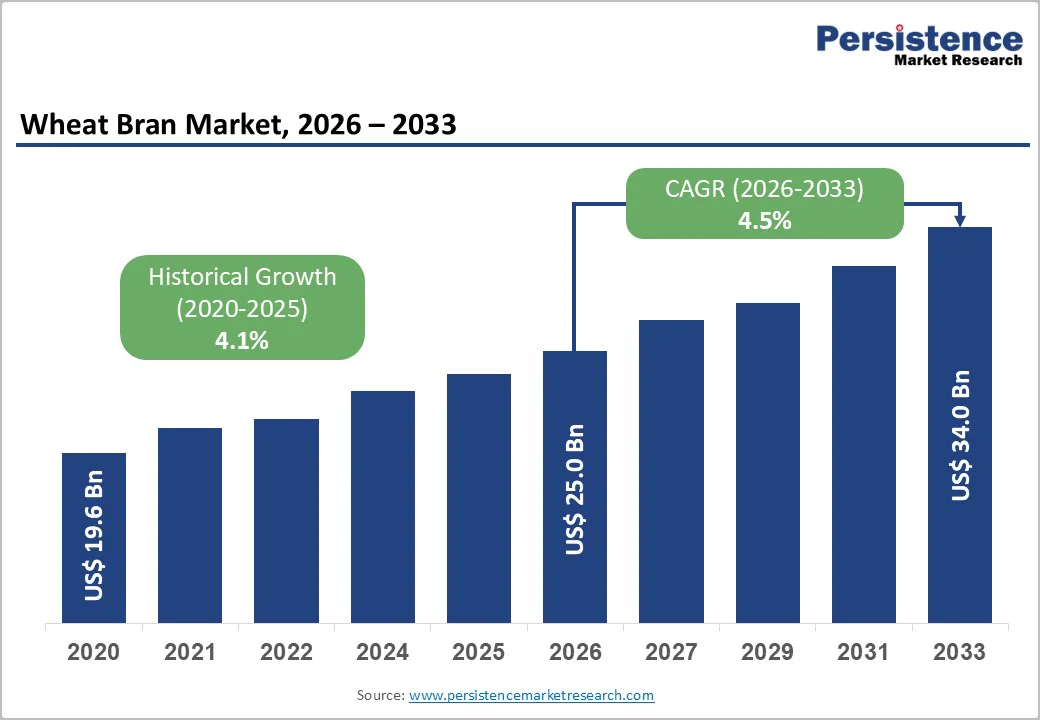
The global wheat bran market size is likely to be valued at US$ 25.0 billion in 2026, and is projected to reach US$ 34.0 billion by 2033, growing at a CAGR of 4.5% during the forecast period 2026-2033. The growth outlook of the market is shaped by the increasing demand for dietary fiber-rich ingredients, rising adoption of wheat bran in animal feed, and expanded use across food & beverages and nutraceutical sectors. Strong growth in livestock production and growing consumer health awareness support volume uptake, while expanding use in functional foods and supplements underpins value growth.
Key Industry Highlights
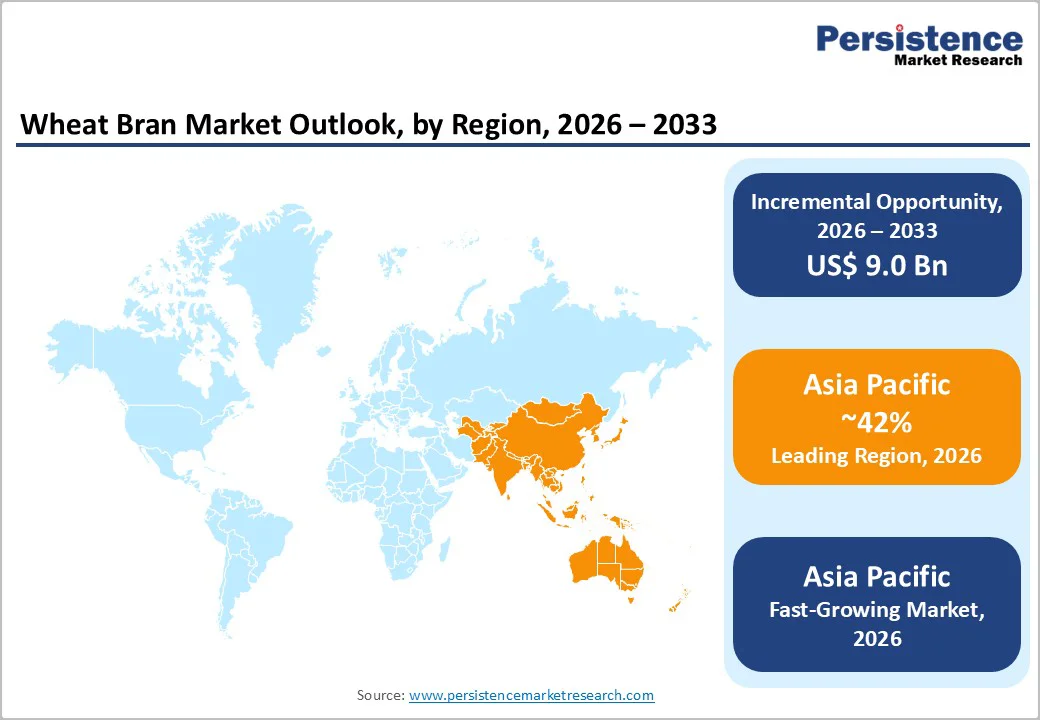
- Dominant Region: Asia Pacific is expected to dominate with an estimated market share of 42% in 2026, backed by high wheat production and a large livestock base.
- Leading Product Type: Conventional wheat bran is projected to dominate with around 60% share in 2026, driven by large-scale milling and established supply chains.
- Fastest-Growing Product Type: Organic wheat bran is likely to grow fastest at 11.2% CAGR through 2033, supported by clean-label and organic food trends.
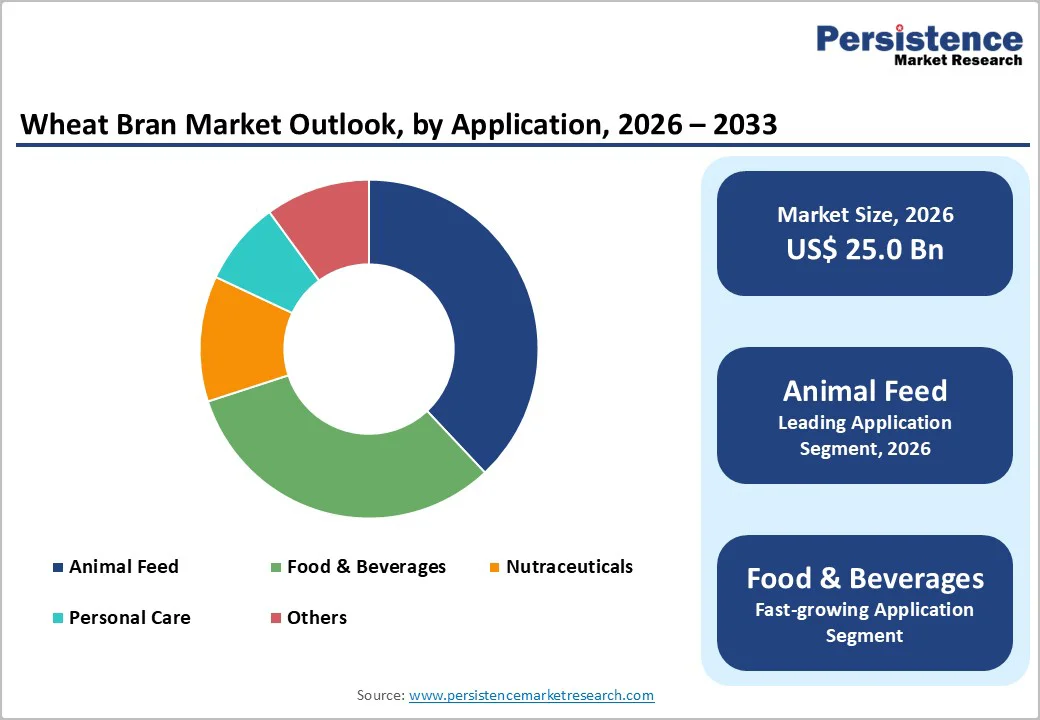
- Leading Application: Animal feed is expected to lead with ~38% share in 2026, on account of growing livestock production and cost-effectiveness.
- Fastest-Growing Application: Food & beverages is projected to post the highest CAGR of nearly 10% from 2026 to 2033, fueled by rising functional food adoption.
| Report Attribute | Details |
|---|---|
|
Wheat Bran Market Size (2026E) |
US$ 25.0 Bn |
|
Market Value Forecast (2033F) |
US$ 34.0 Bn |
|
Projected Growth (CAGR 2026 to 2033) |
4.5% |
|
Historical Market Growth (CAGR 2020 to 2025) |
4.1% |
Market Factors – Growth, Barriers, and Opportunity Analysis
Growing Preference for Nutrient-Rich Foods to Boost the Market
The demand for high-fiber and nutrient-rich products is growing rapidly around the world, driven by widening consumer awareness regarding dietary benefits such as improved digestion and reduced risk of chronic diseases. Urban populations are actively seeking fiber-enriched foods, including bakery items, breakfast cereals, snacks, and dietary supplements. Simultaneously, the expansion of the livestock industry has increased the need for cost-effective, fiber-rich feed ingredients, with wheat bran serving as an economical and nutritious option. This dual demand from both human nutrition and animal feed segments is significantly boosting market adoption.
The availability of wheat bran as a by-product of wheat milling ensures a steady and scalable supply, which supports both food and feed applications. Rising global wheat production further strengthens this supply chain, enabling manufacturers to meet increasing demand efficiently. For instance, Ardent Mills enrolled over 516,000 acres in regenerative agriculture programs and reduced plastic pallet wrap usage by over 90% in 2025, reflecting a shift toward sustainable and clean-label bran production practices. The combination of health-driven consumption trends, sustainable production initiatives, and a reliable supply base underpins sustained growth in the wheat bran market, providing opportunities across multiple sectors, including functional foods, nutraceuticals, and animal feed formulations.
Dietary Trends and Supply Chain Challenges
The soaring popularity of gluten-free diets and alternative bran sources, such as oat, rice, and corn bran, is creating competitive pressure for wheat bran. Rising awareness of celiac disease and a broader consumer preference for non-wheat products are reducing wheat-based ingredient adoption in certain food applications. Manufacturers are increasingly exploring substitute fibers to meet changing dietary preferences, which limits growth opportunities for wheat bran in human nutrition and functional food segments. For instance, in mid-2025, wheat bran prices in India dropped from around INR 25/kg to about INR 20/kg due to increased supply of distilled dried grains with solubles (DDGS), an alternative feed ingredient, highlighting short-term demand restraints in regions where such options are gaining acceptance.
Wheat bran production is also affected by seasonal and storage constraints. Harvesting cycles and agricultural yield variability can cause supply fluctuations of 10–15% in some years. The high oil and fiber content of wheat bran makes also it prone to rancidity and spoilage, requiring careful handling and storage to meet strict food safety standards. These supply chain and quality challenges pose structural limitations on market expansion and may influence pricing and availability in both food and feed applications.
Expanding Demand in Health and Value-Added Applications
The rising global focus on preventive healthcare and wellness is driving demand for dietary supplements, functional foods, and fiber-enriched products. Wheat bran, rich in fiber, micronutrients, and prebiotic properties, is increasingly incorporated into bakery items, breakfast cereals, snack bars, and digestive health supplements. Growing consumer health consciousness is creating a sizeable opportunity for manufacturers to introduce innovative bran-based solutions. For example, in 2025, Siemer Milling Company expanded investments in its Whitewater Mill and intensified research to develop higher-quality, nutritionally enhanced bran products, signaling an industry shift toward premium value-added applications.
Growth in emerging markets and advancements in processing technologies continue to support the development of organic, clean-label, and specialty bran varieties that cater to premium food, nutraceutical, and personal care segments. These value-added forms of wheat bran can command higher margins and appeal to evolving consumer preferences. Expanding urbanization, rising incomes, and changing dietary patterns in Asia, Latin America, and Africa further elevate market potential, enabling companies to capitalize on health-driven trends and supply-chain scalability for sustained growth across multiple applications.
Category-wise Analysis
Product Type Insights
Conventional wheat bran is projected to dominate the market with around 72% revenue share in 2026, supported by its wide availability, cost-effectiveness, and long-standing use in animal feed and food processing. Large-scale wheat milling and established supply chains ensure a consistent supply for feed producers and high-volume food manufacturers. Its affordability relative to alternative fiber sources reinforces its leading position, making it the backbone of wheat bran consumption globally.
Organic wheat bran is expected to grow at a CAGR of approximately 11.2% during the 2026–2033 forecast period, driven by increasing consumer preference for natural, pesticide-free, clean-label products. Health-conscious consumers in the bakery, functional foods, and nutraceuticals are adopting organic bran for its perceived quality and safety. Global shifts toward sustainable agriculture and organic farming practices further fuel demand, enabling manufacturers to capture higher margins and expand into premium and wellness-oriented product lines.
Application Insights
The animal feed segment is expected to hold the largest market share at roughly 38% in 2026, supported by the rapid expansion of global meat, dairy, and poultry industries. Wheat bran remains a preferred ingredient due to its balanced fiber and protein composition, which enhances digestion and feed efficiency in livestock. Its cost-effectiveness compared to alternative feed inputs strengthens adoption across both small and large-scale farms. The by-product nature of bran ensures consistent supply volumes from wheat milling operations, reducing procurement volatility for feed manufacturers. Growing demand for sustainable and nutrient-rich feed ingredients further reinforces its position in modern feed formulations.
Food & beverages and nutraceuticals are projected to grow at a CAGR of 9.8% through 2033, driven by rising consumer awareness of dietary fiber and gut health. Manufacturers are increasingly incorporating wheat bran into bakery products, cereals, snacks, and dietary supplements to meet the growing demand for functional foods. For instance, in August 2025, Grain Millers opened a new flax and fiber processing facility in Canada, expanding its portfolio of fiber-rich ingredients and reinforcing market momentum toward high-fiber food and nutraceutical applications. The rapid expansion of health-oriented and ready-to-eat fiber products positions this segment as a key growth engine beyond animal feed.
Regional Insights
North America Wheat Bran Market Trends
North America is positioned to capture approximately 28% of the wheat bran market share by 2026, driven by mature food processing infrastructure, heightened consumer focus on health and wellness, and well-established livestock feed distribution networks. Within the United States specifically, wheat bran adoption continues to expand across dietary supplements, functional bakery products, and nutritionally enhanced food formulations. Regulatory frameworks governing dietary fiber content and food safety compliance create incentives for manufacturers to develop premium, food-grade, and feed-grade wheat bran offerings that meet stringent quality benchmarks.
The growth trajectory of the regional market reflects a sophisticated innovation environment where clean-label positioning and organic certifications drive consumer preference and product differentiation. Key investment priorities include the development of micronized wheat bran variants that enhance digestibility and bioavailability, alongside expanded feed-grade applications for poultry and livestock sectors. These converging dynamics support a CAGR of approximately 4.1% from 2026 through 2033, characterizing North America as a market balancing the stability inherent in mature categories with genuine momentum from value-added product adoption and strategic expansion.
Europe Wheat Bran Market Trends
Europe is anticipated to secure approximately 26% of the global market by 2026, anchored by a robust demand for nutrition-rich ingredients across Germany, France, the United Kingdom, and Spain. The region's competitive advantage stems from well-established bakery traditions, accelerating consumption of functional food products, and proactive regulatory frameworks that encourage fiber-enriched dietary patterns. Harmonized food safety protocols and quality standards across European Union member states ensure consistent supply chain integrity, enabling wheat bran adoption across diversified end-use sectors such as food manufacturing, nutraceutical formulations, and personal care product development.
Consumer-driven preferences for organic certifications and clean-label formulations are reshaping the competitive landscape, creating expansion opportunities within premium wheat bran segments. The market structure features a dynamic mix of multinational milling corporations and specialized regional suppliers focused on delivering high-quality, food-grade bran materials tailored to specific application requirements. Projected market growth reflects the convergence of functional food innovation, elevated health consciousness among European consumers, and strategic deployment of value-added wheat bran variants designed for specialty applications that command higher margins and strengthen market differentiation across the region.
Asia Pacific Wheat Bran Market Trends
Asia Pacific is poised to command the apex position in 2026, projected to capture approximately 42% of the wheat bran market share while also displaying the highest CAGR of about 5.2% through 2033. Abundant wheat production, substantial livestock populations, and accelerating urbanization are the prime growth determinants for the market in this region. China, India, and Southeast Asian nations are experiencing heightened health consciousness among middle-class consumers, which simultaneously stimulates animal feed demand and increases human consumption of fiber-enriched functional foods. In March 2025, for instance, the Roller Flour Millers Federation of India (RFMFI) formally petitioned the government to create a dedicated Wheat Board, demonstrating regional commitment to advancing research, policy frameworks, and supply-chain optimization for the milling and bran sectors.
Consistent wheat harvests provide a dependable and cost-efficient supply of bran as a milling co-product, enabling widespread integration across diverse applications. Demographic tailwinds, including rising disposable incomes and shifting dietary patterns toward meat, dairy, and processed foods, amplify market demand. Strategic investment priorities encompass modernizing processing infrastructure, scaling organic wheat bran production, and penetrating high-value nutraceutical and premium food-grade segments. These converging factors establish Asia Pacific as the primary engine of wheat bran market expansion, offering manufacturers and investors a compelling growth platform anchored in supply security and evolving consumption patterns.
Competitive Landscape
The global wheat bran market structure is moderately consolidated, led by key players such as Cargill, Archer Daniels Midland (ADM), Bunge Limited, ConAgra Foods, and Associated British Foods. These companies focus on high-volume wheat milling, production of conventional and organic bran, and supply to both animal feed and food & nutraceutical applications. Strong capabilities in quality control, processing efficiency, and regulatory compliance ensure consistent supply of food-grade and feed-grade wheat bran. Investment in value-added and specialty bran products, including micronized, organic, and clean-label varieties, enhances profitability and supports market leadership. Extensive distribution networks, reliable supply chains, and long-term partnerships with feed producers and food manufacturers strengthen their market position globally.
Emerging regional players, particularly in Asia Pacific, Latin America, and Eastern Europe, are gaining traction by offering cost-effective, locally sourced wheat bran for livestock feed and functional food applications. These players leverage flexible production, organic certification, and small-batch processing to meet growing demand in premium and health-focused segments. Innovation in value-added bran, digital tracking for quality, and targeted marketing in urban and health-conscious markets help these companies capture high-growth opportunities, particularly in regions with expanding wheat production and rising consumer awareness of dietary fiber and wellness foods.
Key Industry Developments
- In July 2025, Ardent Mills announced an agreement to acquire Stone Mill, a specialty grain cleaning facility in North Dakota, as part of its strategy to expand specialty ingredient capabilities beyond its core wheat flour business. Stone Mill brings expertise in certified gluten-free and identity-preserved grains, pulses, and seeds, which will help Ardent Mills meet the rising demand for alternative, better-for-you ingredients while improving supply chain control and speed to market for gluten-free and specialty grain solutions.
- In July 2025, Bunge completed its US$?34 billion merger with Viterra, creating a global agribusiness leader capable of competing with ADM and Cargill. The merger strengthens Bunge’s grain export, processing, storage, and handling operations across major wheat-producing regions, significantly affecting wheat bran supply chains worldwide.
- In February 2025, MGP Ingredients introduced “BranPro,” a wheat?bran-based functional ingredient aimed at enhancing fiber content in cereals and bakery products. This innovation reflects the growing trend of treating wheat bran as a value-added ingredient for the food & beverage and health-food sectors, rather than a low-cost by-product.
Companies Covered in Wheat Bran Market
- Ardent Mills
- Wilmar International Ltd.
- Cargill, Inc.
- Siemer Milling Company
- Hindustan Animal Feeds
- GoodMills Group GmbH
- Nisshin Seifun Group Inc.
- Astra Alliance
- Grain Millers, Inc.
- Star of West Milling Co.
Frequently Asked Questions
The global wheat bran market is projected to reach US$ 25.0 billion in 2026.
Rising health-conscious consumption, expansion of the livestock industry, increased wheat production ensuring steady bran supply, and innovation in value-added bran products for premium and functional food applications are driving the market.
The market is poised to witness a CAGR of 4.5% from 2026 to 2033.
Growth in nutraceuticals and functional foods, expansion in emerging markets, production of organic and clean-label bran, development of value-added specialty products, and investment in processing infrastructure for high-quality wheat bran can open new market opportunities.
Cargill, ADM, Bunge Limited, ConAgra Foods, and Associated British Foods are some of the key players in the market.


