




- Biotechnology
- Stem Cell Assay Market
Stem Cell Assay Market Size, Share, and Growth Forecast, 2026 - 2033
Stem Cell Assay Market by Product Type (Instruments, Kits & Reagents), Assay Type (Cell Viability Assay, Differentiation Assay, Others), Application (Regenerative Medicine & Therapy Development, Drug Discovery, Others), and Regional Analysis for 2026 - 2033

Stem Cell Assay Market Size and Trends Analysis
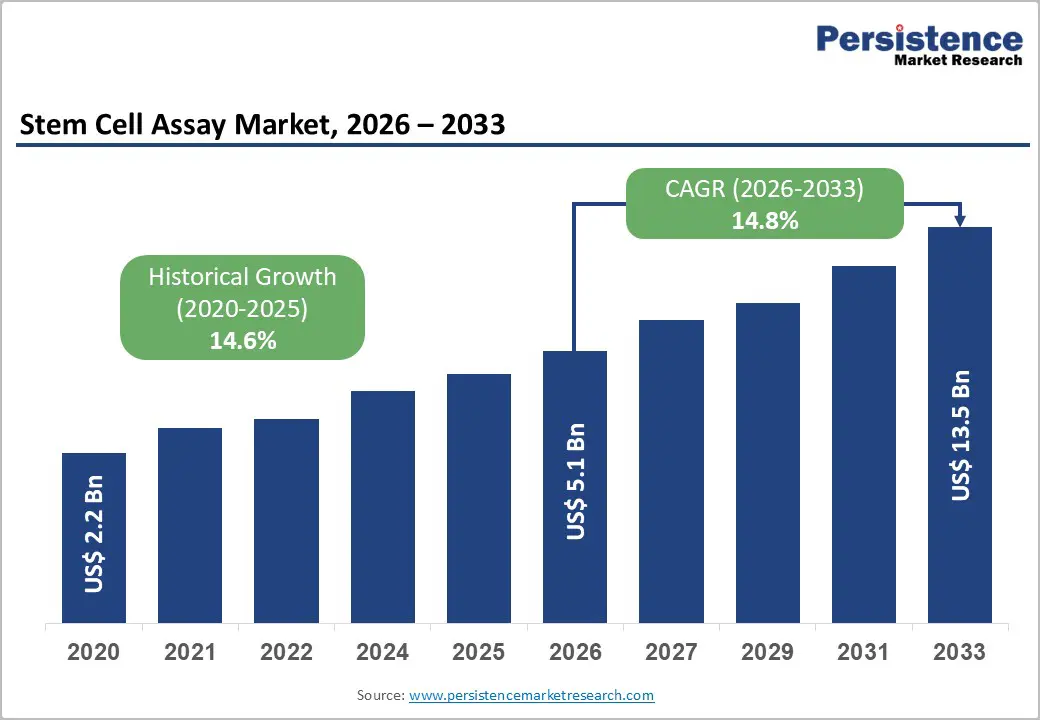
The global stem cell assay market size is likely to be valued at US$5.1 billion in 2026 and is expected to reach US$13.5 billion by 2033, growing at a CAGR of 14.8% during the forecast period from 2026 to 2033, driven by the increasing need for advanced and reliable analytical tools in biomedical research and therapeutic development. This growth reflects sustained demand for accurate and reproducible methods used in drug discovery, disease modeling, and regenerative medicine applications.
Global health and research bodies are increasingly promoting the use of innovative in vitro models, including 3D cultures and organoids, to improve drug development efficiency and translational success rates. WHO highlights the growing focus on precision medicine, regenerative therapies, and patient-specific treatment approaches, driving the need for reliable and standardized research tools such as stem cell assays. The continued push for quality, safety, and reproducibility in biomedical research is driving demand for high-performance assay platforms, positioning stem cell assays as essential tools for advancing innovative healthcare solutions and next-generation therapeutic development.
Key Industry Highlights:
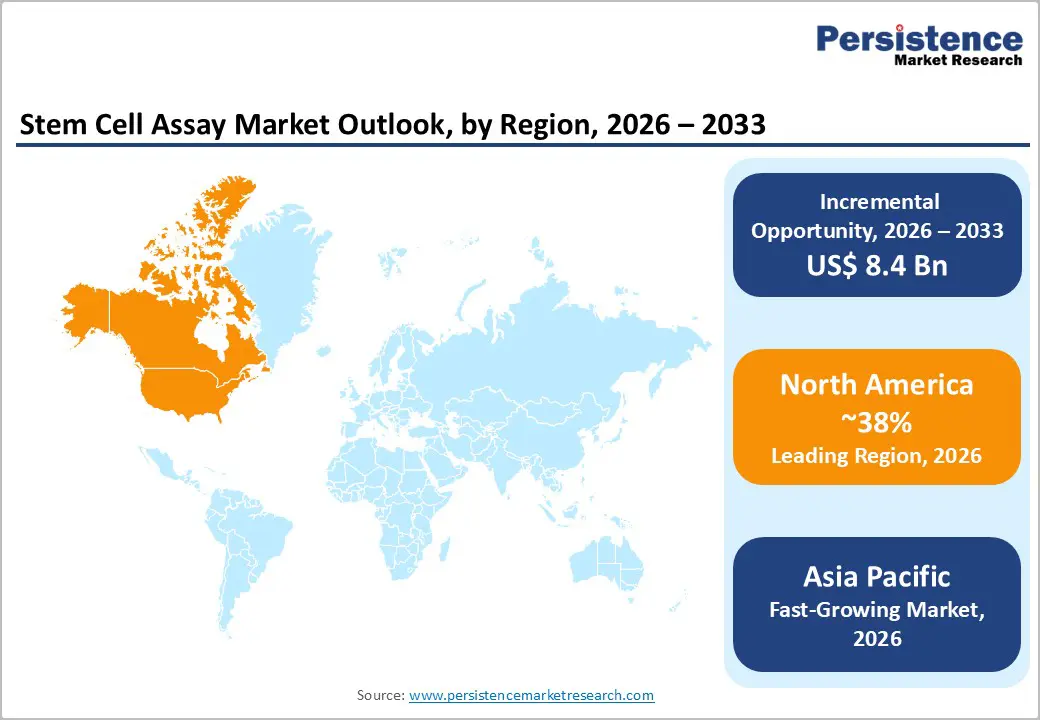
- Leading Region: North America is anticipated to be the leading region, accounting for 38% of the market share in 2026, driven by strong research infrastructure, advanced regulatory frameworks, and high levels of innovation in regenerative medicine.
- Fastest-growing Region: Asia Pacific is likely to be the fastest-growing region, supported by rapid growth in biotechnology investments and expanding research activities across emerging economies.
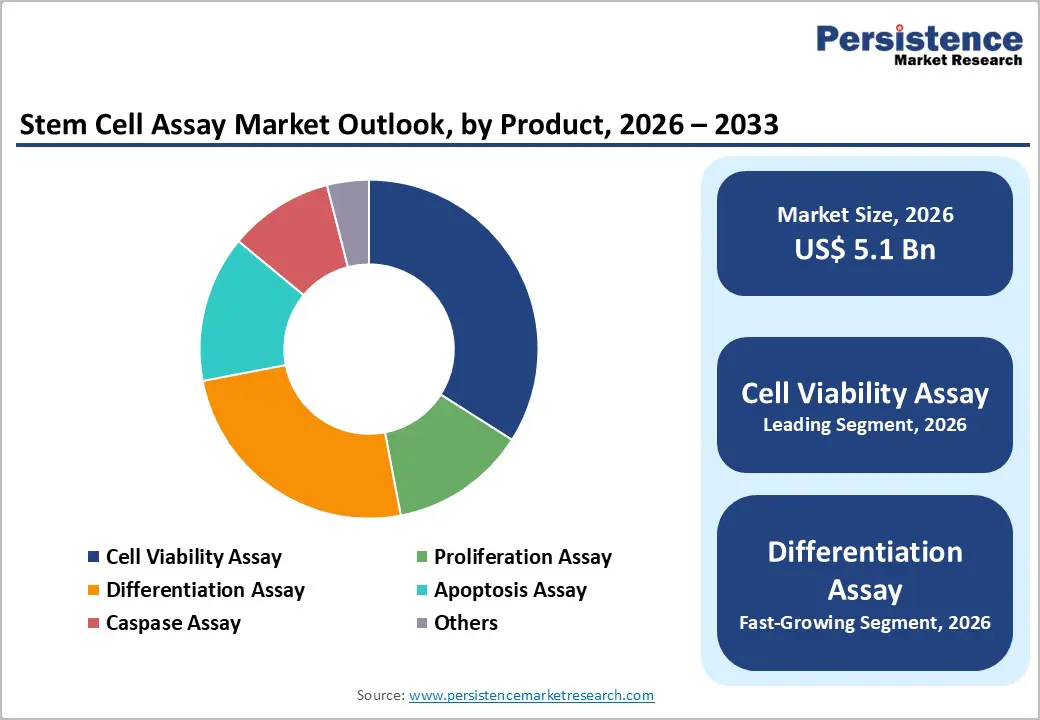
- Leading Product Type: Kits & reagents are projected to represent the leading product type in 2026, accounting for 65% of the revenue share, driven by their widespread use and convenience in routine workflows.
- Leading Assay Type: Cell viability assays are anticipated to be the leading assay type, accounting for over 40% of revenue in 2026, supported by their essential role in cell-based research and testing.
| Key Insights | Details |
|---|---|
|
Stem Cell Assay Market Size (2026E) |
US$5.1 Bn |
|
Market Value Forecast (2033F) |
US$13.5 Bn |
|
Projected Growth (CAGR 2026 to 2033) |
14.8% |
|
Historical Market Growth (CAGR 2020 to 2025) |
14.6% |
Market Factors - Driver, Restraint, and Opportunity Analysis
Driver Analysis - Rising Demand for Physiologically Relevant Models in Drug Discovery and Toxicity Testing
The growing emphasis on improving drug development success rates has accelerated the adoption of physiologically relevant models, significantly increasing reliance on stem cell assays. Traditional animal models often fail to accurately predict human responses, leading to higher costs and delays in clinical trials. Stem cell-based assays, particularly those utilizing 3D cultures and organoids, provide more accurate human-like environments for evaluating drug efficacy and toxicity.
Regulatory agencies and research institutions are encouraging the adoption of alternative testing methods that reduce dependence on animal experimentation. This has led to increased funding and innovation in stem cell assay technologies designed for predictive toxicology and disease modeling. Pharmaceutical companies are integrating these assays into high-throughput screening systems to improve efficiency and data accuracy.
Advancements in Induced Pluripotent Stem Cells (iPSCs) and 3D Culture Technologies
Technological advancements in induced pluripotent stem cells and 3D culture systems are significantly transforming the capabilities of stem cell assays. iPSCs allow researchers to generate patient-specific cell models, enabling more precise disease modeling and personalized therapeutic research. Combined with 3D culture technologies, these systems replicate complex tissue structures more effectively than traditional 2D cultures. This advancement improves the reliability of assay results and enhances their applicability in studying disease progression and drug responses in realistic biological conditions.
Continuous innovation in scaffold materials, microfluidics, and organ-on-chip technologies is expanding the scope of stem cell assays. These integrated systems allow real-time monitoring of cellular behavior and improve experimental reproducibility. Research organizations and biotech firms are increasingly investing in these advanced platforms to gain deeper biological insights and accelerate therapeutic development. The convergence of iPSC technology with 3D culture systems is thus playing a critical role in driving next-generation assay solutions and expanding their adoption across diverse biomedical applications.
Restraint Analysis - Ethical and Regulatory Hurdles in Stem Cell Research
Ethical concerns surrounding the use of certain stem cell types continue to challenge the widespread adoption of stem cell assays. Variations in ethical standards and regulations across different countries create complexities for researchers and companies operating. Strict guidelines governing stem cell sourcing, consent, and usage can delay research timelines and limit access to critical biological materials.
Evolving regulatory frameworks demand rigorous validation and standardization of assay protocols to ensure safety and reliability. Compliance with these requirements increases operational costs and necessitates continuous updates to technologies and methodologies. While these regulations aim to ensure ethical practices and patient safety, they can also slow down research progress and market expansion. Companies must invest in regulatory expertise and robust documentation processes to meet compliance standards, a challenge that can be particularly challenging for smaller organizations and emerging startups.
Technical Challenges in Standardization and Reproducibility
Achieving consistent and reproducible results remains a key technical challenge in the stem cell assay market. Variability in cell sources, culture conditions, and assay protocols can lead to inconsistent outcomes, affecting the reliability of experimental data. Differences in laboratory practices and a lack of universally accepted standards complicate cross-study comparisons. These challenges hinder large-scale adoption, particularly in clinical and regulatory environments where high precision and repeatability are essential.
Efforts to address these issues include developing standardized assay kits, automated systems, and quality control measures. The complexity of stem cell biology continues to pose challenges for maintaining uniform conditions across experiments. Advanced technologies such as high-content imaging and data analytics are being integrated to improve accuracy, but require significant investment and technical expertise. Overcoming these challenges is critical to ensuring the broader acceptance and scalability of stem cell assays across research and clinical applications.
Opportunity Analysis - Expansion of Regenerative Medicine and Cell-Therapy Pipelines
The rapid expansion of regenerative medicine and cell therapy pipelines is creating significant opportunities for the stem cell assay market. Increasing research focused on tissue repair, organ regeneration, and personalized therapies is driving demand for precise and reliable assay systems. Stem cell assays are essential for evaluating cell quality, functionality, and safety during therapy development. As more therapies progress through clinical trials, the need for robust analytical tools continues to grow, supporting both research and manufacturing processes.
Collaborations between biotechnology companies, research institutions, and healthcare providers are accelerating innovation in this field. Advances in gene editing and cell engineering are expanding the scope of regenerative medicine, increasing reliance on sophisticated assay platforms. Governments and private organizations are also investing in infrastructure and funding programs to support therapeutic development. This expanding ecosystem is creating long-term growth opportunities for assay providers, particularly in quality control and translational research applications.
Technological Convergence with AI, Automation, and High-Throughput Screening
The integration of artificial intelligence, automation, and high-throughput screening technologies is revolutionizing the stem cell assay market. AI-driven analytics enable faster interpretation of complex biological data, improving decision-making in drug discovery and disease modeling. Automation reduces manual errors and increases throughput, allowing researchers to process large volumes of samples efficiently. These advancements are enhancing the scalability and precision of stem cell assays, making them more suitable for industrial and clinical applications.
High-throughput screening platforms combined with advanced imaging systems are enabling real-time monitoring of cellular responses. This convergence of technologies supports more detailed and accurate analysis of cellular behavior under various conditions. Companies are increasingly adopting integrated platforms that combine hardware, software, and data analytics to streamline workflows. As digital transformation continues in the life sciences sector, these innovations are playing a crucial role in shaping the future of stem cell assay technologies and expanding their market potential.
Category-wise Analysis
Product Type Insights
Kits & reagents are expected to lead the stem cell assay market, accounting for approximately 65% of revenue in 2026, driven by their extensive use in routine laboratory workflows and ease of application. These products offer ready-to-use, standardized solutions that enhance reproducibility and reduce experimental variability across research settings. The increasing adoption of advanced in vitro models, including 3D cultures and organoids, has amplified the demand for specialized reagents tailored to complex cellular environments. For example, commercially available viability assay kits are widely used in pharmaceutical research to efficiently evaluate drug cytotoxicity, enabling faster screening and better decision-making in early-stage development.
Instruments are likely to be the fastest-growing segment, driven by the growing need for automation and high-throughput capabilities in modern research environments. Advanced instruments such as flow cytometers, high-content imaging systems, and automated cell counters enable precise, real-time monitoring of cellular responses. For example, automated imaging systems are increasingly utilized in stem cell research to analyze cell morphology and differentiation patterns, significantly improving accuracy and reducing manual intervention in experimental processes.
Application Insights
Cell viability assays are projected to lead the market, capturing around 40% of the revenue share in 2026, supported by their fundamental role in assessing cell health and functionality across a wide range of applications. It serves as a critical tool in quality control, toxicity testing, and early-stage drug screening, providing essential insights into cellular responses under various conditions. Advancements in assay sensitivity and detection methods continue to enhance their effectiveness. For example, luminescence-based viability assays are commonly used in pharmaceutical laboratories to measure ATP levels, offering rapid and accurate evaluation of cell viability during drug testing procedures.
Differentiation assay is likely to be the fastest-growing application, driven by the increasing focus on regenerative medicine and advanced therapeutic development. These assays enable researchers to monitor lineage commitment and cell specialization, providing critical insights into the functional behavior of stem cells under various conditions. The rising adoption of induced pluripotent stem cell (iPSC) models has significantly increased their use, allowing more accurate modeling of diseases and assessment of therapeutic interventions. For example, differentiation assays are widely applied in cardiovascular research to study the maturation of iPSC-derived cardiomyocytes, supporting the development of patient-specific treatments and improving translational outcomes.
Regional Insights
North America Stem Cell Assay Market Trends
North America is anticipated to be the leading region, accounting for 38% of the market share in 2026, driven by strong innovation ecosystems, advanced research infrastructure, and significant investments in biotechnology. The region benefits from a high concentration of academic institutions, pharmaceutical companies, and contract research organizations actively engaged in regenerative medicine and drug discovery. Increasing adoption of high-throughput screening, automation, and AI-integrated platforms is enhancing assay efficiency and precision.
A key trend in the region is the shift toward integrated assay platforms combining reagents, instruments, and software, enabling end-to-end workflow solutions. Companies are focusing on developing advanced cell analysis systems that support complex applications such as organoid research and personalized medicine. For example, Thermo Fisher Scientific Inc. has expanded its portfolio with advanced cell analysis and assay platforms that integrate automation and imaging technologies, supporting large-scale drug discovery and translational research.
Europe Stem Cell Assay Market Trends
Europe is likely to be a significant market for stem cell assays, due to strong regulatory standards and a focus on translational research. The region emphasizes quality, safety, and standardization in stem cell research, which drives the adoption of validated and compliant assay systems. Increasing collaboration between academic institutions, biotechnology firms, and government bodies is fostering advancements in regenerative medicine and disease modeling.
The region is also witnessing increased investment in advanced technologies such as organ-on-chip systems and 3D cell cultures, which require sophisticated assay solutions. For example, Merck KGaA develops innovative cell analysis reagents and assay kits tailored for high-precision research applications. This highlights Europe’s commitment to advancing scientific rigor and developing next-generation assay technologies that align with evolving regulatory and research requirements.
Asia Pacific Stem Cell Assay Market Trends
The Asia Pacific region is likely to be the fastest-growing region, driven by expanding biotechnology infrastructure and strong government initiatives promoting stem cell research. Countries such as China and India are investing heavily in regenerative medicine, iPSC research, and clinical trial development, driving demand for advanced assay technologies. The region is also benefiting from cost-effective manufacturing capabilities and increasing participation of local biotech firms, making assay solutions more accessible.
A significant trend in the Asia Pacific is the rapid adoption of localized production and technology transfer, enabling the development of region-specific assay solutions. The growing emphasis on precision medicine and large patient populations is accelerating demand for scalable and affordable assay platforms. For example, Corning Incorporated has expanded its presence in Asia by supplying advanced cell culture and assay technologies to support regional research needs.
Competitive Landscape
The global stem cell assay market exhibits a moderately fragmented structure, driven by a mix of large life science conglomerates and specialized biotechnology firms offering diverse assay platforms and solutions. Established players are investing heavily in product innovation, automation, and integrated workflow solutions to address evolving research needs in drug discovery, regenerative medicine, and disease modeling.
With key leaders including Thermo Fisher Scientific Inc., Merck KGaA, and Danaher Corporation, the competitive landscape is shaped by continuous investments in R&D and global expansion strategies. These players compete through offering broad assay portfolios, strategic acquisitions, and technology partnerships that strengthen their market presence and support end-to-end research workflows.
Key Industry Developments:
- In January 2026, REPROCELL Inc. launched StemEdit, a new clinical gene-editing service and corresponding gene-edited iPSC product lines that leverage the AI-designed OpenCRISPR-1™ genome editing system to support clinical and translational applications in regenerative medicine and cell therapy development. The platform combines REPROCELL’s proprietary clinical-grade iPSC seed clones with high-efficiency, low off-target gene editing in a GMP-aligned, traceable workflow, offering streamlined support from research through early clinical translation.
- In July 2025, STEMCELL Technologies announced the commercial launch of its CellPore™ Transfection System, a novel mechanoporation-based technology designed to enhance intracellular delivery for cell engineering research and therapeutic development. Unlike traditional electroporation, the CellPore™ system uses controlled mechanical deformation to create temporary pores in cell membranes, enabling efficient delivery of cargo such as nucleic acids, proteins, and gene-editing complexes into diverse mammalian cells with minimal impact on viability.
- In August 2025, the International Society for Stem Cell Research (ISSCR) partnered with STEMCELL Technologies to launch a free, on-demand educational course aimed at helping scientists apply the ISSCR Standards for Human Stem Cell Use in Research across their work. The course, designed for researchers, students, and technicians, features interactive modules that walk users through key criteria for rigorous, reproducible, and responsible use of human pluripotent and tissue stem cells in laboratory settings.
Companies Covered in Stem Cell Assay Market
- Thermo Fisher Scientific Inc.
- Merck KGaA
- STEMCELL Technologies Inc.
- Corning Incorporated
- Danaher Corporation
- Lonza
- Bio-Rad Laboratories, Inc.
- PerkinElmer, Inc.
- PromoCell GmbH
- Bio-Techne Corporation
Frequently Asked Questions
The global stem cell assay market is projected to reach US$5.1 billion in 2026.
The stem cell assay market is driven by the rising demand for advanced, physiologically relevant models in drug discovery, disease modeling, and regenerative medicine.
The stem cell assay market is expected to grow at a CAGR of 14.8% from 2026 to 2033.
Key market opportunities lie in the expansion of regenerative medicine, cell‑therapy pipelines, and integration of AI-driven, high-throughput assay technologies.
Thermo Fisher Scientific Inc., Merck KGaA, STEMCELL Technologies Inc., and Corning Incorporated are the leading players.


