




- Biotechnology
- Algal Protein Expression System Market
Algal Protein Expression System Market Size, Share, Growth, and Regional Forecast, 2026 - 2033
Algal Protein Expression System Market by Products and Services (Reagents and Kits, Expression Vectors, Competent Cells, Instruments, and Services), by Host Type (Chlamydomonas protein expression, Synechococcus protein expression, and Others), by Application (Therapeutic, Industrial, Research), End-users, by Regional Analysis, from 2026 - 2033

Algal Protein Expression System Market Share and Trends Analysis
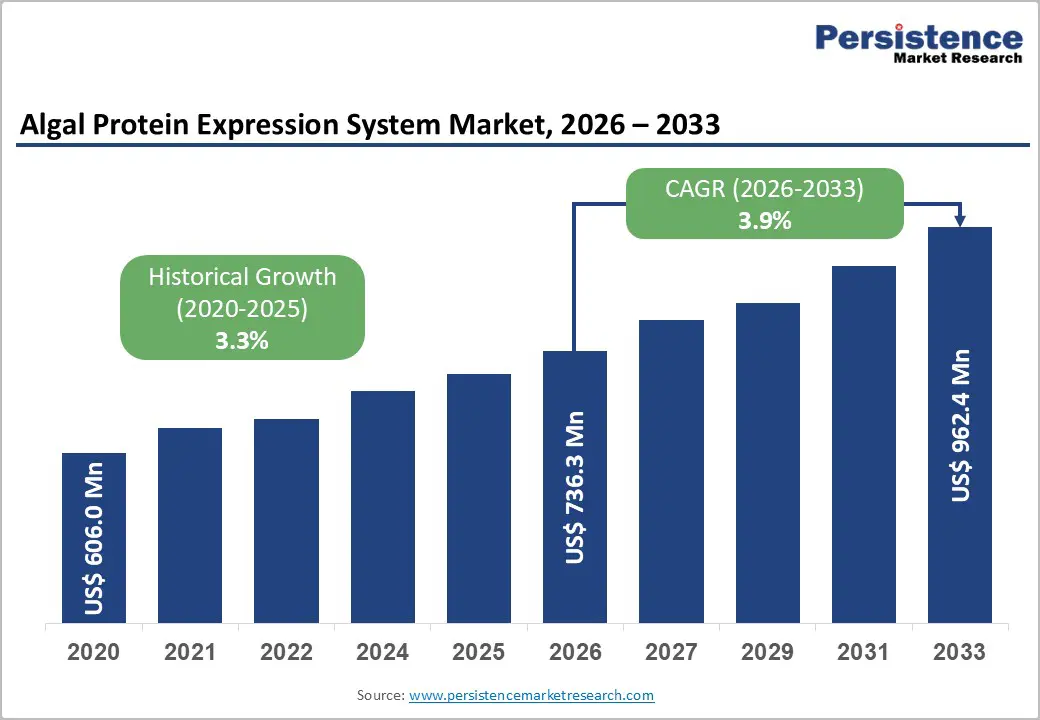
The global algal protein expression system market size is estimated to grow from US$ 736.3 million in 2026 to US$ 962.4 million by 2033, growing at a CAGR of 3.9% during the forecast period from 2026 to 2033.
The global algal protein expression system market focuses on producing, modifying, and regulating proteins in algae for diverse applications. Systems such as Chlamydomonas and Synechococcus are widely used, with Chlamydomonas gaining prominence for therapeutic protein and vaccine production, while Synechococcus supports biofuel and chemical production. Increasing demand for functional protein studies, advancements in technologies like mass spectrometry and protein microarrays, and commercially available kits, such as Thermo Scientific HSP70-rbcs2 and psbA1, are driving market growth. Rising prevalence of chronic diseases, an aging population, and innovation in gene-editing products further expand opportunities in biopharmaceutical, industrial, and research sectors.
Key Industry Highlights
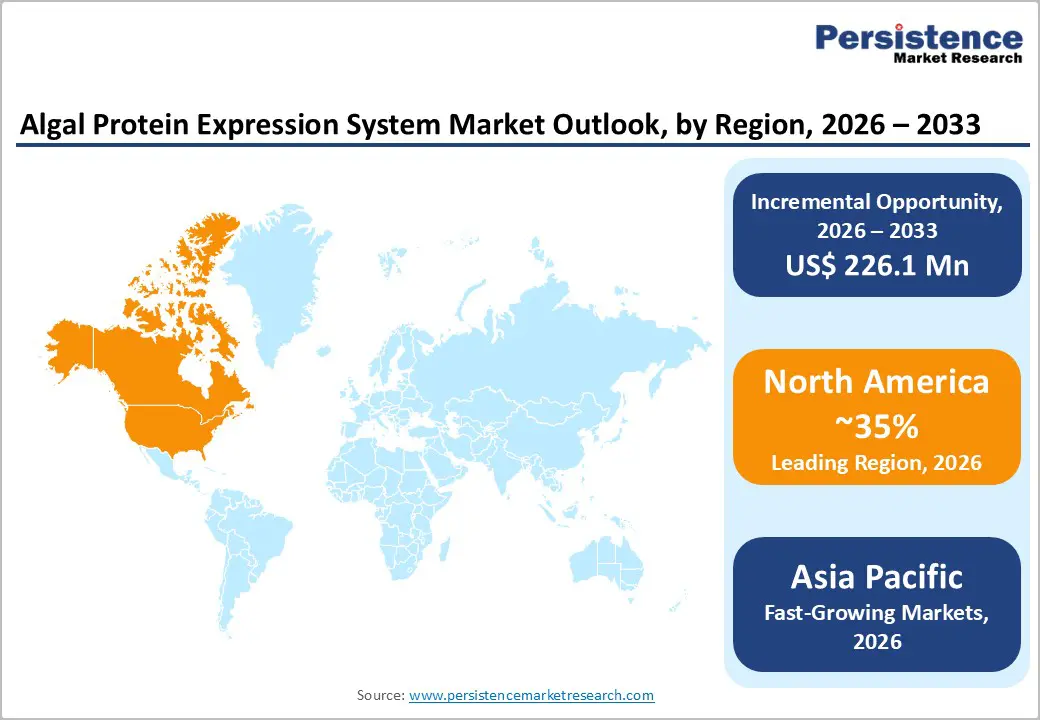
- Leading Region: North America remains the largest market, driven by strong biotechnology infrastructure, government research funding, and widespread adoption of advanced protein expression systems in academic and industrial labs.
- Fastest Growing Region: Asia Pacific is projected to grow at the fastest pace, supported by increasing biopharmaceutical research, rising investment in recombinant protein production, and expanding industrial applications in biofuels and chemicals.
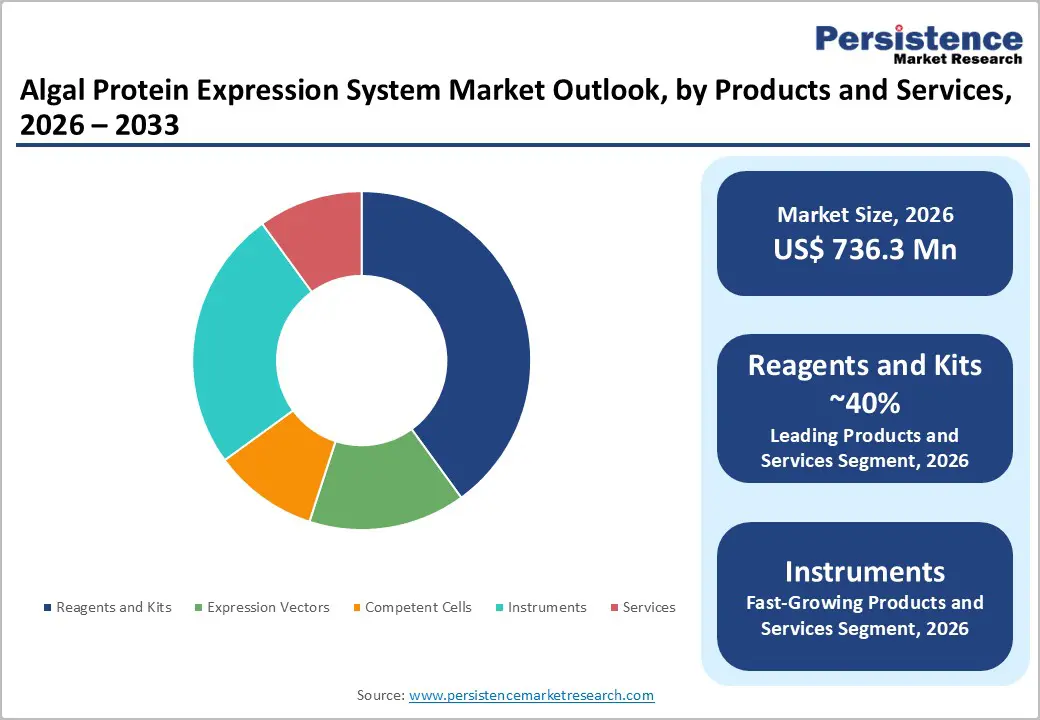
- Dominant Segment: Reagents and Kits dominate by product type, with around 40% share in 2025, reflecting recurring demand for cloning reagents, transformation kits, selection antibiotics, and detection assays across laboratories.
- Fastest Growing Segment: Chlamydomonas protein expression is the fastest growing, due to its established genome, compatibility with complex post-translational modifications, and availability of optimized toolkits for therapeutic protein and vaccine production.
| Key Insights | Details |
|---|---|
|
Algal Protein Expression System Market Size (2026E) |
US$ 736.3 Bn |
|
Market Value Forecast (2033F) |
US$ 962.4 Bn |
|
Projected Growth (CAGR 2026 to 2033) |
3.9% |
|
Historical Market Growth (CAGR 2020 to 2025) |
3.3% |
Market Dynamics
Driver - Rising Demand for Functional Proteins in Therapeutic and Industrial Applications
The growing need for functional proteins in research, therapeutics, and industrial processes is a key driver for the algal protein expression system market. Researchers increasingly rely on algae-based systems to produce and study proteins in vitro, as these systems allow precise regulation, modification, and scalable production of complex proteins. Algal systems such as Chlamydomonas are widely used for therapeutic protein and vaccine development, while Synechococcus contributes to biofuel and chemical synthesis, demonstrating the versatility and efficiency of these platforms.
Technological advancements further support this growth. Innovations like mass spectrometry, protein microarrays, and dual-tag GeneArt products simplify protein detection, purification, and analysis. Commercially available expression kits enable genetic modification of microalgae, reducing time and increasing reproducibility. Additionally, the global rise in chronic diseases and an aging population is intensifying the demand for novel drugs and therapeutic proteins. Consequently, the ability of algal protein expression systems to produce functional proteins efficiently makes them indispensable for research and industrial applications, fueling sustained market expansion.
Restraints - Limited Industrial-Scale Manufacturing Infrastructure and Standardization
Despite strong laboratory advancements, scaling algal protein expression to industrial levels remains a significant challenge. Very few facilities are equipped with closed photobioreactors or hybrid systems optimized for high-yield recombinant protein production. Establishing such infrastructure requires substantial capital investment and extensive validation, which can deter new entrants and slow market expansion.
Furthermore, a lack of standardized upstream and downstream protocols across different algal species increases variability in protein quality and consistency. This variability complicates regulatory approvals, as authorities require reproducible results comparable to established microbial or mammalian expression systems. Each species often demands unique growth conditions, harvesting techniques, and purification processes, further prolonging timelines. Consequently, limited industrial-scale manufacturing capacity and the absence of standardization constrain large-scale adoption, despite growing demand for algal-derived therapeutic proteins, vaccines, and industrial enzymes. Addressing these challenges through optimized bioreactor designs, harmonized protocols, and investment in GMP-compliant facilities is critical to unlocking the market’s full potential and enabling reliable, scalable protein production.
Opportunity - Expansion into High-Value Therapeutic and Regenerative Medicine Applications
Algal protein expression systems offer significant opportunities in therapeutic delivery and regenerative medicine. Engineered Chlamydomonas reinhardtii can be used to continuously secrete recombinant growth factors, such as VEGF, within biomaterial scaffolds, supporting tissue repair, controlled oxygen delivery, and enhanced cell survival. This capability enables localized, sustained release of therapeutic proteins, reducing the need for repeated dosing and improving treatment outcomes.
The approach aligns with the growing demand for novel biologic formats, cell-based therapies, and advanced delivery systems in the global protein expression market. By integrating algal expression with biomaterials, wound dressings, or implantable medical devices, companies can develop differentiated products targeting chronic wounds, orthopedic injuries, and other regenerative medicine applications. These innovative solutions can potentially command premium pricing due to their unique functionality and ability to address unmet clinical needs.
As research continues and regulatory pathways mature, the adoption of algal-based regenerative therapies is expected to expand, creating lucrative opportunities for biopharmaceutical and medical device companies globally.
Category-wise Analysis
By Products and Services
In the algal protein expression system market, reagents and kits dominate, accounting for 40% share in 2025. This segment benefits from recurring demand for cloning reagents, transformation kits, selection antibiotics, and detection assays, which are essential for each new construct or optimization cycle. Academic and industrial laboratories maintain a large installed base, driving continuous consumption. Technological advancements, such as improved vector designs, expanded promoter libraries, and high-throughput screening kits for Chlamydomonas and cyanobacterial hosts, further increase reagent utilization.
In comparison, capital equipment, including photobioreactors and instruments, typically represents one-time or infrequent investments, while specialized services, such as gene synthesis or custom expression solutions, are adopted selectively. This combination reinforces the higher revenue contribution from consumables. The ongoing development of more sophisticated and user-friendly kits allows researchers to streamline workflows, reduce experimental errors, and accelerate protein production, making reagents and kits the cornerstone of market growth and a key driver of adoption across both research and industrial applications.
By Host Type
Among algal hosts, Chlamydomonas protein expression is expected to capture the largest market share, exceeding 50% by 2026. Its widespread use stems from being the most studied eukaryotic microalgal model, with a fully sequenced genome and well-established transformation methods for nuclear and chloroplast genomes. Chlamydomonas reinhardtii supports complex post-translational modifications, making it ideal for therapeutic protein and vaccine production. Available toolkits include optimized promoters, mutant strains with reduced transgene silencing, and secretion signal libraries lower technical barriers and facilitate adoption for new researchers.
In contrast, Synechococcus and other cyanobacteria, although advantageous for photosynthetic growth and simpler genomic structures, are primarily employed for bulk metabolite production rather than high-value recombinant proteins. This limits their current market share. The versatility, scalability, and technical support available for Chlamydomonas solidify its leadership among algal hosts, positioning it as the preferred system for high-value protein expression in both academic research and commercial biotechnology sectors.
Region-wise Insights
North America Algal Protein Expression System Market Trends
North America, led by the U.S., is expected to command the largest regional share of the algal protein expression system market, estimated at about 34% in 2025. The region benefits from strong federal funding for synthetic biology and algae research through agencies such as the U.S. Department of Energy and National Institutes of Health, which support projects on microalgal bio-products, recombinant proteins, and advanced biomanufacturing. A dense ecosystem of biotechnology firms, contract manufacturers, and equipment suppliers further accelerates the adoption of algae-based platforms for both therapeutics and industrial enzymes.
Regulatory clarity and robust intellectual property protections in the U.S. encourage companies to pilot algal expression technologies under well-defined FDA and EPA guidelines for genetically modified organisms. Collaborations between universities and companies focused on Chlamydomonas strain engineering, photobioreactor scale-up, and downstream purification are increasingly transitioning from research grants to commercial partnerships. Canada also contributes through national bioeconomy strategies and algae innovation clusters, helping maintain North America’s leadership in this market.
Asia and Pacific Algal Protein Expression System Market Trends
The Asia Pacific region is emerging as the fastest-growing market for algal protein expression systems, supported by expanding biotechnology capabilities and strong government backing for algae research. China leads with significant investments in microalgae cultivation, photobioreactor manufacturing, and synthetic biology, including programs that target recombinant proteins and high-value biomolecules for pharmaceuticals and nutraceuticals. Japan and South Korea contribute advanced photobioreactor engineering, precision fermentation, and materials science expertise, enabling integrated production of therapeutic proteins and industrial enzymes.
In India and ASEAN countries, rising contract manufacturing activities and interest in affordable biologics create demand for flexible, lower-cost expression systems, where algae can complement or partially substitute conventional microbial hosts. Regional policies promoting bio-based industries and CO2 utilization, along with abundant sunlight and relatively low labor costs, give the Asia Pacific a structural advantage for scaling outdoor or hybrid algal cultivation facilities. These dynamics position the region as a key manufacturing base and innovation hotspot for the global algal protein expression system market.
Competitive Landscape
The algal protein expression system market remains relatively fragmented, with a mix of established life science suppliers and specialized biotechnology firms rather than a few dominant players. Global companies such as Agilent Technologies Inc., Merck KGaA, Lonza Group Ltd., QIAGEN N.V., Promega Corporation, Bio-Rad Laboratories Inc., and New England Biolabs Inc. provide reagents, cloning kits, enzymes, and analytical tools that underpin algal genetic engineering workflows.
Competitive differentiation often centers on vector design, host strain libraries, technical support, and integration with automation platforms rather than on proprietary algae species alone. Emerging firms and academic spin-offs focus on specialized applications such as therapeutic protein secretion, extremophile hosts, or algae-infused biomaterials, with partnerships, licensing agreements, and joint development projects serving as common strategies for scaling and commercialization.
Key Industry Developments:
- In February 2022, the European Commission introduced a dedicated platform aimed at advancing algae production and promoting broader industrial and commercial use across Europe.
Companies Covered in Algal Protein Expression System Market
- Agilent Technologies Inc.
- Lonza Group Ltd.
- Merck KGaA
- GenScript Biotech Corporation
- QIAGEN N.V.
- Promega Corporation
- Bio-Rad Laboratories Inc.
- New England Biolabs Inc.
- Others
Frequently Asked Questions
The global algal protein expression market is projected to be valued at US$ 736.3 Bn in 2026.
Rising demand for sustainable biopharmaceuticals, cost-effective protein production, increasing research in vaccines, enzymes, and therapeutic proteins globally.
The global market is poised to witness a CAGR of 3.9% between 2026 and 2033.
Expansion in biotechnology, genetic engineering, biofuels, and nutraceuticals; collaborations, government funding, and adoption in pharmaceutical and industrial applications.
Major players include Agilent Technologies Inc., Lonza Group Ltd., Merck KGaA, GenScript Biotech Corporation, and QIAGEN N.V.


