




- HVAC
- High Temperature Heat Pump Market
High Temperature Heat Pump Market Size, Share, and Growth Forecast, 2026 - 2033
High Temperature Heat Pump Market by Temperature Range (up to 80 °C, 80 °C to 120 °C, above 120 °C), Application (Industrial Process Heating, Others), End-use Industry (Chemical & Petrochemical, Food & Beverage, Others), and Regional Analysis for 2026 - 2033

High Temperature Heat Pump Market Size and Trends Analysis
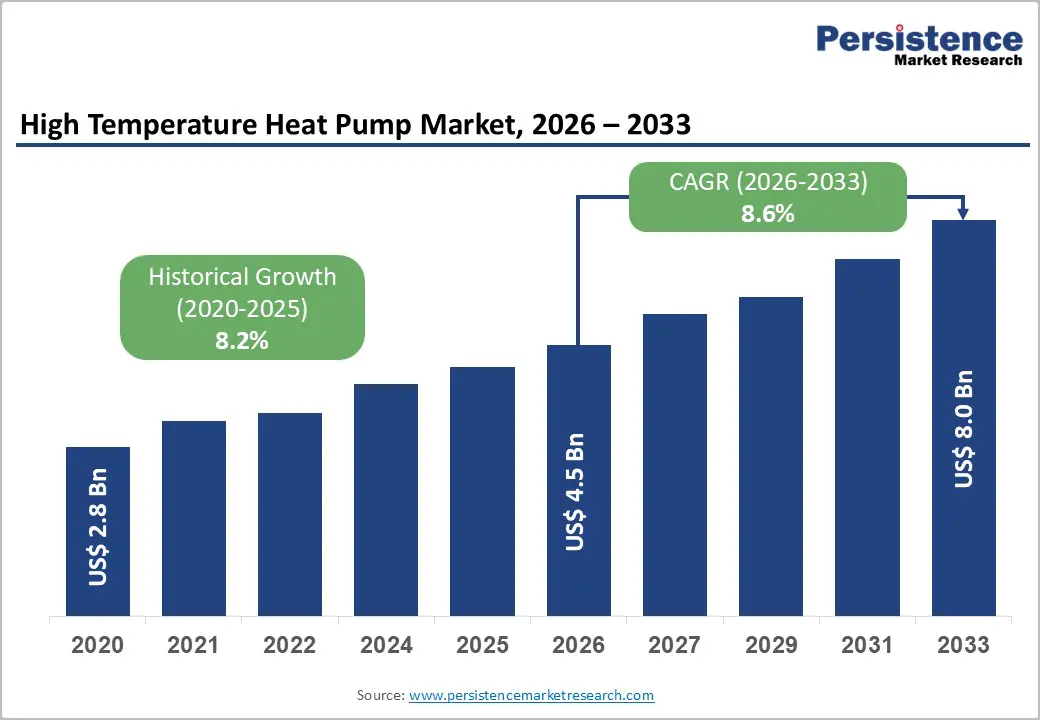
The global high temperature heat pump market size is likely to be valued at US$4.5 billion in 2026, and is expected to reach US$8.0 billion by 2033, growing at a CAGR of 8.6% during the forecast period from 2026 to 2033, driven by the increasing prevalence of industrial decarbonization targets, rising demand for energy-efficient process heat above 100 °C, and advancements in cascade and transcritical CO2 high temperature heat pump technology.
Growing demand for sustainable, high-output, high-temperature heat pumps, particularly in the 80 °C to 120 °C and above 120 °C ranges for chemical & petrochemical, and food & beverage applications, is accelerating adoption across end-use industries. Advances in waste heat recovery integration and low-GWP refrigerants are further increasing uptake by improving COP and enhancing regulatory compliance. The increasing recognition of high-temperature heat pumps as critical to replacing fossil-fuel boilers and achieving net-zero goals in hard-to-abate sectors remains a major driver of market growth.
Key Industry Highlights:
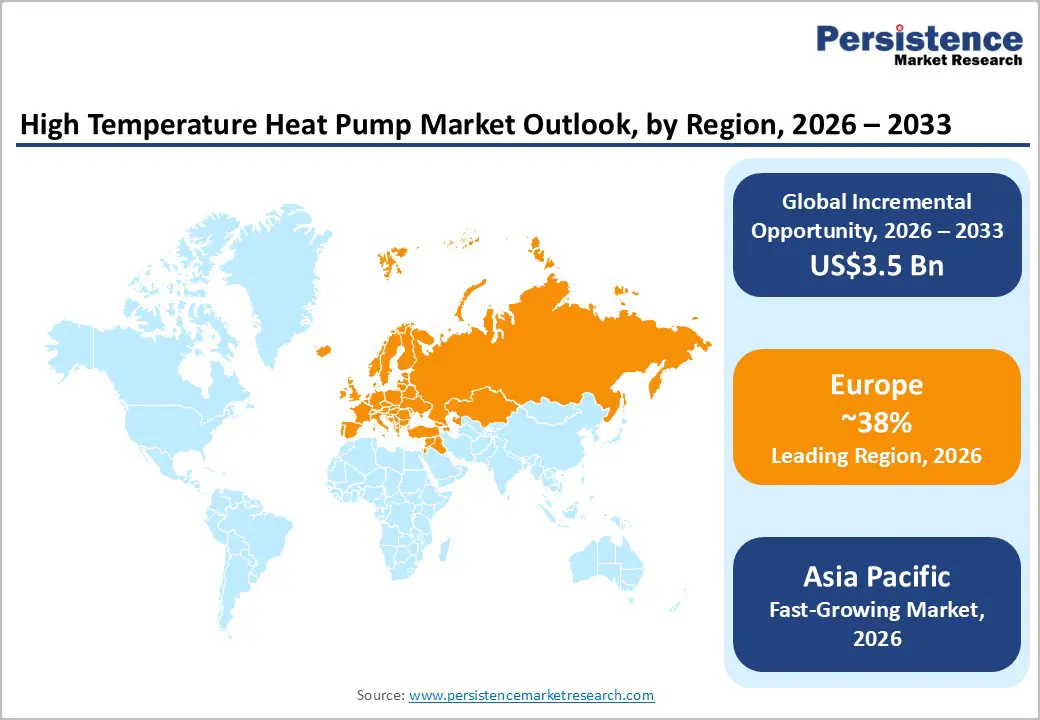
- Leading Region: Europe, anticipated to account for a 38% market share in 2026, driven by aggressive EU Fit for 55 and REPowerEU policies, strong industrial heat demand, and early commercial deployments in Germany and the Netherlands.
- Fastest-growing Region: Asia Pacific, to be fueled by China’s industrial electrification push, India’s process-industry expansion, and growing investments in high-temperature heat pump manufacturing.
- Dominant Temperature Range: 80 °C to 120 °C, holding approximately 45% of the market, as it covers the largest share of current industrial heat demand.
- Leading Application: Industrial process heating accounts for over 50% of market revenue, driven by the highest volume of high-grade heat substitution potential.
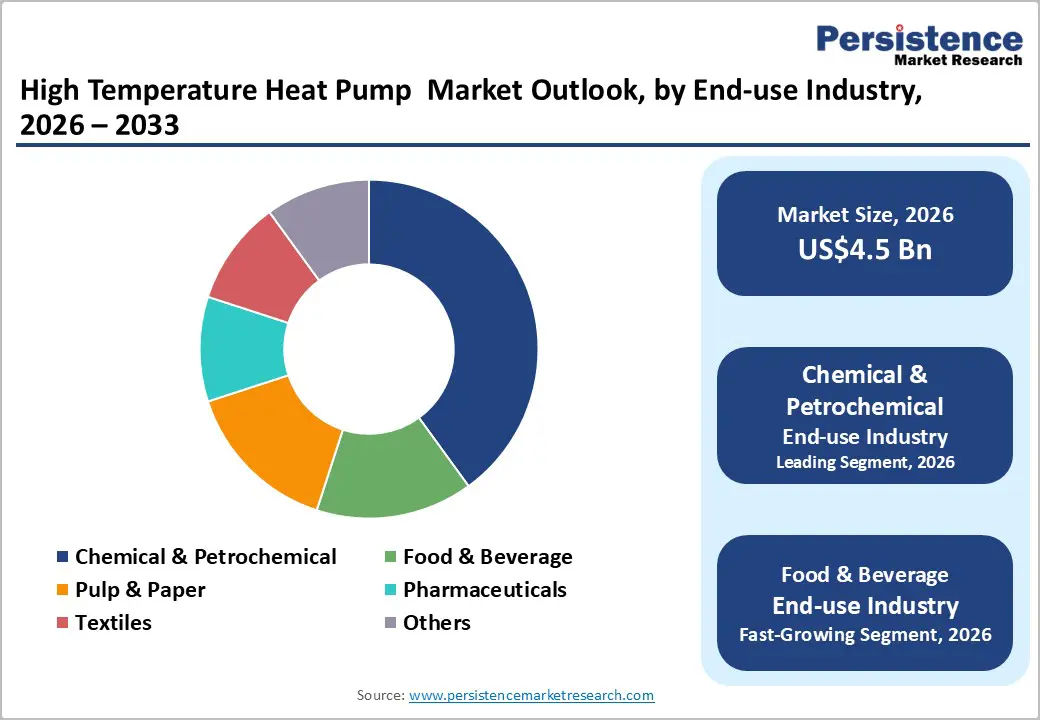
- Leading End-use Industry: The chemical & petrochemical segment, to contribute nearly 30% of the market revenue, due to large steam and hot-water requirements.
| Key Insights | Details |
|---|---|
|
High Temperature Heat Pump Market Size (2026E) |
US$4.5 Bn |
|
Market Value Forecast (2033F) |
US$8.0 Bn |
|
Projected Growth (CAGR 2026 to 2033) |
8.6% |
|
Historical Market Growth (CAGR 2020 to 2025) |
8.2% |
Market Factors - Growth, Barriers, and Opportunity Analysis
Increasing Demand for Industrial Decarbonization Targets and High-Grade Process Heat
Industries worldwide are under increasing pressure to reduce carbon emissions and transition toward more sustainable operations. Governments and regulatory bodies are setting ambitious industrial decarbonization targets, requiring factories, chemical plants, food processing units, and other energy-intensive sectors to adopt low-carbon technologies. Traditional fossil fuel-based heating systems contribute significantly to greenhouse gas emissions, making decarbonization a challenging but urgent priority. High-temperature heat pumps (HTHPs) have emerged as a viable solution because they provide high-grade process heat often reaching temperatures between 80°C and 150°C or higher without relying on combustion-based energy sources.
The demand for HTHPs is driven not only by environmental regulations but also by operational efficiency considerations. These systems can recover waste heat from industrial processes, integrate with renewable energy sources, and supply consistent, high-temperature heat essential for processes such as pasteurization, drying, chemical reactions, and metal treatment. By enabling industries to meet both temperature and sustainability requirements, HTHPs help reduce reliance on natural gas or oil, lower energy costs, and minimize carbon footprints.
Infrastructure and Integration Challenges
Adapting industrial facilities to accommodate high-temperature heat pumps presents more than just a technical upgrade; it requires a transformation of existing infrastructure. Many factories and commercial plants were originally designed around conventional boilers or fossil-fuel-based systems, meaning the piping, heat distribution networks, and control systems are often incompatible with the high operating temperatures and pressures of HTHPs. Installing a new system can demand extensive modifications to these foundational components, which can be both time-consuming and costly.
Integration challenges extend beyond physical infrastructure. High-temperature heat pumps must operate seamlessly with existing process controls, monitoring systems, and backup heating units. Even minor mismatches in temperature regulation, flow rates, or control logic can compromise efficiency or disrupt ongoing production, making facility managers hesitant to replace traditional systems. Space constraints can further complicate installation, as HTHPs require room for compressors, heat exchangers, and auxiliary equipment, something older facilities often lack.
Developments in Cascade Systems and Waste Heat Recovery Integration
Cascade systems use multiple compression stages or different refrigerants in series to achieve higher output temperatures more efficiently than single-stage systems. This approach enables HTHPs to deliver process heat above 120–150°C, making them suitable for industries such as chemical manufacturing, food processing, and pulp and paper processing, where high-grade heat is essential. By optimizing energy transfer at each stage, cascade systems reduce energy consumption and improve overall system efficiency, allowing companies to achieve both operational cost savings and sustainability targets.
Integration with waste heat recovery systems further enhances the appeal of HTHPs. Many industrial processes release significant thermal energy through exhaust gases, hot water, or condensate streams. Capturing this heat as a source for HTHPs not only increases the system’s coefficient of performance (COP) but also reduces reliance on primary energy sources, cutting emissions and lowering costs. Emerging designs now enable HTHPs to recover heat across a wide range of temperatures and feed it into industrial processes with minimal modifications.
Category-wise Analysis
Temperature Range Insights
The 80°C to 120°C segment is projected to dominate the market, accounting for 45% of revenue by 2026, driven by its versatility and broad range of applications across industries. This temperature range meets the needs of various industrial and commercial processes, such as food pasteurization, textile drying, and chemical processing, where moderately high heat is required. Systems operating within this range strike an ideal balance between efficiency, cost, and performance, making them suitable for both retrofitting and new installations. In the U.K., Pure Thermal completed a retrofit project at a major industrial manufacturing site producing bricks and roof tiles. Conventional oil boilers were replaced with industrial heat pumps capable of delivering up to 80°C for curing concrete. The system included two Pure Thermal Black 120 heat pump units, providing the necessary hot water for production and enabling the facility to transition from fossil-fuel-based heating to low-carbon electric heat pumps without significant changes to the production process.
The 120°C segment is likely to be the fastest-growing, driven by increasing demand from industries requiring high-grade process heat, such as chemicals, pharmaceuticals, and metal processing. These processes often cannot rely on lower-temperature heat sources, making HTHPs capable of delivering over 120°C a critical solution for decarbonization and efficiency improvements. Technological advancements in cascade systems, advanced refrigerants, and multi-stage compression now enable heat pumps to safely and efficiently reach these elevated temperatures. In Japan, Kobe Steel, Ltd., together with Tokyo Electric Power Co., Inc., Chubu Electric Power Co., Inc., and The Kansai Electric Power Co., Inc., jointly developed the Steam Glow Heat Pump 165 (SGH165) system, capable of supplying steam at up to 165°C, far exceeding the 120°C threshold. This heat pump system was engineered to deliver high-temperature steam for industrial processes such as sterilization, chemical concentration, and drying, areas traditionally dominated by boilers.
Application Insights
Industrial process heating is projected to lead the market, accounting for 50% of the market in 2026, driven by the widespread need for high-grade, continuous heat in manufacturing. Industries such as chemicals, food and beverages, textiles, and paper rely heavily on reliable heat for drying, pasteurization, sterilization, and chemical reactions. High-temperature heat pumps offer an energy-efficient, low-emission alternative to fossil-fuel boilers, reducing operational costs and carbon footprints. Compagnie des Fromages & Riches Monts (CF&R) production site in Montauban-de-Bretagne, France, Equans installed a high-temperature industrial heat pump to supply process heat for food manufacturing operations. This heat pump replaced part of the fossil-fuel-based heating system, resulting in significant energy savings around 12-GWh per year and an estimated reduction of approximately 2,000 tonnes of CO2 annually by 2024.
Waste heat recovery is likely to be the fastest-growing application, driven by industries’ focus on energy efficiency and emission reduction. Many industrial processes, such as chemical manufacturing, food processing, and metal production, generate substantial amounts of low- to medium-grade waste heat that is often unused. High-temperature heat pumps can capture this waste heat and raise it to temperatures suitable for process or district heating. In the U.K., Futraheat Ltd., a London-based industrial heat pump developer, designed its Greensteam 360 system to capture low-grade waste heat from industrial processes and elevate it to usable steam temperatures (up to ~130°C) for on-site reuse. The heat pump captures energy that would otherwise be lost in processes such as drying or brewing and raises it to higher temperatures suitable for heating or steam generation, significantly reducing energy consumption and carbon emissions.
End-use Industry Insights
The chemical and petrochemical industry is set to lead the market, accounting for nearly 30% of the revenue by 2026, driven by its significant need for continuous, high-grade process heat. Processes such as chemical reactions, distillation, drying, and solvent recovery require precise and reliable heating, making high-temperature heat pumps an efficient alternative to traditional fossil-fuel boilers. HTHPs deliver energy-efficient, low-emission heat while maintaining strict temperature control, helping companies reduce operational costs and meet sustainability objectives. For example, BASF is implementing an industrial heat pump system at its Ludwigshafen site that captures waste heat from a steam cracker and converts it into carbon-free process steam, with an output of up to 50 MWth. This project is part of BASF's broader strategy to electrify steam generation and significantly reduce CO emissions across its production facilities, in line with its long-term sustainability goals.
The food & beverage segment is likely to be the fastest-growing segment, driven by the sector’s increasing focus on energy efficiency, sustainability, and cost reduction. Processes such as pasteurization, sterilization, drying, and cooking require consistent, high-grade heat, which HTHPs can supply more efficiently than conventional fossil-fuel boilers. The industry generates substantial low-grade waste heat that can be upgraded by HTHPs for reuse, further reducing energy costs and emissions. The Hepworth Brewery in West Sussex, U.K., is adopting an ultra-high-temperature heat pump system developed by Futraheat to produce beer using heat recovered from the brewing process, replacing a traditional oil boiler. The system recycles waste vapour and raises it to around 130°C, which is used in key heating steps such as wort boiling, a core heat-intensive part of beer production.
Regional Insights
North America High Temperature Heat Pump Market Trends
North America is expected to experience significant growth owing to the region’s advanced industrial base, strong research and development capabilities, and high public awareness of the benefits of electrification. Manufacturing systems in the U.S. and Canada provide extensive support for heat pump programs, ensuring wide accessibility of high-temperature heat pumps across chemical & petrochemical, food & beverage, and pulp & paper populations. Increasing demand for 80–120 °C, convenient, and easy-to-integrate forms is further accelerating adoption, as these formats improve efficiency and reduce barriers associated with fossil-fuel boilers.
Innovation in high-temperature heat pump technology, including stable cascade, improved waste heat delivery, and targeted industrial enhancement, is attracting significant investment from both public and private sectors. Government initiatives and IRA tax-credit campaigns continue to promote the use of carbon-risk mitigation, energy-cost reduction, and emerging net-zero strategies, creating sustained market demand. The growing focus on food & beverage grades and specialty uses, particularly for pulp & paper and others, is expanding the target applications for high-temperature heat pumps.
Europe High Temperature Heat Pump Market Trends
Europe is projected to lead with a market share of 38% in 2026, driven by increasing awareness of the benefits of decarbonization, robust regulatory frameworks, and government-led industrial heat programs. Countries such as Germany, the Netherlands, France, and Sweden have well-established manufacturing frameworks that support routine use of high-temperature heat pumps and encourage the adoption of innovative delivery methods. These low-carbon formulations are particularly appealing to chemical & petrochemical industries, regulation-conscious operators, and food & beverage users, thereby improving compliance and coverage rates.
Technological advancements in high-temperature heat pump development, such as enhanced cascade cycles, application-specific delivery, and operation at temperatures above 120°C, are further enhancing market potential. European authorities are increasingly supporting research and trials of pumps for both routine and specialized applications, thereby strengthening market confidence. The growing emphasis on convenient, high-COP options aligns with the region’s focus on a preventive industrial transition and reducing gas dependence. Public awareness campaigns and promotion drives are expanding reach in both urban and rural areas, while suppliers are investing in refrigerants and novel variants to increase efficacy.
Asia Pacific High Temperature Heat Pump Market Trends
Asia-Pacific is likely to be the fastest-growing market for high-temperature heat pumps in 2026, driven by rising industrial awareness, expanding government initiatives, and expanding application programs across the region. Countries such as China, India, Japan, and South Korea are actively promoting pump campaigns to address process heat growth and emerging low-carbon needs. High-temperature heat pumps are particularly attractive in these regions due to their scalable administration, ease of integration, and suitability for large-scale manufacturing drives in both urban and rural populations.
Technological advancements are supporting the development of stable, effective, and easy-to-install high-temperature heat pumps, which can withstand challenging operating conditions and minimize efficiency dependence. These innovations are critical for reaching remote facilities and improving overall thermal coverage. Growing demand for chemical & petrochemical, food & beverage, and pulp & paper applications is contributing to market expansion. Public-private partnerships, increased manufacturing expenditure, and rising investment in pump research and manufacturing capacity are further accelerating growth. The convenience of pump delivery, combined with improved COP and reduced risk of emissions, positions high-temperature heat pumps as a preferred choice.
Competitive Landscape
The global high temperature heat pump market features competition between established HVAC leaders and emerging industrial specialists. In Europe and North America, Johnson Controls and Ochsner Energie Technik lead through strong R&D, distribution networks, and industrial ties, bolstered by innovative cascade and high-lift programs. In Asia Pacific, Mayekawa advances with localized solutions, enhancing accessibility. Cascade delivery boosts COP, cuts fuel risks, and enables mass integrations across regions. Strategic partnerships, collaborations, and acquisitions merge expertise, expand portfolios, and speed commercialization. High-lift formulations address temperature-related challenges, improving penetration in hard-to-abate sectors.
Key Industry Developments
- In August 2025, Daikin unveiled a new high-temperature water-cooled heat pump, specifically designed for industrial processes and district heating networks. This next-generation heat pump was developed to deliver efficiency, flexibility, and sustainability, addressing the complex heating needs of large-scale operations.
- In August 2025, Triveni Turbines Ltd., in collaboration with the Indian Institute of Science (IISc), Bengaluru, launched India’s first CO-based high-temperature heat pump capable of delivering heat up to 122°C with a high coefficient of performance (COP of ~6). This system uses carbon dioxide (R744) as a natural refrigerant, offering a more environmentally friendly alternative to conventional heat pumps that rely on synthetic refrigerants.
- In September 2023, Carrier introduced a new range of high- and very-high-temperature heat pumps designed for industrial, commercial, and public buildings, as well as district heating. Developed by Carrier, a part of Carrier Global Corporation, a global leader in intelligent climate and energy solutions, this technology is designed to meet growing demand for efficient heating.
Companies Covered in High Temperature Heat Pump Market
- Johnson Controls
- Mitsubishi Electric
- Kobe Steel
- Viking Heating Engines
- Ochsner Energie Technik
- Hybrid Energy
- Mayekawa
- Konhitherm
- Durr Thermea
- Friotherm
- Star Refrigeration
Frequently Asked Questions
The global high temperature heat pump market is projected to reach US$4.5 billion in 2026.
Industrial decarbonization targets and demand for high-grade process heat substitution are key drivers.
The high temperature heat pump market is poised to witness a CAGR of 8.6% from 2026 to 2033.
Cascade systems and waste heat recovery integration are the key opportunities.
Johnson Controls, Ochsner Energie Technik, Mayekawa, Mitsubishi Electric, and Star Refrigeration are the key players.


