




- Industrial Goods & Service
- Floor Care Machine Market
Floor Care Machine Market Size, Share, and Growth Forecast, 2025 - 2032
Floor Care Machine Market by Product Type (Vacuum Cleaners, Sweeper Machines, Scrubber Machines, Burnisher Machines, Carpet Extractors, Others), Application (Commercial, Industrial, Residential), and Regional Analysis for 2025 - 2032

Floor Care Machine Market Share and Trends Analysis
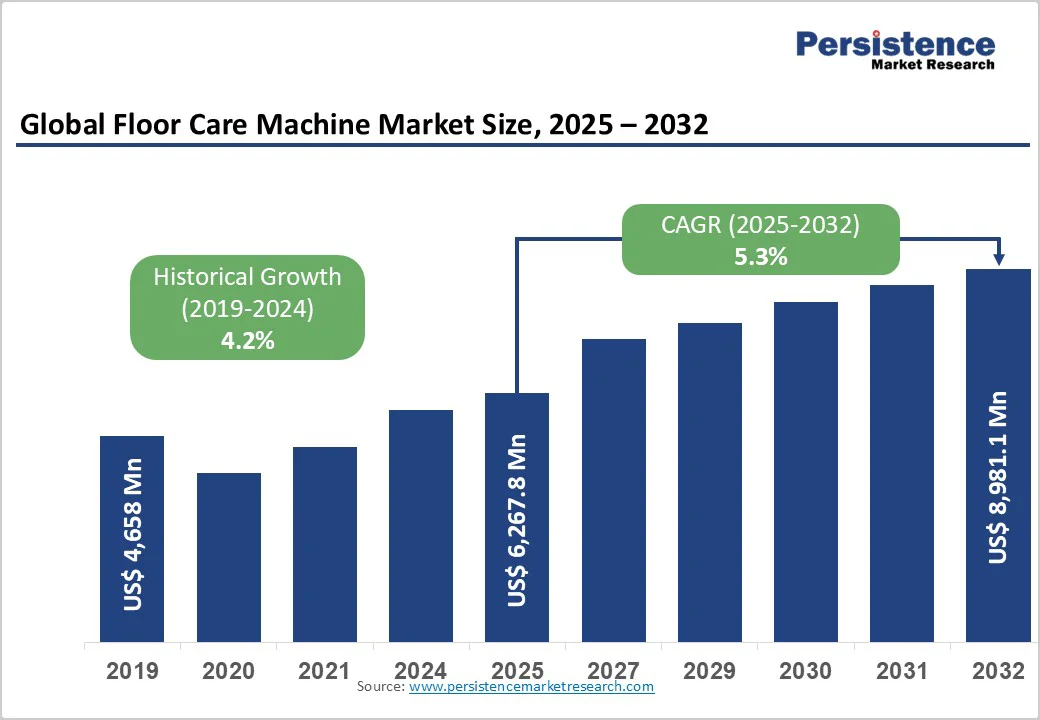
The global floor care machine market size is likely to be valued at US$ 6.3 billion in 2025, and is projected to reach US$ 9.0 billion by 2032, growing at a CAGR of 5.3% during the forecast period 2025-2032. This growth trajectory is primarily driven by increasing workplace safety concerns, stringent hygiene regulations across commercial and industrial sectors, and the accelerating adoption of automated and robotic cleaning solutions. The shift from manual cleaning methods to technologically advanced floor care equipment is fundamentally transforming facility management operations, while the COVID-19 pandemic has heightened awareness regarding cleanliness standards, creating sustained demand for efficient floor maintenance solutions across healthcare, hospitality, retail, and manufacturing sectors.
Key Industry Highlights
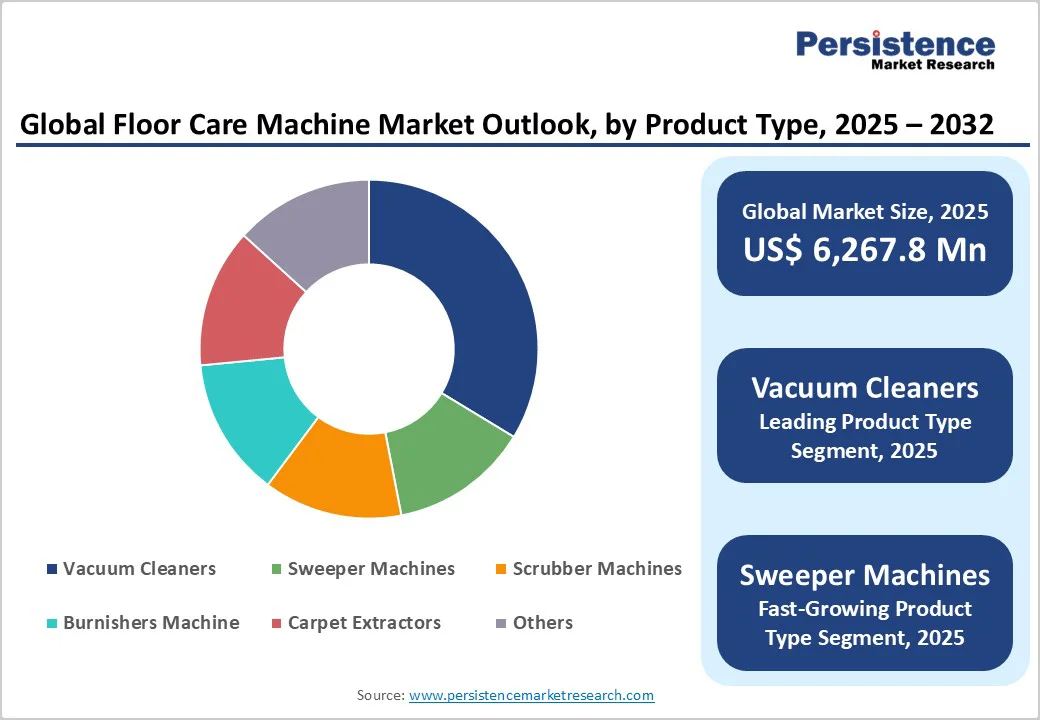
- Product Leadership: Vacuum cleaners are set to dominate with over 52% market share in 2025, while sweeper machines represent the fastest-growing product segment through 2032, driven by industrial and municipal applications across emerging economies.
- Application Dominance: Commercial sector is slated to lead with over 45% market share in 2025, while industrial applications demonstrate fastest growth from 2025 to 2032, supported by manufacturing expansion and e-commerce warehouse proliferation.
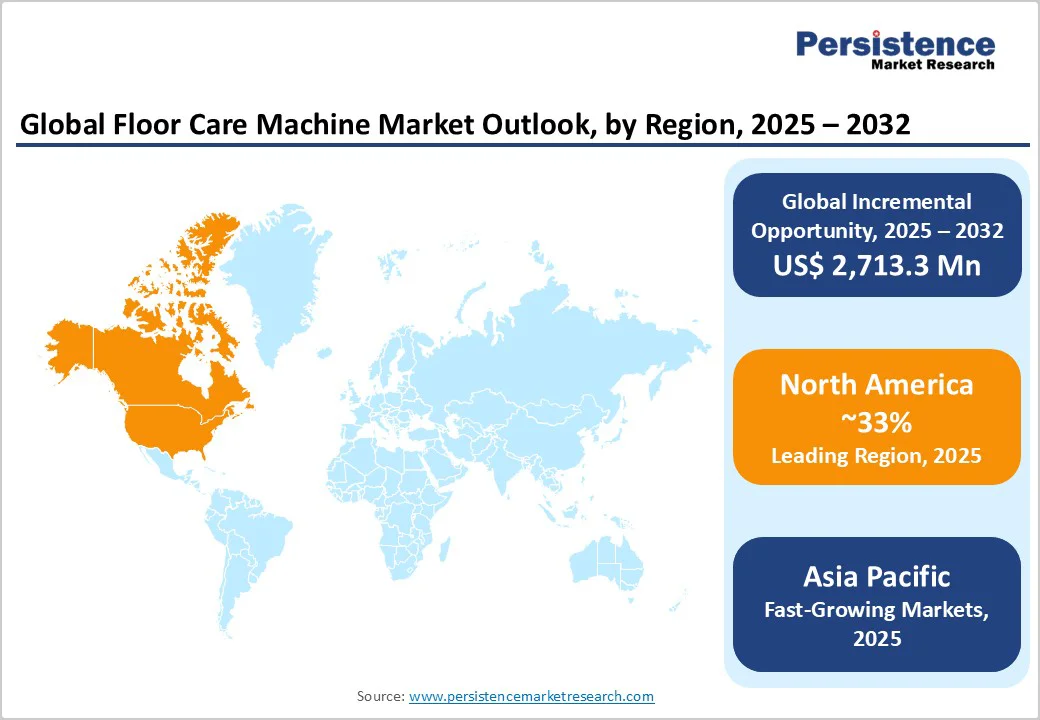
- Regional Dynamics: North America is poised to command more than 33% of the global market share in 2025, backed by a mature construction sector.
- Sustainability Focus: Energy-efficient and eco-friendly equipment is gaining market traction with battery-powered models, water-saving technologies, and chemical-free cleaning solutions addressing environmental regulations and corporate sustainability commitments.
- Strategic M&A Activity: Market witnessing moderate consolidation with a considerable of acquisitions annually as manufacturers expand technological capabilities, geographic presence, and product portfolios through strategic acquisitions and technology partnerships.
| Key Insights | Details |
|---|---|
|
Floor Care Machines Market Size (2025E) |
US$ 6.3 Bn |
|
Market Value Forecast (2032F) |
US$ 9.0 Bn |
|
Projected Growth (CAGR 2025 to 2032) |
5.3% |
|
Historical Market Growth (CAGR 2019 to 2024) |
4.2% |
Market Factors - Growth, Barriers, and Opportunity Analysis
Stringent Workplace Safety and Hygiene Regulations
The global emphasis on workplace safety and hygiene has emerged as a paramount driver for the floor care machines market. Healthcare facilities, food processing units, and pharmaceutical manufacturing plants face stringent regulatory requirements mandating systematic floor cleaning protocols to prevent contamination and ensure compliance with health standards. Industrial scrubbers and vacuum cleaners have become indispensable in environments such as hospitals, where maintaining sterile conditions is paramount. Furthermore, the COVID-19 pandemic has permanently elevated hygiene consciousness, with businesses across sectors prioritizing investment in high-performance floor cleaning solutions to ensure safe environments for employees and customers.
Technological innovation represents a transformative force for the floor care machines market growth, with artificial intelligence (AI), IoT connectivity, and robotics revolutionizing cleaning operations. Advanced AI-powered floor scrubbers equipped with machine learning algorithms can map complex environments, navigate autonomously, and optimize cleaning paths without human intervention, significantly reducing labor costs while improving efficiency. Smart sensors, IoT-enabled monitoring systems, and cloud-based platforms allow facility managers to track equipment performance, schedule predictive maintenance, and analyze cleaning productivity in real-time.
Limited Product Awareness and Economic Sensitivity
Market growth faces constraints from insufficient awareness regarding advanced floor care technologies' long-term benefits and cost-saving potential, particularly in developing regions where traditional cleaning practices remain deeply entrenched. In a large number of cases, facility managers lack understanding of how automated equipment can reduce labor costs, improve cleaning consistency, and minimize floor maintenance expenses over time.
The floor care machines market demonstrates significant sensitivity to economic fluctuations as well, with businesses often deferring or scaling back capital equipment investments during periods of economic uncertainty or recession. Small-scale operators in price-sensitive markets frequently opt for basic manual equipment or outsourced cleaning services rather than investing in sophisticated machinery, limiting market penetration in these segments. Concerns regarding the environmental impact of certain cleaning chemicals and energy consumption patterns have also generated hesitation among eco-conscious buyers, despite manufacturers' efforts to develop sustainable alternatives.
Sustainable Innovation and Sectoral Expansion to Power the Next Growth Wave
The floor care machine market landscape is set to witness robust growth as expanding healthcare, hospitality, e-commerce, and contract cleaning sectors align with increasing emphasis on sustainability and energy efficiency. The healthcare and hospitality industries demand advanced cleaning machines tailored for infection control, hygiene maintenance, and operational precision. Hospitals increasingly adopt machines featuring HEPA filtration, disinfection, and chemical-free cleaning technologies to meet stringent sanitation standards, while hotels, restaurants, and retail environments prioritize quiet, fast-drying, and high-performance machines to ensure superior guest experiences.
In parallel, the surge in e-commerce warehousing and logistics, coupled with the growing influence of third-party contract cleaning services which represent over one-third of the commercial vacuum cleaner market drives the need for high-capacity, durable, and autonomous cleaning machines. Manufacturers can leverage this momentum by introducing eco-friendly, battery-powered, water-saving, and chemical-free systems that minimize environmental impact and operating costs. Particularly in Europe, where regulatory and consumer focus on sustainability is high, machines designed with recyclable materials and circular economy principles enjoy a competitive advantage.
Category-wise Analysis
Product Type Insights
Vacuum cleaners are anticipated to dominate, holding over 52% of the floor care machine market revenue share in 2025, owing to their adaptability across residential, commercial, and industrial environments. The segment includes a wide range of products such as upright, canister, handheld, backpack, and robotic models, each designed for specific cleaning requirements. Industrial-grade vacuum machines, particularly used in manufacturing plants, construction sites, and chemical industries, are equipped with powerful suction systems, HEPA filters, and durable designs to handle both wet and dry materials. Continuous innovation through multi-layer filtration, automatic dust-emptying, and IoT-enabled smart connectivity enhances efficiency and user convenience.
Sweeper machines, on the other hand, are set to be the fastest-growing product category through 2032, driven by a widespread demand for high-efficiency debris removal in expansive indoor and outdoor facilities. With models ranging from manual push to advanced ride-on sweepers offering productivity up to 30,000 m²/h, adoption is surging across warehouses, parking lots, and municipal applications. Asia Pacific, particularly China, and India, exhibits the highest growth potential due to rapid urbanization and infrastructure expansion, while the Middle East’s construction boom and smart city projects further reinforce the growth of this segment.
Application Insights
The commercial sector will lead the floor care machine market, accounting for over 45% of the total revenue share in 2025. This dominance is supported by the widespread adoption of floor cleaning equipment across retail stores, office complexes, airports, shopping malls, and entertainment venues. Clean, well-maintained floors are essential for creating appealing and hygienic environments that enhance customer experience and meet health compliance standards. Retail spaces demand frequent, high-performance cleaning to maintain inviting shopping environments, while office buildings prefer quiet, efficient machines that operate unobtrusively during working hours. The segment shows strong preference for versatile machines such as walk-behind scrubbers, upright vacuums, and compact sweepers that deliver optimal cleaning performance and maneuverability in confined areas.
In contrast, the industrial sector represents the fastest-growing application area for the 2025-2032 period, fueled by rapid manufacturing expansion, warehouse proliferation driven by e-commerce, and stringent occupational safety standards. Facilities such as automotive plants, food processing units, pharmaceutical labs, and distribution centers rely on heavy-duty ride-on scrubbers, sweepers, and industrial-grade vacuums to manage vast floor spaces and diverse contaminants.
Regional Insights
North America Floor Care Machine Market Trends
North America is poised to dominate with a 33% floor care machine market share in 2025, aided by an advanced market infrastructure, strict workplace safety regulations, and widespread adoption of innovative cleaning technologies across commercial and industrial facilities. The United States represents nearly 89.4% of the regional market, driven by a large commercial real estate base, strong manufacturing sector, and well-established distribution channels for professional cleaning machines. Regional stakeholders have demonstrated a clear shift toward automation and robotics to address labor shortages and rising wages, with facility managers increasingly adopting autonomous and robotic cleaning machines to enhance efficiency and reduce manual dependence.
Regulatory frameworks such as OSHA safety standards and CDC hygiene protocols for healthcare facilities continue to drive systematic floor maintenance practices. Hospitals, clinics, and medical centers form a major end-user base, favoring machines equipped with HEPA filtration, chemical-free disinfection, and quiet operation for 24-hour cleaning. Sustainability initiatives further shape market dynamics, with a growing demand for energy-efficient, battery-powered, and water-saving models from brands such as Tennant and Nilfisk.
Europe Floor Care Machine Market Trends
Europe maintains a strong but steadier growth trajectory in the floor care machines market, driven by the ever-broadening adoption of advanced cleaning technologies. The regional market benefits from stringent hygiene regulations across sectors such as healthcare, hospitality, and public spaces, which sustain consistent demand for reliable and high-performance floor care equipment. European consumers and businesses increasingly prioritize eco-friendly, energy-efficient, and smart cleaning solutions, prompting manufacturers to focus on sustainability and innovation. While the market growth is more moderate compared to Asia Pacific and North America, the well-established distribution networks and strong focus on product quality, service, and regulatory compliance in Europe uphold its position as a key market in floor care equipment.
Asia Floor Care Machine Market Trends
Asia Pacific is expected to be the fastest-growing regional market for floor care machines from 2025 to 2032. This growth is driven by rapid urbanization, expanding commercial and residential construction, and increasing disposable incomes in China, India, and Vietnam. The region’s booming construction industry, increasing number of hotels, retail spaces, and office buildings fuel demand for efficient and cost-effective cleaning solutions. Additionally, the growing awareness of hygiene and sanitation, especially in response to public health concerns, is accelerating the adoption of automated and robotic floor care machines. Technological advancements in smart cleaning systems and affordability tailored to emerging markets further propel growth. Government initiatives aimed at improving urban cleanliness and promoting sustainable environments also support market expansion.
Competitive Landscape
The global floor care machine market structure demonstrates moderate concentration, with leading multinationals commanding significant shares while regional players maintain strong positions in specific geographies. Tennant Company, Nilfisk Group, and Alfred Kärcher GmbH & Co. KG collectively hold around 30% of the market, leveraging extensive product portfolios, international distribution networks, and strong brand recognition.
Regional players such as Hako GmbH, EUREKA S.p.A., Comac, Fimap, IPC Group, and Minuteman International compete through specialized products, local manufacturing advantages, and customer relationships. While North America and Europe exhibit higher consolidation, Asia Pacific remains fragmented, reflecting diverse competitive dynamics and strategic differentiation across technology, price, and service offerings.
Key Industry Developments
- In May 2025, Dyson unveiled the PencilVac, its thinnest and slimmest cordless vacuum cleaner to date. Designed for easy handling and storage, the PencilVac features a slim profile that fits comfortably in tight spaces and hard-to-reach areas. Despite its compact size, it delivers strong suction power and versatile cleaning capabilities, making it ideal for quick touch-ups and everyday use.
- In April 2025, Tennant Company introduced the X6 ROVR, a mid-sized autonomous floor scrubber designed for large and complex commercial and light-industrial environments. The X6 ROVR can clean up to 75,000 square feet per cycle using a 26-inch dual-disc scrub path and 25-gallon solution tanks, powered by lithium-ion batteries that support up to six hours of continuous runtime. Equipped with advanced 3D LiDAR technology and AI-driven BrainOS®, the scrubber offers real-time obstacle detection, adaptive routing, and remote fleet management, enhancing cleaning efficiency while minimizing human intervention.
- In February 2025, Nilfisk launched three next-generation vacuum cleaners – VP300, VP400 compact canister vacuums, and the VU200 cordless stick vacuum – designed to enhance simplicity, power, and efficiency for professional cleaning. These models feature ergonomic, lightweight designs with intuitive controls for easy maneuverability in tight spaces and various cleaning environments. The VU200 cordless vacuum offers multiple cleaning modes, an exchangeable battery, and advanced filtration, promoting uninterrupted and adaptable use.
Companies Covered in Floor Care Machine Market
- Tennant Company
- Nilfisk Group
- Kärcher GmbH & Co. KG
- Hako GmbH
- Dyson Ltd.
- TASKI (Diversey Holdings Ltd.)
- Alfred Kärcher SE & Co. KG
- Eureka Forbes Ltd.
- Makita Corporation
- iRobot Corporation
- Hoover (Techtronic Industries Co. Ltd.)
- Bissell Inc.
- Eureka (Midea Group Subsidiary)
- Comac S.p.A.
- RCM S.p.A. (Raimondi Costruzioni Meccaniche)
- Other Market Players
Frequently Asked Questions
The global floor care machine market is projected to reach US$ 6.3 billion in 2025.
The key demand driver is the growing need for clean, hygienic, and well-maintained environments across commercial, industrial, and residential spaces.
The market is poised to witness a CAGR of 5.3% from 2025 to 2032.
The surge in e-commerce warehousing and logistics, growing influence of third-party contract cleaning services, and the introduction of eco-friendly, battery-powered, water-saving, and chemical-free floor care equipment are key market opportunities.
Tennant Company, Nilfisk Group, Kärcher GmbH & Co. KG, and Hako GmbH are a few leading players in the market.


