




- Beauty & Personal Care
- Electric Facial Cleansing Brush Market
Electric Facial Cleansing Brush Market Size, Share, and Growth Forecast, 2026 - 2033
Electric Facial Cleansing Brush Market by Brush Type (Bristle Brush, Silicone Brush and Plastic), By Technology (Fixed, Rotating and Oscillating), By Price Range (Economy, Mid-Range and Premium), By Application (Commercial and Household), Application (Wholesalers/Distributors, Hypermarkets/Supermarkets, Multi-brand Stores, Independent Electronic Stores, Online Retailers and Others), and Regional Analysis for 2026 - 2033

Electric Facial Cleansing Brush Market Size and Trends Analysis
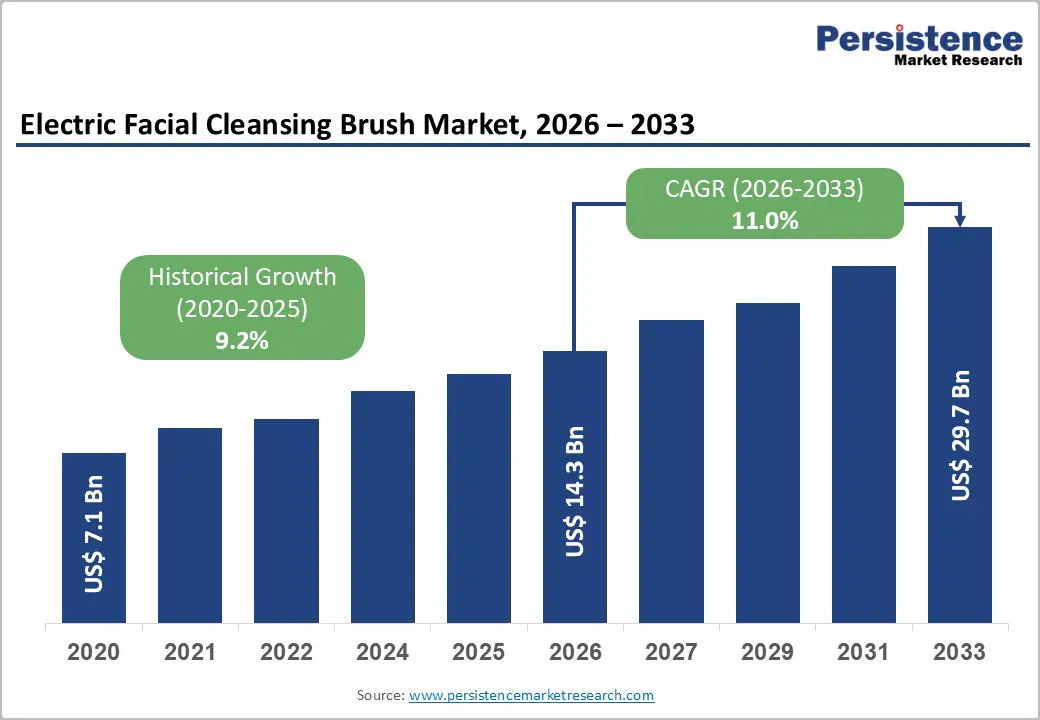
The global electric facial cleansing brush market size is likely to be valued at US$ 14.3 billion in 2026 and is projected to reach US$ 29.7 billion by 2033, growing at a CAGR of 11.0% between 2026 and 2033. The market is driven by growing recognition of deeper cleansing efficacy versus manual methods, increasing disposable income enabling premium beauty device investment, and social media amplification of beauty routines normalizing at-home spa-like treatments.
Key Industry Highlights:
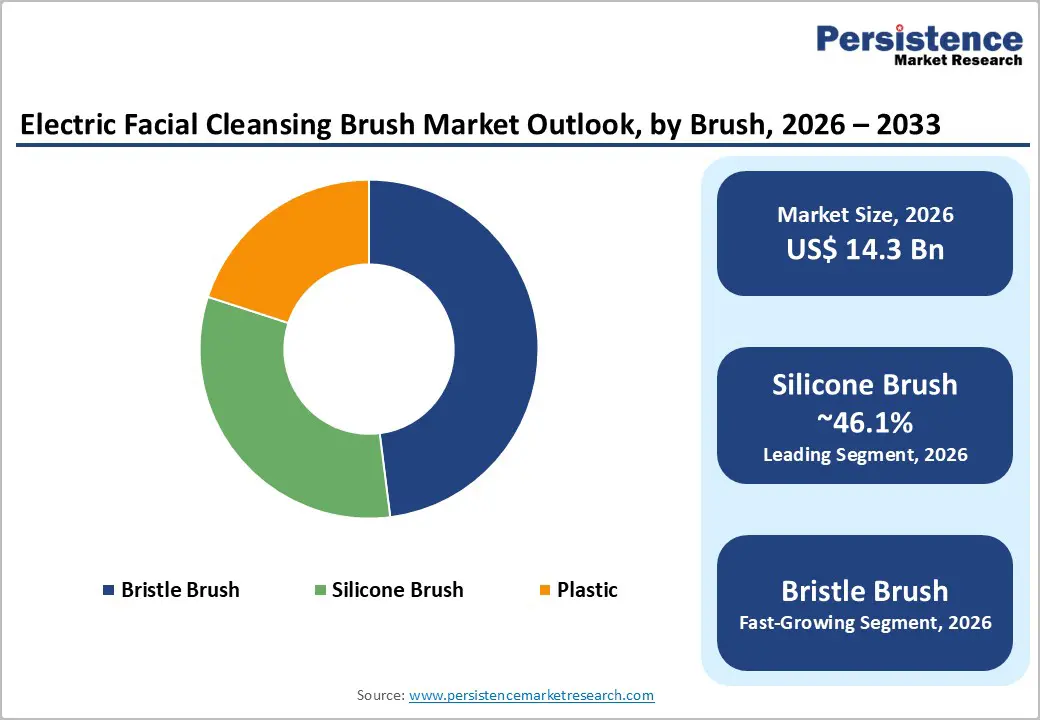
- Leading Brush Type: Silicone brushes dominate with 46.1% market share, driven by their hygienic properties and skin compatibility; Bristle brushes are the fastest-growing, with a 12-16% CAGR, driven by material innovation and consumer familiarity.
- Dominant Technology: Rotating technology maintains 43.2% market share through proven efficacy and consumer familiarity; Oscillating technology is the fastest-growing at a 14% CAGR, driven by advanced cleansing precision and smart integration.
- Leading Application: Household applications command 58.9% market share through personal device accessibility; the Commercial segment is the fastest-growing at a 15% CAGR, driven by professional treatment standardization and salon adoption.
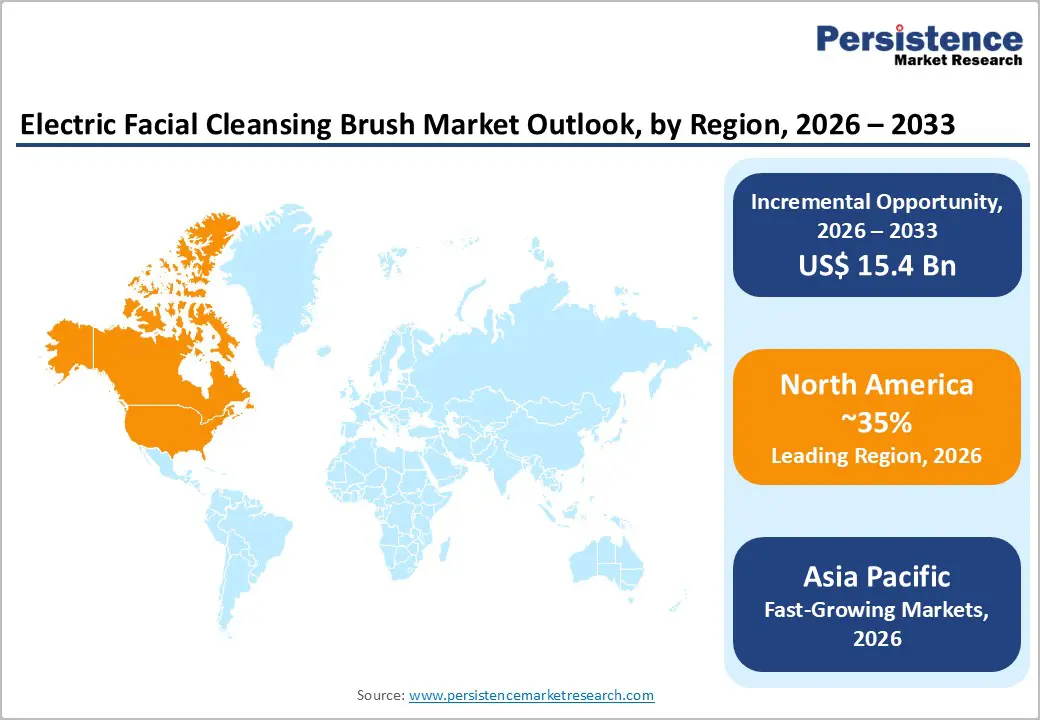
- Regional Market Dominance and Growth: North America maintains 35% global market share driven by premium consumer adoption; Asia-Pacific demonstrates fastest regional growth at 14-18% CAGR, expanding from 30% current share to 40% by 2033.
- Technology and Market Innovation Momentum: Top 10 suppliers control 55% market share (Foreo, Clarisonic, Nuface leading); 5th-generation oscillating technology achieving 16,000+ vibrations per minute; AI-powered skin analysis enabling personalized treatment; Smart ecosystem integration with complementary beauty products.
| Key Insights | Details |
|---|---|
|
Electric Facial Cleansing Brush Market Size (2026E) |
US$ 14.3 Bn |
|
Market Value Forecast (2033F) |
US$ 29.7 Bn |
|
Projected Growth (CAGR 2026 to 2033) |
11.0% |
|
Historical Market Growth (CAGR 2020 to 2024) |
9.2% |
Market Dynamics
Drivers - Growing Consumer Awareness of Skincare Benefits and Deep Cleansing Efficacy
Consumer skincare education proliferation, with 55-70% of consumers actively researching skincare routines and 40-50% adopting multi-step cleansing protocols, establishing proportionate facial cleansing device demand. Clinical validation expansion, with dermatological studies demonstrating 6x superior cleaning compared to manual washing and 25-35% improvement in skin texture within 4-8 weeks, supports adoption justification. Social media influence amplification, with beauty influencers and skincare specialists generating 2-3 billion skincare content engagements annually, promoting electric cleansing brushes, and establishing awareness catalysts.
Pollution and environmental concerns, with 60% of urban consumers expressing concern about pollution's impact on skin, driving demand for advanced cleansing solutions, establish purchasing motivation. Professional treatment accessibility, with at-home electric cleansing brushes enabling spa-quality results, reducing the need for professional facials and saving 40-60% on annual skincare treatment costs, drives consumer value perception.
Technological Advancement Enabling Personalized and Intelligent Cleansing
Vibration technology precision improvement, with oscillation frequencies reaching 10,000 vibrations per minute, enables customizable intensity levels and adapts to diverse skin types and conditions, driving consumer satisfaction. Artificial intelligence integration, with smart sensors detecting skin condition and automatically adjusting cleansing parameters, improves efficacy by 20-30% while reducing irritation, justifying premium pricing. Application connectivity, with 45-55% of premium electric cleansing brushes featuring companion mobile applications enabling guided cleansing routines and performance tracking, support technology adoption.
Material science advancement, with medical-grade silicone development eliminating bacterial growth and improving durability, extending device lifespan 40-50% versus traditional bristle alternatives, establishes reliability confidence. Ergonomic innovation, with lightweight device design (95-120g) and improved grip mechanics, reducing hand fatigue and improving accessibility for diverse user demographics, drives adoption across age groups. Multifunctional capability, with single devices integrating cleansing, exfoliation, toning, and massage functionality through interchangeable heads or software modes, improve value perception and reduce replacement cycle frequency.
Restraints - High Initial Device Costs and Premium Pricing Barriers
Product pricing barrier: premium electric facial cleansing brushes command US$ 150-350+, while mid-range alternatives cost US$ 80-150, restricting adoption to affluent consumer segments (top 30-40% income tier). Device replacement frequency, with technology advancement cycles creating 3–5-year equipment obsolescence discouraging consumer investment in older technology. Maintenance cost escalation, with replacement brush heads and accessories commanding US$ 30-60+ annually, consuming 20-30% of the original device investment over the ownership lifecycle. Emerging market affordability gaps, with pricing remaining prohibitive for 50-60% of consumers in developing economies, despite the relative cost advantages of local manufacturing.
Consumer skepticism, with product effectiveness claims requiring clinical validation and 20-30% of consumers remaining unconvinced of superior benefits versus lower-cost manual cleansing alternatives. Competition from lower-cost alternatives, with traditional facial cleansing products and manual tools offering cost advantage maintaining competitive pressure on device market.
Regulatory Compliance and Safety Standard Complexity
Safety certification requirements, with FDA, CE marking, and regional safety standards requiring comprehensive electrical safety testing and biocompatibility validation, are increasing development costs 15-25%. Dermatological claim substantiation, with regulatory bodies requiring clinical evidence substantiating skincare efficacy claims, consuming 12-18 months and US$ 200K-500K+ per product submission. Data privacy regulation impacts, with GDPR, CCPA, and emerging regulations restricting data collection from connected smart devices limiting app functionality and optimization capability.
Material safety compliance, with lead, phthalate, and other chemical component restrictions requiring supply chain verification and testing adding 5-10% to manufacturing costs. Electromagnetic interference standards, with international EMC (electromagnetic compatibility) standards requiring testing and certification, limiting market entry for smaller manufacturers. Cross-border regulatory fragmentation, with varying international safety standards requiring region-specific product modifications increasing time-to-market and development complexity.
Opportunities - Emerging Market Consumer Beauty Device Adoption
Emerging market middle-class expansion, with China, India, and Southeast Asia adding 200-300 million affluent consumers annually, seeking premium beauty products, establishes a substantial addressable market. Social media beauty trend adoption, with TikTok and Instagram beauty content generating 3+ billion monthly skincare topic engagements, driving emerging consumer awareness and desire. Manufacturing cost advantages, with regional electric cleansing brush production in China achieving a 30-40% cost reduction, enabling accessible pricing to support emerging market penetration. Retail expansion in emerging markets, with hypermarket and supermarket adoption across 1,000+ retail locations in Asia, establishing consumer access and product visibility.
Commercial Spa and Professional Treatment Integration
Salon and spa growth, with wellness tourism growing 8-12% annually globally and professional facilities adopting electric cleansing brushes for multi-step facial protocols, establish professional foundation. Esthetician standardization, with professional beauty organizations recommending electric cleansing brushes as protocol components to ensure treatment consistency and improve outcomes by 25-30%, drives adoption requirements. Hygiene and sanitation advantage, with silicone electric brushes eliminating cross-contamination risk and reducing infection concerns inherent in traditional bristle brush technology, establish professional adoption justification. Treatment efficiency improvement, with electric cleansing reducing manual labor time by 20-30% per facial, enabling higher facility throughput and profitability, drives commercial investment.
Category-wise Analysis
Brush Type Insights
The silicone brush segment holds 46.1% market share, driven by superior hygiene, durability, and skin compatibility. Medical-grade silicone resists bacterial buildup and offers 40% higher durability than traditional bristles. Its non-porous, flexible design reduces irritation, making it suitable for 50% of consumers with sensitive skin. Easy cleaning and seamless construction support professional and salon adoption, while modern aesthetics position silicone brushes as premium products. Low maintenance and the absence of replacement heads enhance lifetime value, reinforcing market leadership.
In contrast, the bristle brush segment is the fastest-growing, projected to expand at a 12% CAGR through 2033. Growth is driven by superior exfoliation performance, removing 20% more dead skin cells than silicone. Continued consumer familiarity, innovations in cruelty-free and sustainable bristle materials, hybrid silicone-bristle designs, and 15–20% lower pricing are accelerating adoption among performance-focused and price-sensitive consumers.
Technology Type Insights
The silicone brush segment holds 46.1% market share, driven by superior hygiene, durability, and skin compatibility. Medical-grade silicone resists bacterial buildup and offers 40–% higher durability than traditional bristles. Its non-porous, flexible design reduces irritation, making it suitable for 50% of consumers with sensitive skin. Easy cleaning and seamless construction support professional and salon adoption, while modern aesthetics position silicone brushes as premium products. Low maintenance and the absence of replacement heads enhance lifetime value, reinforcing market leadership.
In contrast, the bristle brush segment is the fastest growing, projected to expand at 12% CAGR through 2033. Growth is driven by superior exfoliation performance, removing 20% more dead skin cells than silicone. Continued consumer familiarity, innovations in cruelty-free and sustainable bristle materials, hybrid silicone-bristle designs, and 15–20% lower pricing are accelerating adoption among performance-focused and price-sensitive consumers.
Application Insights
Household applications account for 58.9% of the market, driven by strong consumer preference for at-home beauty solutions. Personal device ownership enables spa-quality treatments with greater convenience, eliminating travel and scheduling constraints. Busy lifestyles encourage integration of at-home skincare routines, reducing reliance on professional services. Cost efficiency is a key motivator, as one-time device purchases deliver annual savings of $200–$ 400 compared with $1,200–$ 2,400 spent on professional treatments. Privacy and comfort further support adoption by allowing customized routines without professional oversight. Widespread acceptance, with 65% of consumers viewing at-home beauty tools as standard wellness products, reinforces household dominance.
The commercial segment is the fastest-growing application category, projected to expand at a 15-20% CAGR through 2033, substantially exceeding overall market growth. Professional treatment standardization: spas, salons, and dermatology clinics adopt electric cleansing brushes as protocol components, ensuring treatment consistency, improving client outcomes by 25-30%, and establishing professional adoption drivers. Infection control advantage, with electric cleansing eliminating cross-contamination risks inherent in manual bristle applications, establishes safety and hygiene as a competitive advantage, driving professional adoption.
Regional Insights
North America Electric Facial Cleansing Brush Market Analysis
North America commands approximately 35% of global Electric Facial Cleansing Brush market share, valued at approximately US$ 4.4 billion in 2026 with projections approaching US$ 10.3 billion by 2033. The United States represents dominant regional market contributor, accounting for 82% of North American market value, driven by premium consumer base and advanced beauty technology adoption.
Skincare consciousness prevalence, with 70% of North American consumers maintaining regular skincare routines and investing in advanced beauty technology supporting category adoption. E-commerce integration, with 45-50% of beauty device purchases conducted online, enabling convenient product access and competitive pricing, supporting volume growth. Professional salon adoption, with 80% of spas and salons adopting electric cleansing technology as standard protocol component driving commercial segment expansion.
Europe Electric Facial Cleansing Brush Market Analysis
Market Scale and Performance: Europe represents approximately 22% of the global electric facial cleansing brush market share, valued at approximately US$ 3.43 billion in 2026. Germany, United Kingdom, France, and Spain collectively represent 65% of European market value, reflecting advanced beauty consciousness and premium product adoption.
Premium beauty product preference, with European consumers demonstrating willingness to invest 20-30% more for quality and sustainability aligning with electric cleansing brush positioning. Sustainability focus, with circular economy principles and eco-friendly packaging driving adoption of durable electric devices reducing annual disposable cleansing product consumption. Professional spa expansion, with wellness tourism growing 8-12% annually, and spas standardizing electric cleansing protocols, establishing a commercial segment foundation. Clean beauty movement leadership, with European consumers leading global adoption of natural and chemical-free beauty products with 60-70% preferring sustainable alternatives supporting electric brush ecosystem.
Asia Pacific Electric Facial Cleansing Brush Market Share and Trends
Asia Pacific demonstrates robust growth dynamics, commanding approximately 36-42% market share with projections increasing to 42-50% by 2033. The region valued at approximately US$ 5.15 billion in 2026 is anticipated to reach US$ 15.0 billion by 2033, representing the fastest-growing regional market with an estimated CAGR of 14%.
Middle-class expansion, with China, India, and Southeast Asia adding 200-300 million affluent consumers annually, seeking premium beauty devices, establishing a substantial addressable market. Social media influence, with TikTok and Instagram beauty trends generating 3+ billion monthly skincare engagements driving emerging market consumer awareness and desire. Manufacturing dominance, with 60% of global electric facial cleansing brush production concentrated in China enabling cost-competitive regional pricing supporting emerging market penetration. K-beauty and J-beauty adoption, with Korean and Japanese beauty trends achieving global influence driving consumer technology adoption and innovation preference.
Competitive Landscape
Market concentration demonstrates oligopolistic characteristics with six major vendors (Workday, Microsoft, SAP, Oracle, UKG, ADP) controlling 50% of global market value. Workday maintains market leadership with estimated 9.8% global market share through sophisticated cloud platform, agentic AI integration, and strategic acquisition strategy consolidating talent acquisition, contingent workforce management, and analytics capabilities. Microsoft follows with substantial cloud presence and Power BI analytics adoption among Office 365 organizations. SAP SuccessFactors and Oracle Fusion Analytics command enterprise market segments through comprehensive HCM suite integration.
Key Industry Developments
- In June 2024, Estée Lauder hosted a scientific board advisory meeting in Seoul, South Korea to share insights on dermatology. The convention focused on recent trends in dermatological procedures in China and South Korea, and positive impact of skin care products in dermatological procedures.
- In November 2023, Foreo launched Peach 2, a home IPL technology device designed for painless and efficient hair removal, emphasizing long-lasting results and affordability. Foreo's LUNA line has seen significant updates with the introduction of LUNA 3 and the AI-enabled Luna Fofo, which offers personalized skincare routines
Companies Covered in Electric Facial Cleansing Brush Market
- L’Oreal
- Philips
- Clinique Laboratories
- Conair Corp
- Hitachi Ltd
- Amore Pacific Corp
- Pixnor
- Guthy-Renker
- Olay
- Foreo
- Others Key Players
Frequently Asked Questions
The Electric Facial Cleansing Brush market is estimated to be valued at US$ 14.3 Bn in 2026.
The key demand driver for the Electric Facial Cleansing Brush market is the growing consumer focus on advanced personal skincare, hygiene, and at-home beauty routines, driven by rising disposable incomes and awareness of skin health.
In 2026, the North America region will dominate the market with an exceeding 35% revenue share in the global Electric Facial Cleansing Brush market.
Among the Brush type, Healthcare holds the highest preference, capturing beyond 46.1% of the market revenue share in 2026, surpassing other Brush type.
The key players in Electric Facial Cleansing Brush are L’Oreal, Philips, Conair Corp and Hitachi Ltd.


