




- Food Ingredients & Additives
- Dairy Protein Market
Dairy Protein Market Size, Share, and Growth Forecast, 2026 - 2033
Dairy Protein Market by Protein Type (Casein and Derivatives, Whey Protein, and Milk Protein Concentrate), Form (Solid and Liquid), Application (Food and Beverages, Nutrition, Personal Care and Cosmetics, Feed, and Others), and Regional Analysis for 2026 - 2033

Dairy Protein Market Share and Trends Analysis
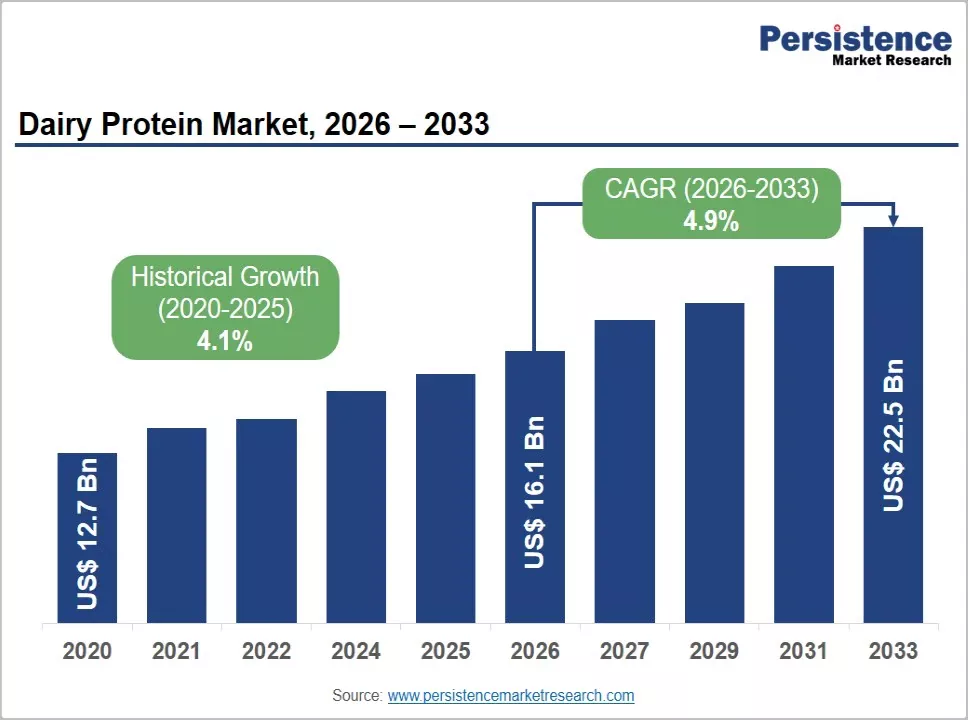
The global dairy protein market size is likely to be valued at US$16.1 billion in 2026, and is estimated to reach US$22.5 billion by 2033, growing at a CAGR of 4.9% during the forecast period from 2026 to 2033, driven by rising consumer demand for high-protein diets, expanding sports and clinical nutrition, and the growing use of dairy proteins in fortified foods and beverages across developed and emerging economies.
The market has been experiencing steady growth, although volatile milk supply and tight availability of whey products have caused price swings. However, the forecast period anticipates firmer momentum as processors expand protein capacity and manufacturers prioritize satiety, muscle health, and healthy aging positioning.
Key Industry Highlights:
- Dominant Protein Types: Whey protein is set to command around 46% of the revenue share in 2026, while milk protein concentrate is likely to grow the fastest at 5.9% CAGR through 2033, as high-protein yogurts, cheeses, and beverages expand.
- Leading Forms: Solid forms, mainly powders, are expected to lead with 78% in 2026, while liquid forms are likely to be the fastest-growing at about 6.1% CAGR during 2026 - 2033, reflecting ready-to-drink and clinical nutrition growth.
- Dominant Applications: Food and beverages are anticipated to lead with an estimated 52% share in 2026, while nutrition applications are slated to represent the fastest-growing segment at 6.4% CAGR from 2026 to 2033.
- Regional Leadership: Europe is poised to lead with an estimated 36% share in 2026, while Asia Pacific is expected to be the fastest-growing region at 6.2% CAGR through 2033, led by China, India, and Southeast Asia.
- Competitive Environment: Competitive dynamics include cooperative mergers, investment in whey and milk protein processing capacity, and new product launches targeting weight management and GLP-1 users.
- June 2026: Arla Foods and DMK Group completed their merger after European Commission clearance, creating Europe's largest farmer-owned dairy business and expanding whey protein output for Arla Foods Ingredients through higher cheese volumes.
DRO Analysis
Driver: High-Protein Diets and Sports and Clinical Nutrition Demand as Primary Growth Catalyst
Growing consumer interest in protein is the leading force driving the dairy protein market growth, as people seek products that support muscle maintenance, satiety, weight management, and healthy aging. Dairy proteins, particularly whey and casein, offer complete amino acid profiles, high digestibility, and strong functional properties, making them preferred ingredients in sports nutrition powders, protein bars, ready-to-drink shakes, yogurts, and bakery products. The popularity of strained yogurts, protein-fortified snacks, and meal replacement products has widened the audience beyond athletes to mainstream consumers, while hospitals and elder care facilities use dairy-based formulas to address malnutrition and sarcopenia.
Newer demand drivers are adding momentum. Widespread use of GLP-1 weight-loss medications has prompted food companies to develop protein-forward products designed to help users maintain lean mass while eating less, and recent industry reports link higher whey prices to this trend. Product development is also supported by technological advances in filtration, which allow processors to create high-purity isolates, hydrolysates, and tailored milk protein fractions with improved taste, solubility, and heat stability. This convergence of dietary trends, clinical nutrition needs, and processing innovation ensures sustained growth in the dairy protein market in the coming years.
Restraints: Price Volatility, Supply Constraints, and Competition from Alternative Proteins
Price volatility and constrained supply have become major challenges for the dairy protein market. Whey protein is a co-product of cheese and casein manufacturing, so its availability depends on cheese output rather than on protein demand alone, which creates bottlenecks when consumption rises quickly. Reports in 2026 indicated that prices of 80% whey protein concentrate rose by around three-quarters compared with the first half of 2025, reaching roughly €20 per kilogram, and tight availability has forced some buyers to reformulate or switch ingredients. Fluctuating milk prices and surges in milk production also create uncertainty for processors and customers.
Competition and consumer constraints add further complexity. Plant proteins such as pea, soy, and potato, along with precision-fermentation proteins, are positioned as alternatives for vegan, lactose-intolerant, and sustainability-minded consumers.
Dairy allergies and lactose intolerance limit use in some populations, and environmental scrutiny of dairy farming emissions affects brand perceptions. Regulatory differences in labeling, heavy metal limits, and standards for sports nutrition claims also add compliance costs for global suppliers. These factors collectively restrain faster adoption of dairy proteins despite their nutritional advantages, highlighting the need for stable supply, transparent pricing, and continued investment in sustainable dairy practices.
Opportunities: Expanding Nutrition Demand in Emerging Markets and Value-Added Protein Fractions
Emerging economies are propelling the market through rising incomes, urbanization, and growing awareness of protein intake. Asia Pacific, Latin America, the Middle East, and Africa are experiencing rapid growth in packaged foods, infant and clinical nutrition, and fitness culture, all of which rely on dairy proteins. Local manufacturers are increasing their use of whey and milk protein ingredients in beverages, bakery, and fortified staples, while governments promote protein-rich diets to address malnutrition and support healthy aging. Investment in dairy processing and cold chain infrastructure across these regions is improving supply and lowering costs.
China and India exemplify this trend, with expanding middle classes, rising participation in fitness activities, and strong demand for infant formula, sports nutrition, and fortified dairy products. Value-added protein fractions, such as alpha-lactalbumin, lactoferrin, osteopontin, and micellar casein, command premium pricing and are used in advanced infant, medical, and performance nutrition. Large processors are also investing in new cheese and whey facilities, such as Arla's reported EUR 300 million cheese dairy in Götene, Sweden, to secure protein supply. Consequently, emerging markets are expected to increase their share of the global dairy protein market substantially, creating additional opportunities in localized processing, application support, and technology partnerships.
Category-wise Analysis
Protein Type Insights
Whey protein is the leading protein type segment, expected to hold about 46% of the dairy protein market revenue share in 2026. It is available as concentrates, isolates, and hydrolysates, each tailored to different applications, from sports nutrition and weight management to infant formula and clinical products. Whey's rapid digestion, high leucine content, and clean taste make it a preferred choice for muscle recovery and protein fortification. Demand has outpaced supply in recent periods, resulting in elevated prices and encouraging processors to expand capacity, improve yields, and develop higher-value fractions.
Milk protein concentrate is likely to grow the fastest through 2033, at an estimated 5.9% CAGR. Combining casein and whey in natural proportions, it offers functional benefits such as heat stability, water binding, and creamy texture, and it is increasingly used in high-protein yogurts, cheese, ready-to-drink beverages, and nutritional products. Its availability is also seen as a relief valve when whey supply is tight. Casein and its derivatives, including micellar casein and caseinates, retain a significant share, valued for slow digestion in sports and clinical nutrition, as well as for use in processed cheese, coffee creamers, and bakery.
Form Insights
Solid forms, primarily spray-dried powders, dominate the form segment, projected to capture about 78% of the revenue share in 2026. Powders offer long shelf life, easy transport, and compatibility with a wide range of formulations, making them the standard ingredient for sports nutrition, infant formula, bakery, and confectionery. Global trade in dairy protein is largely based on powders, allowing exporters in Europe, New Zealand, and the U.S. to supply markets worldwide. Investment in drying capacity, agglomeration, and instantizing technologies continues to improve solubility and handling.
Liquid forms are the fastest-growing, anticipated to achieve about 6.1% CAGR during the 2026 - 2033 period. Liquid concentrates and ready-to-drink protein solutions reduce processing steps, save energy used in drying, and suit regional supply chains where customers are close to dairies. Growth in ready-to-drink protein shakes, clinical nutrition beverages, and high-protein dairy desserts is increasing demand for stable liquid proteins with good heat resistance and low viscosity. However, shorter shelf life and logistics costs limit liquid trade across long distances, so adoption is concentrated near major dairy processing hubs.
Application Insights
Food and beverages are poised to lead with an estimated 52% share in 2026, driven by yogurts, cheeses, bakery products, confectionery, dairy beverages, and meal replacement foods that use dairy proteins for protein enrichment, texture, and emulsification. High-protein product launches are among the most active areas of food innovation, and dairy proteins offer strong sensory performance compared with many plant alternatives. Manufacturers also use milk proteins in processed meats, soups, and sauces to improve water retention and creaminess, ensuring broad, stable demand.
Nutrition applications are likely to be the fastest-growing segment, expected to showcase an approximate 6.4% CAGR through 2033. This includes sports nutrition, infant formula, medical nutrition, and weight management products, where protein quality and bioavailability are central. Aging populations and the use of GLP-1 medications encourage products designed to preserve muscle mass and support nutritional intake. Personal care and cosmetics use hydrolyzed milk proteins in skin and hair formulations for moisturizing and conditioning, while feed applications include calf milk replacers and young animal nutrition, and other uses cover pharmaceuticals and specialty foods.
Regional Insights
Europe Dairy Protein Market Trends
Europe is predicted to command an estimated 36% of the dairy protein market share in 2026. The region has an advanced dairy industry, large cheese production, and leading ingredient producers such as Arla Foods Ingredients, FrieslandCampina Ingredients, and Tirlán. The merger of Arla and DMK, completed in June 2026, increases cheese volumes and is expected to expand whey protein output, while Arla's reported record 2025 revenue and strong first-half 2026 profit indicate the importance of protein in the region's dairy economy. Germany, France, the Netherlands, Ireland, and Denmark are major supply hubs, and demand is strong for sports nutrition and fortified foods.
The Europe market is characterized by high regulatory standards, strong cooperative structures, and growing emphasis on sustainability, with processors investing in lower-emission dairy and efficient processing. Eastern European countries such as Poland, Lithuania, and the Czech Republic represent emerging opportunity zones, with expanding milk production and investments in cheese and whey processing.
North America Dairy Protein Market Trends
North America is likely to hold 29% of the global market share in 2026. The U.S. provides the regional growth anchor, with large-scale cheese production that generates significant whey volumes, along with strong consumption of sports nutrition, protein snacks, and high-protein dairy. Whey protein concentrate prices reportedly exceeded US$ 18,000 per tonne in the U.S. in spring 2026, reflecting tight supply and strong demand. Processors such as Glanbia, Hilmar, and Dairy Farmers of America continue to expand protein capacity and application development.
Canada's supply-managed dairy system supports domestic protein production for food and nutrition. The North America market is characterized by intense competitive dynamics, with large cooperatives, multinational ingredient firms, and branded nutrition companies competing on supply security, customization, and technical support.
Asia Pacific Dairy Protein Market Trends
Asia Pacific is anticipated to be the fastest-growing region, commanding an estimated 24% in 2026 and projected to achieve a 6.2% CAGR through 2033. China provides the dominant regional growth engine, with strong demand for infant formula, sports nutrition, and fortified foods, and substantial reliance on imported whey and milk protein ingredients. Oceania, led by Fonterra, is a major supplier, and Fonterra's agreement in August 2025 to sell its consumer business to Lactalis reflects a sharper focus on ingredients and foodservice.
India is expected to offer the most dynamic growth opportunities, supported by large domestic milk production, expanding protein supplementation culture, and the rise of branded nutrition products. The India dairy protein market is attracting aggressive competition from both multinational corporations and domestic dairy cooperatives and nutrition brands. Southeast Asia, Japan, and South Korea are also experiencing accelerated demand, driven by aging populations, health consciousness, and growth of modern retail and e-commerce.
Competitive Landscape
The global dairy protein market structure is moderately consolidated, with the top vendors, including Arla Foods, FrieslandCampina, Fonterra, and Glanbia, controlling a significant portion of the revenue share. These established players leverage extensive milk collection networks, integrated cheese and whey processing, and long-standing relationships with global food and nutrition companies. They are also known to invest heavily in R&D to maintain technological leadership in membrane filtration, protein fractionation, and tailored ingredient solutions.
Regional and niche competitors such as Tirlán, Hilmar, Saputo, and Agropur are focusing on specialized segments and geographic strongholds. Barriers such as milk supply access, capital-intensive processing assets, and stringent food safety requirements limit new entrants, but precision-fermentation and plant protein startups are creating alternative sources. Market consolidation is expected to increase gradually, as illustrated by the Arla-DMK merger and portfolio reshaping at Fonterra, while global leaders continue forming partnerships with nutrition brands to secure demand.
Key Industry Developments
- In August 2026, Arla Foods reported first-half net profit of about €213 million, up 35% from the prior year, driven largely by higher whey protein prices linked to health and nutrition trends, including GLP-1 diets. Industry reports indicated that prices of 80% whey protein concentrate rose by roughly 75% year on year, underscoring tight supply and the strength of dairy protein demand.
- In February 2026, Arla reported record 2025 revenue of €15.1 billion, citing the protein trend as a key factor behind its results in a year marked by volatile milk markets. The company also pointed to the planned merger with DMK, expected to increase cheese volumes and strengthen whey production for its ingredients business.
- In August 2025, Fonterra agreed to sell its consumer business, including the Mainland brand, to Lactalis in a transaction valued at about NZ$4.2 billion. The sale allows the New Zealand cooperative to concentrate on its ingredients and foodservice operations, which include milk protein concentrates, whey proteins, and other dairy nutrition ingredients.
Companies Covered in Dairy Protein Market
- Arla Foods amba
- Royal FrieslandCampina N.V.
- Fonterra Co-operative Group Limited
- Glanbia plc
- Lactalis Ingredients
- Saputo Inc.
- Kerry Group plc
- Hilmar Cheese Company, Inc.
- Tirlán Group
- Agropur Cooperative
- Dairy Farmers of America, Inc.
Frequently Asked Questions
The global dairy protein market is projected to reach US$ 16.1 billion in 2026.
Rising consumer demand for high-protein diets, expanding sports and clinical nutrition, and growing use of dairy proteins in fortified foods and beverages are driving the market.
The dairy protein market is poised to witness a CAGR of 4.9% from 2026 to 2033.
Expanding nutrition demand in emerging markets, value-added protein fractions, and new products for weight management and healthy aging are key market opportunities.
Arla Foods amba, Royal FrieslandCampina N.V., Fonterra Co-operative Group Limited, and Glanbia plc are some of the key players in the dairy protein market.


