




- Food Ingredients & Additives
- Dairy Cultures Market
Dairy Cultures Market Size, Share, and Growth Forecast, 2026 - 2033
Dairy Cultures Market by Product Type (Thermophilic Cultures, Mesophilic Cultures), Fermentation (Lactic Acid Fermentation, Yeast-Lactic Acid Fermentation, Others), Applications (Cheese, Yoghurt, Others), and Regional Analysis for 2026 - 2033

Dairy Cultures Market Size and Trends Analysis
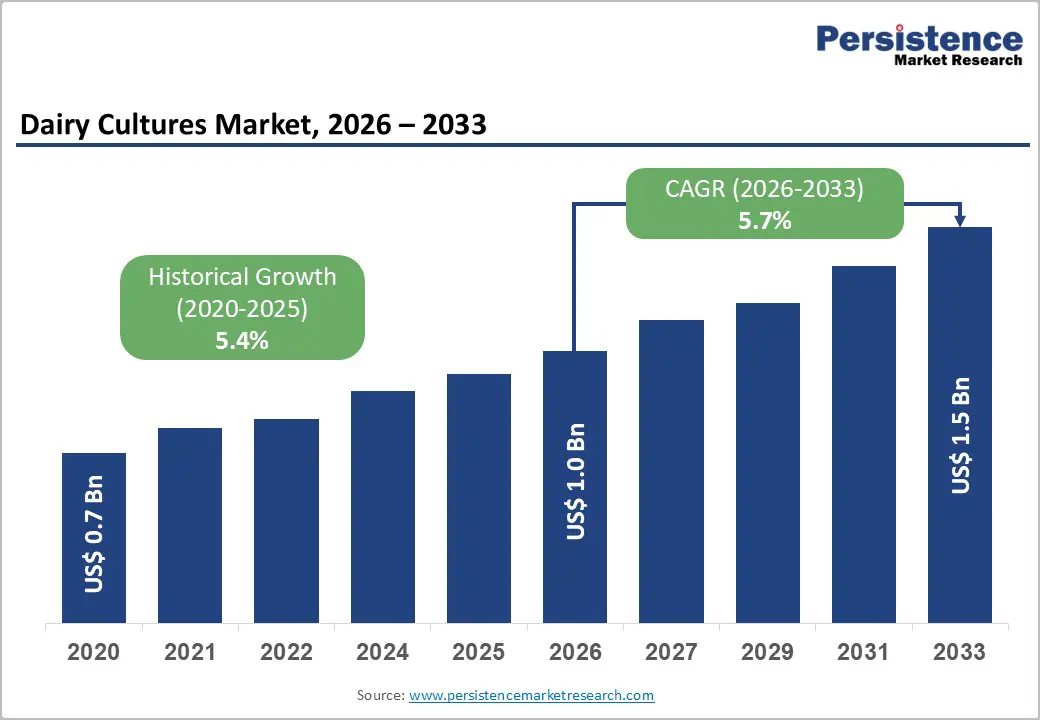
The global dairy cultures market size is likely to be valued at US$1.0 billion in 2026 and is expected to reach US$1.5 billion by 2033, growing at a CAGR of 5.7% during the forecast period from 2026 to 2033, driven by the increasing consumption of fermented dairy products and the growing importance of microbial functionality in food processing.
Dairy cultures, microbial formulations primarily composed of lactic acid bacteria and other beneficial microorganisms, play a crucial role in initiating and controlling fermentation in dairy applications. These cultures are essential for developing the characteristic texture, flavour, aroma, and acidity of products such as yogurt, cheese, buttermilk, and kefir, while also enhancing shelf life and delivering probiotic benefits.
Continuous advancements in microbial strain development, culture stabilization, and preservation technologies have improved product consistency, efficiency, and customization for specific dairy applications. Increasing urbanization, evolving dietary patterns, and higher disposable incomes in emerging economies are contributing to greater consumption of processed and value-added dairy products.
Key Industry Highlights:
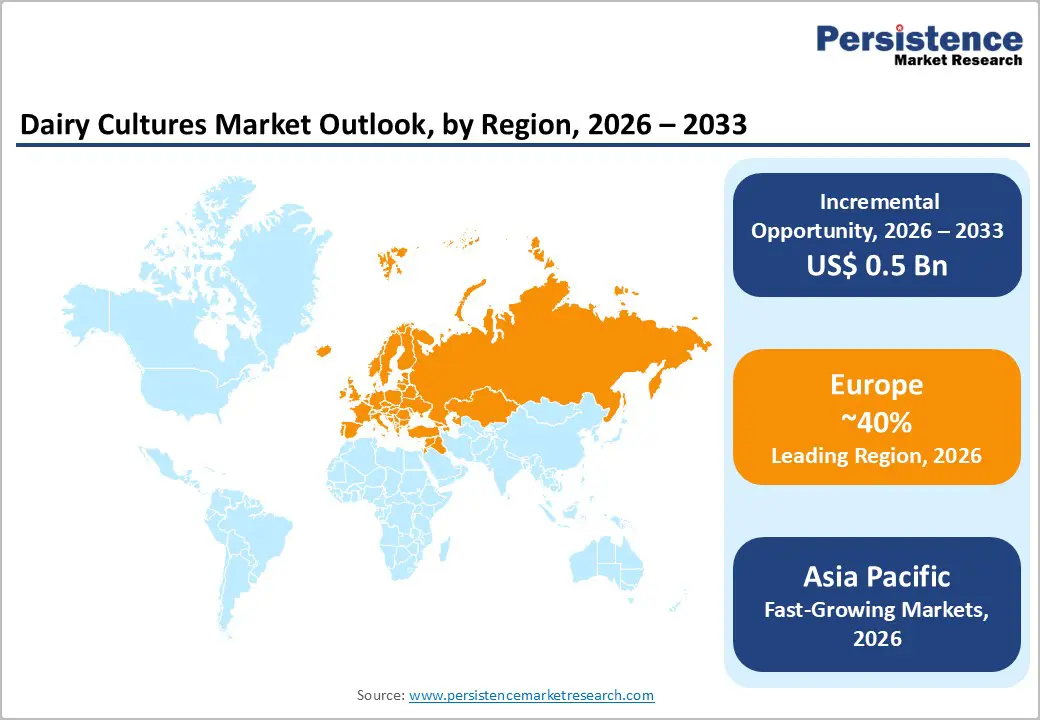
- Leading Region: Europe is anticipated to be the leading region, accounting for a market share of 40% in 2026, driven by strong traditional fermented dairy consumption and advanced regulatory support.
- Fastest-growing Region: Asia Pacific is likely to be the fastest-growing region, supported by rapid urbanization, rising dairy consumption, and strong manufacturing advantages across emerging economies.
- Leading Product Type: Thermophilic cultures are projected to represent the leading product type in 2026, accounting for 45% of the revenue share, driven by widespread use in yogurt and high-temperature dairy processing.
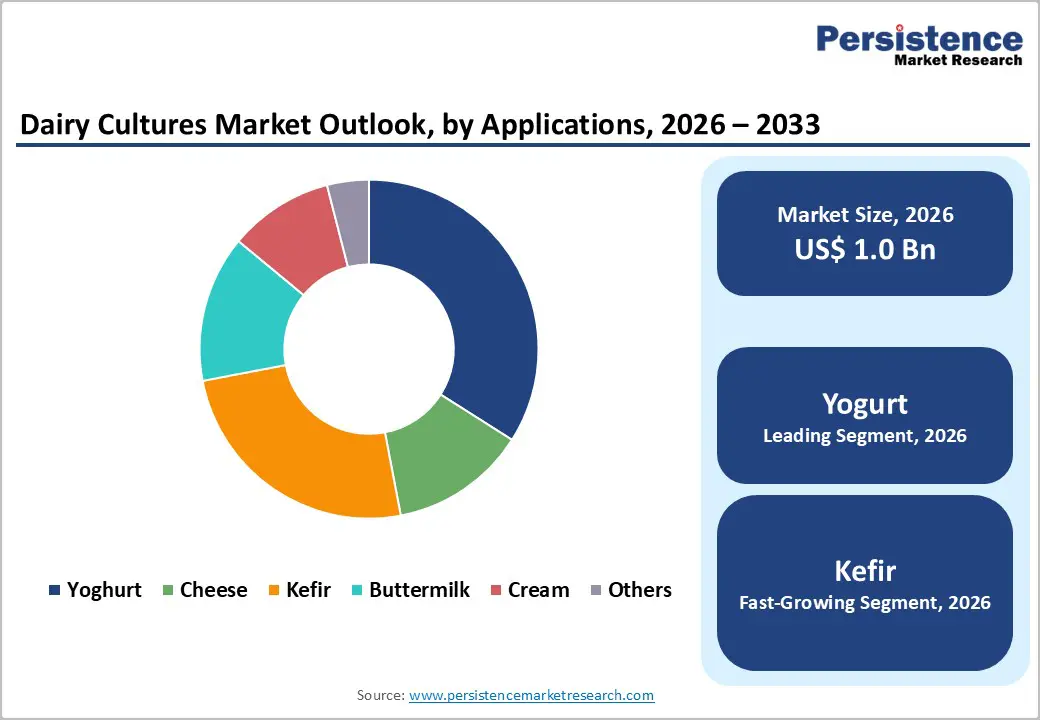
- Leading Application: Yogurt is anticipated to be the leading application, accounting for over 55% of the revenue share in 2026, supported by its high consumption and probiotic demand.
| Key Insights | Details |
|---|---|
| Dairy Cultures Market Size (2026E) | US$1.0 Bn |
| Market Value Forecast (2033F) | US$1.5 Bn |
| Projected Growth (CAGR 2026 to 2033) | 5.7% |
| Historical Market Growth (CAGR 2020 to 2025) | 5.4% |
DRO Analysis
Driver - Rising Demand for Probiotic and Functional Dairy Products
Increasing consumer awareness of gut health and immunity has significantly elevated the demand for probiotic and functional dairy products. Dairy cultures, particularly lactic acid bacteria, play a crucial role in delivering these health benefits by supporting digestion and enhancing microbiome balance. Products such as yogurt, kefir, and cultured milk are widely recognized for their probiotic properties, leading to consistent demand across both developed and emerging markets.
Evolving consumer preferences for clean-label and natural ingredients have reinforced the importance of dairy cultures as biological solutions rather than chemical additives. The ability of these cultures to naturally enhance flavor, texture, and shelf life aligns well with current food trends focused on transparency and minimal processing. Food manufacturers are increasingly incorporating multi-strain and high-viability cultures to differentiate their products and meet specific health claims.
Expansion of Dairy Processing Infrastructure and Cheese/Yogurt Production
The rapid expansion of dairy processing infrastructure, particularly in emerging economies, is significantly supporting the growth of dairy culture usage. Increasing investments in modern dairy plants, cold chain logistics, and large-scale fermentation facilities have enabled higher production capacities for cheese, yogurt, and other cultured dairy products. This industrial growth is closely linked with rising urbanization and changing dietary patterns, where consumers increasingly prefer processed and packaged dairy.
Established dairy-producing regions continue to upgrade their processing technologies to improve yield, reduce production time, and enhance product quality. Cheese and yogurt manufacturing, being culture-intensive processes, rely heavily on optimized microbial formulations for acidification and flavor development. The scalability of thermophilic and mesophilic cultures supports continuous production cycles, making them indispensable in industrial settings. This growth helps increase domestic supply and improves export opportunities, encouraging manufacturers to use advanced culture solutions that meet quality standards and changing consumer needs.
Restraint - Complex Regulatory Approval Processes for New Microbial Strains
The development and commercialization of new microbial strains for dairy cultures are often constrained by complex and time-consuming regulatory approval processes. Authorities in various regions require extensive safety assessments, clinical validations, and compliance with food safety standards before approving new cultures for commercial use. These stringent regulations are essential for ensuring consumer safety, but can delay innovation and increase the cost of research and development.
Regulatory inconsistencies between regions can hinder the adoption of advanced culture technologies, particularly those involving genetic modification or novel probiotic claims. Manufacturers often need to tailor their products to meet specific regional requirements, leading to increased operational complexity and cost. Smaller players may find it especially difficult to compete due to limited resources for regulatory compliance. This environment can slow down the pace of innovation and restrict the availability of differentiated products, ultimately impacting the overall growth potential of the dairy cultures market despite strong underlying demand.
Competitive Pressure from Non-Dairy and Plant-Based Alternatives
The rising popularity of non-dairy and plant-based alternatives presents a growing competitive challenge for the dairy cultures market. Consumers are increasingly shifting toward plant-based diets due to health, environmental, and ethical considerations, leading to reduced consumption of traditional dairy products in some regions. This trend directly impacts the demand for conventional dairy cultures, as applications such as yogurt and cheese face substitution from plant-based variants made from soy, almond, or oat.
Advancements in plant-based fermentation technologies are enabling the use of similar microbial cultures in non-dairy applications, intensifying competition within the broader fermentation market. While this creates new opportunities, it also shifts focus away from traditional dairy segments. Companies operating in the dairy cultures space are increasingly required to diversify their portfolios and invest in cross-category innovations.
Opportunity - Technological Convergence with Precision Fermentation and Clean-Label Solutions
Technological advancements in precision fermentation and biotechnology are opening new avenues for innovation within the dairy cultures market. Precision fermentation allows for the development of highly specific and efficient microbial strains that can enhance functionality, improve consistency, and deliver targeted health benefits. These technologies enable manufacturers to design cultures with optimized performance characteristics, such as improved acidification rates, flavor profiles, and shelf-life stability. The shift toward clean-label products is encouraging the use of natural fermentation processes, positioning dairy cultures as key enablers of transparent and minimally processed food solutions.
The integration of advanced techniques such as genomics, strain engineering, and controlled fermentation systems is accelerating product development and customization. Manufacturers can now create tailored culture blends for specific applications, meeting diverse consumer demands across regions and product categories. This convergence of technology and consumer preference is driving investments in research and innovation, enabling companies to stay competitive in a rapidly evolving market.
Expansion into Probiotic and Health-Focused Dairy Applications
The growing emphasis on health and wellness is creating significant opportunities for expanding dairy cultures into probiotic and health-focused applications. Consumers are increasingly seeking foods that offer functional benefits beyond basic nutrition, such as improved digestion, immunity, and overall well-being. Dairy cultures play a central role in enabling these benefits, making them essential for the development of next-generation functional dairy products.
Ongoing research into the human microbiome is providing deeper insights into the health benefits of specific microbial strains, supporting the development of scientifically backed products. This has encouraged collaborations between food manufacturers and research institutions to develop clinically validated probiotic solutions. As consumer demand continues to evolve, companies are focusing on innovation in product formats, including ready-to-drink and on-the-go options.
Category-wise Analysis
Product Type Insights
Thermophilic cultures are expected to lead the dairy cultures market, accounting for approximately 45% of revenue in 2026, driven by their widespread application in high-temperature fermentation processes such as yogurt and certain cheese varieties. These cultures operate efficiently at elevated temperatures, enabling rapid acidification and consistent product quality, which is essential for large-scale industrial dairy production. For example, in industrial yogurt production, thermophilic strains such as Streptococcus thermophilus are widely used to achieve desired thickness and taste, demonstrating their importance in high-volume dairy processing.
Mesophilic cultures are likely to represent the fastest-growing segment, supported by increasing demand for specialty cheeses, artisanal dairy products, and diversified fermented dairy offerings. These cultures operate at moderate temperatures and are valued for their ability to enhance flavor complexity and texture, especially in aged and regional cheese varieties. Growth is supported by rising consumer interest in premium and traditional dairy products, along with energy-efficient processing advantages. For example, cheddar and gouda cheese producers increasingly rely on mesophilic cultures to achieve distinct taste profiles and product differentiation, highlighting their expanding role in value-added and specialty dairy segments.
Application Insights
Yogurt is projected to lead the market, capturing around 55% of the revenue share in 2026, supported by its widespread consumption and strong positioning as a probiotic and functional food. The segment benefits from daily consumption patterns, diverse flavor innovations, and increasing demand for health-oriented products that support digestion and immunity. For example, large-scale yogurt manufacturers utilize standardized culture blends to maintain uniform quality across high production volumes, reinforcing the segment’s leadership in the market.
Kefir is likely to be the fastest-growing application, driven by rising consumer interest in probiotic-rich and traditional fermented beverages. These products are gaining popularity due to their perceived health benefits, including improved gut health and enhanced nutrient absorption. Innovation in ready-to-drink formats and flavor diversification is driving growth in this segment. For example, modern kefir brands are introducing flavored and convenient packaging formats to attract health-conscious consumers, illustrating how innovation and functional positioning are accelerating growth within this segment.
Regional Insights
North America Dairy Cultures Market Trends
North America is likely to be a significant market for dairy cultures, driven by strong demand for probiotic-rich and functional dairy products such as yogurt, kefir, and specialty cheeses. The region benefits from advanced dairy processing infrastructure, high consumer awareness of gut health, and continuous product innovation in fermented dairy categories. For example, DSM-Firmenich has introduced advanced yogurt cultures with improved fermentation efficiency and post-acidification control, supporting large-scale dairy manufacturers in optimizing production and product consistency.
Companies are investing in customized strain development, phage management solutions, and application-specific cultures to meet evolving consumer demands. The region’s competitive landscape is characterized by strong collaboration between culture suppliers and dairy processors, enabling co-development of tailored solutions. Growth is supported by stringent food safety standards and well-established regulatory frameworks that ensure product quality and consumer trust.
Europe Dairy Cultures Market Trends
Europe is anticipated to be the leading region, accounting for a market share of 40% in 2026, due to its deep-rooted tradition of fermented dairy consumption and strong cheese production heritage. The region emphasizes both artisanal authenticity and industrial efficiency, with high demand for cultures used in cheese, yogurt, and specialty dairy products. A significant trend is the shift toward clean-label and natural fermentation solutions, supported by stringent regulatory frameworks that ensure safety, traceability, and quality. European manufacturers focus heavily on flavor development, texture optimization, and product differentiation, particularly in premium and specialty cheese segments.
The growing adoption of adjunct and customized cultures designed to enhance sensory profiles and meet regional taste preferences. Sustainability is also becoming a key focus, with manufacturers investing in eco-friendly production processes and resource-efficient fermentation technologies. For example, Chr. Hansen Holding A/S exemplifies this trend through its development of natural and sugar-reduction enabling cultures for yogurt, widely adopted across European dairy brands. This reflects the region’s emphasis on innovation aligned with health and clean-label trends.
Asia Pacific Dairy Cultures Market Trends
The Asia Pacific region is likely to be the fastest-growing region, driven by rapid urbanization, rising disposable incomes, and increasing adoption of fermented dairy products. Changing dietary patterns and growing health awareness are encouraging consumers to incorporate yogurt, probiotic drinks, and functional dairy into daily diets. Countries such as China, and India are leading this expansion, with strong growth in both traditional fermented milk products and Western-style dairy offerings.
A key trend in Asia Pacific is the localization of culture solutions, where manufacturers develop strains adapted to regional tastes and traditional fermentation practices. The market also benefits from cost-effective manufacturing and expanding domestic production capabilities, making it an attractive hub for players. For example, Lallemand Inc. has expanded its presence in Asia by offering customized cultures for regional dairy applications, supporting both industrial producers and emerging dairy brands.
Competitive Landscape
The global dairy cultures market exhibits a moderately fragmented structure, driven by the presence of a few dominant multinational players alongside several regional and niche manufacturers specializing in specific strains and applications. The market is characterized by strong consolidation at the top, with leading companies leveraging advanced biotechnology capabilities, extensive strain libraries, and distribution networks to maintain their competitive edge.
With key leaders including Chr. Hansen Holding A/S, DSM-Firmenich, IFF (Danisco), Lallemand Inc., and Sacco System, the market demonstrates a strong focus on innovation, product differentiation, and expansion strategies. These players compete through continuous investment in advanced strain development, customized culture solutions, and improved fermentation performance to meet evolving dairy industry requirements.
Key Industry Developments:
- In January 2026, Karnataka Milk Federation launched a new range of dairy products under its Nandini brand with a strong focus on nutrition and transparency, aligning with the growing demand for functional and value-added dairy products. The portfolio includes high-protein milk, probiotic curd, flavored lassi, and premium ghee, targeting health-conscious consumers and supporting the shift toward probiotic-rich and fortified dairy offerings.
- In September 2025, DSM-Firmenich launched its next-generation Dairy Safe™ cultures, designed to support additive-free cheese production while enhancing quality and process efficiency. These advanced cultures provide improved protection against spoilage, greater resistance to bacteriophages, and better temperature tolerance, enabling more stable and reliable fermentation across different cheese varieties.
- In June 2025, Chr. Hansen introduced advanced DVS® dairy starter cultures, designed to improve fermentation reliability, enhance flavor uniformity, and ensure better batch-to-batch consistency for yogurt and cheese manufacturers.
Companies Covered in Dairy Cultures Market
- CHR. Hansen Holdings A/S
- Lallemand Inc.
- DSM-Firmenich
- Alltech Inc.
- ADM
- Associated British Foods plc
- Cargill, Incorporated
- DuPont Nutrition & Biosciences (now part of IFF)
- Biochem SRL
- Dalton Biotechnologies
- CSK Food Enrichment
Frequently Asked Questions
The global dairy cultures market is projected to reach US$1.0 billion in 2026.
The dairy cultures market is driven by the rising demand for probiotic and functional dairy products.
The dairy cultures market is expected to grow at a CAGR of 5.7% from 2026 to 2033.
Key market opportunities lie in the expansion of probiotic and health-focused dairy products and the adoption of advanced, clean-label culture solutions.
Chr. Hansen Holding A/S, Lallemand Inc., DSM-Firmenich, and ADM are the leading players.


