Plant-based Proteins Market Size, Share, Growth, and Regional Forecast, 2026 to 2033

Plant-based Proteins Market by Source (Soy, Wheat, Pea, Rice, Spirulina, Others), Form (Isolates, Concentrates, and Hydrolysates), Nature (Organic, Conventional), End-user (Functional Foods, Snacks & Cereals, Dairy Alternatives, Bakery & Confectionery, Animal Feed, Sports Nutrition, Others) and Regional Analysis from 2026 to 2033

ID: PMRREP10283
Calendar

January 2026

200 Pages

Author : Amol Patil

Key Industry Highlights:

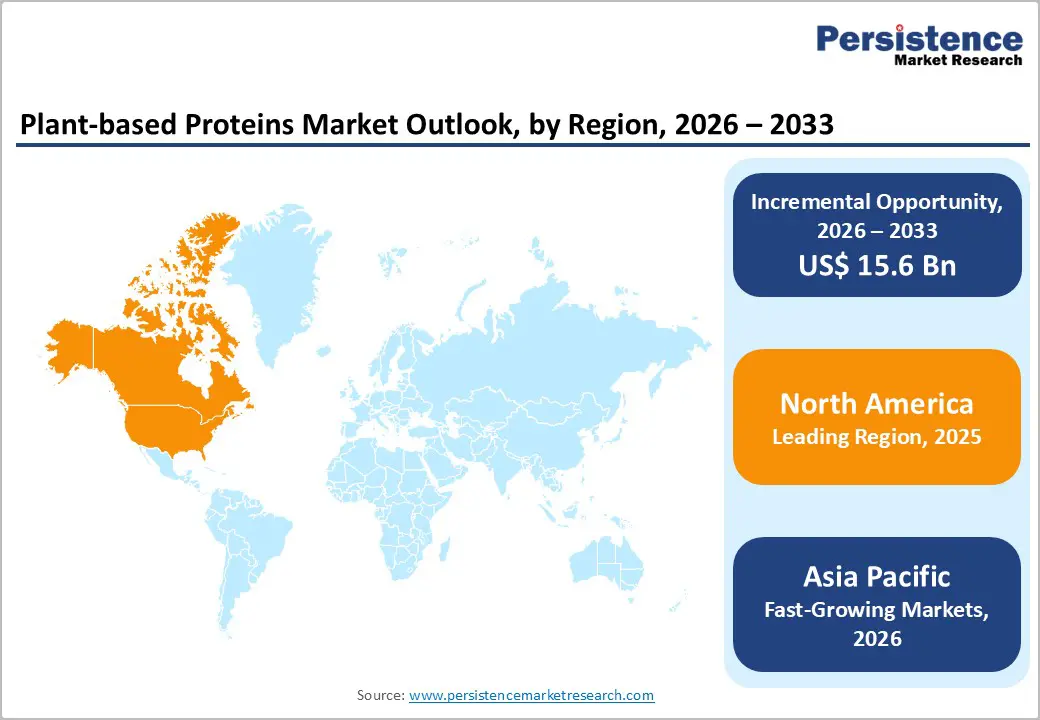
  • Leading Region: North America, holding 42% market share, fueled by health-conscious consumption, convenience-driven protein products, and strong adoption of clean-label, plant-based formulations.
  • Fastest-Growing Region: Asia Pacific, growing at a CAGR of 11.3%, driven by rising lactose intolerance, vegan and flexitarian diet adoption, and expanding e-commerce channels for protein-rich foods and supplements.
  • Fastest-Growing Nature Segment: Organic plant-based proteins, projected to grow at a CAGR of 10.6%, driven by rising consumer demand for clean-label, sustainably sourced, and chemical-free protein alternatives.
  • Market Drivers: Lactose intolerance, dairy sensitivity, and active-lifestyle trends are boosting demand for plant-based protein alternatives with superior nutrition and digestibility.
  • Opportunities: Expansion of clean-label, organic, and niche protein sources such as pea, mung bean, and spirulina across beverages, snacks, and functional foods.
  • Key Developments: In December 2025, ADM showcased functional ingredients and plant-based proteins at Fi Europe 2025. In July 2025, Protein Industries Canada launched a C$48.7 million pea protein pilot project. In June 2025, Roquette expanded NUTRALYS® plant protein portfolio with textured wheat solutions.
Global Market Attributes Key Insights
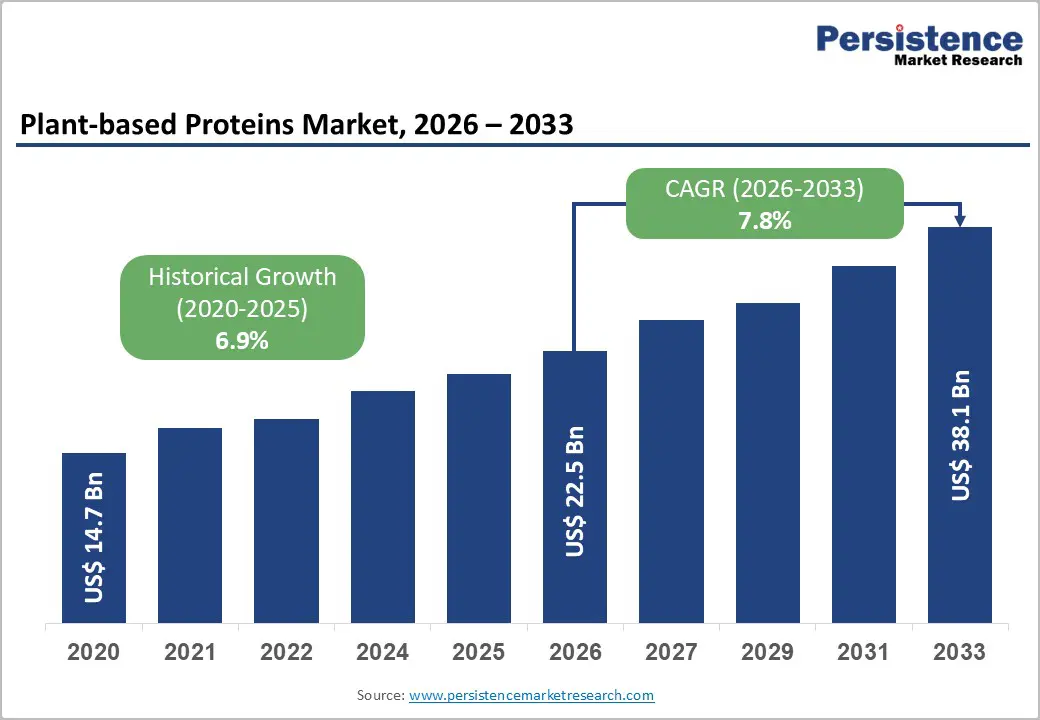
Global Plant-based Proteins Market Size (2026E) US$ 22.5 Bn
Market Value Forecast (2033F) US$ 38.1 Bn
Projected Growth (CAGR 2026 to 2033) 7.8%
Historical Market Growth (CAGR 2020 to 2025) 6.9%

plant-based-proteins-market-2026–2033

Market Dynamics

Driver - Rising lactose intolerance and dairy sensitivity fuel demand for plant protein alternatives

A sharp global shift toward digestive-friendly nutrition is reshaping protein choices, and this momentum is accelerating as dairy intolerance becomes more visible in everyday eating habits. As per the U.S. Department of Health and Human Services, about 68% of the world’s population has lactose malabsorption, driving consumers to search for protein options that avoid discomfort and support gut wellness. This pattern is especially pronounced in cultures where dairy has never been a dietary staple, pushing plant-based proteins into mainstream usage across beverages, snacks, and clinical nutrition.

The trend is even more intense across Africa and Asia, where the majority of the population experiences lactose malabsorption, creating a large built-in consumer base for non-dairy protein solutions. Manufacturers are capitalizing on this shift by developing plant proteins that deliver cleaner digestion, improved texture, and richer amino acid profiles. The rising preference for allergen-free, stomach-friendly proteins is positioning plant-based formulations as the default choice for future product development.

Restraints - Higher production costs keep price points above conventional protein sources

A new set of consumer demands is challenging plant-based protein companies, creating hurdles that restrict broader market progress. Brands frequently face difficulties achieving the right balance of taste, mouthfeel, and nutritional value, since many plant proteins require intensive processing to replicate the performance of animal proteins. This results in off-flavors, grainy textures, and inconsistent functionality in products such as meat and dairy alternatives. These formulation barriers extend development cycles and force companies to channel significant resources into product innovation.

Cost pressures compound the issue, as premium pea, faba, and niche seed proteins remain relatively expensive to produce and scale. Weather-driven crop instability, tight regional supply, and limited global processing capacity lead to price swings and unpredictable availability. For smaller manufacturers, these fluctuations create margin risks and slow their ability to expand, ultimately restraining growth across the plant-based protein landscape.

Opportunity - Growth in sports nutrition and active-lifestyle products increases demand for high-purity, high-solubility protein isolates

Rapid shift toward performance-focused nutrition is opening a high-value window for plant protein suppliers, especially those capable of delivering isolates with exceptional purity and solubility. Athletes, fitness enthusiasts, and active consumers want protein sources that mix easily, digest quickly, and deliver clean amino acid profiles without allergens. This shift pushes brands to source advanced plant-based isolates that elevate taste, texture, and functionality in shakes, bars, and fortified foods. Companies that engineer highly soluble proteins stand to capture growing demand across gyms, retail shelves, and digital wellness platforms.

Startups and established suppliers can accelerate growth by developing next-generation isolates tailored for hydration blends, endurance formulations, and recovery products. Superior dispersibility, neutral flavor, and higher protein concentration enable manufacturers to expand into ready-to-drink formats and premium nutrition categories. This opportunity rewards players investing in precision processing, enzymatic refinement, and crop diversification, positioning them at the center of a rapidly expanding active-lifestyle nutrition ecosystem.

Category-wise Analysis

By Source Insights

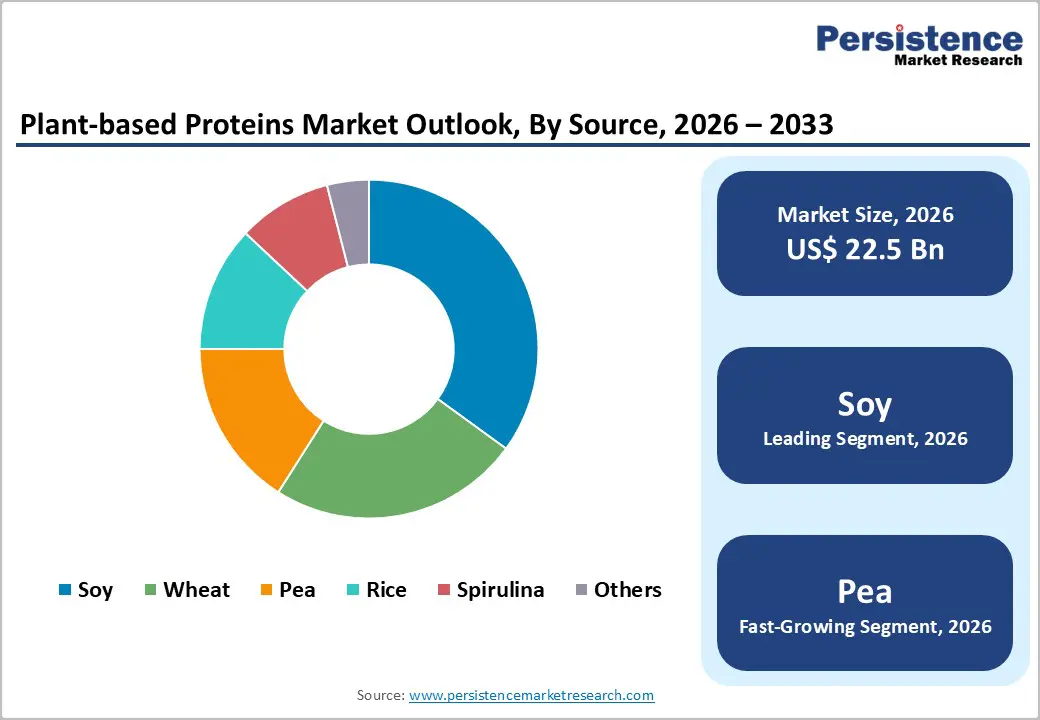
Soy protein holds approx 36% share as of 2025, dominating the global Plant-based Proteins market due to its balanced amino acid profile, high functionality, and versatility across a wide range of applications. Its excellent solubility, emulsifying properties, and neutral flavor make it a preferred choice for protein powders, beverages, meat analogues, and bakery formulations. Manufacturers favor soy protein for its scalability, cost-effectiveness, and ability to meet both nutritional and sensory expectations, making it a cornerstone of plant-based innovation.

Wheat protein is gaining traction for its high gluten content and texture-enhancing properties in meat alternatives and bakery products. Pea protein appeals for allergen-friendly formulations, while rice protein offers hypoallergenic benefits and mild taste. Spirulina protein is emerging in niche health and supplement segments for its nutrient density and sustainability credentials.

By Nature Insights

Organic plant-based proteins are projected to grow at a CAGR of 10.6% during the forecast period in the global plant-based proteins market, driven by rising consumer awareness around clean-label, sustainably sourced, and chemical-free ingredients. Shoppers are increasingly seeking products that align with wellness, environmental responsibility, and ethical farming practices, fueling demand for certified organic proteins across beverages, snacks, and nutritional supplements.

The organic segment benefits from its perception of higher quality and safety, attracting health-conscious consumers, families, and athletes seeking natural alternatives. Key applications include organic protein powders, meat substitutes, and fortified food products, where traceability, non-GMO sourcing, and eco-friendly cultivation resonate strongly. This trend presents opportunities for established players and agile startups to innovate with premium, organic offerings that meet evolving consumer preferences.
plant-based-proteins-market-outlook-by-source-2026–2033

Region-wise Insights

North America Plant-based Proteins Market Trends

North America holds approximately 42% market share in the global Plant-based Proteins Market, reflecting strong consumer adoption of alternative protein sources driven by health, sustainability, and ethical considerations. In the United States, demand for soy, pea, and rice protein-based products continues to rise across beverages, protein bars, and meat substitutes, with major players such as ADM, Ingredion, Roquette, and Cargill expanding production capacities and introducing innovative, clean-label formulations. Plant-based protein snacks and ready-to-drink shakes are gaining traction among fitness enthusiasts and busy urban consumers seeking convenient, nutritious options.

In Canada, growth is fueled by increased interest in dairy-free alternatives and high-protein functional foods. Companies like Burcon NutraScience, NutriLeads, and Tate & Lyle are developing high-solubility isolates and organic protein solutions to cater to both retail and foodservice channels. Expansion of e-commerce platforms and sustainability-focused marketing further strengthen adoption across the region, making North America a key driver of global plant-based protein trends.

Asia Pacific Plant-based Proteins Market Trends

Asia Pacific plant-based proteins market is expected to grow at a CAGR of 11.3%, driven by increasing health awareness, rising lactose intolerance, and growing adoption of vegan and flexitarian diets. In India, demand is surging for pea and soy protein-based beverages, snacks, and nutritional supplements, as urban consumers seek convenient, protein-rich options. China is witnessing innovation in plant-based meat alternatives and high-protein dairy substitutes, supported by leading companies such as Roquette, ADM, and Cargill expanding localized production and R&D.

In Japan and South Korea, clean-label, organic, and high-solubility protein isolates are trending among fitness enthusiasts and health-conscious consumers. Startups are exploring novel ingredients such as rice, spirulina, and mung bean proteins for functional foods and supplements. E-commerce platforms and cross-border retail expansions are further boosting product accessibility and adoption across the region.
plant-based-proteins-market-outlook-by-region-2026–2033

Competitive Landscape

The global plant-based proteins market exhibits a moderately consolidated structure, with leading companies and innovative startups competing through scale, technology, and product differentiation. Industry giants are investing in production expansion, clean-label ingredient lines, and high-purity protein isolates tailored for sports nutrition, dairy alternatives, and functional foods. Startups are focusing on niche sources such as mung bean, spirulina, and rice proteins, emphasizing sustainability and eco-friendly processing. Collaborations, MoUs, and joint ventures are driving innovation, supply chain efficiency, and regional market penetration. Rising consumer awareness around plant-based diets, health benefits, and allergen-friendly alternatives is encouraging product innovation. Stricter government regulations on labeling, safety, and nutrient claims are shaping development and market entry strategies globally.

Key Developments:

  • In December 2025, ADM showcased its range of functional ingredients and plant-based proteins at Fi Europe 2025, highlighting innovations that cater to the growing global wellness trend. The company emphasized solutions that support clean-label, nutritious, and sustainable product development across food and beverage categories.
  • In July 2025, Protein Industries Canada launched a C$48.7 million pilot project to develop new pea protein ingredients and finished foods. The initiative partners with Louis Dreyfus Company and Seven Oaks Hospital CDIC to meet rising demand for Canadian-made plant-based protein alternatives.
  • In June 2025, Roquette expanded its NUTRALYS® plant protein portfolio with two new textured solutions, entering the textured wheat segment. The launch highlights the company’s focus on next-generation food innovation and diversified plant-based protein offerings.
  • In November 2024, Ingredion Inc. partnered with Lantmännen to supply sustainably sourced pea protein isolates to the European market. The collaboration combines Ingredion’s ingredient expertise with Lantmännen’s grain-focused, farmer-owned cooperative model to meet rising demand for plant-based proteins.

Companies Covered in Plant-based Proteins Market

  • ADM
  • Cargill,Incorporated
  • IFF
  • Glanbia plc
  • Ingredion
  • Kerry Group Plc
  • Tate & Lyle
  • Wilmar International Ltd.
  • Roquette Frères
  • Bunge
  • Louis Dreyfus Company
  • dsm-firmenich
  • Burcon
  • Others
Frequently Asked Questions

The global plant-based proteins market is projected to be valued at US$ 22.5 Bn in 2026.

Rising lactose intolerance and increasing dairy sensitivities are boosting the demand for plant-based protein alternatives, driving growth in the global Plant-based Proteins market.

The global plant-based proteins market is poised to witness a CAGR of 7.8% between 2026 and 2033.

The expanding sports nutrition and active-lifestyle sector is fueling demand for high-purity, highly soluble protein isolates, presenting significant growth opportunities for companies in the plant-based proteins market.

Major players in the global Plant-based Proteins market include ADM, Cargill, Incorporated, IFF, Glanbia plc, Ingredion, Kerry Group Plc, Tate & Lyle, and others.

Global Plant-based Proteins Market Report Scope
Report Attribute Details
Historical Data/Actuals 2020 - 2025
Forecast Period 2026 - 2033
Market Analysis Value: US$ Bn, Volume: Tons
Geographical Coverage
  • North America
  • Europe
  • East Asia
  • South Asia and Oceania
  • Middle East and Africa
  • Latin America
Segmental Coverage
  • Source
  • Form
  • Nature
  • End-user
  • Region
Competitive Analysis
  • ADM
  • Cargill,Incorporated
  • IFF
  • Glanbia plc
  • Ingredion
  • Kerry Group Plc
  • Tate & Lyle
  • Wilmar International Ltd.
  • Roquette Frères
  • Bunge
  • Louis Dreyfus Company
  • dsm-firmenich
  • Burcon
  • Others
Report Highlights
  • Market Forecast and Trends
  • Competitive Intelligence & Share Analysis
  • Growth Factors and Challenges
  • Strategic Growth Initiatives
  • Future Opportunities and Revenue Pockets
  • Industry Market Analysis Tools
Market Segmentation

By Source

  • Soy
  • Wheat
  • Pea
  • Rice
  • Spirulina
  • Others

By Form

  • Isolates
  • Concentrates
  • Hydrolysates

By Nature

  • Organic
  • Conventional

By End-user

  • Functional Foods
  • Snacks & Cereals
  • Dairy Alternatives
  • Bakery & Confectionery
  • Animal Feed
  • Sports Nutrition
  • Others

By Region

  • North America
  • Europe
  • East Asia
  • South Asia and Oceania
  • Latin America
  • Middle East and Africa

Related Reports

  1. Executive Summary
    1. Global Plant-based Proteins Market Snapshot, 2026 and 2033
    2. Market Opportunity Assessment, 2026 - 2033, US$ Bn
    3. Key Market Trends
    4. Future Market Projections
    5. Premium Market Insights
    6. Industry Developments and Key Market Events
    7. PMR Analysis and Recommendations
  2. Market Overview
    1. Market Scope and Definition
    2. Market Dynamics
      1. Drivers
      2. Restraints
      3. Opportunity
      4. Challenges
      5. Key Trends
    3. COVID-19 Impact Analysis
    4. Forecast Factors - Relevance and Impact
  3. Value Added Insights
    1. Value Chain Analysis
    2. Key Market Players
    3. Regulatory Landscape
    4. PESTLE Analysis
    5. Porter’s Five Force Analysis
    6. Key Marketing Strategies
    7. Consumer Behavior Analysis
  4. Price Trend Analysis, 2020 - 2033
    1. Pricing Analysis, By Source
    2. Key Factors Impacting Product Prices
  5. Global Plant-based Proteins Market Outlook
    1. Key Highlights
      1. Market Volume (Tons) Projections
      2. Market Size (US$ Bn) and Y-o-Y Growth
      3. Absolute $ Opportunity
    2. Market Size (US$ Bn) Analysis and Forecast
      1. Historical Market Size (US$ Bn) Analysis, 2020-2025
      2. Market Size (US$ Bn) Analysis and Forecast, 2026-2033
    3. Global Plant-based Proteins Market Outlook: Source
      1. Historical Market Size (US$ Bn) and Volume (Tons) Analysis, By Source, 2020-2025
      2. Market Size (US$ Bn) and Volume (Tons) Analysis and Forecast, By Source, 2026-2033
        1. Soy
        2. Wheat
        3. Pea
        4. Rice
        5. Spirulina
        6. Others
      3. Market Attractiveness Analysis: Source
    4. Global Plant-based Proteins Market Outlook: Form
      1. Historical Market Size (US$ Bn) and Volume (Tons) Analysis, By Form, 2020-2025
      2. Market Size (US$ Bn) and Volume (Tons) Analysis and Forecast, By Form, 2026-2033
        1. Isolates
        2. Concentrates
        3. Hydrolysates
      3. Market Attractiveness Analysis: Form
    5. Global Plant-based Proteins Market Outlook: Nature
      1. Historical Market Size (US$ Bn) and Volume (Tons) Analysis, By Nature, 2020-2025
      2. Market Size (US$ Bn) and Volume (Tons) Analysis and Forecast, By Nature, 2026-2033
        1. Organic
        2. Conventional
      3. Market Attractiveness Analysis: Nature
    6. Global Plant-based Proteins Market Outlook: End Use
      1. Historical Market Size (US$ Bn) and Volume (Tons) Analysis, By End Use, 2020-2025
      2. Market Size (US$ Bn) and Volume (Tons) Analysis and Forecast, By End Use, 2026-2033
        1. Functional Foods
        2. Snacks & Cereals
        3. Dairy Alternatives
        4. Bakery & Confectionery
        5. Animal Feed
        6. Sports Nutrition
        7. Others
      3. Market Attractiveness Analysis: End Use
  6. Global Plant-based Proteins Market Outlook: Region
    1. Historical Market Size (US$ Bn) and Volume (Tons) Analysis, By Region, 2020-2025
    2. Market Size (US$ Bn) and Volume (Tons) Analysis and Forecast, By Region, 2026-2033
      1. North America
      2. Latin America
      3. Europe
      4. East Asia
      5. South Asia and Oceania
      6. Middle East & Africa
    3. Market Attractiveness Analysis: Region
  7. North America Plant-based Proteins Market Outlook
    1. Historical Market Size (US$ Bn) and Volume (Tons) Analysis, By Market, 2020-2025
      1. By Country
      2. By Source
      3. By Form
      4. By Nature
      5. By End Use
    2. Market Size (US$ Bn) and Volume (Tons) Analysis and Forecast, By Country, 2026-2033
      1. U.S.
      2. Canada
    3. Market Size (US$ Bn) and Volume (Tons) Analysis and Forecast, By Source, 2026-2033
      1. Soy
      2. Wheat
      3. Pea
      4. Rice
      5. Spirulina
      6. Others
    4. Market Size (US$ Bn) and Volume (Tons) Analysis and Forecast, By Form, 2026-2033
      1. Isolates
      2. Concentrates
      3. Hydrolysates
    5. Market Size (US$ Bn) and Volume (Tons) Analysis and Forecast, By Nature, 2026-2033
      1. Organic
      2. Conventional
    6. Market Size (US$ Bn) and Volume (Tons) Analysis and Forecast, By End Use, 2026-2033
      1. Functional Foods
      2. Snacks & Cereals
      3. Dairy Alternatives
      4. Bakery & Confectionery
      5. Animal Feed
      6. Sports Nutrition
      7. Others
    7. Market Attractiveness Analysis
  8. Europe Plant-based Proteins Market Outlook
    1. Historical Market Size (US$ Bn) and Volume (Tons) Analysis, By Market, 2020-2025
      1. By Country
      2. By Source
      3. By Form
      4. By Nature
      5. By End Use
    2. Market Size (US$ Bn) and Volume (Tons) Analysis and Forecast, By Country, 2026-2033
      1. Germany
      2. France
      3. U.K.
      4. Italy
      5. Spain
      6. Russia
      7. Rest of Europe
    3. Market Size (US$ Bn) and Volume (Tons) Analysis and Forecast, By Source, 2026-2033
      1. Soy
      2. Wheat
      3. Pea
      4. Rice
      5. Spirulina
      6. Others
    4. Market Size (US$ Bn) and Volume (Tons) Analysis and Forecast, By Form, 2026-2033
      1. Isolates
      2. Concentrates
      3. Hydrolysates
    5. Market Size (US$ Bn) and Volume (Tons) Analysis and Forecast, By Nature, 2026-2033
      1. Organic
      2. Conventional
    6. Market Size (US$ Bn) and Volume (Tons) Analysis and Forecast, By End Use, 2026-2033
      1. Functional Foods
      2. Snacks & Cereals
      3. Dairy Alternatives
      4. Bakery & Confectionery
      5. Animal Feed
      6. Sports Nutrition
      7. Others
    7. Market Attractiveness Analysis
  9. East Asia Plant-based Proteins Market Outlook
    1. Historical Market Size (US$ Bn) and Volume (Tons) Analysis, By Market, 2020-2025
      1. By Country
      2. By Source
      3. By Form
      4. By Nature
      5. By End Use
    2. Market Size (US$ Bn) and Volume (Tons) Analysis and Forecast, By Country, 2026-2033
      1. China
      2. Japan
      3. South Korea
    3. Market Size (US$ Bn) and Volume (Tons) Analysis and Forecast, By Source, 2026-2033
      1. Soy
      2. Wheat
      3. Pea
      4. Rice
      5. Spirulina
      6. Others
    4. Market Size (US$ Bn) and Volume (Tons) Analysis and Forecast, By Form, 2026-2033
      1. Isolates
      2. Concentrates
      3. Hydrolysates
    5. Market Size (US$ Bn) and Volume (Tons) Analysis and Forecast, By Nature, 2026-2033
      1. Organic
      2. Conventional
    6. Market Size (US$ Bn) and Volume (Tons) Analysis and Forecast, By End Use, 2026-2033
      1. Functional Foods
      2. Snacks & Cereals
      3. Dairy Alternatives
      4. Bakery & Confectionery
      5. Animal Feed
      6. Sports Nutrition
      7. Others
    7. Market Attractiveness Analysis
  10. South Asia & Oceania Plant-based Proteins Market Outlook
    1. Historical Market Size (US$ Bn) and Volume (Tons) Analysis, By Market, 2020-2025
      1. By Country
      2. By Source
      3. By Form
      4. By Nature
      5. By End Use
    2. Market Size (US$ Bn) and Volume (Tons) Analysis and Forecast, By Country, 2026-2033
      1. India
      2. Indonesia
      3. Thailand
      4. ANZ
      5. Rest of South Asia & Oceania
    3. Market Size (US$ Bn) and Volume (Tons) Analysis and Forecast, By Source, 2026-2033
      1. Soy
      2. Wheat
      3. Pea
      4. Rice
      5. Spirulina
      6. Others
    4. Market Size (US$ Bn) and Volume (Tons) Analysis and Forecast, By Form, 2026-2033
      1. Isolates
      2. Concentrates
      3. Hydrolysates
    5. Market Size (US$ Bn) and Volume (Tons) Analysis and Forecast, By Nature, 2026-2033
      1. Organic
      2. Conventional
    6. Market Size (US$ Bn) and Volume (Tons) Analysis and Forecast, By End Use, 2026-2033
      1. Functional Foods
      2. Snacks & Cereals
      3. Dairy Alternatives
      4. Bakery & Confectionery
      5. Animal Feed
      6. Sports Nutrition
      7. Others
    7. Market Attractiveness Analysis
  11. Latin America Plant-based Proteins Market Outlook
    1. Historical Market Size (US$ Bn) and Volume (Tons) Analysis, By Market, 2020-2025
      1. By Country
      2. By Source
      3. By Form
      4. By Nature
      5. By End Use
    2. Market Size (US$ Bn) and Volume (Tons) Analysis and Forecast, By Country, 2026-2033
      1. Brazil
      2. Mexico
      3. Rest of Latin America
    3. Market Size (US$ Bn) and Volume (Tons) Analysis and Forecast, By Source, 2026-2033
      1. Soy
      2. Wheat
      3. Pea
      4. Rice
      5. Spirulina
      6. Others
    4. Market Size (US$ Bn) and Volume (Tons) Analysis and Forecast, By Form, 2026-2033
      1. Isolates
      2. Concentrates
      3. Hydrolysates
    5. Market Size (US$ Bn) and Volume (Tons) Analysis and Forecast, By Nature, 2026-2033
      1. Organic
      2. Conventional
    6. Market Size (US$ Bn) and Volume (Tons) Analysis and Forecast, By End Use, 2026-2033
      1. Functional Foods
      2. Snacks & Cereals
      3. Dairy Alternatives
      4. Bakery & Confectionery
      5. Animal Feed
      6. Sports Nutrition
      7. Others
    7. Market Attractiveness Analysis
  12. Middle East & Africa Plant-based Proteins Market Outlook
    1. Historical Market Size (US$ Bn) and Volume (Tons) Analysis, By Market, 2020-2025
      1. By Country
      2. By Source
      3. By Form
      4. By Nature
      5. By End Use
    2. Market Size (US$ Bn) and Volume (Tons) Analysis and Forecast, By Country, 2026-2033
      1. GCC Countries
      2. Egypt
      3. South Africa
      4. Northern Africa
      5. Rest of Middle East & Africa
    3. Market Size (US$ Bn) and Volume (Tons) Analysis and Forecast, By Source, 2026-2033
      1. Soy
      2. Wheat
      3. Pea
      4. Rice
      5. Spirulina
      6. Others
    4. Market Size (US$ Bn) and Volume (Tons) Analysis and Forecast, By Form, 2026-2033
      1. Isolates
      2. Concentrates
      3. Hydrolysates
    5. Market Size (US$ Bn) and Volume (Tons) Analysis and Forecast, By Nature, 2026-2033
      1. Organic
      2. Conventional
    6. Market Size (US$ Bn) and Volume (Tons) Analysis and Forecast, By End Use, 2026-2033
      1. Functional Foods
      2. Snacks & Cereals
      3. Dairy Alternatives
      4. Bakery & Confectionery
      5. Animal Feed
      6. Sports Nutrition
      7. Others
    7. Market Attractiveness Analysis
  13. Competition Landscape
    1. Market Share Analysis, 2025
    2. Market Structure
      1. Competition Form Mapping By Market
      2. Competition Dashboard
    3. Company Profiles (Details - Overview, Financials, Strategy, Recent Developments)
      1. ADM
        1. Overview
        2. Segments and Source
        3. Key Financials
        4. Market Developments
        5. Market Strategy
      2. Cargill,Incorporated
      3. IFF
      4. Glanbia plc
      5. Ingredion
      6. Kerry Group Plc
      7. Tate & Lyle
      8. Wilmar International Ltd.
      9. Roquette Frères
      10. Bunge
      11. Louis Dreyfus Company
      12. dsm-firmenich
      13. Burcon
      14. Others
  14. Appendix
    1. Research Methodology
    2. Research Assumptions
    3. Acronyms and Abbreviations

Research Methodology Framework for Market Research Excellence

At Persistence Market Research, we implement a comprehensive, validated, and multi-dimensional approachto market analysis that delivers actionable insights across complex market landscapes. Our methodology combines the analytical rigor of leading consulting firms with innovative research techniques, ensuring robust market assessments that guide strategic decision-making with confidence.

Core Research Philosophy

Our methodology is built on four foundational pillars:

Research Philosophy Image

At Persistence Market Research, our methodology is designed to transcend conventional market studies by combining analytical rigor, multi-source validation, and future-focused insights.

We integrate advanced research frameworks, robust data collection strategies, cutting-edge analytics, and innovative technologies to deliver a 360-degree view of complex markets.

We integrate advanced research frameworks, robust data collection strategies, cutting-edge analytics, and innovative technologies to deliver a 360-degree view of complex markets.

Each stage spanning from strategic scoping and hypothesis-building to competitive intelligence, quality validation, and actionable recommendations is engineered to provide clients with unmatched clarity, precision, and confidence in decision-making.

By embedding innovation and technology at the core, our approach ensures that insights are not only comprehensive but also predictive, empowering businesses to seize opportunities, mitigate risks, and achieve sustainable growth

Research Philosophy Image

Capturing Key Information and Events

During this phase, key research objectives focus on essential information and data points for assessing the market, including:

Research Philosophy Image

TAM-SAM-SOM Framework Implementation

We employ both top-down and bottom-up approaches to ensure accurate market sizing.

Top-Down Market SizingBottom-Up Market Sizing
Universe Definition: Total global/regional market identificationUnit Economics: Average transaction values, purchase frequencies, customer lifecycle
Segmentation Filters: Geographic, demographic, and behavioral constraintsCustomer Segmentation: Detailed buyer persona development and sizing
Market Share Analysis: Competitive landscape assessment and share allocationPenetration Analysis: Market penetration rates by segment and geography
Growth Rate Application: Historical trends and forward-looking growth assumptionsScaling Methodology: Extrapolation techniques with confidence intervals

Validation & Cross-Verification

  • Triangulation: Comparing top-down and bottom-up results for consistency
  • Sensitivity Analysis: Testing key assumptions and parameter variations
  • Peer Benchmarking: Comparison with analogous markets and industry benchmarks
  • Expert Review: External validation through industry specialist consultation

Research Philosophy Image

Forecasting & Projection Modeling

Our proprietary forecasting models incorporate multiple variables and scenarios.

Forecasting Components

  • Historical Trend Analysis: 10-year historical growth patterns and cyclical variations
  • Driver-Based Modeling: Economic indicators, demographic shifts, technology adoption
  • Scenario Planning: Base case, optimistic, and conservative projections
  • Monte Carlo Simulations: Probability-weighted outcomes and risk assessments

Model Validation

  • Back-Testing: Historical accuracy assessment over 3–5-year periods
  • Cross-Validation: Multiple modeling approaches for result comparison
  • External Benchmarking: Comparison with established market forecasts
  • Continuous Calibration: Quarterly model updates based on new data

Comprehensive Data Collection Strategy

Our secondary research phase establishes a robust knowledge base utilizing diverse, credible sources.

Secondary Data Sourcess

  • Industry Publications & Reports
  • Government & Regulatory Data
  • Financial Intelligence (filings & reports)
  • Academic Research & Digital Intelligence

Quality Assurance Protocol

  • Source credibility assessment and publication date validation
  • Data consistency checks across multiple sources
  • Bias identification and neutralization techniques
  • Information gap tracking for primary research prioritization

Research Philosophy Image

Primary Research Excellence

Our primary research methodology employs best-in-class techniques to capture unique market insights.

Quantitative Research Methods

  • Large-Scale Surveys: Statistically representative samples with 95% confidence intervals
  • Survey Methodology: Multi-channel deployment (online, telephone, in-person)
  • Question Architecture and Response Optimization

Qualitative Research Methods

  • Executive Interviews
  • Focus Groups
  • Expert Consultations

Quality Assurance & Validation Framework

Multi-Stage Validation Process

  • Source Verification and Consistency Testing
  • Outlier Detection and Bias Assessment
  • Peer Review Process and External Validation
  • Sensitivity Analysis and Confidence Intervals

Research Philosophy Image

Methodology Validation & Credibility

Our research methodology has been extensively validated through:

  • Academic Partnerships: Collaborations with top-tier business schools and research institutions
  • Client Success Stories: Documented case studies demonstrating research impact and ROI
  • Continuous Benchmarking: Performance comparison with leading global research firms

This comprehensive methodology framework positions Persistence Market Research at the forefront of market intelligence, combining the analytical sophistication of top-tier consulting firms with innovative research techniques. Our approach ensures that every market assessment delivers precise, actionable, and strategically valuable insights that drive business success in competitive market environments.

Ready to unlock your market potential? Contact our research experts to discuss how our validated methodology can transform your strategic decision-making with data-driven market intelligence.

Copyright © 2026 Persistence Market Research. All Rights Reserved

Connect With Us -