




- Beverages
- Plant-based Milk Powder Market
Plant-based Milk Powder Market Size, Share, and Growth Forecast 2026 - 2033
Plant-based Milk Powder Market by Powder Type (Almond, Soy, Coconut, Oat, Rice, Others), Application (Food & Beverages, Nutritional Supplements, Infant Formula, Others), Distribution Channel (Supermarkets/Hypermarkets, Online, Specialty Stores, Others), and Regional Analysis, 2026 - 2033

Plant-based Milk Powder Market Share and Trends Analysis
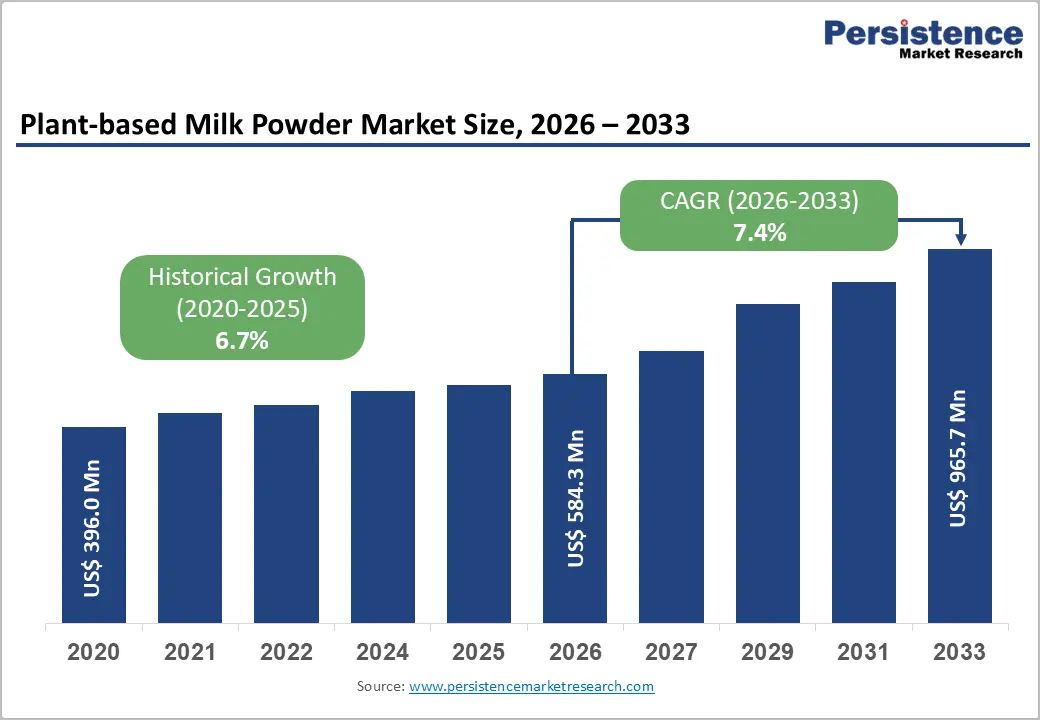
The global plant-based milk powder market size is expected to be valued at US$ 584.3 million in 2026 and projected to reach US$ 965.7 million by 2033, growing at a CAGR of 7.4% between 2026 and 2033.
This steady expansion reflects the broader momentum of plant-based dairy alternatives, as consumers seek lactose-free, cholesterol-free and more sustainable options for everyday beverages, bakery, confectionery and infant nutrition. Supported by declining per capita consumption of conventional fluid milk in markets such as the U.S. and rising vegan and flexitarian lifestyles worldwide, plant-based milk powders are emerging as a convenient, shelf-stable format that can be easily shipped, stored, and reconstituted for multiple uses.
Key Market Highlights
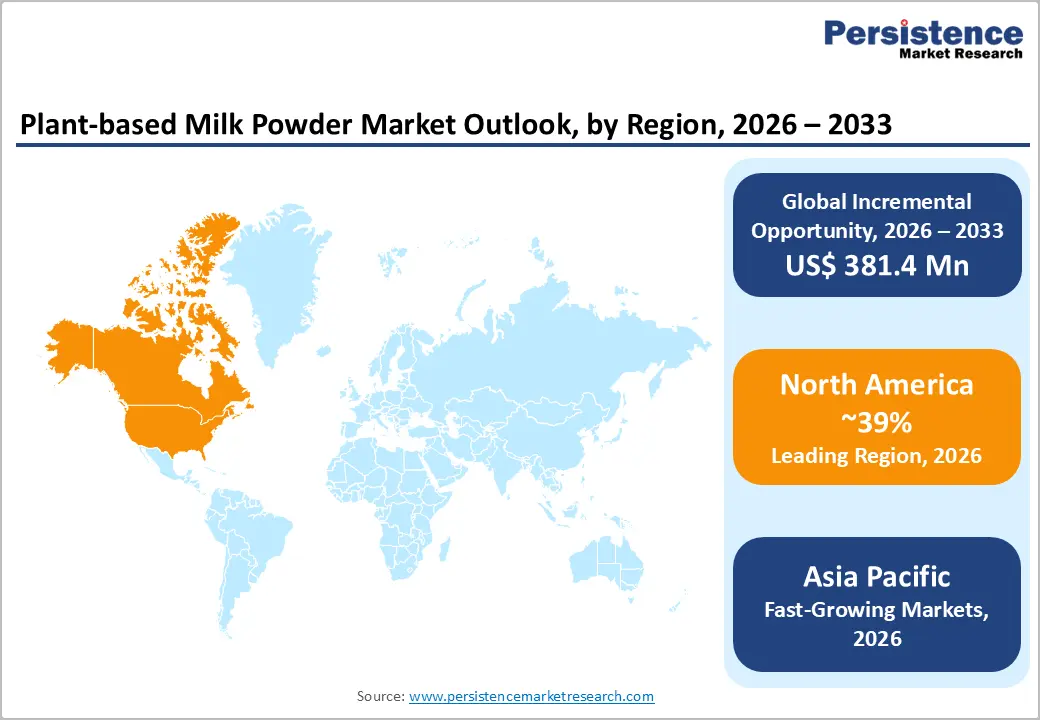
- Regional Leadership: North America remains the leading region in the plant-based milk powder market, contributing an estimated 39% of global value in 2025, supported by high consumer awareness, strong retail and foodservice penetration, and a robust innovation ecosystem spanning beverages, creamers and dry blends.
- Fast-growing Market: Asia Pacific is the fastest-growing regional market for plant-based milk powders, driven by high lactose intolerance, rapid urbanization, rising vegan and flexitarian populations, and double-digit growth in dairy alternatives across China, India, Japan, and key ASEAN economies.
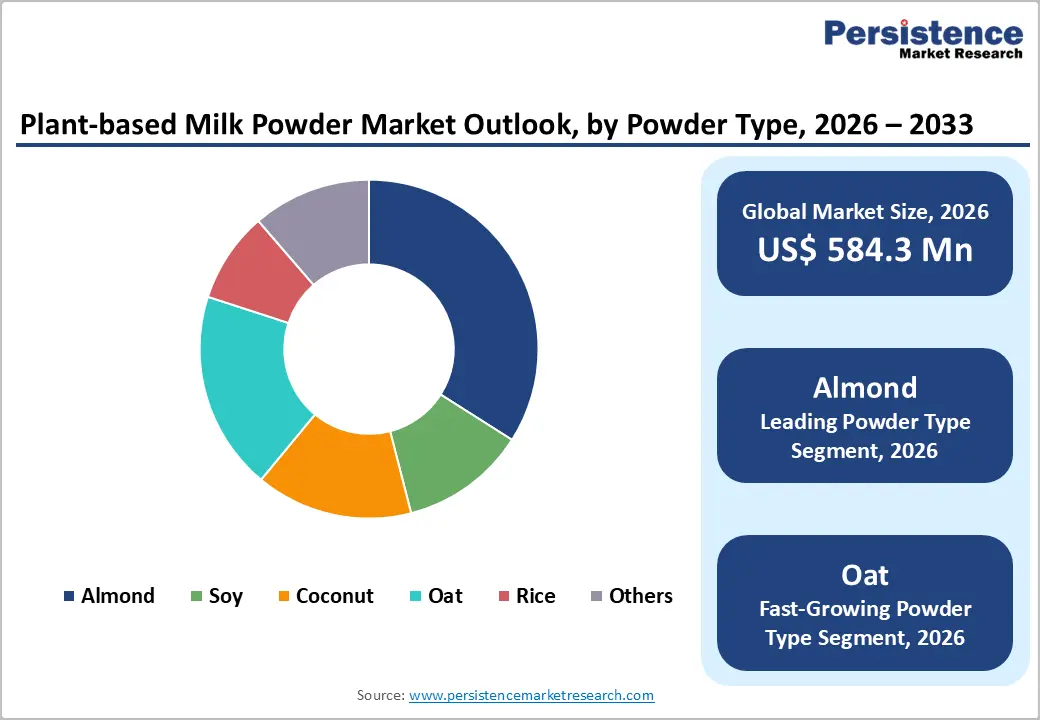
- Leading Powder Type: The almond powder segment dominates the powder type category with around 34% share in 2025, reflecting its leadership in the broader plant-based milk category and its strong acceptance in beverages, bakery and nutrition applications due to taste, functionality and health positioning.
- Leading Application: Within applications, the food & beverages holds the largest share of plant-based milk powder usage, driven by integration into instant beverage mixes, coffee whiteners, cocoa and cereal blends and bakery or confectionery recipes, while online and specialty channels expand consumer access to niche and premium products.
- Opportunity: A key opportunity lies in fortified, blended and clean-label plant-based milk powders for infants, children and adults, where leading companies are combining plant proteins with targeted micronutrients and prebiotics, and tailoring formulations to local dietary habits and regulatory frameworks in both developed and emerging markets.
| Key Insights | Details |
|---|---|
| Plant-based Milk Powder Market Size (2026E) | US$ 584.3 million |
| Market Value Forecast (2033F) | US$ 965.7 million |
| Projected Growth CAGR (2026 - 2033) | 7.4% |
| Historical Market Growth (2020 - 2025) | 6.7% |
DRO Analysis
Drivers - Rising lactose intolerance and shift away from dairy
A fundamental structural driver for plant-based milk powder is the high and rising prevalence of lactose intolerance and dairy protein allergies, particularly in Asia, Africa and among certain ethnic groups in Western markets. Scientific and public-health literature notes that lactose intolerance affects between 70% and 100% of adults in many East Asian population and around 75-90% of adults in several African, Asian, Mediterranean and Jewish communities.
In parallel, the USDA Economic Research Service (ERS) shows that daily per capita fluid milk consumption in the United States fell from about 0.78 cups in 1990 to 0.49 cups in 2019, continuing a multi-decade downward trend. This combination of high lactose intolerance and declining dairy intake directly supports demand for shelf-stable plant-based milk powders that can be used in beverages, cereals, bakery products and specialty nutrition formulations.
Health, sustainability and broader plant-based dairy momentum
Health-conscious and environmentally aware consumers increasingly view plant-based dairy alternatives as better aligned with their wellness and sustainability goals, which lifts the entire plant-based dairy value chain, including milk powders. The plant-based milk category is estimated to reach positive growth in the current decade underpinned by interest in lower saturated fat, zero cholesterol, and reduced environmental footprint versus dairy milk.
Industry data reveals that almond and oat formats have become leading and fastest-growing plant-based milk types in key markets such as the U.S. and Europe, with extensive launches of fortified, barista-grade and flavored variants across retail and foodservice. As these liquid and ready-to-drink segments scale up, demand for versatile plant-based milk powders used in dry blends, mixes and industrial applications tends to follow a similar growth trajectory.
Market Restraints
Price sensitivity and raw material volatility
Despite robust underlying demand, price remains a significant barrier, especially in cost-sensitive emerging markets where consumers closely compare plant-based alternatives with conventional dairy powders. Key raw materials such as almonds, oats and certain nuts or seeds are exposed to agricultural and climate risks in major producing regions such as California, causing fluctuations in farm gate prices that feed through to finished product costs.
When combined with higher processing costs, specialized drying technology, fortification, and certification (for example, organic, non-GMO, allergen-free), plant-based milk powders can be substantially more expensive than dairy milk powders. This price premium restricts penetration among low and middle-income consumers and can slow adoption in institutional segments where procurement is highly price driven.
Sensory, nutritional, and labeling challenges
A second key restraint relates to consumer perceptions around sensory quality and nutritional equivalence. Academic reviews note that many plant-based milks are lower in protein than cow’s milk and require fortification with calcium, vitamin D, vitamin B12, and other micronutrients to approximate dairy’s nutritional profile, with large differences across almond, oat, rice and coconut bases. Some consumers also perceive off-notes or a thinner mouthfeel in certain plant-based beverages, which can translate into skepticism toward powdered forms.
The European Court of Justice (ECJ) underscored that terms such as “milk”, “butter” and “yogurt” cannot generally be used to market purely plant-based products, except where explicitly allowed by EU law. This tightening of labeling rules has forced brands to invest in consumer education and packaging adjustments, using descriptors such as “almond drink” or “oat beverage” while still conveying usage equivalence, adding complexity and cost to category development.
Opportunities - Fortified, blended, and clean-label product innovation
A substantial opportunity lies in developing nutrient-dense, blended and clean-label plant-based milk powders. Leading nutrition and dairy companies have begun launching hybrid dairy-plus-plant powdered products for infants and family nutrition, combining milk proteins with soy and other plant proteins, and fortifying with iron, zinc, iodine, folate and vitamins A, B6, B12, C and D. For instance, Danone has introduced dairy and plant milk powder blends for infants and toddlers in Australia and New Zealand, explicitly addressing parental interest in more plant-forward formulas without compromising on essential nutrients. Similarly, Nestlé’s Nido Milk & Soya Instant Powder Mix in Nigeria combines milk powder with locally sourced soy to create an affordable, fortified option for family use. As consumers increasingly demand convenient, nutrient-rich and minimally processed products, brands that can deliver science-backed, fortified plant-based powders with short, clean ingredient lists are well-positioned to capture premium demand.
Category-wise Analysis
Powder Type Insights
Almond is the leading powder type in the plant-based milk powder market, accounting for about 34% of global revenues in 2025. This leadership mirrors the broader plant-based milk category, where almond milk has emerged as a top product type in markets such as North America and Europe, supported by its mild taste, versatility and strong consumer familiarity. Nutritional assessments highlight that almond-based beverages offer a favorable fat profile and can be fortified to provide optimal levels of vitamin E, calcium , and other micronutrients, which supports their perception as a better-for-you option compared with some sweetened dairy products.
Almond’s alignment with low-cholesterol, weight-management, and heart-health narratives further underpins its success. As more brands launch almond milk powders for bakery mixes, at-home beverages and meal replacement formats, this segment is expected to maintain its dominant position while facing increasing competition from fast-growing oat-based powders.
Application Insights
Within applications, food & beverages is the dominant segment for plant-based milk powders, representing the largest share of global consumption in 2025. Powdered almond, soy, coconut and oat formulations are widely used in beverage mixes, instant cocoa, tea, and coffee whiteners, cereal blends and smoothies as consumers seek convenient, lactose-free alternatives for everyday use. In addition, plant-based milk powders are being incorporated into bakery, confectionery and dessert recipes to provide flavor, browning and texture benefits while enabling “dairy-free” or “vegan” labeling. The strong growth of the broader plant-based milk market driven by health, ethics, and sustainability considerations, encourages brands to develop dry-blend extensions that deliver longer shelf life, lower transport costs and flexible portion control for households, cafés and industrial food manufacturers.
Distribution Channel Insights
By distribution channel, supermarkets/hypermarkets currently capture the largest share of plant-based milk powder sales worldwide. Large grocery chains in North America and Europe allocate dedicated shelf space to plant-based categories, expand private-label offerings and run promotions that help normalize plant-based powder usage alongside dairy milk powders. In-store visibility, sampling programs and cross-merchandising with cereals, coffee and baking ingredients play an important role in educating consumers about new powder formats and flavors.
Online channels are expanding at the fastest pace, as e-commerce platforms, specialist marketplaces and direct-to-consumer websites allow brands to reach niche segments, offer broader SKU ranges and serve both urban and remote customers. Digital-first, plant-based shoppers often discover products via social media and influencer marketing, making online distribution particularly important for emerging and regional brands of plant-based milk powders.
Regional Insights
North America Plant-Based Milk Powder Market Trends and Insights
The North America plant-based milk powder market is witnessing steady growth, driven by rising lactose intolerance, vegan adoption, and demand for clean-label nutrition. Consumers are increasingly shifting toward shelf-stable, convenient formats, making powdered alternatives attractive for both retail and foodservice applications. Almond-based powders continue to dominate due to strong consumer familiarity, while oat-based powders are gaining rapid traction, supported by sustainability trends and barista-friendly formulations.
The region is also witnessing an increased demand for fortified products enriched with calcium, vitamins, and protein to match dairy nutrition. E-commerce expansion and health-focused specialty stores are accelerating product accessibility. Additionally, manufacturers are investing in innovative formulations such as organic, non-GMO, and allergen-free variants to cater to evolving dietary preferences. The growing use of plant-based milk powders in bakery, beverages, and nutritional supplements further supports market expansion across the U.S. and Canada.
Asia Pacific Plant-Based Milk Powder Market Trends and Insights
Asia Pacific is the fastest-growing region for plant-based milk and related powder formats, driven by high lactose intolerance, rapid urbanization and strong demand for convenient, shelf-stable nutrition. Market studies indicate that plant-based milk and dairy alternative markets in China, India, Japan and key ASEAN economies are expanding at CAGRs of 10%, supported by rising incomes and growing health and environmental awareness. In India, plant-based milks are increasingly popular among urban, health-conscious consumers, while in China, a long tradition of soy beverages provides a strong base for the adoption of almond, oat and other plant-based offerings.
The region also benefits from structural manufacturing advantages. Local availability of soy, rice and coconut, combined with competitive contract manufacturing, packaging capabilities and favorable cost structures, enables efficient production of plant based milk powders targeted at domestic and export markets. Multinational and regional players are investing in localized formulations that suit tea, coffee and traditional cereal or porridge consumption habits, as well as tailoring sweetness and flavor profiles to local preferences. Rapid growth of e commerce and quick commerce in major cities across China, India, Japan and Southeast Asia further accelerates category development by improving access to niche brands, fortified children’s powders and functional adult nutrition blends.
Competitive Landscape
The plant-based milk powder market is moderately fragmented and highly competitive, with a mix of large food manufacturers and niche plant-based specialists competing on innovation, quality, and distribution reach. Companies are increasingly focusing on product differentiation through clean-label, organic, and fortified formulations to attract health-conscious consumers. Continuous investment in R&D to improve taste, texture, and nutritional value remains a key competitive strategy. Strategic partnerships, e-commerce expansion, and regional market penetration are also widely adopted to strengthen market presence.
Key Developments:
- In July 2025, Oatly expanded its product portfolio by launching a ready-to-drink matcha latte oat milk, combining matcha green tea with its oat-based formulation and a hint of vanilla. The product was introduced to capitalize on evolving consumer preferences toward café-style beverages and the growing popularity of matcha.
- In October 2025, iSqueeze partnered with Numilk to launch a countertop plant-based milk dispensing machine aimed at cafés, bars, and other foodservice outlets. The machine enabled businesses to produce fresh plant-based milk on demand using recyclable pouches, delivering up to two litres per use while eliminating the need for storage and refrigeration of cartons. It also incorporated foaming and steaming capabilities for specialty beverages.
- In June 2025, Albert Heijn launched a new range of hybrid dairy and plant-based milk blends in the Netherlands, marking one of the first large-scale retail introductions of such products. The range was developed in collaboration with Farm Dairy and PlanetDairy, combining traditional dairy with plant ingredients to deliver a similar taste and nutritional profile while reducing environmental impact.
Companies Covered in Plant-based Milk Powder Market
- Danone S.A.
- Nestlé S.A.
- Archer Daniels Midland Company
- SunOpta Inc.
- Oatly AB
- Blue Diamond Growers
- Vitasoy International Holdings
- The Hain Celestial Group
- Califia Farms
- Asahi Group Foods Ltd.
- Bulk Ba Foods Limited
- Synlait Milk Ltd.
Frequently Asked Questions
The global plant-based milk powder market is expected to reach around US$ 584.3 million in 2026, reflecting steady expansion from 2020 levels as plant-based dairy alternatives gain traction across beverages, bakery, confectionery and nutrition applications worldwide.
A major demand driver is the high and rising prevalence of lactose intolerance and dairy-protein allergies, particularly in Asia, Africa and among certain ethnic groups in Western markets, combined with declining per capita fluid milk consumption and strong interest in healthier, more sustainable diets.
North America currently leads the global plant-based milk powder market, contributing an estimated 39% of total value, supported by high consumer awareness, extensive retail and foodservice penetration and continuous product innovation from multinational and regional brands.
One of the most attractive opportunities is the development of fortified, blended and clean-label plant-based milk powders for infants, children and adults, combining plant proteins with targeted micronutrients and prebiotics, and adapting flavors and formats to local dietary patterns and regulatory requirements.
Key players include global and regional companies such as Danone S.A., Nestlé S.A., Archer Daniels Midland Company, SunOpta Inc., Oatly AB, Blue Diamond Growers, etc.


