




- Baby Care & Accessories
- High Chairs Market
High Chairs Market Size, Share, and Growth Forecast, 2026 - 2033
High Chairs Market by Material (Wood, Plastic, Metal), Installation (Non-Folding, Folding, Detachable), Sales Channel (Supermarkets, Online Stores), and Regional Analysis for 2026 - 2033

High Chairs Market Share and Trends Analysis
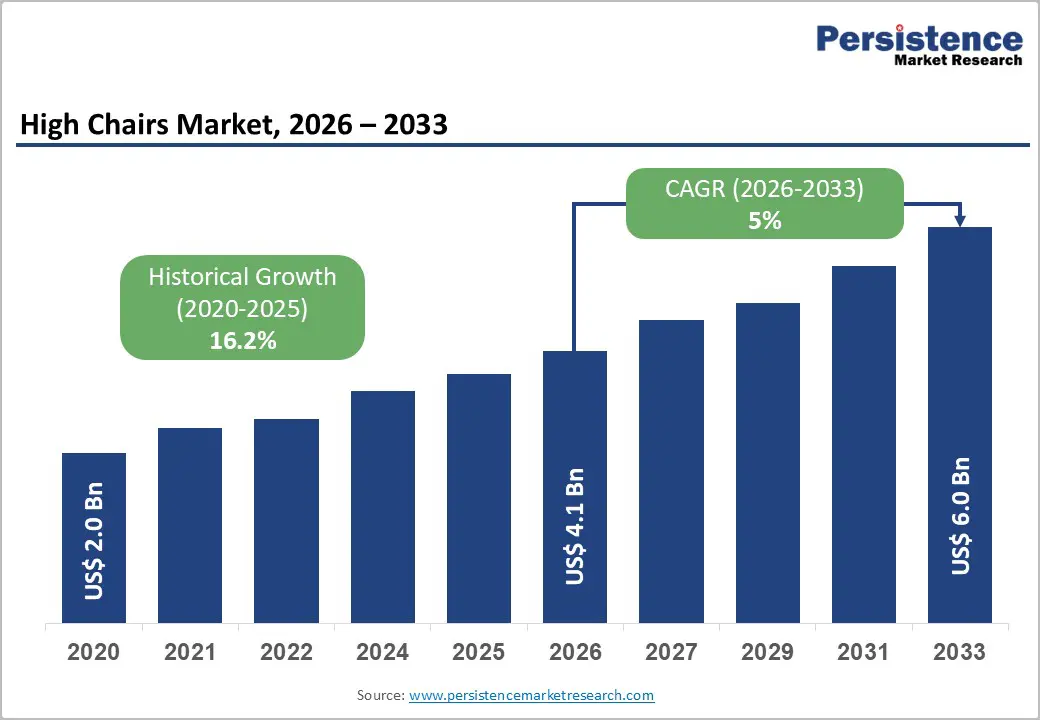
The global high chairs market size is likely to be valued at US$ 4.1 billion in 2026, and is projected to reach US$ 6.0 billion by 2033, growing at a CAGR of 5.0% during the forecast period 2026−2033.
The demand for these products is being fueled by rising birth rates across emerging economies and increasing parental focus on child safety, hygiene, and ergonomics. Higher disposable incomes are enabling families to invest in premium and branded products, which is strengthening value growth alongside unit sales.
A structural shift in consumer purchasing behavior toward digital retail platforms and curated online marketplaces is opening new avenues for market growth. Parents are increasingly prioritizing multifunctional furniture that supports feeding, learning, and storage within compact living spaces. E-commerce channels are improving product visibility, comparison, and access to international brands, which is accelerating market penetration beyond major urban centers.
Key Industry Highlights
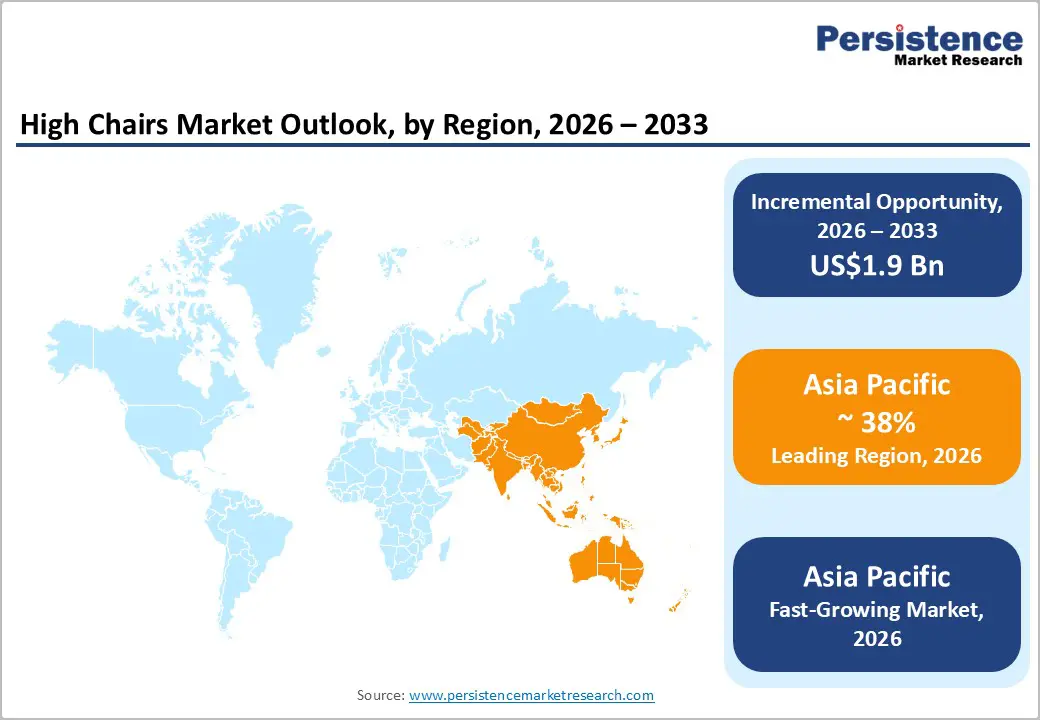
- Regional Dominance: Asia Pacific is likely to be the leading and fastest-growing regional market from 2026 to 2033, accounting for approximately 38% of market share, underpinned by strong demographic momentum and widespread urbanization.
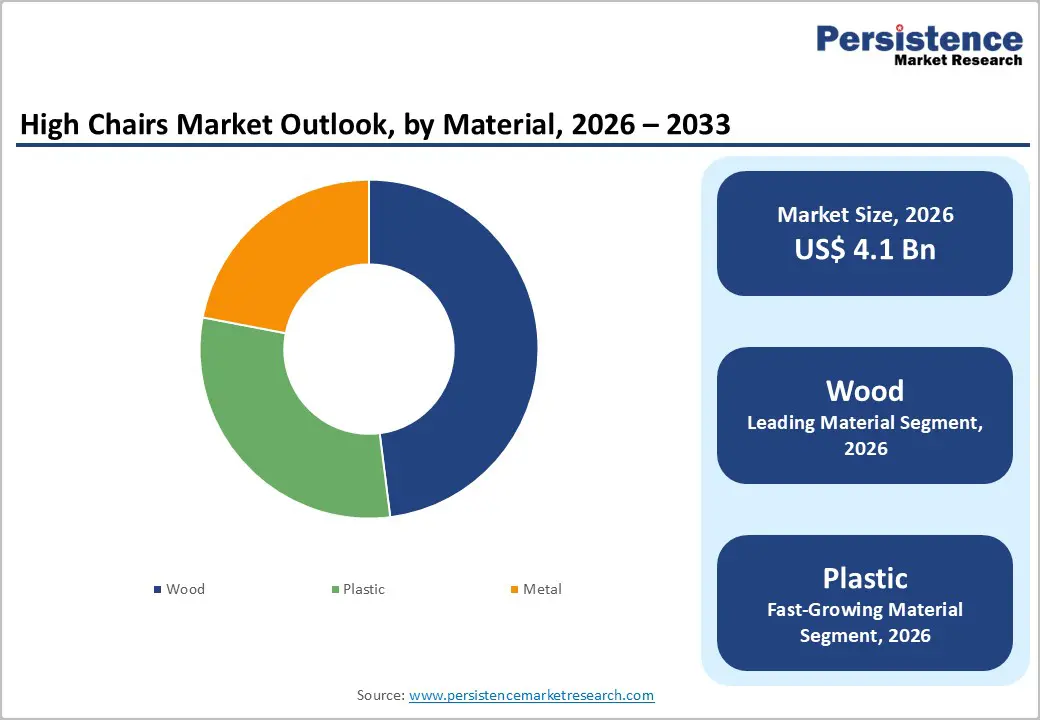
- Dominant Material: Wood is set to capture roughly 48% market revenue share in 2026 due to its inherent aesthetic appeal and structural durability.
- Fastest-growing Material: Plastic is slated to be the fastest-growing segment over the 2026-2033 forecast period, owing to its lightweight portability, ease of cleaning, and suitability for outdoor environments.
- Market Driver: The primary growth factor for the high chairs market is the increasing emphasis on child safety and comfort.
- Market Opportunity: Environmental consciousness among parents is reshaping product expectations, as many caregivers now prioritize high chairs that align with broader sustainability values and household health goals.
| Key Insights | Details |
|---|---|
| High Chairs Market Size (2026E) | US$ 4.1 Bn |
| Market Value Forecast (2033F) | US$ 6.0 Bn |
| Projected Growth (CAGR 2026 to 2033) | 5% |
| Historical Market Growth (CAGR 2020 to 2025) | 16.2% |
Market Factors - Growth, Barriers, and Opportunity Analysis
Increasing Emphasis on Child Safety and Comfort
Parents today have access to far more information about child safety than previous generations, and this awareness directly influences how they evaluate high chair purchases. They increasingly research product specifications, safety certifications, and customer reviews before making a decision, which raises expectations for both design and performance. High chairs that incorporate visible and well-documented safety features tend to stand out on retail shelves and online platforms. Products that offer secure multi-point harness systems, sturdy frame construction, stable bases, and non-toxic, food-safe materials are seeing stronger uptake, as parents look for solutions that minimize everyday risk during feeding and playtime.
Manufacturers are enhancing ergonomics by designing seats, footrests, and support structures that promote proper posture and comfort over longer periods, which is increasingly viewed as part of overall child wellbeing. These ergonomic improvements not only help children sit more comfortably but also make it easier for caregivers to manage feeding, cleaning, and adjustments, thereby improving day-to-day usability. Collectively, this combination of robust safety engineering and thoughtful ergonomic design is becoming a key differentiator, strengthening brand credibility, improving customer satisfaction, and supporting sustained growth in the high chairs market.
Product Lifecycle Limitations and Competition from Multi-functional Furniture
High chairs support children for only a relatively brief stage of development, as most parents use them from early infancy through toddlerhood before transitioning their children to standard seating. This limited period of use prompts households to reconsider how much budget and floor space they allocate to single-purpose furniture, particularly when they face tight financial constraints or live in smaller homes. In this context, many caregivers now assess purchases based on lifecycle value, long-term usability, and alignment with evolving family needs rather than focusing solely on immediate functionality. This shift reduces the appeal of traditional designs that only serve the feeding phase and then require resale, storage, or disposal.
Manufacturers increasingly respond by prioritizing convertible designs that adapt as children grow, such as solutions that transition into toddler chairs, booster seats, or even fully usable adult furniture. These products improve space utilization in compact urban apartments and help parents rationalize higher initial costs by extending the item's useful life. High chairs are facing major competition from booster seats because they offer babies and toddlers key advantages by safely elevating them to dining table height for better interaction, promoting independence at meals with features like trays and straps, and providing portability for on-the-go use, bridging the gap between high chairs and regular seating for comfort and confidence.
Sustainability and Eco-conscious Product Development
Environmental consciousness among parents is reshaping product expectations, as many caregivers now prioritize high chairs that align with broader sustainability values and household health goals. Families increasingly seek sustainably produced designs that use certified renewable materials, non-toxic finishes, and recyclable components, and they expect brands to communicate these attributes transparently and credibly. Certifications such as Forest Stewardship Council (FSC) for wood, Global Organic Textile Standard (GOTS) for fabrics, and Cradle to Cradle for holistic environmental performance help parents distinguish genuine responsible products from mere marketing claims and strengthen trust in both product safety and brand integrity.
This shift creates a strategic opportunity to position high chairs as long-term, values-aligned investments rather than purely functional feeding products. Companies that develop portfolios centered on eco-certified designs can support higher price points by presenting clear value propositions around material safety, reduced environmental impact, and longer useful life through repairable or upgradable components. European markets, in particular, serve as a testing ground for circular-economy models such as refurbishment programs, buyback schemes, and modular replacement parts, which help extend product lifecycles, reduce waste, and strengthen brand differentiation.
Category-wise Analysis
Material Insights
Wood is poised to dominate, capturing approximately 48% of the high chairs market revenue share in 2026. This segment leadership stems from the inherent aesthetic appeal and structural durability of wood, as well as its fit with contemporary home décor trends that favor natural materials. Premium hardwood varieties such as beech, oak, and maple are especially common in European and North American markets, where consumers associate wooden construction with quality, longevity, and environmental responsibility. Manufacturers increasingly highlight FSC-certified wood and non-toxic finishes to comply with stringent safety regulations and to attract environmentally conscious parents.
Plastic high chairs are likely to be the fastest-growing segment over the 2026-2033 forecast period. This accelerated growth reflects several advantages, including lightweight portability, ease of cleaning, suitability for outdoor environments, and lower manufacturing costs that support more competitive pricing. Parents value high chairs that they can move easily between rooms, transport in vehicles, and store in compact spaces, which makes plastic-based designs particularly attractive in smaller urban homes. Smooth, non-porous surfaces allow caregivers to wipe down trays and seating areas quickly, reducing hygiene concerns and maintenance effort after frequent feeding sessions.
Installation Insights
Non-folding chairs are expected to hold the highest revenue share at an estimated 55% in 2026. This segment leadership stems from several factors, including strong structural stability, higher perceived safety among parents, and the ability to integrate a wide range of features. Non-folding designs often support advanced features such as multi-position height adjustment, reclining seats, removable trays with dishwasher-safe inserts, and robust five-point harness systems, enhancing usability and comfort for both children and caregivers. Premium manufacturers particularly favor non-folding construction as it enables solid wood craftsmanship, reinforced frame architecture, and aesthetic designs that complement home décor as permanent furniture pieces.
Folding high chairs are anticipated to register the highest CAGR during 2026-2033. Folding mechanisms allow high chairs to collapse into a compact form for storage when they are not in use, which makes these products well-suited to small apartments, multi-generational households that only need a high chair occasionally, and families that prioritize portability for travel or movement between homes. This flexibility helps caregivers manage limited space more effectively while still retaining access to a full-featured seating solution when required.
Sales Channel Insights
Supermarkets are set to lead with approximately 58% of the high chairs market share in 2026, aided by institutionalized consumer preference for physical product examination, particularly regarding safety features, material quality, and ergonomic comfort. Specialty baby retailers provide expert consultation, in-store product demonstrations, and comprehensive after-sales support, which helps parents feel more confident when making higher-value purchasing decisions. These stores often employ trained staff who can explain safety features, compare models, and recommend options that match specific household needs, such as space constraints or lifestyle preferences.
Online stores are expected to be the fastest-growing segment during the 2026-2033 forecast period, driven by superior product variety, transparent pricing, detailed customer reviews, and convenient home delivery services. Major platforms, including Amazon, specialized baby product retailers, and direct-to-consumer brand websites, have invested heavily in enhanced product visualization technologies, virtual consultation services, and liberal return policies addressing traditional online purchase hesitations. The channel particularly appeals to younger, digitally native parents who conduct extensive online research, value peer recommendations, and prioritize convenience when shopping.
Regional Insights
Asia Pacific High Chairs Market Trends
Asia Pacific is likely to be both the leading and fastest-growing regional market for high chairs in 2026, accounting for an approximate share of 38%, underpinned by strong demographic momentum, urbanization, and rising disposable incomes among young families. This shift is particularly evident in China and increasingly in India and major ASEAN markets, where aspirational consumption patterns and global lifestyle influences encourage parents to choose branded nursery products that meet international safety and design standards.
As awareness of the developmental benefits of proper seating grows, demand is gradually shifting away from purely functional, low-cost options toward solutions that balance safety, aesthetics, and durability, expanding the opportunity for both international players and domestic brands upgrading their product portfolios.
Competitive intensity in the region remains high, as local manufacturers, regional champions, and global brands all use major digital commerce platforms such as Alibaba and JD.com to reach consumers directly, test new commercial models, and roll out omnichannel strategies that link online discovery with in-store experience and after-sales support. These players increasingly view digital channels not only as sales outlets but also as critical sources of insight on consumer behaviour, product performance, and emerging preferences, which they feed back into product development and marketing.
Europe High Chairs Market Trends
Europe functions as a mature yet steadily expanding market for high chairs, characterized by strong design traditions, elevated safety expectations, and a clear preference for premium and sustainable products. Consumers in Germany, the United Kingdom, France, Spain, and the Nordic countries place particular emphasis on durability, visual coherence with home interiors, and documented compliance with strict child safety standards. Many European parents treat high chairs as long-term household investments rather than short-lived baby accessories, which reinforces demand for robust wooden constructions, high-quality finishes, and designs that can support multiple life stages or be shared across siblings.
The regulatory framework in Europe reinforces these dynamics by setting clear, harmonized benchmarks for safety and environmental performance under European Union (EU) directives such as EN 14988, which covers requirements for stability, structural integrity, and material safety. Manufacturers that operate across multiple European markets benefit from working with a single core standard, but they must also commit to rigorous testing, detailed documentation, and ongoing compliance processes, which tends to favor organized, well-capitalized companies with pan-European growth ambitions.
Growth opportunities increasingly focus on capturing additional demand in Eastern and Southern Europe, scaling circular economy initiatives such as take-back and refurbishment programs, and balancing the expansion of e-commerce with the continued importance of specialty retailers that provide expert advice and hands-on product evaluation for parents.
North America High Chairs Market Trends
North America functions as a large, high-value market for high chairs, shaped by strong purchasing power, high safety expectations, and a clear preference for premium, feature-rich products. The United States accounts for most regional demand, as parents often prioritize safety certifications, durable construction, and advanced functionality when selecting seating solutions for infants and toddlers. Consumers in this region generally accept higher price points in exchange for products that deliver multiple benefits, such as ergonomic design, long usable life, and alignment with broader lifestyle and interior design preferences.
The regulatory and competitive landscape in North America reinforces these dynamics by requiring manufacturers to meet stringent safety standards while continuing to innovate their product lines. Requirements set by authorities such as the Consumer Product Safety Commission (CPSC) raise expectations for product safety and create natural barriers to entry, generally favoring established companies with strong engineering, testing, and quality management capabilities.
For companies aiming to grow in North America, success increasingly depends on combining rigorous compliance practices with distinctive product design, credible sustainability features, and a sophisticated omnichannel strategy that integrates mass retailers, specialty baby stores, and direct online sales channels.
Competitive Landscape
The global high chairs market structure is remaining moderately fragmented, with leading companies such as Dorel Industries, Artsana Group, Mattel, Newell Brands, and Goodbaby International collectively accounting for an estimated 55-60% of the total market revenue. Leadership in this market is founded on established brand equity, broad distribution networks, and diversified product portfolios that address multiple price and functionality tiers. Competitive positioning is increasingly depending on consistent product quality, compliance with evolving safety standards, and the ability to balance premium features with accessible pricing across global markets.
Competition remains dynamic as both established and emerging brands are actively refining their value propositions. Companies with long operating histories are continuing to benefit from strong consumer trust and repeat purchasing behavior, which is supporting share stability in a crowded category. At the same time, newer entrants are introducing differentiated designs, modular features, and enhanced portability to appeal to modern households with space and lifestyle constraints. Manufacturers that are combining design innovation with transparent safety certification, digital marketing strength, and responsive product refresh cycles are positioning themselves to defend and expand share as parental expectations continue rising.
Key Industry Developments
- In November 2025, over 4,000 5-in-1 Convertible High Chairs sold online on Walmart.com by Rotinyard were recalled due to lacking required restraint systems, posing deadly fall and head entrapment hazards between seat and tray. While no incidents have been reported, the products violate federal high chair safety standard, necessitating the recall.
- In January 2025, Cybex launched the “Click & Fold” high chair - a sustainable, space-saving seating solution crafted from European beech wood. Designed to grow with the user from infancy to adulthood, it features adjustable height and depth settings and can be folded flat with a single click for easy storage. Combining functionality, ergonomics, and contemporary design, the chair reflects Cybex’s focus on adaptable and stylish family furniture for modern homes.
Companies Covered in High Chairs Market
- Dorel Industries Inc.
- Artsana Group
- Mattel, Inc.
- Newell Brands
- Goodbaby International Holdings Limited
- Stokke AS
- Peg Pérego S.p.A.
- Summer Infant, Inc.
- 4moms
- BabyBjörn AB
- Joie International Co., Ltd.
- Hauck GmbH & Co. KG
- Inglesina Baby S.p.A.
- Cosatto Ltd.
- Evenflo Company, Inc.
Frequently Asked Questions
The global high chairs market is projected to reach US$ 4.1 billion in 2026.
Deepening parental focus on child safety and ergonomics, growing disposable incomes, and increasing adoption of premium, multifunctional baby products are driving the market.
The market is poised to witness a CAGR of 5% from 2026 to 2033.
Sustainable and eco-certified designs, convertible and space-saving configurations, and expansion into fast-growing emerging markets in Asia Pacific are creating new opportunities.
Dorel Industries Inc., Artsana Group, Mattel, Inc., Newell Brands, and Goodbaby International Holdings Limited are some of the key players in the market.


