




- Baby Care & Accessories
- Baby Detergent & Laundry Product Market
Baby Detergent & Laundry Product Market Size, Share, and Growth Forecast 2026 - 2033
Baby Detergent & Laundry Product Market by Application (Laundry, Home cleaning), by Fragrance/Scent (Regular, Lavender, Citrus, Flower), by Packaging (Plastic Bottles, Spray Bottles, Cans, Pouches/Sachets), by Sales Channel (Hypermarkets/Supermarkets, Groceries, Convenience stores, Online retails, Company Website, 3rd Party Online sales), and Regional Analysis, 2026 - 2033

Baby Detergent & Laundry Product Market Size and Trend Analysis
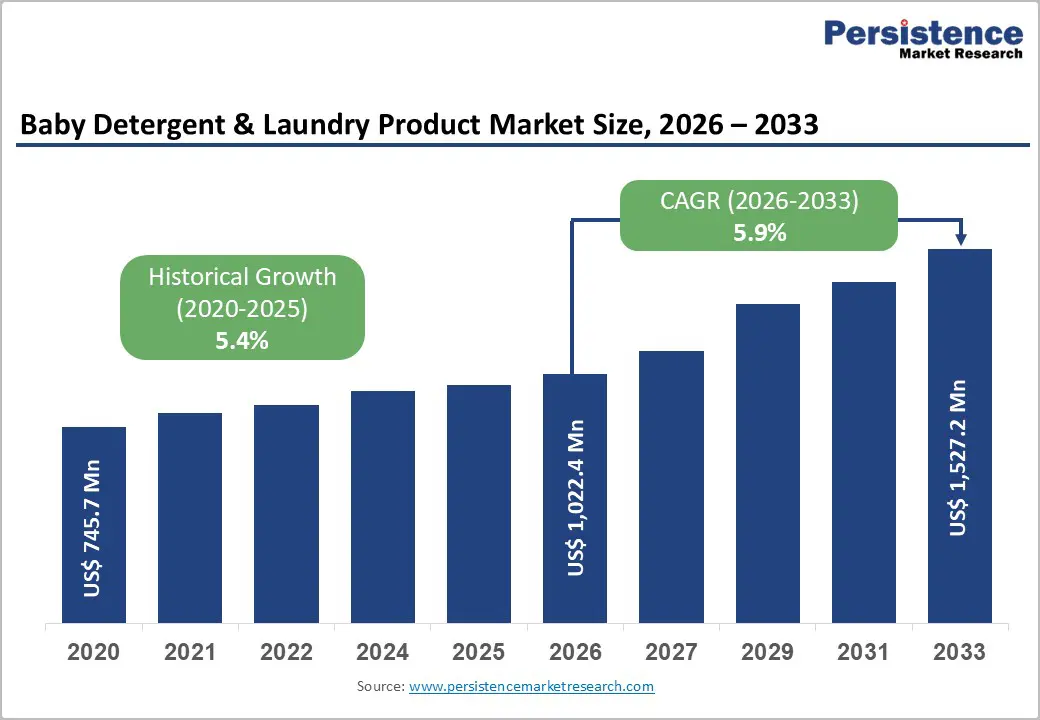
The global Baby Detergent & Laundry Product market size is expected to be valued at US$ 1,022.4 million in 2026 and projected to reach US$ 1,527.2 million by 2033, growing at a CAGR of 5.9% between 2026 and 2033.
Rising parental awareness of infant skin sensitivity is a key driver of growth, as parents increasingly prefer hypoallergenic and chemical-free formulations. The World Health Organization reports that nearly 20% of infants experience skin irritation from standard detergents, thereby increasing demand for specialized products. Additionally, increasing urbanization and the prevalence of dual-income households, with 56% of the global population living in urban areas, further support market expansion.
Key Highlights:
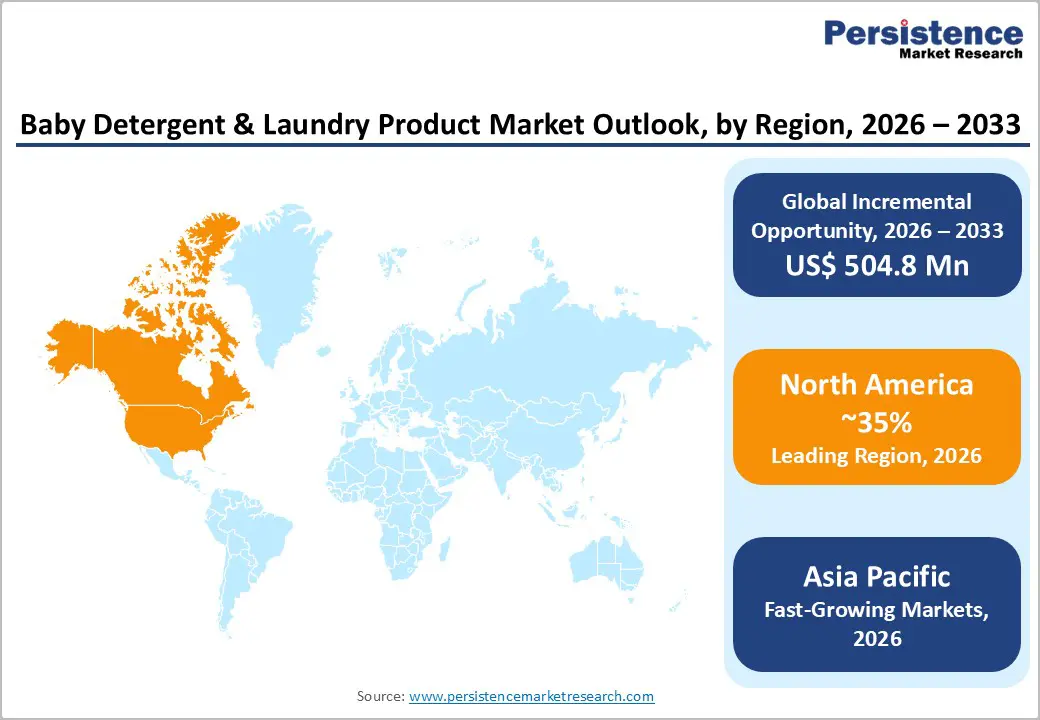
- Leading Region: North America leads the Baby Detergent & Laundry Product market with a 35% share in 2025, supported by strong regulatory standards and high parental awareness.
- Fastest Growing Region: Asia Pacific accounts for 30% share in 2025 and is emerging as the fastest-growing region, driven by rapid urbanization and expanding organized retail.
- Leading Packaging Category: Plastic bottles account for 55% of the market in 2025, driven by durability, safety, and dosing convenience.
- Leading Sales Channel: Hypermarkets and supermarkets lead with a 45% share in 2025, benefiting from strong in-store visibility and consumer trust.
- Key Market Opportunity: Eco-friendly and refill packaging variants present significant growth opportunities amid rising demand for sustainability and bio-based products.
| Key Insights | Details |
|---|---|
|
Baby Detergent & Laundry Product Size (2026E) |
US$ 1,022.4 Million |
|
Market Value Forecast (2033F) |
US$ 1,527.2 Million |
|
Projected Growth CAGR (2026-2033) |
5.9% |
|
Historical Market Growth (2020-2025) |
5.4% |
Market Dynamics
Drivers - Growing Preference for Hypoallergenic and Dermatologist-Tested Baby Laundry Formulations
Parents are increasingly prioritizing hypoallergenic baby detergents formulated without dyes, fragrances, or harsh enzymes to reduce risks of rashes and allergies. The American Academy of Dermatology notes that nearly 60% of infants under one year experience eczema, often aggravated by conventional laundry chemicals, encouraging a shift toward plant-based, pH-neutral alternatives.
Manufacturers are responding by enhancing R&D, conducting clinical trials, and securing pediatrician-backed certifications to strengthen consumer trust. Innovations such as pH-balanced and enzyme-free formulas have improved product safety perception, while regulatory approvals and pharmacy distribution channels further reinforce credibility, expanding adoption across both premium and mass-market segments.
Rapid Urbanization and Time-Constrained Lifestyles Boost Demand for Convenient Baby-Safe Solutions
Accelerating urbanization and rising dual-income households are increasing reliance on efficient and safe baby laundry products. With the United Nations projecting significant urban population growth in developing regions, disposable incomes are rising, enabling families to choose premium, baby-specific detergents for delicate skin protection.
Busy lifestyles also drive demand for concentrated, cold-wash, and low-water formulations that offer time and energy efficiency. Energy-saving detergents align with sustainability trends, while convenient formats such as pods and liquid concentrates gain traction in urban retail channels, supporting sustained market growth.
Restraints - Stringent Chemical Regulations Increasing Compliance Burden for Manufacturers
Tightening global regulations on detergent ingredients significantly restricts formulation flexibility and increases compliance costs. Authorities such as the European Chemicals Agency have limited the use of numerous chemical substances in cleaning products, compelling manufacturers to reformulate existing offerings and delaying new product launches across regulated markets.
Similarly, environmental standards mandating biodegradability and safety testing raise production expenses, particularly for smaller players with limited R&D budgets. Compliance-driven reformulations often elevate final product prices, reducing competitive margins and slowing innovation cycles, thereby restraining overall market expansion.
High Price Sensitivity and Counterfeit Competition in Emerging Economies
Premium pricing of specialized baby detergents limits adoption in cost-sensitive markets where households prioritize essential spending. A significant proportion of global families allocate a large share of their income to necessities, making baby-specific laundry products appear discretionary rather than essential.
Additionally, the presence of low-cost counterfeit and generic alternatives intensifies competition, particularly across parts of Asia and developing regions. These products, often priced substantially lower, capture notable market share, pressuring branded manufacturers and restricting growth opportunities in emerging economies.
Opportunity - Rising Adoption of Eco-Friendly and Certified Organic Baby Laundry Solutions
Growing environmental awareness among millennials and Gen Z parents is accelerating demand for eco-friendly and organic baby detergents. Certifications for organic and bio-based products have increased significantly, reflecting consumer preference for plant-derived, non-toxic, and sustainably packaged alternatives that ensure infant safety while reducing environmental impact.
Natural fragrances such as lavender and chamomile are gaining traction due to perceived calming benefits and dermatological compatibility. Regulatory initiatives promoting bio-based ingredients further encourage innovation, enabling manufacturers to develop green formulations aligned with sustainability targets and strengthen their premium positioning in developed markets.
Rapid Growth of E-Commerce and Subscription-Based Sales Channels
The expansion of online retail platforms presents substantial opportunities for baby detergent brands to enhance market reach. Rising e-commerce penetration, driven by subscription-based purchasing models, provides convenience for busy parents seeking regular, hassle-free deliveries of baby-safe laundry products.
Digital channels also facilitate bundled promotions, product comparisons, and access to reviews, strengthening consumer confidence. Moreover, online distribution enables brands to penetrate underserved semi-urban and rural regions, broadening customer bases and accelerating revenue growth beyond traditional brick-and-mortar retail networks.
Category-wise Analysis
Application Insights
Laundry applications dominate the Baby Detergent & Laundry Product market, accounting for 65% share in 2025 due to their essential role in daily infant hygiene. Parents rely heavily on baby-specific laundry detergents to remove milk stains, food spills, and spit-up while minimizing residue and irritation. Safety-focused purchasing behavior and preference for dedicated formulations over multi-purpose cleaners continue to strengthen this segment’s leadership.
Stain removers and specialized laundry additives are emerging as the fastest-growing category, supported by rising concerns about stubborn organic stains and fabric hygiene. Increasing innovation in enzyme-free stain solutions and fabric-safe boosters is attracting
Fragrance/Scent Insights
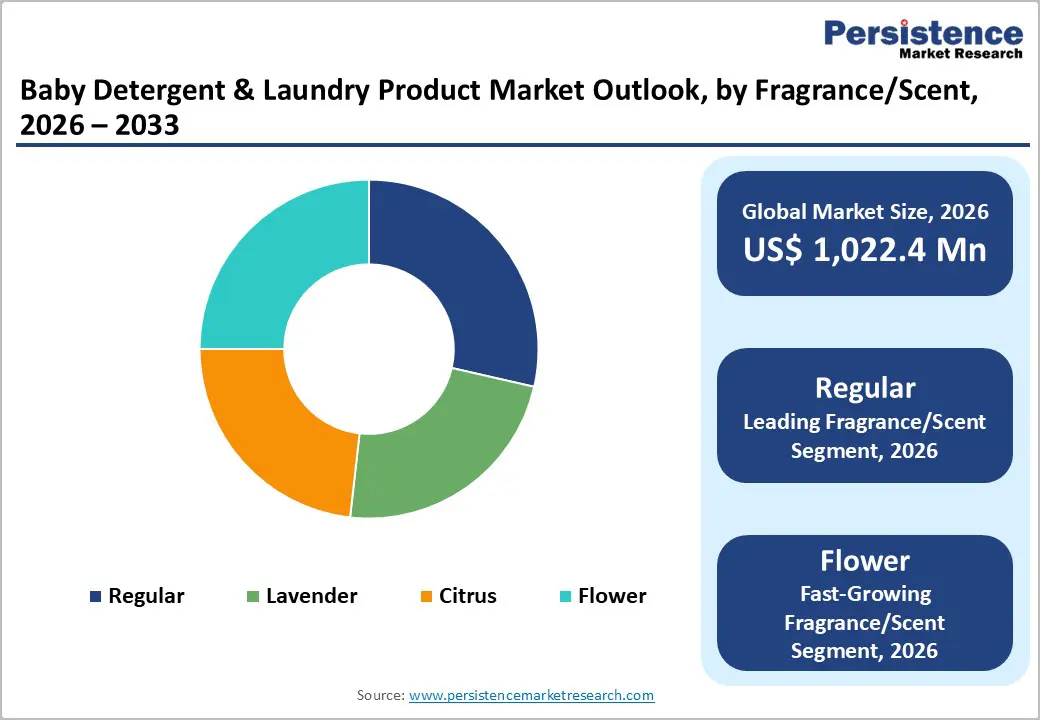
Regular and fragrance-free variants hold 40% share in 2025, leading the segment due to their hypoallergenic positioning and reduced risk of triggering skin flare-ups. Parents increasingly prefer neutral or unscented formulations to ensure compatibility with sensitive infant skin, reinforcing demand for dermatologically tested and clinically validated options.
Natural and mild botanical scents are the fastest-growing category, driven by demand for subtle, plant-based aromas perceived as calming and safe. Manufacturers are introducing lavender, chamomile, and aloe-infused variants to combine sensory appeal with gentle care, aligning with growing interest in wellness-oriented baby products.
Packaging Insights
Plastic bottles lead the market with 55% share in 2025, primarily due to their durability, spill resistance, and precise dosing convenience. Resealable caps and ergonomic designs enhance safety and storage ease, making them a preferred choice among households with infants requiring frequent laundry cycles.
Eco-friendly and refill packaging formats are the fastest-growing segment as sustainability awareness rises. Refill pouches, concentrated packs, and recyclable materials are gaining traction among environmentally conscious parents seeking to reduce plastic waste while maintaining product safety and functionality.
Sales Channel Insights
Hypermarkets and supermarkets command 45% share in 2025, benefiting from strong in-store visibility, bundled promotions, and consumer trust in established retail chains. The convenience of one-stop shopping and frequent discount campaigns significantly influences purchase decisions for baby care essentials.
E-commerce platforms represent the fastest-growing channel, supported by subscription services, doorstep delivery, and wider product comparisons. Digital retail enhances accessibility, particularly in semi-urban areas, while offering personalized recommendations and bundled deals that attract modern, time-constrained parents.
Regional Insights
North America Baby Detergent & Laundry Product Market Trends
North America holds a leading 35% share of the global Baby Detergent & Laundry Product market in 2025, driven primarily by the United States. Strong regulatory oversight from agencies such as the FDA and EPA enforces strict hypoallergenic labeling and biodegradability standards, encouraging innovation in safe and eco-friendly formulations. Consumer testing organizations continue to highlight the effectiveness of pH-balanced and fragrance-free variants.
The region is witnessing rising demand for plant-based and dermatologist-tested products as sustainability awareness strengthens. Manufacturers increasingly introduce bio-derived ingredients and recyclable packaging formats, while pharmacy and supermarket channels remain dominant in reinforcing brand trust and premium product adoption
Europe Baby Detergent & Laundry Product Market Trends
Europe demonstrates steady expansion, supported by stringent chemical safety regulations under REACH and the EU Detergent Regulation framework. Countries such as Germany lead in quality-focused manufacturing, while the U.K. and France emphasize harmonized compliance standards that enhance intra-regional trade and product credibility. The regional market is projected to grow at a CAGR of 5.2% during the forecast period.
Sustainability remains a core growth pillar, with brands accelerating the launch of environmentally responsible and bio-based detergent lines. Increasing consumer preference for certified organic and eco-labeled baby products further strengthens innovation, positioning Europe as a hub for green formulation advancements.
Asia Pacific Baby Detergent & Laundry Product Market Trends
Asia Pacific accounts for 30% share of the global market in 2025, supported by large infant populations and rising disposable incomes across China, India, and Southeast Asia. China plays a major role in manufacturing, scaling production while tightening safety standards to address growing consumer awareness of infant skin health and product transparency.
Rapid urbanization and expansion of organized retail channels are accelerating market penetration in India and ASEAN economies. Increasing middle-class spending and stronger e-commerce adoption are driving demand for branded, baby-specific detergents, positioning the region as one of the most dynamic growth markets globally.
Competitive Landscape
The baby detergent & laundry product market is moderately consolidated, characterized by the strong presence of established multinational consumer goods manufacturers with extensive distribution networks and advanced research capabilities. Leading players maintain competitive advantage through continuous product innovation, dermatological testing, and the development of hypoallergenic and eco-friendly formulations. Strong brand loyalty, wide retail penetration, and strategic partnerships with pharmacies and supermarkets further reinforce their market positioning.
Competition is increasingly shaped by sustainability initiatives, premium product differentiation, and digital expansion. Companies are investing in recyclable packaging and plant-based ingredients to align with environmental standards. At the same time, direct-to-consumer and e-commerce channels are enabling emerging niche brands to gain visibility in the organic and specialty segments.
Key Developments:
- In March 2025, Henkel launched enzyme-free baby detergent pods fully compliant with updated EU chemical safety norms, strengthening its hypoallergenic portfolio and reinforcing its sustainability strategy across regulated European markets.
- In July 2024, Reckitt Benckiser expanded its Dettol baby care line across key Asian markets, enhancing regional distribution and introducing skin-sensitive formulations tailored to growing urban demand.
- In November 2024, Kimberly-Clark introduced recyclable detergent pouches designed to reduce plastic usage by 40%, supporting circular packaging goals and improving environmental footprint across its baby laundry product range.
Companies Covered in Baby Detergent & Laundry Product Market
- Procter & Gamble
- Unilever
- Henkel AG & Co. KGaA
- Church & Dwight Co., Inc.
- The Honest Company Inc.
- Seventh Generation
- Babyganics
- The Clorox Company
- S. C. Johnson & Son Inc.
- Artsana S.p.A. (Chicco)
- Attitude Living Inc.
- Tru Earth Environmental Products Inc.
- Venus Laboratories Inc.
- Cotton Babies Inc.
- Puracy LLC
Frequently Asked Questions
The Baby Detergent & Laundry Product market is projected to reach US$ 1,022.4 million in 2026, supported by strong demand across laundry applications holding.
Rising awareness of infant skin sensitivity is driving demand for hypoallergenic and fragrance-free variants.
North America leads the market with a 35% share in 2025, while Asia Pacific holds 30% share and represents a high-growth region.
Expansion into eco-friendly formulations and sustainable packaging presents key growth opportunities, particularly beyond plastic bottles.
Leading companies include Procter & Gamble, Unilever, and Johnson & Johnson.


