




- Baby Care & Accessories
- Baby Stroller Market
Baby Stroller Market Size, Share, and Growth Forecast 2026 - 2033
Baby Stroller Market by Product Type (Full-Size Strollers, Umbrella / Lightweight Strollers, Travel System Strollers, Jogging / All-Terrain Strollers, Double / Multi-Child Strollers, Specialty Strollers), Age Group (Newborn, Infants, Toddlers, Older Toddlers), Distribution Channel (Online, Offline), and Regional Analysis, 2026 - 2033

Baby Stroller Market Size and Trend Analysis
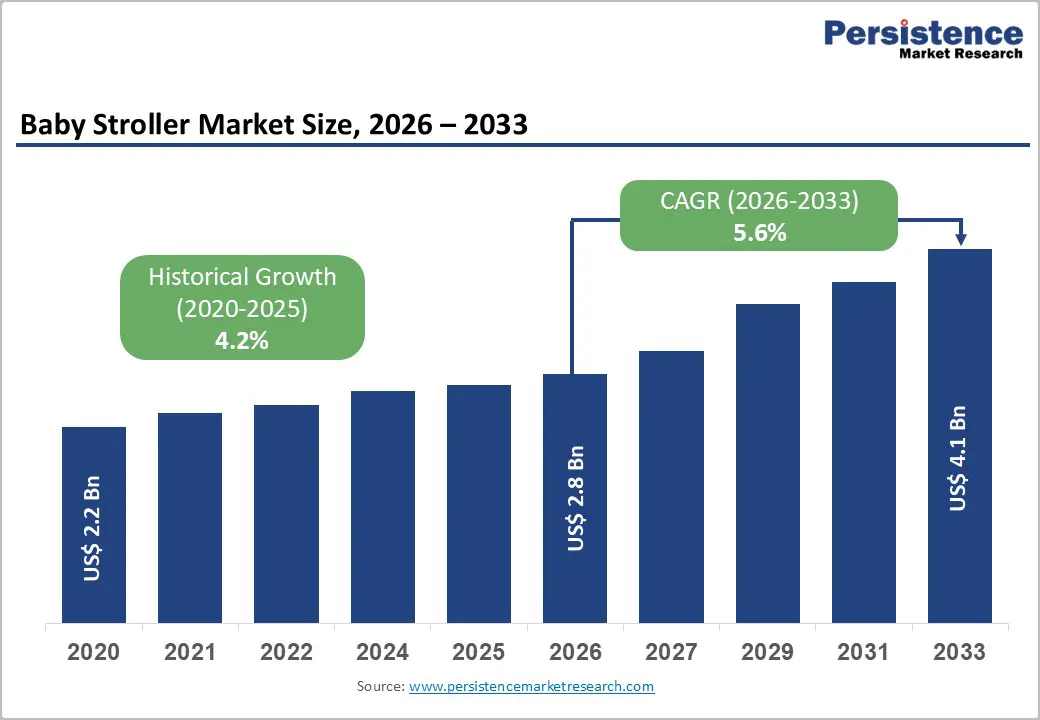
The global baby stroller market size is expected to be valued at US$ 2.8 billion in 2026 and projected to reach US$ 4.1 billion by 2033, growing at a CAGR of 5.6% between 2026 and 2033. Market growth is driven by rising parental awareness regarding infant mobility, comfort, and safety.
Increasing urbanization, with the United Nations reporting that 56% of the global population lived in urban areas in 2023, is accelerating demand for compact and travel-friendly strollers. Higher disposable incomes and evolving lifestyles further support the adoption of premium products. Technological innovations, lightweight designs, and stricter child-safety standards continue to drive global market expansion.
Key Industry Highlights:
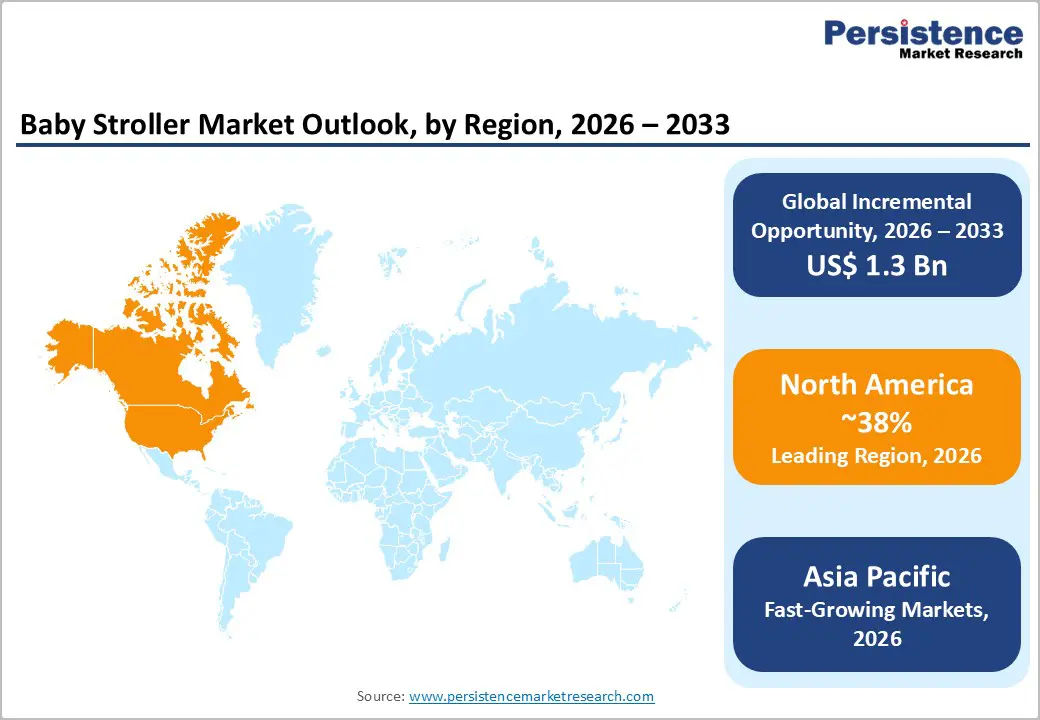
- Leading Region: North America leads the baby stroller market with a 38% share in 2025, supported by strong purchasing power, 65% dual-income households in the U.S., and strict safety regulations.
- Fastest Growing Region: Asia Pacific captures 29% share in 2025, supported by 9.5 million births in China and India’s 35% urbanization rate, accelerating compact stroller demand.
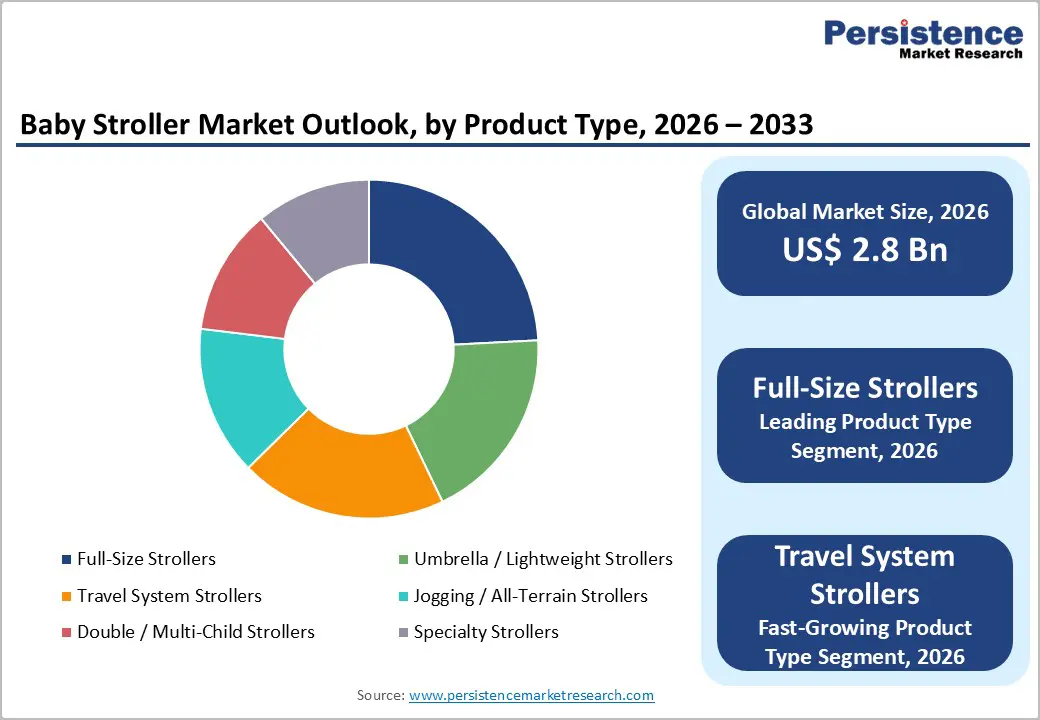
- Leading Product: Full-size strollers dominate with a 35% share in 2025, favored for durability, multifunctionality, and ergonomic comfort for infants transitioning into toddler stages.
- Leading Demographics: The infant segment holds a 42% share in 2025, supported by rising emphasis on bassinet and flat-lying safety features during early-stage development.
- Key Opportunity: Eco-friendly and smart stroller innovations present significant growth potential, aligned with rising parental preference for sustainable materials and technology-integrated designs.
| Key Insights | Details |
|---|---|
| Baby Stroller Size (2026E) | US$ 2.8 billion |
| Market Value Forecast (2033F) | US$ 4.1 billion |
| Projected Growth CAGR (2026 - 2033) | 5.6% |
| Historical Market Growth (2020 - 2025) | 4.2% |
Market Dynamics
Drivers - Rapid Urbanization and Increasing Dual-Income Households Driving Demand for Compact and Versatile Strollers
Urbanization worldwide is significantly increasing demand for compact and maneuverable baby strollers as families adjust to space-constrained city living. The World Bank reports that over 50% of the global population was living in urban areas by 2020, with the share continuing to rise across developing economies. This demographic shift supports higher adoption of lightweight, foldable, and travel-friendly stroller models.
Additionally, the rise in dual-income households strengthens purchasing power and prioritizes convenience-oriented products. According to the U.S. Bureau of Labor Statistics, more than 60% of U.S. households were dual-income in 2023. Working parents increasingly prefer multifunctional travel systems that integrate seamlessly with commuting and public transport.
Technological Advancements in Safety Standards and Sustainable Materials Enhancing Consumer Confidence
Continuous innovation in safety mechanisms and material technology is playing a vital role in boosting consumer trust and product adoption. Certifications from the Juvenile Products Manufacturers Association (JPMA) ensure advanced safety features such as five-point harness systems and reliable braking mechanisms. The Consumer Product Safety Commission reported a 25% decline in stroller-related injuries between 2018 and 2022, reflecting improved compliance with safety standards.
Manufacturers are also adopting eco-friendly and recyclable materials to align with growing sustainability awareness. Compliance with ASTM International standards ensures durability and non-toxic construction. These improvements not only reduce safety concerns but also attract premium buyers seeking long-lasting, environmentally responsible products.
Restraints - High Product Costs and Macroeconomic Pressures Limiting Affordability and Volume Growth
Premium pricing of technologically advanced strollers restricts accessibility, particularly among price-sensitive consumers in emerging markets. Mid-range stroller models typically range between USD 200 and USD 500, as indicated by 2024 product testing benchmarks from BabyGearLab. Such price points discourage low-income households and reduce penetration in cost-conscious regions.
Macroeconomic pressures further intensify this restraint. According to the International Monetary Fund, global consumer spending on non-essential goods declined by approximately 3-5% in 2023 amid inflationary pressures. Economic slowdowns push consumers toward refurbished or second-hand strollers, thereby limiting new product sales and moderating overall market volume growth.
Stringent Safety Regulations and Rising Compliance Costs Creating Entry Barriers
Strict international safety regulations significantly increase manufacturing and compliance expenses, particularly for small and mid-sized players. Standards such as EN 1888 in Europe and guidelines enforced by the Consumer Product Safety Commission in the United States mandate extensive durability and safety testing. Discussions within ASTM International committees highlight that compliance can raise production costs by 15-20%.
Failure to meet regulatory standards can result in product recalls and reputational damage. In 2023, over 100,000 stroller units were flagged by the Consumer Product Safety Commission due to compliance concerns. Such regulatory pressures increase operational complexity and create substantial entry barriers in highly regulated markets, including North America and Europe.
Opportunity - Rapid Urbanization and Rising Middle-Class Incomes in Emerging Economies Creating Strong Expansion Potential
Asia Pacific presents significant growth opportunities driven by accelerating urbanization and stable birth rates in countries such as India and China. The United Nations Population Division projects that Asia’s urban population will reach 2.5 billion by 2030, strengthening demand for compact, affordable, and durable strollers suited to dense urban environments.
Expanding local manufacturing capabilities and favorable trade agreements across ASEAN countries help reduce production costs and improve export competitiveness. Free trade policies within the region enable manufacturers to offer competitively priced, lightweight models tailored to middle-income families, supporting strong growth in infant and toddler-focused stroller categories.
Rising Preference for Eco-Friendly Materials and Smart Technology Integration
Growing environmental awareness among parents is accelerating demand for eco-friendly stroller designs. A 2024 survey by Nielsen indicates that nearly 70% of parents prefer products made from sustainable or recyclable materials. This trend supports the development of biodegradable fabrics, non-toxic components, and responsibly sourced materials in premium stroller segments.
Technological integration further expands market potential, with features such as GPS tracking and app-based monitoring gaining traction among tech-savvy consumers. According to Statista, smart baby product adoption continues to rise steadily, encouraging manufacturers to introduce connected and innovation-driven stroller models targeting modern urban families.
Category-wise Analysis
Product Type Insights
Full-size strollers dominate the product landscape, accounting for 35% of the market share in 2025 due to their durability, comfort, and multifunctional design. These models are preferred for extended daily use, offering superior suspension systems and larger storage capacity suited for urban mobility. Retail audit insights from the Juvenile Products Manufacturers Association in 2024 indicate strong sales performance for full-size variants, supported by pediatric recommendations highlighting ergonomic support for infants transitioning into toddler stages.
Meanwhile, lightweight and travel system strollers are witnessing the fastest growth. Increasing preference for compact, foldable designs among urban working parents is accelerating adoption. Convenience-driven purchasing behavior, rising air travel, and demand for easy-to-carry models are encouraging manufacturers to expand innovative and modular stroller offerings.
Age Group Insights
The infant segment leads the market with a 42% share in 2025, primarily driven by the necessity of bassinet attachments and fully reclining seating options for newborns up to 12 months. Guidelines from the World Health Organization emphasize proper infant positioning, reinforcing demand for flat-lying stroller configurations. Sales data from the Juvenile Products Manufacturers Association in 2024 show infant-focused models accounting for a substantial portion of total stroller unit sales.
The toddler segment is emerging as the fastest-growing category, supported by increasing demand for lightweight, adjustable, and multi-position seating systems. As children transition to active mobility stages, parents prefer adaptable strollers that combine comfort with portability for extended outdoor activities.
Distribution Channel Insights
Offline retail channels hold a dominant 55% market share in 2025, supported by consumer preference for physical product inspection before purchase. Specialty baby stores and department outlets enable hands-on safety checks and product comparisons. According to the National Retail Federation, physical retail accounted for a majority of juvenile product purchases in 2024, reinforcing trust for high-value items like strollers.
Online channels represent the fastest-growing distribution segment, driven by expanding e-commerce penetration and convenience-based shopping behavior. Digital platforms offer wider product assortments, competitive pricing, customer reviews, and home delivery options, increasingly appealing to tech-savvy urban parents seeking flexible purchasing experiences.
Regional Insights
North America Baby Stroller Market Trends and Insights
North America leads the global baby stroller market with a 38% share in 2025, supported by strong purchasing power and a mature retail ecosystem. The United States remains the primary revenue contributor, where dual-income households account for nearly 65% according to the U.S. Bureau of Labor Statistics in 2024. High disposable incomes and brand awareness continue to drive premium and travel-system stroller adoption.
Strict regulatory oversight from the Consumer Product Safety Commission and certification frameworks from the Juvenile Products Manufacturers Association encourage continuous product innovation. Recent launches emphasize UV-protective canopies, all-terrain wheels, and enhanced suspension systems aligned with growing outdoor and active parenting trends across the region.
Europe Baby Stroller Market Trends and Insights
Europe represents a mature yet steadily expanding market and is projected to grow at a CAGR of 5.1% through the forecast period. Demand is primarily supported by stable birth rates and strong safety regulations. According to Eurostat, the region records approximately 1.8 million annual births, sustaining consistent product demand across Germany, the UK, and France.
Harmonized safety compliance under EN 1888 strengthens consumer confidence and standardization across member states. Additionally, sustainability initiatives under the European Commission Green Deal are influencing manufacturers to adopt recyclable fabrics and eco-friendly materials, particularly in compact and urban-focused stroller categories.
Asia Pacific Baby Stroller Market Trends and Insights
Asia Pacific holds a 29% share of the global baby stroller market in 2025, driven by high population density and expanding middle-class income levels. China and India remain key contributors, with the National Bureau of Statistics of China reporting 9.5 million births in 2024. Rising awareness of child safety and affordability is accelerating demand for lightweight and cost-effective stroller models.
The region benefits from strong manufacturing capabilities across Japan and ASEAN countries, enhancing export competitiveness. According to the World Bank, India’s urbanization rate reached approximately 35% in 2024, supporting growth in compact, travel-friendly stroller adoption across metropolitan areas.
Competitive Landscape
The baby stroller market is moderately consolidated, characterized by the presence of established global manufacturers with strong brand recognition and extensive distribution networks. Competition is largely driven by continuous product innovation, safety enhancements, and design differentiation. Companies focus on expanding geographic reach through strategic partnerships, product portfolio diversification, and investments in advanced manufacturing technologies to strengthen market positioning.
Innovation remains central to competitive strategy, particularly in premium and urban-focused segments. Manufacturers are prioritizing lightweight materials, modular designs, and eco-friendly components to attract sustainability-conscious consumers. Additionally, the rise of direct-to-consumer online sales channels and customization options is intensifying competition, encouraging faster product development cycles and enhanced customer engagement strategies.
Key Developments:
- In July 2025, Bugaboo introduced AI-assisted folding technology in its Fox 5 model, designed to improve one-hand operation and compact storage. The innovation enhances convenience for urban parents navigating public transport and tight city spaces.
- In March 2024, UPPAbaby launched the Vista V3 stroller featuring enhanced under-seat storage and eco-friendly fabric materials. The upgrade targets growing multi-child families seeking modular configurations, improved durability, and sustainability-focused design enhancements for everyday urban mobility.
- In November 2024, Britax expanded its all-terrain stroller line with upgraded safety features aligned with Consumer Product Safety Commission standards, strengthening compliance and consumer confidence following prior recall-related adjustments.
Companies Covered in Baby Stroller Market
- Goodbaby International Holdings Ltd.
- Artsana Group (Chicco)
- Newell Brands (Graco)
- Dorel Industries Inc. (Maxi-Cosi, Quinny, Safety 1st)
- Bugaboo International B.V.
- UPPAbaby
- Britax
- Peg Perego S.p.A.
- Stokke AS
- Inglesina
- Silver Cross
- Emmaljunga
- Baby Jogger LLC
- Combi Corporation
- Thule Group
Frequently Asked Questions
The global baby stroller market is expected to reach US$ 2.8 billion in 2026, growing to US$ 4.1 billion by 2033 at a 5.6% CAGR.
Urbanization, dual-income households, and safety innovations drive demand, with over 56% global urban population and advancements reducing injuries by 25%.
North America leads the market with a 38% share in 2025, supported by strong disposable incomes, mature retail networks, and strict safety standards regulated by the Consumer Product Safety Commission.
Eco-friendly and smart strollers tap into 70% parental preference for sustainability and IoT growth at 12% CAGR.
Leading companies include Goodbaby International Holdings Ltd., Artsana Group (Chicco), Newell Brands (Graco), Dorel Industries Inc. (Maxi-Cosi, Quinny, Safety 1st), and Bugaboo International B.V., which dominate through R&D and safety-focused innovations.


