




- Healthcare Services
- Per Diem Nurse Staffing Market
Per Diem Nurse Staffing Market Size, Share, and Growth Forecast, 2026-2033
Per Diem Nurse Staffing Market by Nurse Type (Registered Nurses (RN), Others), Department (Emergency Care, Intensive Care Units (ICU), Others), End-user (Hospitals, Ambulatory Surgical Centers, Others), and Regional Analysis for 2026 - 2033

Per Diem Nurse Staffing Market Size and Share Analysis
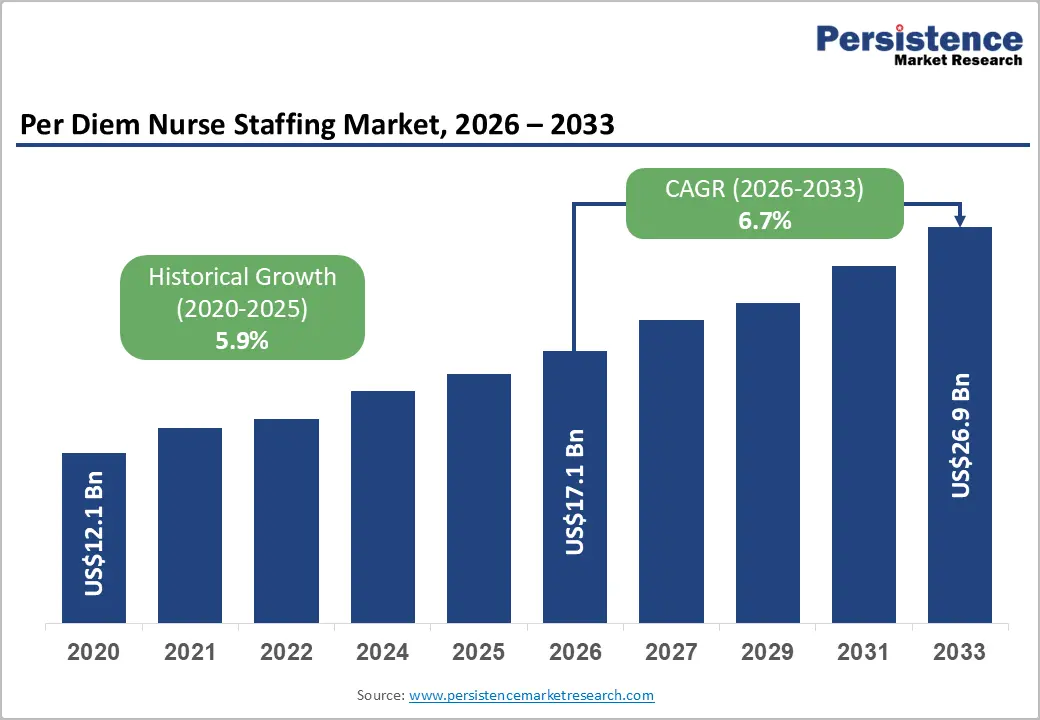
The global per diem nurse staffing market size is likely to be valued at US$17.1 billion in 2026 and is estimated to reach US$26.9 billion by 2033, growing at a CAGR of 6.7% during the forecast period 2026−2033, driven by rising acute care demand, workforce variability in healthcare systems, expansion of flexible staffing models, and increasing integration of digital workforce platforms across clinical environments.
Population aging increases hospitalization frequency and long-term care dependency, intensifying demand for flexible nursing capacity. Healthcare systems prioritize staffing elasticity to manage episodic surges in patient volumes. Regulatory pressure on staffing ratios strengthens reliance on per diem deployment models.
Key Industry Highlights:
- Leading Nurse Type: Registered nurses are set to hold around 58% revenue share in 2026, driven by the critical necessity of executing complex acute clinical interventions.
- Fastest-Growing Nurse Type: Licensed practical nurses are projected as the fastest-growing segment, supported by severe institutional pressure to optimize variable labor expenditure.
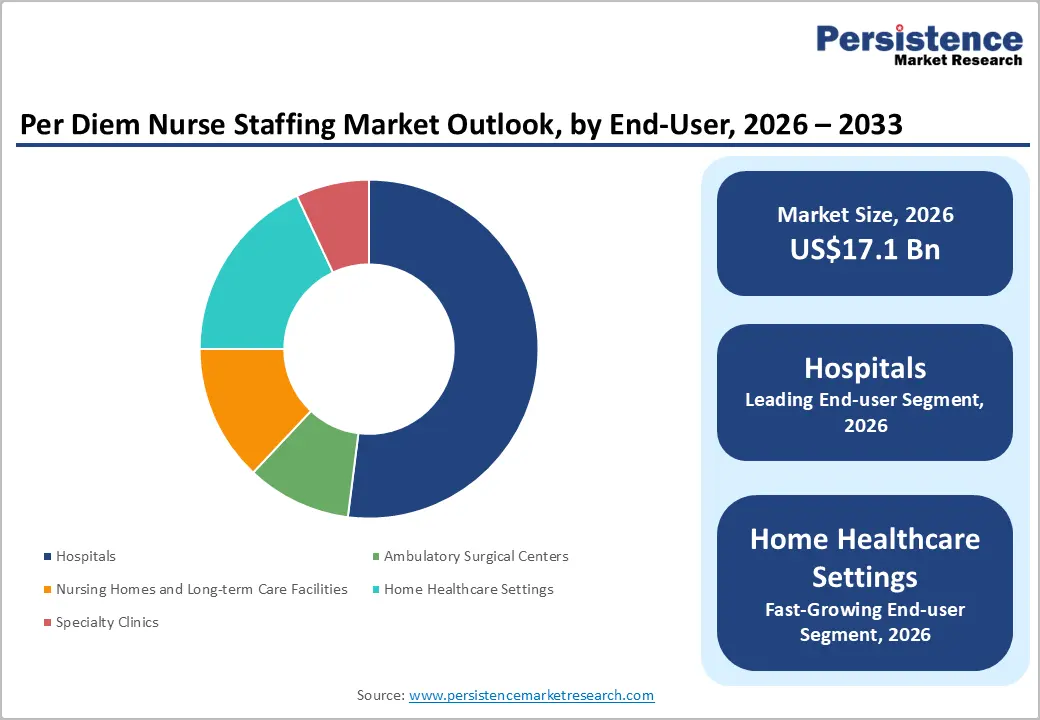
- Leading End-user: Hospitals are estimated to hold roughly 52% share in 2026, due to continuous inpatient demand and workforce variability.
- Fastest-Growing End-User: Home healthcare settings are forecast to record the fastest growth, driven by decentralized care adoption and chronic disease management.
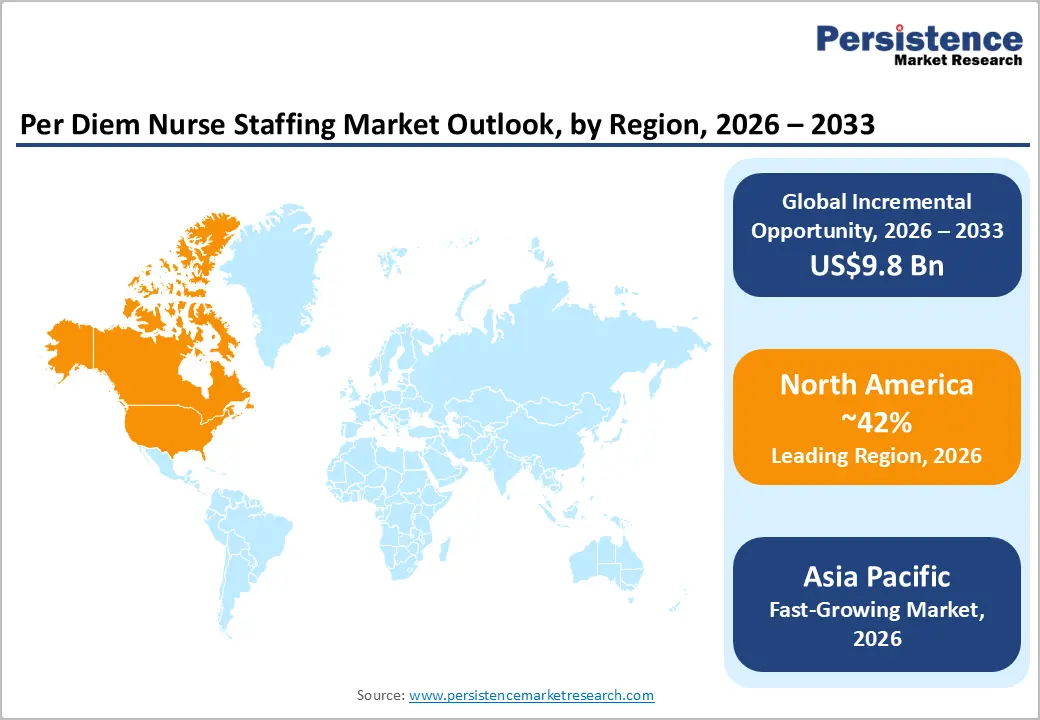
- Regional Leadership: North America is projected to capture roughly 42% of the market share by 2026, driven by staffing shortages and digital workforce adoption.
- Competitive Environment: The market reflects a moderately fragmented structure, with companies such as AMN Healthcare Services, Aya Healthcare, and Cross Country Healthcare leveraging digital staffing platforms.
DRO Analysis
Driver - Rising Healthcare Workforce Shortages and Staffing Imbalance
Chronic shortage of clinical personnel increases dependence on flexible staffing pools. Hospitals and care facilities face recurring gaps due to attrition, burnout, and uneven regional distribution of nurses. Per diem staffing addresses short-term workforce deficits without long-term hiring commitments, improving operational continuity in high-demand departments.
United States Bureau of Labor Statistics data in 2025 indicates over 189,100 annual openings for registered nurses, reflecting a sustained supply-demand imbalance. This structural gap accelerates the adoption of contingent staffing models across inpatient and outpatient care environments. Healthcare systems restructure workforce allocation strategies to stabilize care delivery. Staffing agencies expand candidate pools to include cross-specialty nursing professionals.
Restraint - High Administrative Complexity in Workforce Coordination
Per diem staffing requires continuous scheduling adjustments, credential verification, and compliance monitoring. Fragmented coordination between staffing agencies and healthcare providers increases operational overhead. This complexity reduces efficiency in rapid deployment scenarios.
Administrative burden increases staffing cycle time, limiting scalability across multi-facility healthcare systems. Resource allocation inefficiencies raise coordination costs and reduce margin expansion potential for staffing intermediaries.
Opportunity - Integration of Predictive Machine Learning and Real-Time Mobile Scheduling Platforms
Automated labor marketplace platforms eliminate historical communication delays by connecting independent nurses directly with immediate open shifts through smartphone interfaces. Automated credential matching algorithms instantly verify professional licenses, background checks, and clinical competencies against localized institutional standards. This technological integration drastically lowers administrative overhead expenses and shortens fill times from days to minutes. Healthcare providers capture expanded regional market presence by deploying these frictionless digital matching ecosystems.
This software architecture enables data-driven matching that matches local nurse availability with real-time operational demands. Automated shift alerts provide transparent pay rate clarity, attracting highly skilled clinicians who prioritize scheduling autonomy over traditional employment frameworks. The utilization of cloud-based scheduling databases optimizes labor distribution, transforming historical agency models into highly scalable digital infrastructure networks. This shift allows staffing providers to capture market share across previously fragmented geographical zones.
Category-wise Analysis
Nurse Type Insights
Registered nurses are anticipated to secure around 58% of the per diem nurse staffing market share in 2026, reflecting the critical necessity of these professionals in maintaining patient safety and executing complex clinical interventions. General hospitals require the continuous presence of these professionals to manage medication titrations and respond to medical emergencies. This high baseline demand ensures consistent contractual booking volume across healthcare networks.
Licensed practical nurses/Licensed vocational nurses are expected to be the fastest-growing segment, propelled by severe budgetary constraints forcing healthcare facilities to optimize total labor expenditures. Long-term care environments utilize these practitioners to handle routine wound care and medication administration at lower hourly bill rates. This financial optimization drives rapid adoption across post-acute care infrastructure.
Department Insights
Emergency care units are poised to dominate with a forecast market share of over 31% in 2026, powered by highly unpredictable patient surge volumes and intense acute care staffing requirements. Urban trauma centers experience sudden spikes in patient presentations following regional accidents, requiring immediate enrollment of temporary personnel. This volatility necessitates constant access to external, on-demand nursing networks.
Intensive care units are estimated to be the fastest-growing segment, fueled by an escalating volume of high-acuity patients requiring continuous, complex clinical monitoring. Specialized cardiac units utilize temporary critical care nurses to manage advanced mechanical ventilation systems during unexpected full-time staff absences. This specialized need drives premium shift pricing and rapid revenue expansion.
End-User Insights
Hospitals are likely to be the leading segment with a projected 52% of the per diem nurse staffing market share in 2026 due to their status as the largest single employer of registered nurses and their continuous exposure to census volatility and mandatory overtime restrictions. Ascension Health, operating over 140 hospitals across 19 states, maintains enterprise per diem staffing contracts to support coverage across departments. Volume purchasing agreements provide price stability and placement responsiveness.
Home healthcare settings are anticipated to be the fastest-growing segment, fueled by federal policy priorities favoring community-based care delivery and the Centers for Medicare & Medicaid Services (CMS) Enhancing Oncology Model promoting home-based clinical monitoring. Providers such as Amedisys and Louisiana Health Care (LHC) Group have expanded per diem nurse utilization to accommodate post-acute discharge volumes. Rising Medicare Advantage plan growth and funding home health benefits expand the addressable placement market at a structurally higher rate than institutional care settings.
Regional Insights
North America Per Diem Nurse Staffing Market Trends
North America is expected to lead with an estimated 42% of the per diem nurse staffing market share in 2026, supported by strict regulatory ratio enforcement and advanced digital procurement infrastructure. Severe healthcare professional burnout across metropolitan hubs drives extensive transition from permanent employment to flexible contract models.
U.S. Per Diem Nurse Staffing Market Insights
The U.S. market is projected to secure 86% of the regional market share in 2026, due to high turnover rates within acute care environments and an aging baby boomer demographic. Federal grant provisions directed toward rural hospital stabilization encourage the targeted utilization of flexible temporary labor pools to prevent service reductions.
Canada Per Diem Nurse Staffing Market Insights
The Canada market is expected to account for 13% of the regional revenue share in 2026, as provincial healthcare authorities increase funding allocations for surge-capacity staffing models. Widespread professional supply deficits within remote territories accelerate institutional reliance on mobile, short-term contract clinicians to sustain basic primary care access.
Europe Per Diem Nurse Staffing Market Trends
Europe is forecast to hold a 26% share of the global market in 2026, driven by escalating public healthcare sector union tensions, structural workforce retirements, and expanding multi-country health delivery networks. Chronic staffing shortages across Western European healthcare facilities lead to extended patient wait times and high emergency room strain.
Germany Per Diem Nurse Staffing Market Insights
The Germany market is expected to capture 34% of the European market share in 2026, driven by statutory modifications regarding maximum patient-to-nurse ratios in sensitive clinical specialties. Expanding investments in private inpatient rehabilitation networks create strong demand for specialized geriatric and transitional care temporary personnel. Staffing providers expand specialized language integration and credential verification programs to incorporate international clinical talent into local staffing frameworks.
U.K. Per Diem Nurse Staffing Market Insights
The U.K. market is anticipated to claim 29% of the European market share in 2026, due to high vacancy rates within National Health Service trusts. Strategic emphasis on reducing elective surgical backlogs requires extended operating theater hours, necessitating the immediate procurement of qualified temporary scrub and anesthetic nurses. Regulatory focus on limiting expensive agency price caps drives deployment of specialized bank staffing technology platforms.
Asia Pacific Per Diem Nurse Staffing Market Trends
Asia Pacific is forecast to be the fastest-growing market for per diem nurse staffing, stimulated by large-scale healthcare infrastructure privatization and an expanding senior demographic. Major Private Hospital chains across emerging economies establish centralized vendor management contracts to standardize temporary labor procurement protocols.
Japan Per Diem Nurse Staffing Market Insights
The Japan market is projected to command a dominant 48% of the Asia Pacific market share in 2026 due to unparalleled demographic aging patterns, inflating home healthcare and long-term care utilization rates. Regulatory adjustments allowing greater flexibility in nurse scheduling models encourage experienced clinicians to rejoin the workforce via part-time, on-demand frameworks.
China Per Diem Nurse Staffing Market Insights
The China market is likely to capture 31% of the regional revenue share in 2026, as massive tier-one medical facilities adopt digital workforce optimization software to manage complex shift scheduling. Increasing investments in private ambulatory surgical centers drive competitive demand for temporary perioperative nursing professionals to maximize daily caseload throughput.
Competitive Landscape
The global per diem nurse staffing market is moderately fragmented, with a mix of established international workforce corporations and specialized regional clinical deployment firms driving operational standards. Key industry participants include AMN Healthcare, Cross Country Healthcare, CHG Healthcare, Aya Healthcare, and Healthcare Staffing Services. These enterprises utilize digital platforms to manage large, localized nursing pools effectively.
Private equity investments continue to accelerate regional agency consolidation, enhancing the collective bargaining leverage of top-tier providers during national hospital contract negotiations. Smaller localized agencies maintain niche market shares by offering highly specialized clinical talent, including critical care and neonatal intensive care specialists, to regional trauma centers.
Key Industry Developments:
- In July 2025, symplr acquired AMN Healthcare’s Smart Square scheduling software, enhancing AI-driven workforce optimization and improving nurse and staff scheduling efficiency across healthcare systems.
- In June 2025, StaffDNA acquired the Per Diem Healthcare Staffing business from Kevala, strengthening its digital workforce platform and expanding access to per diem nursing talent across healthcare facilities.
Companies Covered in Per Diem Nurse Staffing Market
- AMN Healthcare, Inc.
- Cross Country Healthcare, Inc.
- Aya Healthcare
- CHG Healthcare Services
- Maxim Healthcare Staffing
- Medical Staffing Network
- Jackson Healthcare
- Grapetree Medical Staffing
- Accountable Healthcare Staffing
- NurseFinders, Inc.
- Favorite Healthcare Staffing
- Supplemental Health Care
- PRN Funding, LLC
Frequently Asked Questions
The per diem nurse staffing market is projected to reach US$17.1 billion in 2026.
Rising healthcare workforce shortages, increasing patient demand variability, and growing adoption of flexible and digital staffing models drive the per diem nurse staffing market.
The per diem nurse staffing market is poised to witness a CAGR of 6.7% from 2026 to 2033.
Expansion of digital workforce platforms, growth in home healthcare services, and increasing demand for flexible staffing in aging populations create key market opportunities.
Some of the key market players include AMN Healthcare, Cross Country Healthcare, CHG Healthcare, Aya Healthcare, and Healthcare Staffing Services.


