




- Food Ingredients & Additives
- Crushed Red Pepper Market
Crushed Red Pepper Market Size, Share, and Growth Forecast, 2026 - 2033
Crushed Red Pepper Market By Base Ingredient (Cayenne-based, Blended Pepper Flakes, Others), Nature (Conventional, Organic, Others), Formulation (Standard Flakes, Flavored, Others) and Regional Analysis for 2026 - 2033

Crushed Red Pepper Market Size and Trends Analysis
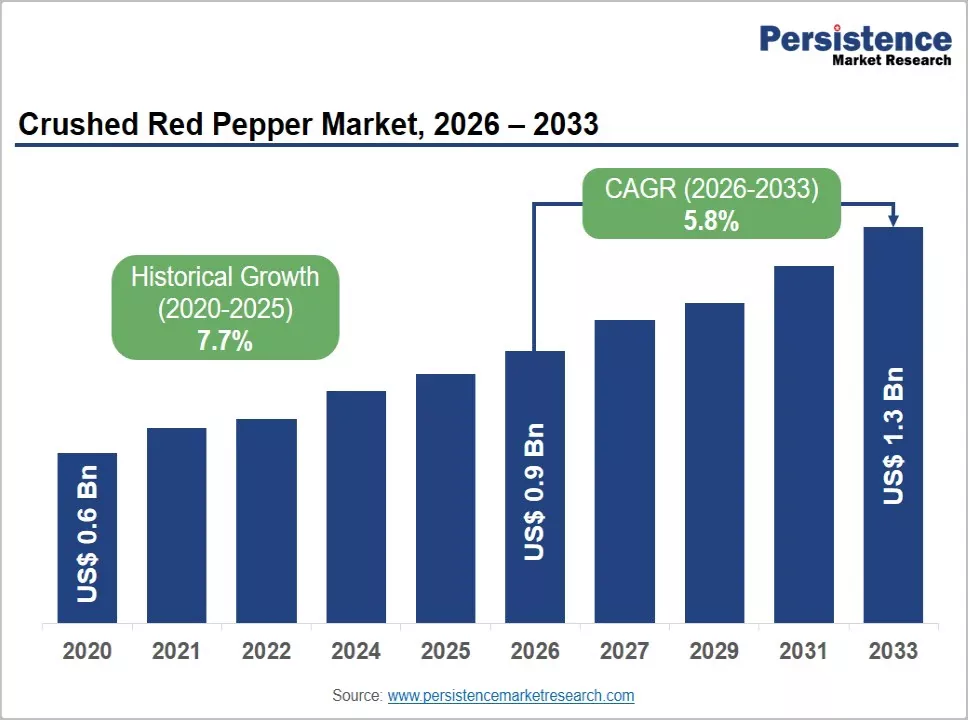
The global crushed red pepper market size is likely to be valued at US$0.9 billion in 2026 and is expected to reach US$1.3 billion by 2033, growing at a CAGR of 5.8% between 2026 and 2033, driven by rising demand for spicy flavors in foodservice and packaged foods, wider use of chili-based seasonings in snacks, sauces, and ready meals, and steady growth in organic and premium spice consumption.
Food manufacturers, restaurant operators, and households use crushed red pepper as a heat source that adds flavor, color, and texture across multiple cuisines.
Key Industry Highlights
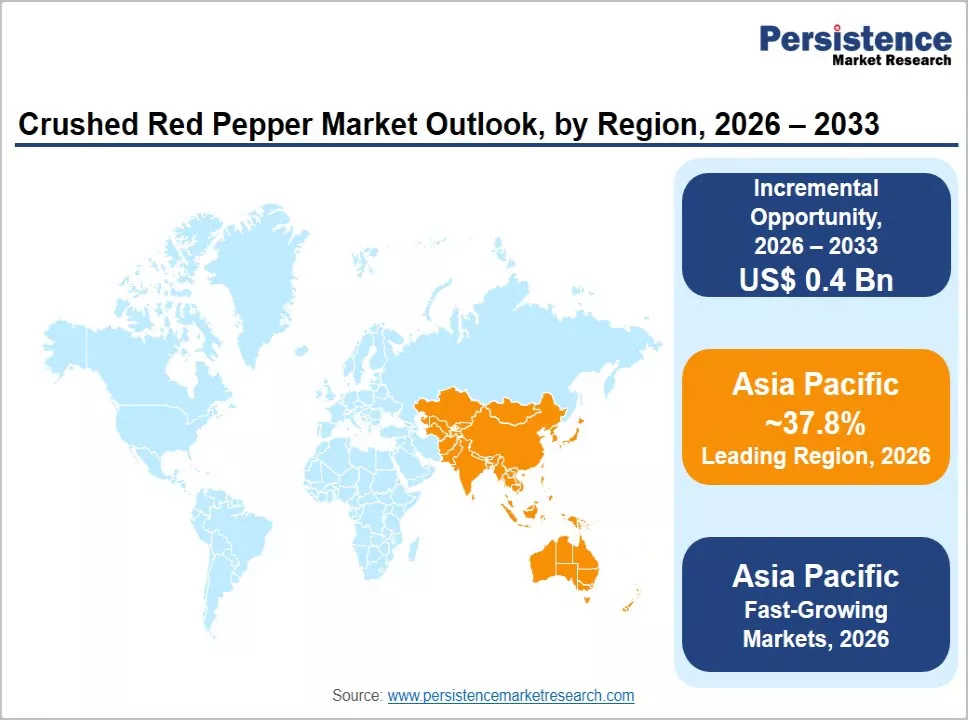
- Leading Region: Asia Pacific, anticipated to account for approximately 37.8% of the market share, supported by large-scale chili cultivation, established processing clusters, and strong domestic consumption of chili-based foods.
- Fastest-growing Region: Asia Pacific, driven by rising packaged food consumption, expanding foodservice chains, and growing demand for spicy flavors across India, China, and Southeast Asia.
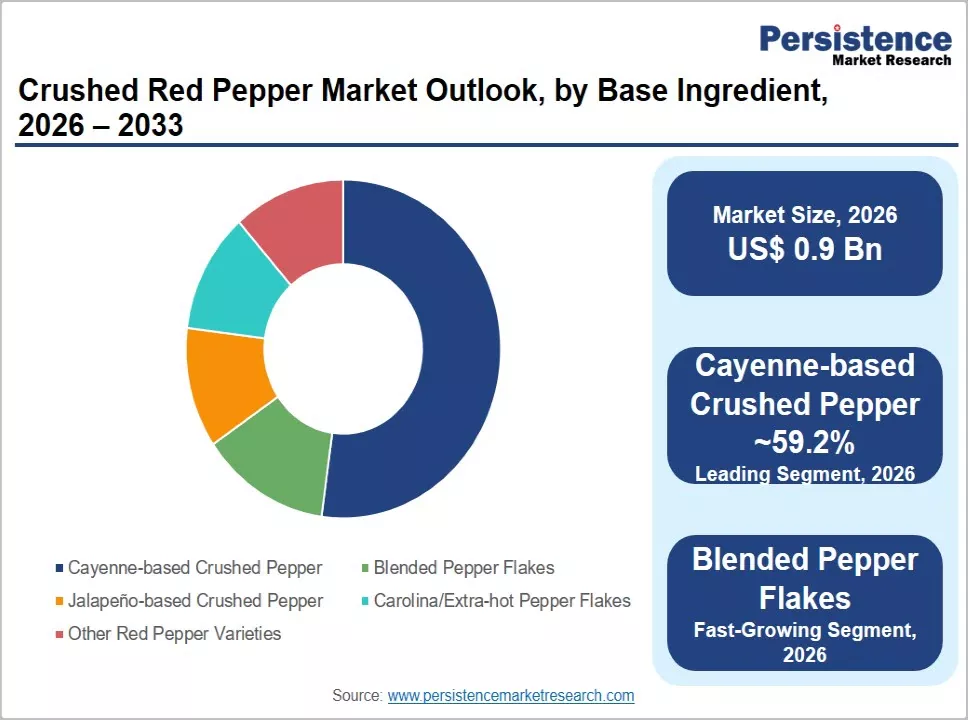
- Dominant Base Ingredient: Cayenne-based crushed pepper, anticipated to hold approximately 59.2% of the market share, as cayenne is the most commonly used pepper type in crushed red pepper due to consistent heat, bright color, and wide availability.
- Leading Nature: Conventional crushed red pepper, anticipated to account for 64.4% of the market share, as most commercial supply remains conventionally produced.
DRO Analysis
Drivers - Rising Demand for Spicy Flavors Is Expanding Crushed Red Pepper Use Across Foodservice and Packaged Foods
Consumer preference for heat is widening the use of crushed red pepper across restaurants, snacks, sauces, and ready meals. McCormick reports that more than 90% of consumers now prefer some level of heat, compared with 46% in 2009. Younger consumers are driving demand for sweet-and-spicy combinations such as hot honey and chili-based condiments, which use red pepper flakes as a visible source of heat and color.
Pizza chains, fast-casual restaurants, and food manufacturers specify crushed red pepper by heat level, color, and particle size, which supports recurring bulk purchasing. This pattern converts flavor trends into steady ingredient volumes for processors and suppliers.
Established Chili Supply Base and Processing Capacity Support Market Availability
India accounts for approximately 43% of global dry chilli production, according to FAOSTAT data, and exported more than 700,000 tonnes of chillies in 2024-25, an increase of about 19% over the previous year, based on Spices Board of India data. China, Thailand, Bangladesh, and Myanmar add significant production, which keeps raw material supply broad and diversified.
Large producing regions also host cleaning, steam treatment, crushing, and packing facilities, which allows suppliers to serve both retail and industrial buyers at scale and supports consistent quality for flake products. The Spices Board of India also operates eight crop-specific Spices Parks that provide shared processing infrastructure.
Restraint - Contaminant Compliance and Price Volatility Raise Supply Chain Risks
In 2022, the Rapid Alert System for Food and Feed recorded 290 notifications for spices and herbs, and 65% of the issues related to pesticide residues, according to the Centre for the Promotion of Imports. Regulation (EU) 2023/915 sets a 20 µg/kg ochratoxin A limit for dried Capsicum, and the Spices Board of India made ethylene oxide testing mandatory for shipments to Singapore and Hong Kong in April 2024.
Price movement adds commercial risk. India's chilli export volume rose about 19% in 2024-25, while export value declined about 11%, reducing realization per tonne and complicating procurement planning.
Opportunities - Premium Blended and Flavored Flakes Create Higher-Value Product Categories
Consumers increasingly look for differentiated heat rather than heat alone. A 2024 survey by NC Solutions found that 62% of consumers are more likely to buy a food or beverage item advertised as hot, and sweet-and-spicy combinations continue to gain space on restaurant menus. McCormick's Flavor Forecast identifies chili-forward heat, layered pairings, and textured condiments such as chili crisp and salsa macha as expressions of modern heat.
Blended, flavored, and heat-calibrated flakes allow brands to move beyond commodity pricing. Suppliers that offer defined Scoville ranges, color values, and flavor profiles such as chili-lime, smoked, or garlic-infused gain access to premium retail shelves and customized foodservice contracts.
Category-wise Analysis
Base Ingredient Insights
Cayenne-based crushed pepper is anticipated to account for approximately 59.2% of the market share, as cayenne is the most commonly used pepper type in crushed red pepper. The segment benefits from consistent heat, bright red color, and wide availability from major chili-producing countries. For example, shaker-pack red pepper flakes sold for pizza, pasta, and soups, and bulk flakes supplied to pizza chains and food processors, commonly use cayenne-type peppers. Food manufacturers also use these flakes in sauces, marinades, meat rubs, snack seasonings, and ready meals, where standardized heat levels support repeatable formulations. The established supply base and familiar flavor profile maintain the segment's position across retail, foodservice, and industrial channels.
Blended pepper flakes are anticipated to be the fastest-growing base ingredient segment, driven by demand for customized heat, flavor, and color profiles. Suppliers combine cayenne, jalapeño, and other red varieties with milder, smoky, or fruity types to achieve targeted heat levels and visual appearance. For example, a pizza chain or snack manufacturer specifies a flake blend with a defined Scoville range, color value, and particle size to maintain consistent taste across locations. Blending also allows processors to manage raw material costs and crop variability by adjusting the proportion of individual varieties. Growing interest in layered heat, where chili is paired with smoky, sweet, or citrus notes, further supports adoption of blended formats in retail seasonings and foodservice.
Nature Insights
Conventional crushed red pepper is anticipated to account for 64.4% of the market share, as most commercial supply remains conventionally produced. The segment benefits from lower cost, larger crop volumes, and established sourcing relationships in India, China, and other producing countries. For example, bulk conventional flakes supplied to pizza chains, sauce manufacturers, and private-label spice brands form the base of industrial demand. Retail packs with non-GMO and kosher certifications also sit within the conventional supply base. Conventional supply is tested for aflatoxin, ochratoxin A, pesticide residues, and microbial contamination, and steam treatment is widely used to meet importing-country food safety requirements. Price competitiveness keeps conventional flakes the default choice for high-volume foodservice and food processing applications.
Organic crushed red pepper is anticipated to be the fastest-growing nature segment, especially in Europe, due to demand for organic and sustainable supply. Regulation (EU) 2018/848, effective since January 2021, established a common certification and labeling framework, and the Centre for the Promotion of Imports reports that EU imports of organic spices and herbs grew 14% in 2024. Germany is the largest organic food market in Europe and a major buyer of certified spice products. In North America, major brands such as McCormick offer organic crushed red pepper in retail packs, which reflects broader availability of organic flakes through mainstream grocery channels.
Regional Insights
North America Crushed Red Pepper Market Trends
North America is a mature market supported by extensive pizza and fast-casual foodservice networks, strong branded spice retail, and rising consumption of spicy sauces and seasonings. Supply is largely import-based, which places food safety verification and trade policy at the center of purchasing decisions. Importers operate under the U.S. Food Safety Modernization Act foreign supplier verification program and Canada's Safe Food for Canadians Regulations, which require documented preventive controls for spice supply chains.
U.S. Crushed Red Pepper Market Trends
The United States remains the leading market in North America due to its large foodservice sector, established spice brands, and high household use of red pepper flakes. Technomic's 2024 Flavor Consumer Trend Report found that 34% of consumers prioritize a restaurant's sauce and condiment offerings when choosing where to dine, which supports heat-led menu innovation. On November 14, 2025, an executive order exempted many spices from reciprocal tariffs, effective November 13, 2025, according to the American Spice Trade Association, which reduces tariff exposure for importers of spice products, although other duties remain in place for some origins.
In January 2026, McCormick completed the acquisition of an additional 25% ownership interest in McCormick de Mexico for US$750 million, raising its stake to 75%. In March 2026, McCormick agreed to combine with Unilever's foods business in a transaction valued at approximately US$44.8 billion, creating a flavor company with approximately US$20 billion in combined fiscal year 2025 revenue. These developments reflect consolidation among large flavor companies and growing scale in seasonings and condiments.
Europe Crushed Red Pepper Market Trends
Europe is a mature market characterized by high demand for organic and sustainably sourced spices and strict contaminant regulation. Europe imports more spices and herbs than North and South America combined, and EU imports of organic spices and herbs grew 14% in 2024. As of August 2025, official checks were temporarily increased for selected spice products from Ethiopia, India, Pakistan, Sri Lanka, and Türkiye. Regulation (EU) 2018/848 harmonizes organic certification across member states, and investment is flowing toward certified testing, traceability, and organic sourcing programs.
Germany Crushed Red Pepper Market Trends
Germany is the largest European importer of spices and herbs, with imports of almost €592 million in 2021, and the port of Hamburg serves as a major entry point. The country also hosts one of the largest European spice companies, Fuchs Group, and the largest organic food market in Europe, which supports demand for certified organic crushed red pepper. The Centre for the Promotion of Imports expects lower inflation to support demand for organic and higher-value spices in 2025 - 2026, although economic conditions remain weak in Germany.
Scrutiny of pesticide residues, ethylene oxide, and mycotoxins in imported spices is increasing preference for organic, steam-treated, and fully traceable flakes, particularly in private-label and industrial seasoning supply.
United Kingdom Crushed Red Pepper Market Trends
The United Kingdom remains an important market for crushed red pepper due to its strong curry, takeaway, and ethnic food culture, and the Centre for the Promotion of Imports identifies the UK as one of Europe's largest importers of crushed and ground spices and spice mixtures. Aflatoxin limits for whole chilli in the UK match EU levels at 5 µg/kg for aflatoxin B1 and 10 µg/kg for total aflatoxins. Ochratoxin A limits for dried Capsicum, introduced by Regulation (EU) No 105/2010, are also retained in UK legislation.
Retail demand for flavored and heat-graded flakes is rising, and foodservice operators continue to add chili-based condiments to menus. UK buyers apply the same contaminant limits to imported flakes, which makes testing documentation a standard supplier requirement.
Asia Pacific Crushed Red Pepper Market Trends
Asia Pacific is the leading and fastest-growing regional market, accounting for approximately 37.8% of the market share, driven by large-scale chili cultivation, manufacturing advantages in processing, and strong domestic consumption. India produces approximately 43% of the world's dry chillies, while China, Thailand, and Myanmar are other significant producers. Expanding packaged food, quick-service restaurant, and e-commerce channels are increasing demand for standardized flakes.
India Crushed Red Pepper Market Trends
India is the largest producer and exporter of chillies. Andhra Pradesh accounts for approximately 43% of national chilli output, and exports exceeded 715,000 tonnes in 2024-25, with China, Bangladesh, and Thailand together absorbing about 57% of shipment volume. Chilli contributes roughly one-third of India's spice export value, according to the Spices Board of India. Total spice exports reached US$4.45 billion in 2024-25, as reported by the Press Information Bureau of India.
In April 2024, the Spices Board made ethylene oxide testing mandatory for spice consignments to Singapore and Hong Kong, which increased the focus on traceability and testing across the export chain. The Spices Board also issued guidelines for exporters on preventing ethylene oxide contamination. India has also set a goal of US$10 billion in spice exports by 2030, supporting investment in processing and value-added products such as crushed flakes.
China Crushed Red Pepper Market Trends
China is a major chili producer and consumer, supported by large processing clusters in Guizhou and Xinjiang. In 2023, Guizhou cultivated approximately 5.2 million mu of chili with output of around 7.7 million tonnes and a production value above CNY 30 billion. Processed chili product output in the province reached 294,800 tonnes in 2024, up 15.7% year-on-year. The province hosts more than 300 scaled chili processing enterprises, according to Guizhou provincial reporting. Provincial authorities issued CNY 100 million in government funds in 2020 to attract public capital to the chili industry.
China also imports dried chillies for processing, with Indian shipments exceeding 179,000 tonnes in FY2024. Rising demand for hot pot seasonings, chili oils, and snack seasonings is increasing use of crushed and flaked chili in packaged food manufacturing.
Competitive Landscape
The global crushed red pepper market is fragmented, with competition among multinational spice and seasoning companies, ingredient suppliers, regional spice brands, and chili processors and exporters in India, China, and other producing countries. Large companies hold strong positions in branded retail and foodservice channels across North America and Europe, while regional processors supply bulk flakes to food manufacturers and distributors. Companies compete on sourcing scale, quality consistency, food safety compliance, brand strength, distribution reach, and the ability to supply customized heat and color specifications.
Leading companies are focusing on portfolio expansion, vertical integration of sourcing, traceability, acquisitions, and premium, organic, and blended product lines. Competitive differentiation increasingly depends on food safety assurance, consistent specifications, and the ability to supply flavored and blended formats at scale.
Key Industry Developments
- In January 2026, McCormick & Company completed the acquisition of an additional 25% ownership interest in McCormick de Mexico from Grupo Herdez for US$750 million, increasing its ownership to 75% and creating a platform for expansion across Latin America.
- In March 2026, McCormick announced an agreement to combine with Unilever's foods business, excluding India and certain other businesses, in a transaction valued at approximately US$44.8 billion, with closing expected by mid-2027 and approximately US$600 million in annual cost synergies targeted.
Companies Covered in Crushed Red Pepper Market
- McCormick & Company, Incorporated
- Olam Food Ingredients (ofi)
- Everest Food Products Pvt. Ltd.
- MDH (Mahashian Di Hatti Pvt. Ltd.)
- ITC Limited
- Tata Consumer Products Limited
- Catch (DS Group)
- Eastern Condiments Private Limited
- Badia Spices, Inc.
- Frontier Co-op
- Pacific Spice Company, Inc.
- S&B Foods Inc.
- Sabater Spices
- Dabur India Limited (Badshah Masala)
Frequently Asked Questions
The global crushed red pepper market is projected to be valued at US$ 0.9 billion in 2026.
The market is expected to reach US$ 1.3 billion by 2033.
Key trends include growing demand for spicy and sweet-and-spicy flavors, wider use of blended and flavored flakes, rising demand for organic and non-GMO products, expansion of foodservice and packaged food applications, and stricter food safety and contaminant testing requirements.
Cayenne-based crushed pepper is anticipated to remain the leading base ingredient segment, accounting for approximately 59.2% of the market.
The market is projected to expand at a CAGR of 5.8% between 2026 and 2033.
Major companies include McCormick & Company, Olam Food Ingredients (ofi), Everest Food Products, MDH, and ITC.


