




- Nutraceuticals & Functional Foods
- Marine Enzymes Market
Marine Enzymes Market Size, Share, and Growth Forecast, 2026 – 2033
Marine Enzymes Market by Product Type (Proteases, Xylanases, Pectinase, Lipases, Amylases), Application (Food & Beverage, Medicine, Nutraceutical, Cosmetics, Textile), and Regional Analysis for 2026 – 2033

Marine Enzymes Market Size and Trends Analysis
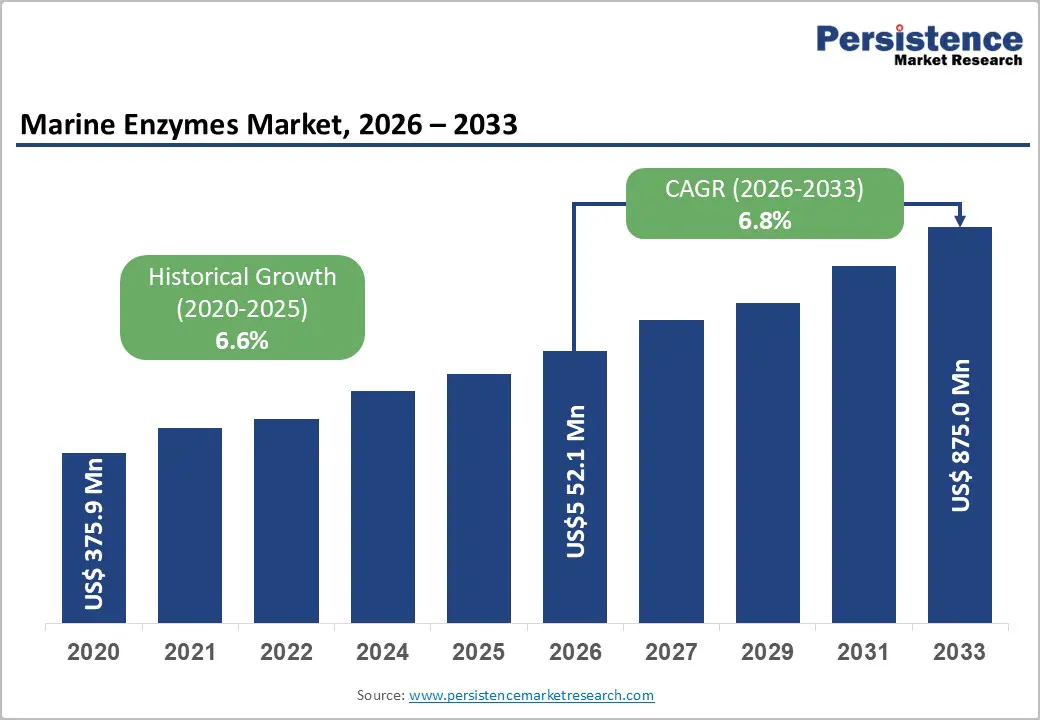
The global marine enzymes market size is likely to be valued at US$552.1 million in 2026 and is expected to reach US$875.0 million by 2033, growing at a CAGR of 6.8% during the forecast period from 2026 to 2033, driven by rising demand for natural and sustainable enzymes in food processing, pharmaceuticals, nutraceuticals, and cosmetics, coupled with advances in marine biotechnology that enable efficient enzyme extraction and enhanced stability under extreme conditions, as well as increasing regulatory support for eco-friendly bioprocesses. The market is fueled by growing applications in biofuels, industrial biocatalysts, and wastewater treatment, where marine enzymes offer high efficiency and specificity. Expanding R&D investments and innovations in enzyme engineering are enabling customized solutions for diverse industrial needs, supporting continued market expansion. Growing consumer preference for clean-label and functional products also contributes to the increasing adoption of marine enzymes across multiple sectors.
Key Industry Highlights:
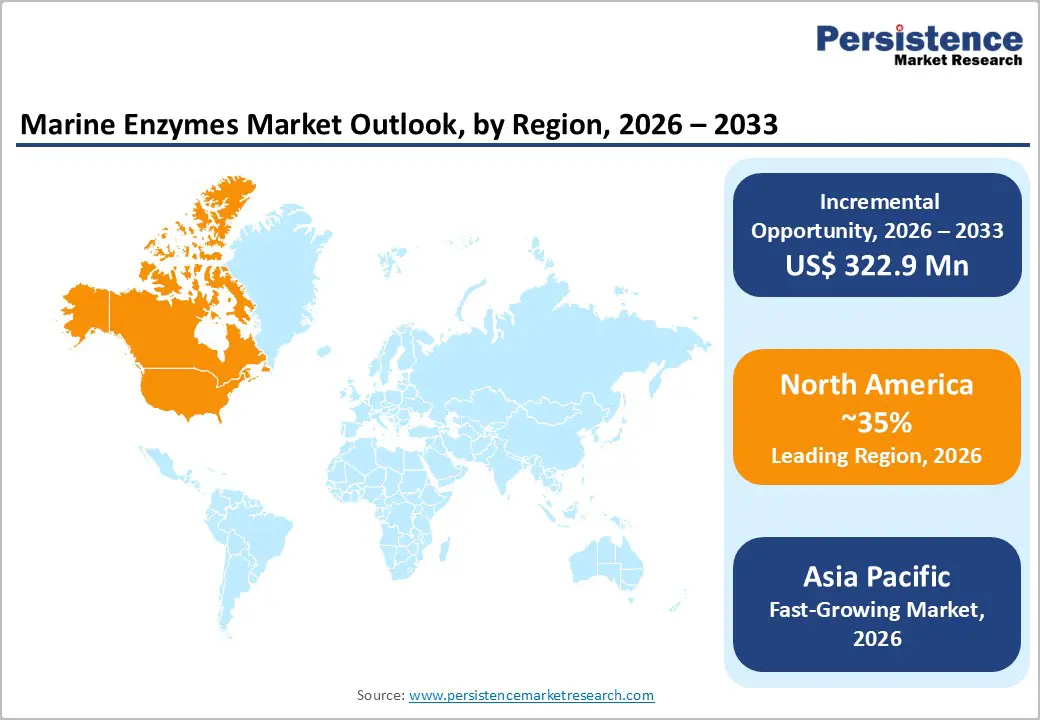
- Leading Region: North America is anticipated to be the leading region, accounting for a market share of 35% in 2026, driven by strong biotech investments and demand across pharmaceuticals and nutraceuticals.
- Fastest-growing Region: Asia Pacific is likely to be the fastest-growing region, supported by rising demand, government support, and cost-efficient manufacturing.
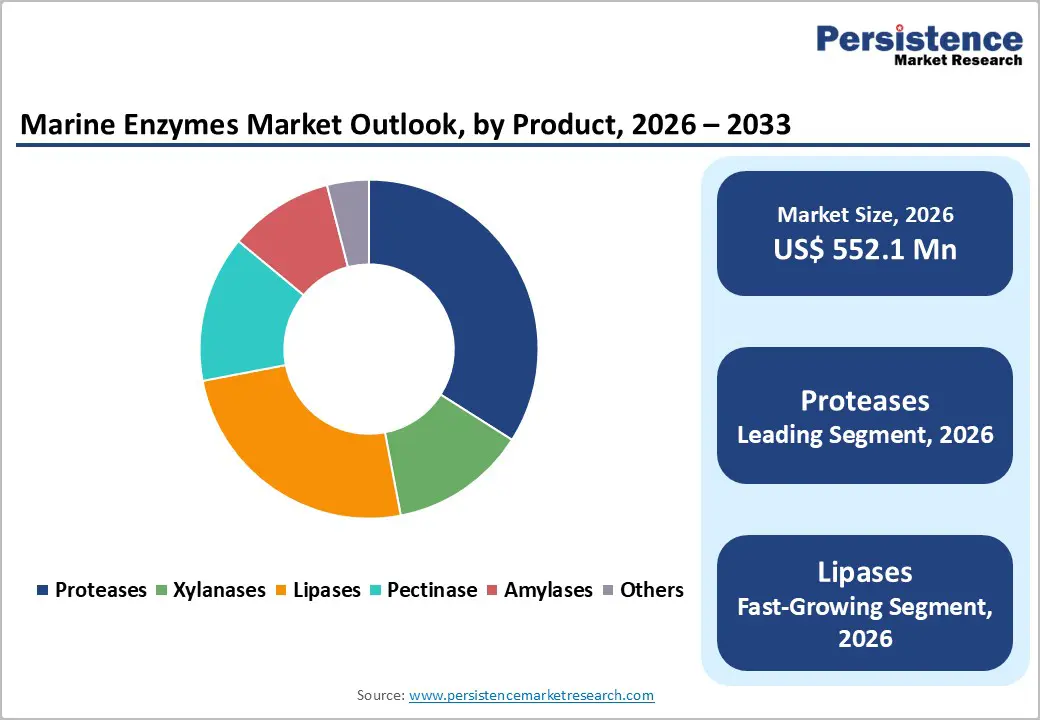
- Leading Product Type: Proteases are projected to represent the leading product type in 2026, accounting for 35% of the revenue share, driven by high demand in food processing, detergents, and pharmaceutical applications due to their versatility and stability in marine environments.
- Leading Application: The food & beverage segment is anticipated to be the leading application type, accounting for over 32% of the revenue share in 2026, driven by enzyme use in dairy, bakery, and beverage sectors to improve efficiency, yield, and product quality.
| Report Attribute | Details |
|---|---|
|
Marine Enzymes Market Size (2026E) |
US$552.1 Mn |
|
Market Value Forecast (2033F) |
US$875.0 Mn |
|
Projected Growth (CAGR 2026 to 2033) |
6.8% |
|
Historical Market Growth (CAGR 2020 to 2025) |
6.6% |
Market Factors – Growth, Barriers, and Opportunity Analysis
Technological Advancements in Enzyme Extraction and Biotechnology
Recent innovations such as metagenomics, bioinformatics, and synthetic biology have enabled researchers to explore previously inaccessible marine environments to identify novel enzymes with superior catalytic properties and stability profiles, significantly broadening the enzyme portfolio available for industrial applications across food processing, pharmaceuticals, cosmetics, and biofuels. These technologies allow scientists to bypass traditional cultivation methods, reducing reliance on wild harvesting and enabling scalable and sustainable production approaches, such as recombinant DNA technology and fermentation using engineered microbial hosts, which improve yields and consistency while lowering operational costs. Enzyme engineering techniques such as directed evolution and rational design are optimizing marine enzymes for specific applications by enhancing substrate specificity, catalytic efficiency, and environmental tolerance, making them more effective under diverse processing conditions.
Advances in extraction and purification technologies have greatly expanded the availability of marine enzymes, making them more accessible and cost-effective and overcoming previous barriers to market adoption. These developments include sophisticated fermentation methods and automated bioprocessing systems that ensure consistent production at larger scales while reducing reliance on harsh chemical catalysts. Such systems also contribute to environmental sustainability by lowering energy use and waste generation compared with traditional extraction methods. Innovations such as enzyme immobilization and microencapsulation enhance enzyme stability and reusability, creating more efficient biocatalysts and reducing costs for industries such as textiles and detergents.
Complex Production Processes
Marine enzymes are extracted from organisms that often inhabit high-pressure, deep-sea, or extreme environments, requiring specialized collection methods and sophisticated bioreactor systems for cultivation and extraction that are not readily scalable for industrial production. These processes require advanced purification technologies, such as chromatography and sensitive stabilization protocols, which significantly increase operational costs and pose a challenge for smaller manufacturers entering the market. Complex downstream processing techniques are necessary to maintain enzyme bioactivity and purity, but they add time and expense to production cycles and require highly skilled personnel and specialized equipment.
Complex production processes contribute to high production costs, which serve as a significant restraint for the marine enzymes market by affecting pricing competitiveness relative to terrestrial enzyme alternatives. The extraction and purification of enzymes from marine organisms require extensive R&D investments, energy-intensive operations, and temperature-controlled environments, particularly when handling enzymes sensitive to heat or degradation outside narrow conditions, all of which increase per-unit costs. These barriers make marine enzymes less attractive to price-sensitive end users than lower-cost terrestrial or synthetic alternatives, limiting market penetration in cost-driven industries such as textiles and detergents.
Expansion into Emerging Nutraceutical and Cosmetics Markets
Marine-derived enzymes increasingly integrate into health supplement formulations that support digestive health, immunity, and metabolic function. Marine enzymes such as proteases, lipases, and amylases are being used to improve the bioavailability and functional efficacy of nutraceutical products, particularly in protein hydrolysates, omega-3 fatty acid supplements, and specialty dietary formulations where consumers seek natural, high-performance ingredients. This trend is driven by a growing focus on preventive healthcare and wellness, with nutraceuticals gaining traction among aging and health-conscious populations that prefer enzyme-enhanced products to promote digestion, nutrient absorption, and overall well-being.
Marine enzymes, including collagenases, proteases, and lipases, are increasingly incorporated into formulations for anti-aging, skin renewal, hydration, and barrier repair, demonstrating enhanced performance such as improved skin permeability, gentle exfoliation, and targeted activity profiles that appeal to premium and mass-premium skincare segments. This adoption is supported by robust market growth in marine enzyme cosmetic applications, which analysts forecast to expand rapidly as brands leverage the bioactive and multifunctional properties of marine-derived enzymes to deliver differentiated benefits in serums, masks, cleansers, and treatment products.
Category-wise Analysis
Product Type Insights
Proteases are expected to lead the marine enzymes market, accounting for approximately 35% of revenue in 2026, driven by their versatility and widespread industrial applications. Proteases are highly effective hydrolyzers, making them essential for food processing, detergents, and pharmaceutical formulations. For example, in the detergent industry, proteases help break down protein-based stains such as blood or egg on fabrics, improving cleaning efficiency and consumer satisfaction. Marine-derived proteases have an advantage over terrestrial enzymes due to their stability in saline and extreme pH environments, making them ideal for applications in challenging industrial processes. The dominance of proteases is also supported by rising demand in nutraceutical production, where they enhance protein digestibility in functional foods.
Lipases are likely to be the fastest-growing segment, supported by rising applications in pharmaceuticals, nutraceuticals, and cosmetics. Marine lipases are particularly valuable for their ability to catalyze fat and lipid transformations, such as in omega-3 extraction for nutraceutical supplements. For example, lipases are used in the production of fish oil-based dietary supplements, enhancing the bioavailability of polyunsaturated fatty acids for cardiovascular and cognitive health benefits. The growth of lipases is fueled by technological advancements in enzyme engineering and immobilization, which improve stability and catalytic efficiency in industrial processes. Cosmetic applications are also expanding rapidly, where lipases aid in fat emulsification and skin-conditioning formulations, aligning with consumer demand for natural and effective skincare ingredients.
Application Insights
The food & beverage segment is projected to lead the market, capturing around 32% of revenue share in 2026, supported by the extensive use of marine enzymes in dairy, bakery, and beverage processing to enhance product quality, improve processing efficiency, and meet the growing demand for natural and clean-label food ingredients. Enzymes in this sector improve processing efficiency, enhance product quality, and contribute to sustainability by reducing energy and chemical use. For example, in dairy processing, marine proteases are employed to hydrolyze proteins during cheese production, accelerating maturation and improving texture while maintaining flavor integrity. The segment benefits from consistent demand driven by consumption of processed foods, bakery products, and beverages, and by regulatory encouragement for natural, clean-label ingredients.
The nutraceutical segment is likely to be the fastest-growing application in 2026, driven by increasing consumer preference for functional foods and dietary supplements. Marine enzymes, such as lipases and proteases, enhance the bioavailability and efficacy of nutraceutical products, including omega-3 fatty acids and protein hydrolysates. For example, proteases are widely used in the production of protein supplements to improve digestibility and amino acid absorption in functional nutrition products targeted at aging populations and health-conscious consumers. Growth is supported by rising awareness of preventive healthcare, the popularity of natural and sustainable ingredients, and regulatory policies encouraging clean-label formulations.
Regional Insights
North America Marine Enzymes Market Trends
North America is expected to lead the market, accounting for approximately 35% of the total share in 2026, supported by its advanced biotechnology ecosystem, robust R&D investments, and well-established food processing and pharmaceutical industries. The region is witnessing growing adoption of marine enzymes in industrial applications that enhance product quality, minimize waste, and improve overall processing efficiency. For instance, Novozymes A/S, a major global enzyme producer with significant operations in the U.S., is actively advancing sustainable marine enzyme solutions for food processing, biofuels, and industrial biocatalysis, leveraging its broad enzyme portfolio and strong research partnerships to address diverse industrial requirements.
Emerging growth trends in the market indicate strong expansion into biotechnology-driven applications, diagnostics, and advanced therapeutic development, opening opportunities beyond conventional food and industrial uses. Marine enzymes are increasingly incorporated into pharmaceutical synthesis, life sciences research, and novel functional ingredients, highlighting the diversification of end-use industries and the rising demand for customized, high-performance solutions. For instance, BioLume Inc., a U.S.-based company recognized as a key market participant, focuses on marine-derived enzyme products for high-precision applications such as diagnostic platforms and specialized bioprocessing reagents, illustrating how niche players are leveraging innovation to capture new growth opportunities.
Europe Marine Enzymes Market Trends
Europe is expected to be a significant market for marine enzymes in 2026, supported by the region’s strong focus on sustainability, regulatory compliance, and innovation-led industrial practices, which position it as a key driver of global demand. Industries across Europe, particularly food processing, pharmaceuticals, and environmentally conscious manufacturing, are increasingly adopting marine enzymes as alternatives to synthetic catalysts to meet stringent environmental standards, including those outlined in the EU Green Deal and circular economy initiatives. For instance, AB Enzymes GmbH, a Germany-based enzyme developer, has been strengthening its European footprint by developing advanced marine enzyme formulations for clean-label food processing and sustainable biocatalysis, closely aligning with regional priorities for eco-friendly ingredients.
The European marine enzymes market is also witnessing a strong growth in emerging applications such as advanced biopharmaceutical manufacturing, functional ingredients, and sustainable industrial processes, reflecting a broader shift toward natural, high-performance enzyme solutions. Marine enzymes are increasingly being incorporated into biofuel production, enzyme-assisted waste management, and specialized cosmetic formulations, driven by rising consumer demand for natural products and industry efforts to improve efficiency while reducing environmental impact. For example, Chr. Hansen A/S, a Danish bioscience company active across Europe, develops marine-derived enzyme solutions for functional food and personal care applications, supporting market expansion by addressing growing demand for clean-label, high-quality ingredients.
Asia Pacific Marine Enzymes Market Trends
The Asia Pacific region is likely to be the fastest-growing region, driven by rapid industrialization, expanding biotechnology sectors, and abundant marine biodiversity that support enzyme discovery and production. Government initiatives promoting blue economy growth and marine biotechnology research are bolstering regional demand, particularly in major economies such as China, Japan, and South Korea, where enzyme platforms are integrated into innovation agendas. For example, Amano Enzyme Inc., a Japan-based company with global operations, has expanded marine enzyme solutions for food and nutraceutical applications, leveraging its expertise in enzyme engineering to meet rising demand for functional ingredients and health-oriented formulations in the Asia Pacific market.
Emerging trends in the Asia Pacific marine enzymes market highlight diversification into high-growth applications and technological sophistication, which are contributing to sustained momentum. Marine enzymes are increasingly utilized in advanced nutraceutical formulations, eco-friendly detergents, and bio-industrial processes, aligning with the region’s shift toward sustainable biotechnology solutions. Rapid growth is particularly evident in sectors such as enzyme-assisted biofuel production and specialty cosmetic ingredients, where marine enzymes offer unique stability and catalytic efficiency under demanding conditions, driving adoption beyond traditional food and beverage uses.
Competitive Landscape
The global marine enzymes market exhibits a moderately fragmented structure, driven by a diverse mix of large biotechnology firms and specialized marine enzyme innovators competing for share in food processing, pharmaceuticals, and industrial biocatalysts. While no single company dominates outright, Novozymes A/S holds a significant share with a broad portfolio of marine-derived enzymes and strong global distribution, reflecting its sustained R&D investment and strategic partnerships in multiple sectors.
With key leaders including Biotec Pharmacon ASA, Amano Enzyme Inc., and ArcticZymes Technologies ASA, the competitive landscape is shaped by a combination of large multinational corporations and mid-tier specialists that emphasize product differentiation and application-focused developments. These players compete through continuous research and development, strategic collaborations with academic institutions and marine biotechnology centers, and expansion into emerging regions to capture new growth opportunities.
Key Industry Developments:
- In December 2025, Researchers from CIIMAR (Interdisciplinary Centre of Marine and Environmental Research) and the University of Helsinki reported the discovery of a previously unknown enzyme capability in cyanobacteria, marking a major advancement for marine biotechnology and drug development. Published in Nature Communications, the study revealed that cyanobacteria can phosphorylate cyanobactins, a well-known class of bioactive peptides with strong therapeutic potential and an ability never before observed in this peptide family.
- In June 2025, the AI MareExplore project was officially launched at the GEOMAR Helmholtz Centre for Ocean Research Kiel, aiming to uncover previously unknown marine enzymes with the potential to address major environmental challenges such as plastic pollution and carbon dioxide capture. The interdisciplinary initiative leverages artificial intelligence and large marine genome databases to identify novel biocatalysts that traditional laboratory methods have been unable to detect. Led by GEOMAR and funded by the Helmholtz Innovation Pool, the project brings together expertise from four Helmholtz centres, including Forschungszentrum Jülich, UFZ, and GFZ.
Companies Covered in Marine Enzymes Market
- BASF SE
- Koninklijke DSM N.V.
- Novozymes A/S
- Biocon Ltd.
- Amano Enzyme Inc.
- Codexis Inc.
- Advanced Enzymes Technologies Ltd.
- ArcticZymes Technologies
- AB Enzymes
- Royal DSM N.V.
- E.l. Du Pont de Nemours & Company
- Rossari Biotech Limited
- Lallemand Inc.
- Biocatalysts Limited
- Creative Enzymes
- Nagase & Co., Ltd.
Frequently Asked Questions
The global marine enzymes market is projected to reach US$552.1 million in 2026.
Rising demand for sustainable and high-performance biocatalysts across food processing, pharmaceuticals, nutraceuticals, cosmetics, and textiles is supported by advances in marine biotechnology and eco-friendly regulations.
The marine enzymes market is expected to grow at a CAGR of 6.8% from 2026 to 2033.
Expanding applications in nutraceuticals and cosmetics, increasing use in sustainable industrial processes, and the integration of AI-driven marine bioprospecting to discover novel, high-value enzymes.
BASF SE, Koninklijke DSM N.V., Novozymes A/S, Biocon Ltd., Amano Enzyme Inc., and Codexis Inc. are the leading players.


