




- HVAC
- Industrial Heat Exchangers Market
Industrial Heat Exchangers Market Size, Share, and Growth Forecast 2026 - 2033
Industrial Heat Exchangers Market by Product (Plate & Frame Heat Exchanger, Shell & Tube Heat Exchanger, Air‑Cooled Heat Exchanger, Others), Material (Metals, Alloys), End-user (Oil & Gas, HVAC & Refrigeration, Chemical & Petrochemical, Power Generation, Food & Beverage, Pharmaceuticals, Metals & Mining), by Regional Analysis, 2026 - 2033

Industrial Heat Exchangers Market Size and Trend Analysis
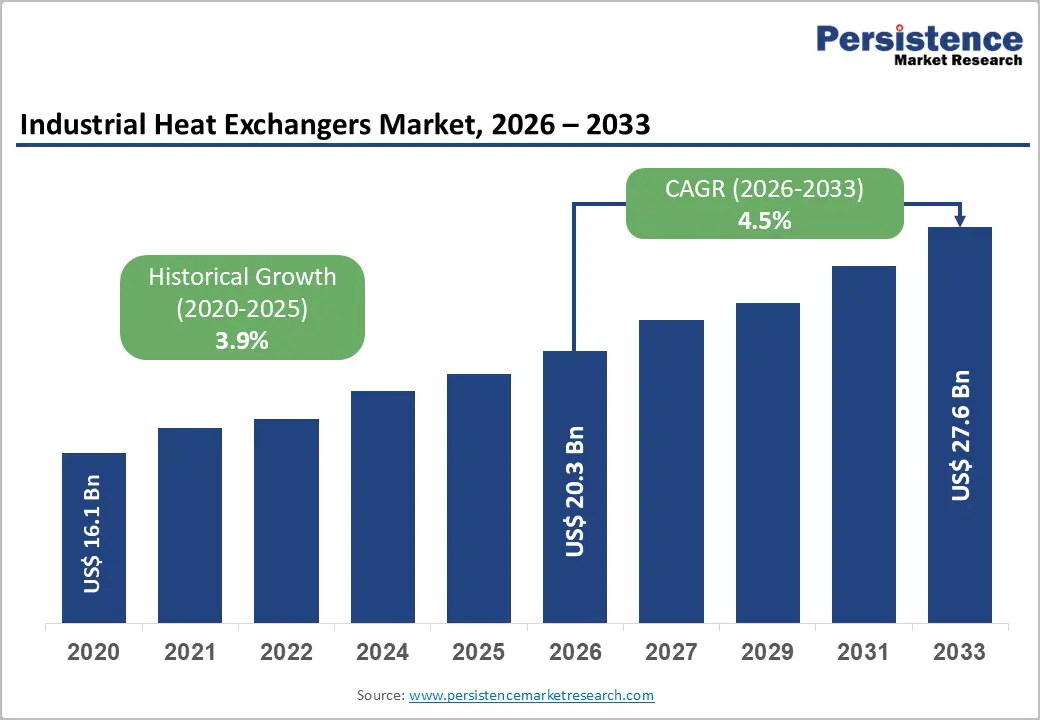
The global Industrial Heat Exchangers Market size is likely to be valued at US$ 20.3 billion in 2026 and is expected to reach US$ 27.6 billion by 2033, growing at a CAGR of 4.5% during the forecast period from 2026 to 2033. This steady expansion is driven by rising energy-efficiency requirements, aging infrastructure upgrades, and growing demand for reliable heat-transfer solutions across oil & gas, power generation, chemical & petrochemical, and HVAC & refrigeration sectors.
Key Industry Highlights:
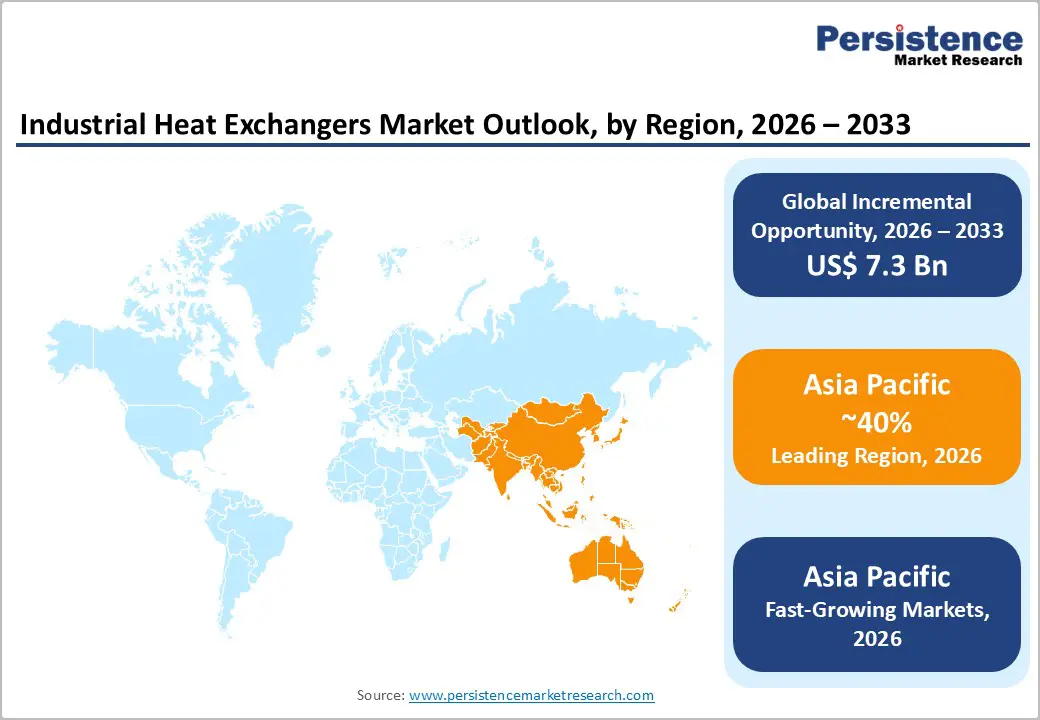
- Leading region: Asia Pacific leads the Industrial Heat Exchangers Market holding 40% share in the market, due to large populations, rising industrialization, and strong domestic manufacturing of heat exchangers in China, Japan, India, and ASEAN countries.
- Fastest-growing region: Asia Pacific is also the fastest-growing region, driven by energy-efficiency mandates, urbanization, and increasing demand for HVAC & refrigeration and oil & gas infrastructure.
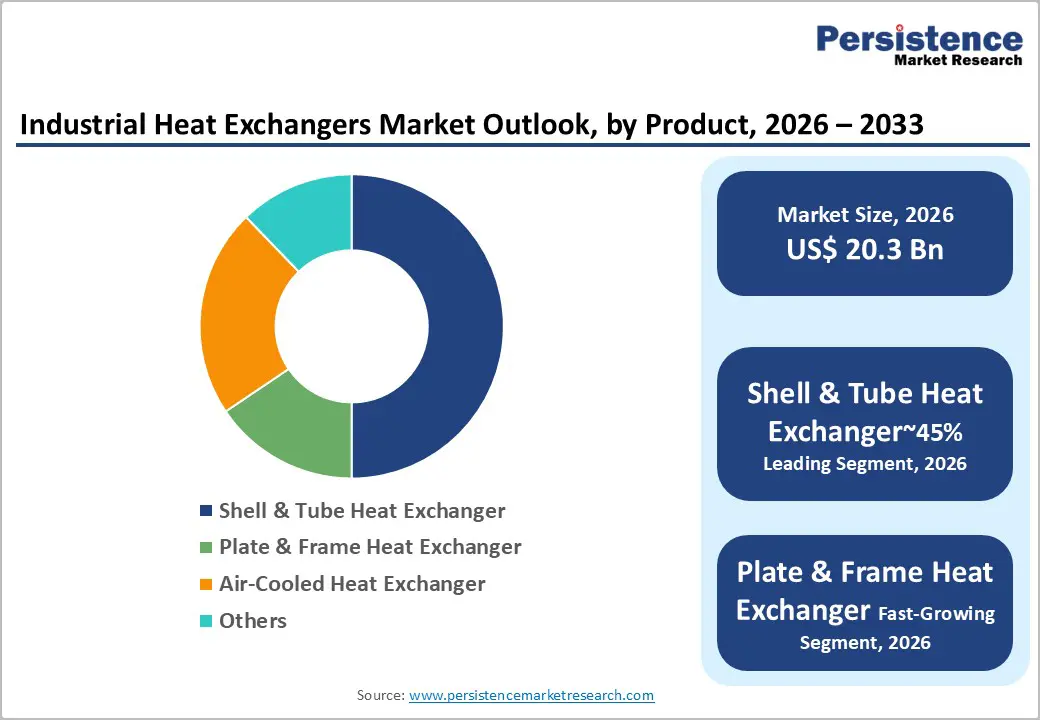
- Dominant segment: Shell & tube heat exchangers are the dominant product segment, capturing 45% of demand due to their widespread use in oil & gas, chemical & petrochemical, and power-generation applications.
- Fastest-growing segment: Plate & frame heat exchangers are one of the fastest-growing segments, expanding at a higher CAGR than the overall market as compact, high-efficiency units gain traction in HVAC & refrigeration, food & beverage, and pharmaceutical applications.
- Key market opportunity: The expansion of heat-recovery and waste-heat utilization systems in power generation, metals & mining, and chemical & petrochemical plants represents a high-value growth opportunity, particularly in Europe and Asia Pacific.
| Key Insights | Details |
|---|---|
|
Industrial Heat Exchangers Market Size (2026E) |
US$ 20.3 Billion |
|
Market Value Forecast (2033F) |
US$ 27.6 Billion |
|
Projected Growth CAGR (2026–2033) |
4.5% |
|
Historical Market Growth (2020–2025) |
3.9% CAGR |
Market Dynamics
Drivers - Rising Energy Regulations Driving Demand for High-Efficiency Industrial Heat Exchangers
Strict energy-efficiency standards and emissions regulations are a major growth driver for the Industrial Heat Exchangers Market, especially across power generation, oil & gas, and chemical and petrochemical industries. Regulatory frameworks such as the European Union’s Industrial Emissions Directive and the U.S. Environmental Protection Agency guidelines require industrial facilities to reduce fuel usage and lower carbon emissions. As a result, refineries, power plants, and chemical processors are increasingly investing in advanced heat exchanger technologies, including shell & tube, plate & frame, and air-cooled systems.
Industry studies show that modern heat exchangers can improve thermal efficiency by 10%, leading to meaningful reductions in energy consumption and operating costs. With governments worldwide strengthening climate commitments and sustainability targets, industries are prioritizing energy-efficient equipment upgrades. This regulatory push continues to drive strong and consistent demand for high-performance industrial heat exchangers across global markets.
Global Expansion of Energy and Processing Infrastructure Fueling Market Growth
The rapid expansion and modernization of oil & gas, petrochemical, and power generation infrastructure is another key factor supporting growth in the Industrial Heat Exchangers Market. Large-scale investments in new refineries, LNG terminals, gas-processing plants, ethylene crackers, and combined-cycle power stations are rising across Asia Pacific, the Middle East, and Latin America.
These facilities require extensive heat-transfer systems for cooling, condensation, energy recovery, and temperature control, creating strong demand for shell & tube and air-cooled heat exchangers. Countries such as China and India are expanding gas-based power capacity and petrochemical production to support industrial growth and energy security. Meanwhile, Middle Eastern nations are increasing refining and LNG capacity to diversify exports. These long-term infrastructure projects ensure continuous equipment replacement and upgrades, positioning industrial heat exchangers as essential components in modern energy and processing facilities.
Restraints - High Equipment and Maintenance Costs Limiting Adoption in Price-Sensitive Markets
One of the main challenges limiting growth in the Industrial Heat Exchangers Market is the high initial investment and ongoing maintenance costs associated with large-scale systems. Equipment such as shell & tube and air-cooled heat exchangers often requires specialized alloy materials, advanced engineering, and precision manufacturing, which significantly increases capital expenditure. In addition, regular cleaning, inspections, tube replacements, and downtime during maintenance add to long-term operational expenses.
For many companies, especially in cost-sensitive or emerging markets, these expenses can delay system upgrades or new installations. During periods of economic uncertainty, industries may prioritize short-term savings over equipment modernization, slowing purchasing activity. Smaller operators often struggle with financing options for large projects, further limiting market adoption. These cost-related barriers continue to impact procurement decisions, particularly in developing regions where budget limitations remain a critical concern.
Material Price Volatility and Supply Disruptions Impacting Production and Project Timelines
Supply-chain disruptions and limited availability of high-grade materials represent another major restraint in the Industrial Heat Exchangers Market. Many heat exchanger systems rely on stainless steel, nickel-based alloys, and titanium to withstand corrosion, high temperatures, and harsh industrial environments. Prices of these materials fluctuate due to global metal supply dynamics, geopolitical tensions, trade restrictions, and mining output changes.
Any disruption in sourcing can cause project delays, higher manufacturing costs, and extended delivery timelines. In recent years, logistics challenges and international trade uncertainties have further increased procurement risks for manufacturers and end-userrs. Although companies in North America and Europe are investing in local sourcing and diversified supply networks, these adjustments require significant capital and operational restructuring. As a result, material volatility continues to pressure profit margins and complicate long-term planning across the heat exchanger value chain.
Opportunity - Compact Plate Heat Exchangers Gaining Popularity for Energy Savings and Space Efficiency
The increasing demand for compact and high-efficiency plate & frame heat exchangers presents a strong growth opportunity across multiple industries. These systems are widely adopted in HVAC, refrigeration, food processing, pharmaceuticals, and district heating due to their superior heat-transfer performance and smaller space requirements. Compared with traditional shell & tube units, plate heat exchangers offer 20% higher thermal efficiency while reducing water usage and overall energy consumption. Their modular design allows users to expand or adjust capacity easily by adding or removing plates, making them ideal for retrofit projects and space-limited facilities. Manufacturers such as SWEP International and Sondex continue to introduce advanced gasketed, brazed, and semi-welded models for specialized applications. As businesses focus more on energy savings and sustainability goals, demand for these compact and efficient solutions is expected to rise steadily worldwide.
Rising Adoption of Waste-Heat Recovery Systems Boosting Demand for Advanced Heat Exchangers
Growing investments in heat-recovery and waste-heat utilization technologies offer another high-value opportunity for the Industrial Heat Exchangers Market. Industries such as power generation, metals, cement, chemicals, and mining are increasingly adopting systems that capture exhaust heat and reuse it for steam production, electricity generation, or process heating. Equipment such as economizers, heat-recovery steam generators, and exhaust-gas heat exchangers help improve overall plant efficiency by 5%, significantly lowering fuel consumption and emissions.
With rising energy costs and stricter environmental regulations, companies are actively seeking ways to maximize energy efficiency and reduce carbon footprints. European and Asia Pacific markets are leading adoption due to aggressive decarbonization policies and industrial modernization programs. As sustainability becomes a core business priority, heat-recovery systems are expected to become standard across heavy industries, boosting long-term demand for advanced heat exchangers.
Category-wise Analysis
Product Insights
Shell & tube heat exchangers remain the dominant product segment in the Industrial Heat Exchangers Market, accounting for approximately 45% of total market value. Their strong position is driven by widespread use in oil & gas, chemical processing, and power generation, where high pressure, extreme temperatures, and aggressive fluids are common. These exchangers are essential for applications such as condensers, reboilers, steam generators, and refinery process cooling systems.
Their durable construction allows them to handle harsh operating environments and corrosive substances, making them a preferred choice for critical industrial processes. Additionally, shell & tube designs support the use of premium alloys, enhancing reliability and long service life. Despite growing adoption of compact alternatives, their proven performance and flexibility continue to secure strong demand in large-scale facilities, reinforcing their role as the backbone of industrial heat-transfer systems.
Material Insights
Alloys form the leading material category in the Industrial Heat Exchangers Market, representing roughly 50% of total market value. This dominance reflects the need for high-performance materials that can withstand extreme temperatures, pressures, and corrosive industrial conditions. Stainless steels, nickel-based alloys, and titanium are widely used in oil & gas facilities, chemical plants, offshore platforms, and power stations where equipment reliability is critical. These materials offer superior resistance to corrosion, thermal stress, and mechanical wear, reducing downtime and maintenance risks.
As industrial processes continue to operate at higher efficiencies and more demanding conditions, the demand for premium alloy heat exchangers is steadily increasing. Stricter environmental regulations and process-intensification trends are further driving the use of advanced materials. This positions alloy-based systems as a long-term growth segment across energy, chemical, and heavy industrial applications.
End-user Insights
The oil & gas sector remains the largest end-use segment in the Industrial Heat Exchangers Market, accounting for approximately 30% of global demand. Heat exchangers are essential throughout upstream, midstream, and downstream operations, including gas processing, crude refining, LNG liquefaction, and compression systems. They play a critical role in cooling, condensation, heat recovery, and temperature control to ensure safe and efficient plant performance.
Shell & tube and air-cooled heat exchangers are particularly dominant in high-pressure and high-temperature environments common in this industry. As global energy demand continues to rise and LNG infrastructure expands across North America, Asia Pacific, and the Middle East, investment in new processing facilities remains strong. These developments create long-term replacement and expansion demand, reinforcing oil & gas as the core revenue driver for industrial heat exchanger manufacturers.
Regional Insights
North America Industrial Heat Exchangers Market Trends
North America represents a technologically advanced and regulation-driven market for industrial heat exchangers, led primarily by the United States. Strong enforcement of energy-efficiency and emissions standards by agencies such as the EPA and Department of Energy is encouraging industries to upgrade to high-performance heat-transfer equipment. Major investments in oil & gas processing, LNG export terminals, power generation, and industrial decarbonization projects are supporting long-term market growth.
The region also benefits from a strong innovation ecosystem, with companies introducing digital monitoring, modular designs, and compact solutions for improved operational efficiency. Heat recovery systems and energy-optimization projects are gaining momentum across chemical, refining, and manufacturing sectors. Combined with rising HVAC and data-center cooling demand, these trends position North America as a high-value, stable market focused on advanced, energy-efficient heat exchanger technologies.
Europe Industrial Heat Exchangers Market Trends
Europe is a sustainability-focused and regulation-led market, with strong demand across Germany, France, the United Kingdom, Spain, and Italy. The European Union’s energy efficiency and emissions directives are pushing industries to reduce fuel consumption and improve thermal performance, driving adoption of advanced heat exchanger systems. Germany’s chemical sector and France’s power generation industry are major users of shell & tube and air-cooled equipment, while district heating expansion across the UK and Scandinavia supports growing demand for plate heat exchangers.
Waste-heat recovery projects in cement, metals, and chemical industries are accelerating as part of the EU Green Deal and carbon-reduction initiatives. Strong ESG commitments from corporations are also encouraging long-term investments in energy-efficient infrastructure. Together, regulatory pressure, sustainability goals, and industrial modernization continue to position Europe as a steady growth region for high-performance heat-transfer solutions.
Asia Pacific Industrial Heat Exchangers Market Trends
Asia Pacific is the fastest-growing region in the Industrial Heat Exchangers Market, driven by rapid industrialization, infrastructure development, and energy expansion across China, India, Japan, and Southeast Asia. Government policies promoting energy efficiency and emissions reduction are accelerating adoption of advanced heat-transfer technologies in power plants, refineries, and chemical facilities. China’s industrial modernization programs and India’s expanding oil-refining and gas-processing capacity are generating strong demand for shell & tube and air-cooled exchangers.
ASEAN countries are emerging as manufacturing hubs for industrial equipment, supporting regional supply growth. Urbanization and cold-chain development are also boosting HVAC and refrigeration installations across the region. With large-scale infrastructure investment and favorable industrial policies, Asia Pacific continues to combine strong demand growth with expanding production capabilities, making it the most dynamic regional market globally.
Competitive Landscape
The industrial heat exchangers market features a moderately consolidated structure, with a few global manufacturers holding strong positions across major product categories while numerous regional players focus on fabrication and service support. Leading companies such as SPX Flow, Tranter, Sondex, and SWEP International dominate high-value segments through advanced engineering, proprietary designs, and digital performance solutions. These firms are heavily investing in research, material innovation, and smart monitoring technologies to improve efficiency and reliability.
Service-based business models, including predictive maintenance and performance contracts, are becoming increasingly common as customers seek long-term operational value. Sustainability-focused designs, compact systems, and integrated solutions are emerging as key competitive differentiators, especially in regulated markets. Overall, success in this market is increasingly driven by technological expertise, global reach, regulatory compliance capability, and strong after-sales service networks.
Key Developments:
- In April 2025: SPX Flow unveiled a new compact plate & frame heat exchanger in April 2025, designed for enhanced thermal performance and modular scalability in refrigeration and process-cooling sectors, strengthening its competitive position in food & beverage, pharmaceutical, and data-center thermal applications.
- In September 2024: Sondex committed €50 million to expand European production capacity for plate & frame heat exchangers, adding automation and digital quality controls to meet stronger demand from HVAC, refrigeration, and district-heating markets while improving supply-chain resilience.
- In March 2023: SWEP International launched a brazed plate heat exchanger in March 2023, tailored to heat-pump systems with high thermal efficiency and compact design, supporting Europe’s accelerating heat-pump adoption and energy-efficiency initiatives within commercial and residential heating segments.
Companies Covered in Industrial Heat Exchangers Market
- Almar Container Group
- CARU Containers BV
- China International Marine Containers Co. Ltd
- China Shipping Container Lines
- Evergreen Marine Corporation
- Ritveyraaj Cargo Shipping Containers
- Sea Box Inc
- Singamas Container Holdings Limited
- Triton International Limited
- W&K Container Inc.
- Shell & Tube Heat Exchangers (STHE)
- Sondex
- SPX Flow
- SWEP International
- Tranter
- GEA Group
- Alfa Laval AB
- Kelvion Holding GmbH
- Danfoss A/S
- Vahterus Oy
Frequently Asked Questions
The global Industrial Heat Exchangers Market is valued at US$ 20.3 Billion in 2026 and is projected to reach US$ 27.6 Billion by 2033, growing at a CAGR of 4.5% from 2026 to 2033, with a historical CAGR of 4.5% between 2020 and 2025.
Key demand drivers include energy‑efficiency regulations, emissions standards, and expansion of oil & gas, petrochemical, and power‑generation infrastructure, which require high‑performance heat‑transfer equipment to improve process efficiency and reduce fuel consumption.
The shell & tube heat exchangers segment is the leading product category, capturing 45% of demand due to their widespread use in oil & gas, chemical & petrochemical, and power‑generation applications.
Asia Pacific is the largest regional market for industrial heat exchangers, accounting for roughly 40% of global value, driven by industrialization, urbanization, and strong domestic manufacturing in China, Japan, India, and ASEAN countries.
A key opportunity lies in the expansion of heat‑recovery and waste‑heat utilization systems in power generation, metals & mining, and chemical & petrochemical plants, which can improve efficiency by 15% and reduce emissions.


