




- Industrial Goods & Service
- Hydraulic Hoses Market
Hydraulic Hoses Market Size, Share, and Growth Forecast, 2026 – 2033
Hydraulic Hoses Market by Product Type (Reinforced, Corrugated, Coiled, Braided), Material (Rubber, Thermoplastic, Metal, Polytetrafluoroethylene (PTFE)), Application (Agriculture, Construction, Others), and Regional Analysis for 2026 – 2033

Hydraulic Hoses Market Size and Trends Analysis
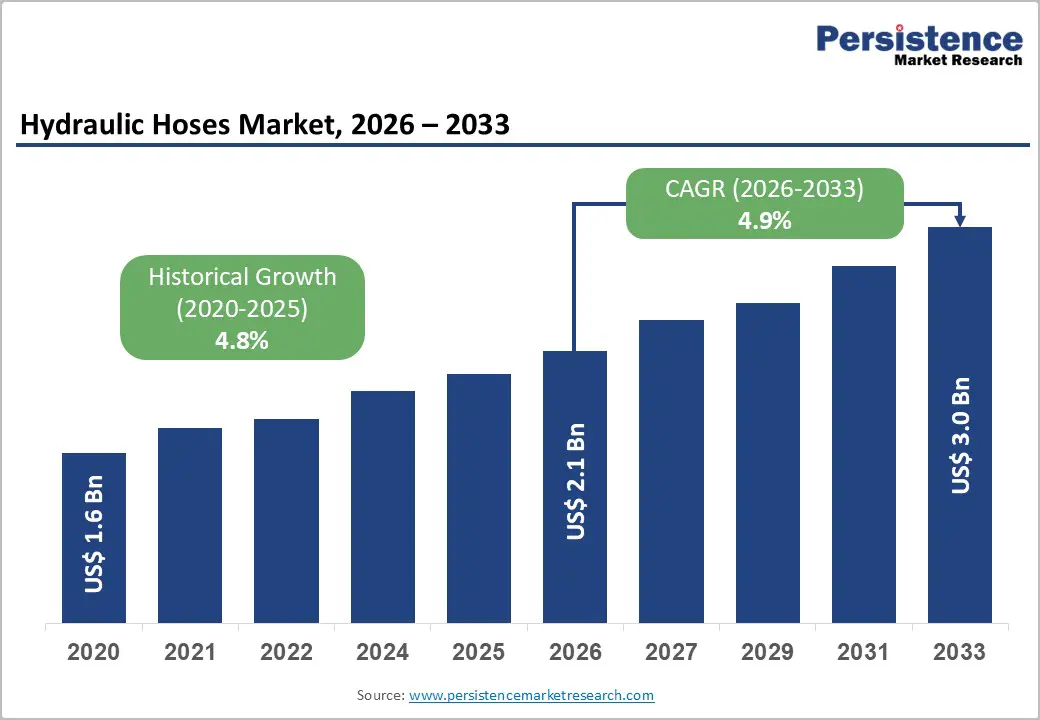
The global hydraulic hoses market size is likely to be valued at US$2.1 billion in 2026 and is expected to reach US$3.0 billion by 2033, growing at a CAGR of 4.9% during the forecast period from 2026 to 2033, driven by expanding industrialization, infrastructure development, and mechanization across multiple sectors. Hydraulic hoses are essential components in fluid power systems, enabling efficient transmission of hydraulic fluids in construction machinery, agricultural equipment, material handling systems, automotive applications, and industrial machinery, which ensures ongoing demand for both new installations and replacements. The market is being shaped by technological advancements in hose design, including the development of reinforced, braided, coiled, and thermoplastic hoses that offer improved flexibility, durability, and pressure resistance, as well as the integration of smart sensors for condition monitoring and predictive maintenance. Trends toward sustainability and environmental compliance are influencing material choices, with manufacturers incorporating eco-friendly rubber, PTFE, and thermoplastic materials to reduce environmental impact while enhancing performance.
Key Industry Highlights:
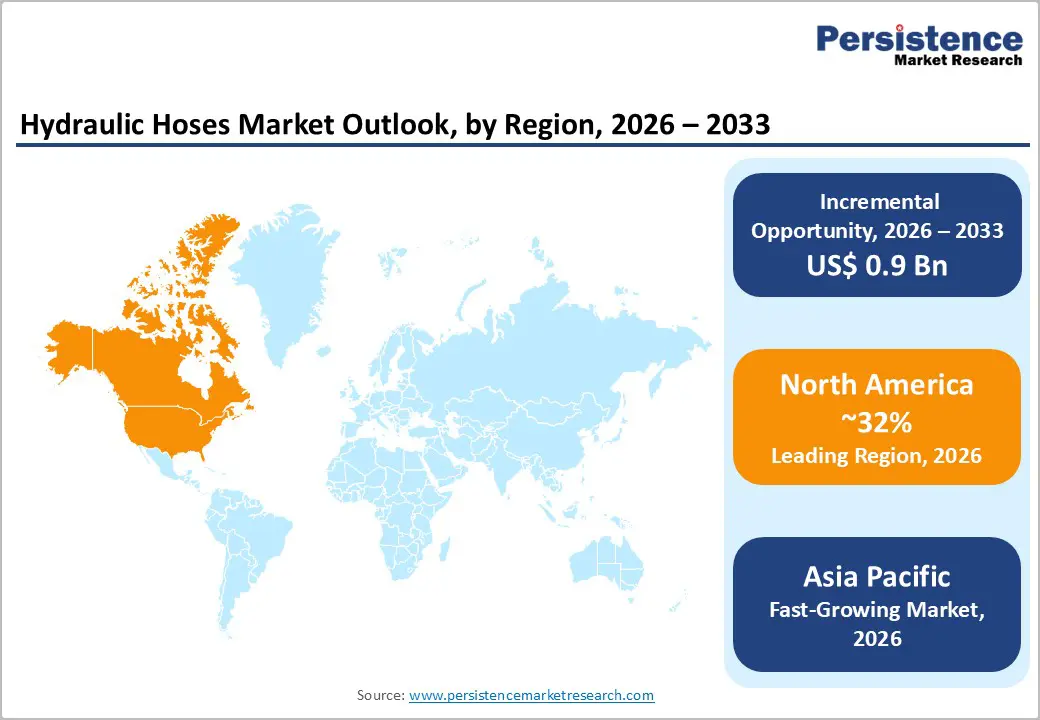
- Leading Region: North America is anticipated to be the leading region, accounting for a market share of 32% in 2026, driven by strong manufacturing, infrastructure, and technological innovation.
- Fastest-growing Region: Asia Pacific is likely to be the fastest-growing region, supported by rapid industrialization, infrastructure, and agricultural mechanization.
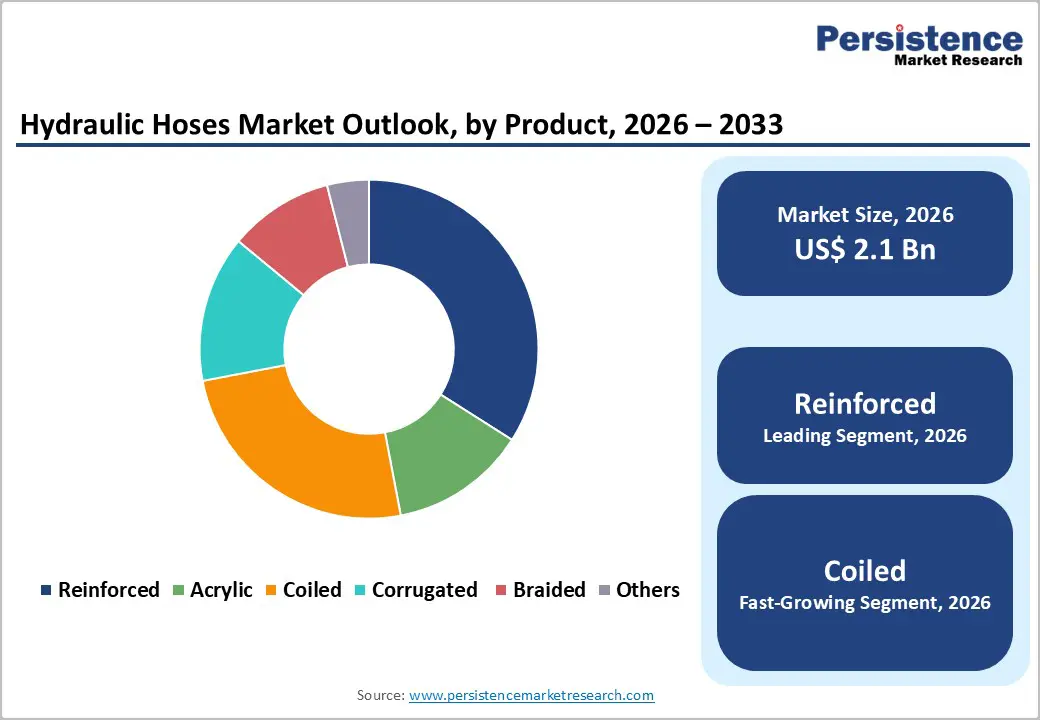
- Leading Product Type: Reinforced hydraulic hoses are projected to represent the leading product type in 2026, accounting for 45% of the revenue share, driven by their durability and versatility. They remain the preferred choice for heavy-duty construction, agriculture, and industrial applications.
- Leading Material: Rubber hydraulic hoses are anticipated to be the leading material, accounting for over 50% of the revenue share in 2026, supported by their cost-effectiveness, resilience in harsh conditions, and broad compatibility with existing equipment.
| Key Insights | Details |
|---|---|
|
Hydraulic Hoses Market Size (2026E) |
US$2.1 Bn |
|
Market Value Forecast (2033F) |
US$3.0 Bn |
|
Projected Growth (CAGR 2026 to 2033) |
4.9% |
|
Historical Market Growth (CAGR 2020 to 2025) |
4.8% |
Market Factors – Growth, Barriers, and Opportunity Analysis
Growth Analysis - Rising Demand for Construction and Mining Equipment
Heavy machinery such as excavators, loaders, bulldozers, and drilling rigs relies extensively on hydraulic systems for fluid transmission and operational efficiency. As infrastructure projects expand, particularly in urbanization, road development, and mining exploration, equipment utilization intensifies, driving the need for durable hydraulic hoses. Reinforced and high-pressure variants are preferred for these applications due to their ability to withstand extreme mechanical stress. Continuous replacement cycles for maintenance support sustained market growth, positioning construction and mining equipment demand as a primary driver for hydraulic hose adoption.
Rising construction activity in developing economies and mining expansions in resource-rich regions increase both new installations and aftermarket demand for hydraulic hoses. Equipment modernization and fleet expansions in large-scale projects necessitate hoses that can endure high pressure, abrasion, and temperature variations. OEMs favor reinforced and wire-braided hoses, which offer reliability and longevity, minimizing downtime. Growth in specialized machinery for tunneling, material handling, and bulk excavation amplifies hose consumption. Government-funded infrastructure programs, industrial parks, and urban development initiatives also indirectly support the hydraulic hoses market, ensuring continuous demand from heavy-duty construction and mining machinery sectors.
Growth in Agricultural Mechanization and Industrial Automation
These machines require high-performance hoses to handle hydraulic fluid transfer under high pressure while remaining flexible and durable. Industrial automation in factories and material handling plants employs hydraulic-powered robotic arms, presses, and conveyor systems. The integration of hydraulic hoses in automated systems ensures precise motion control, reducing manual intervention and improving productivity. Rising adoption of smart agriculture technologies and automated production lines enhances hose utilization, contributing to market growth. Both sectors support replacement cycles and installation of new equipment, amplifying overall demand.
As agricultural sectors modernize, particularly in Asia Pacific and North America, the demand for reliable hydraulic hoses has surged. Equipment exposed to varying weather and soil conditions requires hoses resistant to abrasion, temperature fluctuations, and chemical exposure. Industrial automation in manufacturing plants and logistics facilities relies on hydraulic systems for efficient operations. The push for higher productivity, reduced labor costs, and precision operations reinforces the adoption of advanced hydraulic hoses. Multi-layered, reinforced, and thermoplastic hoses are increasingly preferred, combining strength with lightweight flexibility. Growth in mechanized farming and industrial automation continues to be a major driver for the hydraulic hoses market.
Barrier Analysis - Technological Convergence Risks from Alternative Systems
Hydraulic hoses face potential restraint from emerging alternative technologies, including electric actuators, pneumatic systems, and electro-hydraulic hybrids. These solutions offer lower maintenance, reduced leakage risk, and energy efficiency, posing competition to traditional hydraulic systems. As industries explore smart and sustainable automation, the adoption of alternatives could limit hydraulic hose market penetration, especially in cost-sensitive or environmentally regulated regions. The convergence of these technologies also creates integration challenges, requiring hoses to meet higher performance standards while coexisting with new systems. Manufacturers must invest in innovation to remain competitive and maintain relevance amid shifting technological preferences across industrial, agricultural, and construction applications.
The rise of compact, energy-efficient alternatives can impact the replacement demand for hydraulic hoses in OEM and aftermarket segments. Electric and pneumatic solutions reduce the need for traditional high-pressure fluid transmission, potentially diminishing hose consumption in certain sectors. Integration with hybrid systems demands hoses that can operate under unconventional pressures or temperatures, increasing design complexity and cost. Firms that fail to adapt face market share erosion, particularly in regions aggressively pursuing automation and green technology adoption. Technological convergence represents a significant restraint, compelling hydraulic hose manufacturers to focus on innovation, compatibility, and multi-functional solutions to sustain growth.
Abrasion and Fatigue Durability Issues
Hydraulic hoses are inherently subject to wear and tear due to constant exposure to high pressure, fluid friction, vibration, and bending cycles. Abrasion from external environments, such as dust, gravel, and chemical contact, accelerates material degradation, while fatigue from repeated flexing can lead to hose failure. Such durability issues create operational risks, including leaks, system inefficiency, and unplanned downtime. Maintenance and replacement cycles increase operational costs for end users, which can restrain market growth. Ensuring consistent quality and selecting appropriate materials are critical for mitigating these risks, as users demand reliability in demanding construction, mining, and industrial applications.
High-pressure hydraulic systems amplify the impact of hose abrasion and fatigue, particularly in mobile and industrial equipment. Rubber hoses may crack over time, while thermoplastic or PTFE hoses can degrade under thermal and chemical stress. Fatigue-related failures can compromise safety, resulting in downtime or equipment damage. These issues necessitate frequent inspection, preventive maintenance, and replacement, raising total ownership costs and influencing end-user purchasing decisions. Durability concerns act as a restraint on hydraulic hose adoption, prompting manufacturers to develop reinforced, abrasion-resistant, and multi-layered hoses to address operational reliability challenges while maintaining competitive performance standards across diverse sectors.
Opportunity Analysis - Technological Convergence with Lightweight and Eco-Friendly Materials
Thermoplastic, PTFE, and composite materials reduce hose weight while maintaining pressure resistance and flexibility, enhancing energy efficiency in mobile and industrial equipment. Eco-friendly materials, including recyclable and low-emission rubber compounds, align with sustainability goals, meeting regulatory standards and corporate responsibility mandates. Adoption of such materials also supports lighter machinery designs, lowering fuel consumption and operating costs. The convergence of advanced materials with hydraulic technology allows manufacturers to offer differentiated products, addressing market demand for sustainable, high-performance hoses across construction, agriculture, and industrial automation sectors.
Manufacturers leveraging lightweight, eco-friendly hoses can tap into growing environmental awareness and regulatory pressures. Innovations in multi-layer construction and polymer blends improve chemical resistance, durability, and operational lifespan, providing value-added solutions for end users. Sustainable material adoption also facilitates market entry in regions with stringent environmental regulations, while enhancing brand reputation. As industries increasingly prioritize energy efficiency and reduced environmental footprint, these hoses become preferred choices for OEMs and aftermarket providers. Technological convergence with lightweight and eco-conscious materials represents a lucrative opportunity, enabling growth, product differentiation, and long-term market sustainability for hydraulic hose manufacturers.
Industrial Automation Convergence
Industrial automation is driving new opportunities for hydraulic hoses, as advanced machinery increasingly relies on hydraulic systems for precise motion control, force transmission, and fluid handling. Integration with automated assembly lines, robotic systems, and material handling equipment demands hoses capable of high reliability, flexibility, and durability under continuous operation. The adoption of smart hydraulic systems with sensors, condition monitoring, and predictive maintenance increases hose requirements, opening avenues for technologically advanced and connected products. Manufacturers that align hoses with automation trends can capture value from OEMs and aftermarket providers seeking efficiency, reduced downtime, and seamless integration in automated operations.
As factories, warehouses, and processing plants expand automation capabilities, hydraulic hoses are central to the performance of robotic arms, presses, and mobile material handling units. Customizable hoses that withstand high pressure, repetitive motion, and temperature variations become essential to maintain operational continuity. Opportunities exist in designing hoses compatible with IoT-enabled systems, providing real-time monitoring of fluid flow, pressure, and wear. These solutions help industrial operators optimize maintenance schedules, reduce operational costs, and enhance productivity. Convergence with industrial automation creates a significant growth avenue, positioning hydraulic hoses as integral components in the modernization of industrial processes and smart factory ecosystems.
Category-wise Analysis
Product Type Insights
Reinforced hydraulic hoses are expected to lead the hydraulic hoses market, accounting for approximately 45% of revenue in 2026, driven by their superior strength, durability, and ability to handle high-pressure applications across demanding industries. These hoses, particularly wire-braided and multi-layer reinforced variants, are widely used in construction, agriculture, and industrial machinery where reliability under extreme operating conditions is essential. As heavy equipment usage continues to grow, the need for robust hydraulic solutions strengthens the dominance of reinforced hoses. For example, their extensive use in excavators and loaders in large-scale construction projects, where consistent hydraulic performance is critical for lifting, digging, and material handling operations, reinforces their leading position in the market.
Coiled hydraulic hoses are likely to represent the fastest-growing segment, supported by increasing demand for compact, flexible, and space-efficient solutions in modern hydraulic systems. These hoses are specifically designed with a spiral or coiled structure that allows them to extend and retract easily, making them highly suitable for applications requiring mobility and organized hose management. Their ability to minimize clutter, prevent kinking, and reduce wear during repeated motion makes them ideal for dynamic environments such as mobile machinery and lifting systems. For example, their use in aerial work platforms and hydraulic lifts, where coiled hoses enable smooth extension and retraction during vertical movement, ensuring consistent fluid transfer while maintaining flexibility and durability in continuous operation environments.
Material Insights
Rubber is projected to lead the market, capturing around 50% of the revenue share in 2026, supported by its cost-effectiveness, durability, and adaptability across a wide range of industrial applications. These hoses are widely preferred in construction, mining, and heavy machinery operations because they can withstand harsh environmental conditions, including extreme temperatures, abrasion, and exposure to chemicals. Their ease of manufacturing and availability in various specifications contribute to their widespread adoption. For example, their extensive use in mining equipment such as drilling rigs and haul trucks, where reliable hydraulic performance under rugged conditions is essential, reinforces rubber hoses as the leading material segment in the market.
Polytetrafluoroethylene (PTFE) is likely to be the fastest-growing material, driven by its lightweight nature, superior chemical resistance, and increasing alignment with sustainability goals. These materials offer distinct advantages over traditional rubber hoses, including lower weight, higher flexibility, and enhanced resistance to corrosion and aggressive fluids, making them suitable for specialized applications. Regulatory pressures encouraging environmentally friendly and energy-efficient solutions support their adoption. For example, their use in automotive fuel and brake systems, where lightweight and corrosion-resistant properties contribute to improved vehicle efficiency and safety, is accelerating their growth as the fastest-growing material segment.
Regional Insights
North America Hydraulic Hoses Market Trends
North America is anticipated to be the leading region, accounting for a market share of 32% in 2026, driven by strong demand from construction, oil & gas, agriculture, and industrial automation sectors, with the U.S. acting as the primary growth engine. Increasing infrastructure renewal projects and high machinery utilization are driving consistent demand for high-pressure and reinforced hydraulic hoses. Strict regulatory standards related to safety, leakage prevention, and environmental compliance are pushing manufacturers toward advanced, durable, and certified hose solutions. The region is also witnessing a shift toward high-performance materials such as thermoplastics and hybrid polymers, which offer better resistance to extreme temperatures, chemicals, and abrasion.
The integration of IoT-enabled hoses for real-time monitoring and predictive maintenance is gaining traction, improving operational efficiency and reducing downtime in industrial applications. For example, Gates Corporation introduced an advanced ultra-flexible coolant hose designed for high-density data centers, supporting modern infrastructure and energy-efficient systems. This reflects the region’s focus on innovation, sustainability, and performance optimization. The expansion of digital procurement platforms and strong distribution networks enhances accessibility and competitiveness, positioning North America as a technologically advanced and mature market for hydraulic hoses.
Europe Hydraulic Hoses Market Trends
Europe is likely to be a significant market for hydraulic hoses in 2026, due to strong industrial foundations, particularly in automotive manufacturing, industrial machinery, and high-precision engineering sectors. Countries such as Germany, France, Italy, and the U.K. play a central role in driving demand, with widespread adoption of hydraulic systems in robotics, production lines, and heavy equipment. The region emphasizes compliance with stringent regulatory frameworks such as REACH and Pressure Equipment Directive (PED), which promote the use of high-quality, low-emission, and recyclable hose materials.
Increasing adoption of eco-friendly and lightweight hoses is aligned with the region’s environmental goals, while rising automation in manufacturing plants continues to support replacement demand. For example, Continental AG has introduced advanced hose solutions designed for high-performance industrial and food-grade applications, incorporating innovative materials that meet strict European standards. This reflects the broader market trend toward high-specification, application-specific products. Expansion of production facilities in Eastern Europe and increasing investments in localized manufacturing and supply chains are improving delivery efficiency, positioning Europe as a technologically advanced and regulation-driven hydraulic hoses market.
Asia Pacific Hydraulic Hoses Market Trends
The Asia Pacific region is likely to be the fastest-growing region, driven by strong industrialization, infrastructure development, and increasing mechanization across key economies such as China, India, and Southeast Asia. Large-scale government initiatives, including infrastructure corridors and smart city projects, are significantly increasing the demand for construction and earthmoving equipment, which rely heavily on hydraulic hoses. The growing adoption of agricultural machinery and automation in manufacturing is accelerating hose utilization across diverse applications.
Manufacturers are investing in local production and innovation to cater to growing regional demand and improve supply chain responsiveness. For example, Polyhose India Pvt. Ltd. has expanded its manufacturing capabilities and introduced high-performance thermoplastic and spiral hoses designed for industrial and export markets, reflecting the region’s emphasis on innovation and scalability. Increasing environmental awareness is encouraging the adoption of eco-friendly and energy-efficient hose materials, while automation and robotics integration continue to create long-term growth opportunities.
Competitive Landscape
The global hydraulic hoses market exhibits a moderately fragmented structure, driven by the presence of a mix of large multinational corporations and numerous regional and niche manufacturers competing across diverse application segments. While a handful of players hold a significant share, a substantial portion of the market remains distributed among local suppliers focusing on cost competitiveness and customized solutions. The competitive dynamics are influenced by strong demand from construction, agriculture, and industrial sectors, along with increasing emphasis on high-performance and application-specific hose solutions.
With key leaders including Parker Hannifin Corporation, Eaton Corporation, Gates Corporation, Continental AG, Bridgestone Corporation, and Manuli Hydraulics, the market reflects strong competition among established brands. These players compete through product innovation, advanced material development, and integration of smart technologies such as IoT-enabled hoses for predictive maintenance and real-time monitoring. Companies focus on expanding distribution channels, strengthening OEM partnerships, and offering value-added services such as on-site assembly and aftermarket support.
Key Industry Developments:
- In March 2026, Danfoss launched the Aeroquip FC619C corrugated hydraulic hose, featuring the industry’s smallest bend radius, enabling superior flexibility and easier installation in compact hydraulic systems while enhancing durability and resistance to abrasion, temperature, and vacuum conditions.
- In October 2025, Continental AG (through its ContiTech division) launched a Reduced Dimension Spiral hydraulic hose series in the Asia-Pacific region, designed to deliver high-pressure performance with improved flexibility, reduced weight, and extended service life, enhancing efficiency in construction, mining, and agricultural equipment.
Companies Covered in Hydraulic Hoses Market
- Parker Hannifin Corporation
- Eaton Corporation
- Gates Corporation
- Manuli Hydraulics
- RYCO Hydraulics
- Bridgestone Corporation
- Kurt Manufacturing
- Semperit AG Holding
- Continental AG
- Dunlop Hiflex
- Trelleborg AB
- Alfagomma Group
- Polyhose India Pvt. Ltd.
- Hansa-Flex AG
- Yokohama Rubber Co., Ltd.
- Flexaust Inc.
- Transfer Oil S.p.A.
- Hose Solutions Inc.
- JGB Enterprises, Inc.
- Kuriyama of America, Inc.
Frequently Asked Questions
The global hydraulic hoses market is projected to reach US$2.1 billion in 2026.
The hydraulic hoses market is driven by rising demand from construction, mining, agricultural mechanization, and industrial automation sectors.
The hydraulic hoses market is expected to grow at a CAGR of 4.9% from 2026 to 2033.
Key market opportunities lie in the adoption of lightweight, eco-friendly materials and the integration of smart, IoT-enabled hydraulic hose solutions.
Parker Hannifin Corporation, Eaton Corporation, Gates Corporation, Manuli Hydraulics, and RYCO Hydraulics are the leading players.


