




- Food Ingredients & Additives
- Non-sugar Sweetener Market
Non-sugar Sweetener Market Size, Share, and Growth Forecast, 2026 - 2033
Non-sugar Sweetener Market by Product Type (Aspartame, Sucralose, Saccharin, Acesulfame Potassium (Ace-K), Cyclamate, Stevia, Monk Fruit, Neotame, Advantame, Allulose, Tagatose, Sugar Alcohols, Other Sweeteners), Source (Artificial Sweeteners, Natural Sweeteners, Sugar Alcohols, Novel Sweeteners) Form (Powder, Granules, Liquid, Tablets, Other), Application (Beverages, Bakery and Confectionery, Dairy Products, Packaged Foods, Pharmaceuticals, Oral Care, Dietary Supplements, Other), and Regional Analysis for 2026 - 2033

Non-sugar Sweetener Market Size and Trends Analysis
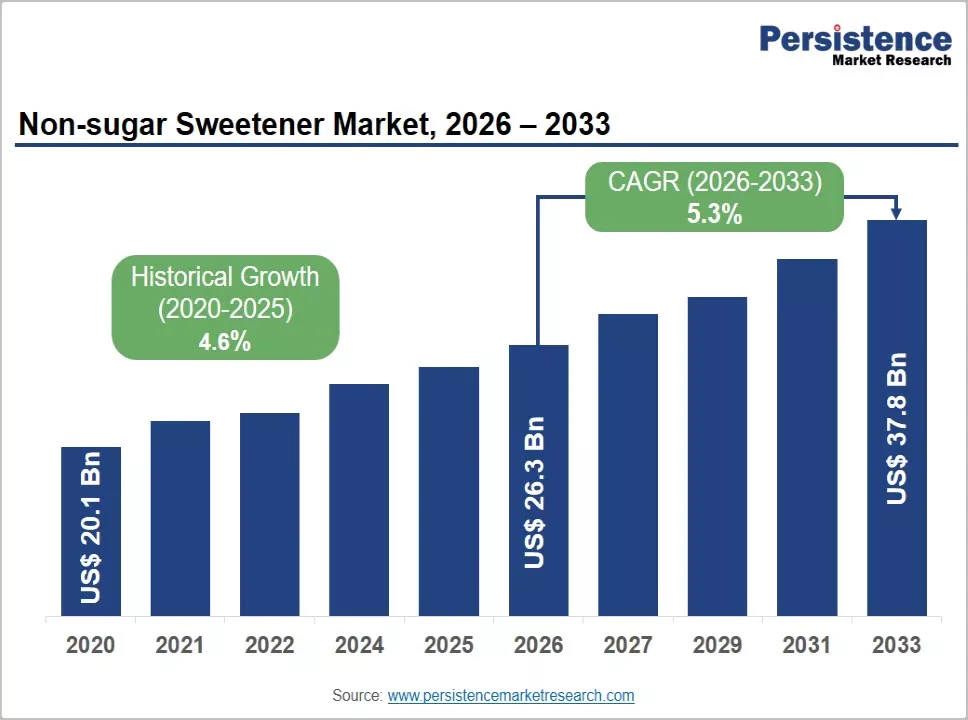
The global non-sugar sweetener market size is likely to be valued at US$26.3 billion in 2026 and is estimated to reach US$37.8 billion by 2033, growing at a CAGR of 5.3% during the forecast period 2026 - 2033, driven by rising obesity prevalence, sugar-reduction regulation, clean-label formulation, and expansion of low-calorie food and beverage manufacturing.
Demographic trends reinforce this shift. Urbanization, aging populations, rising diabetes risk, and expanding middle-income consumption are increasing demand for products that deliver sweetness with lower caloric load. The result is a broader customer base for high-intensity sweeteners, natural extracts, sugar alcohols, and novel sweeteners.
Key Industry Highlights:
- Leading Product Type: Aspartame is set to hold around 24% market share in 2026, driven by high sweetness intensity and established use in beverages. The FDA identifies aspartame among approved high-intensity sweeteners.
- Fastest-Growing Product Type: Allulose is projected as the fastest-growing segment, supported by favorable labeling treatment and sugar-like functionality. FDA guidance applies enforcement discretion to exclude allulose from Total Sugars and Added Sugars declarations.
- Leading Source: Artificial sweeteners are estimated to hold roughly 58% market share in 2026, due to mature approvals and low dosage requirements. The FDA lists six high-intensity sweeteners as approved food additives.
- Fastest-Growing Source: Natural sweeteners are forecast to record the fastest growth, driven by clean-label demand.
- Leading Application: Beverages are likely to hold around 38% market share in 2026, due to high-volume reformulation and sugar-reduction regulation. The U.K. Soft Drinks Industry Levy contributed to a 46% average reduction in sugar in in-scope soft drinks between 2015 and 2020.
- Fastest-Growing Application: Dairy products are anticipated to grow fastest, driven by levy-driven reformulation in milk-based beverages. The U.K. Government announced that specified milk-based and milk-alternative drinks will enter levy scope from January 2028.
- Regional Leadership: North America is projected to capture roughly 43% of market share in 2026, while Asia Pacific is forecast to record the fastest growth due to expanding processed-food and beverage production.
DRO Analysis
Driver - Rising Obesity Burden and Preventive Nutrition Demand
The global burden of obesity is creating durable demand for sweetness without the caloric and metabolic consequences associated with added sugar. The WHO estimates that 1.1 billion people were living with obesity in 2024, including 940 million adults, while 45% of adults worldwide were overweight. This burden increases the incidence of type 2 diabetes, cardiovascular disease, and other noncommunicable conditions, placing prevention at the center of public-health policy.
Food and beverage manufacturers respond by reducing sugar content while retaining palatability. Non-sugar sweeteners enable calorie reduction without eliminating sweetness, allowing brands to preserve consumer acceptance in soft drinks, flavored dairy, confectionery, and packaged foods. This creates a direct cause-and-effect link between obesity prevalence, reformulation programs, and ingredient demand.
Restraint - Taste and Functional Formulation Limitations
High-intensity sweeteners can introduce bitterness, metallic notes, delayed sweetness, or lingering aftertaste, especially at higher replacement levels. These sensory constraints limit the share of sugar that can be removed in a single formulation step.
Sugar also contributes bulk, viscosity, browning, freezing-point depression, moisture retention, and microbial stability. Replacing it requires complementary ingredients such as fibers, polyols, bulking agents, flavors, and stabilizers. This raises formulation complexity and input costs, compressing margins in price-sensitive categories.
Opportunity - Blended Sweetener Platforms and Taste Modulation
The growth pathway is to commercialize multi-component systems that combine high-intensity sweeteners, bulk sweeteners, fibers, and flavor modifiers. Blends reduce off-notes, improve the temporal sweetness profile, and lower the cost of achieving a sugar-like sensory experience.
Expansion logic rests on application breadth. A single optimized platform can serve beverages, bakery, dairy, confectionery, and nutritional products, allowing ingredient suppliers to increase account penetration without relying on one molecule. Platform strategies improve customer retention because reformulation becomes faster and more repeatable. Innovation and policy align in this opportunity. Regulatory reevaluation by EFSA continues across permitted sweeteners, raising the value of transparent safety data, validated specifications, and traceable supply chains.
Category-wise Analysis
Product Type Insights
Aspartame is expected to lead the segment, accounting for 24% of revenue in 2026. Its high sweetness intensity, established regulatory approvals, low use level, and compatibility with beverages and tabletop products support continued adoption. The FDA identifies aspartame among approved high-intensity sweeteners and states that approved sweeteners are safe under approved conditions of use. A practical example is diet carbonated soft drinks, where aspartame is frequently combined with acesulfame potassium to balance sweetness and stability.
Allulose is likely to represent the fastest-growing segment, propelled by reduced-calorie formulation needs and favorable labeling treatment. The FDA guidance applies enforcement discretion to exclude allulose from Total Sugars and Added Sugars declarations while using 0.4 kcal/g for calorie determination. A real-world example is reduced-sugar ice cream, where allulose supports sweetness, freezing behavior, and texture. Growth is reinforced by bakery, confectionery, and beverage applications seeking sugar-like functionality with fewer calories.
Form Insights
The powder segment is expected to lead the non-sugar sweetener market, accounting for 42% of market revenue in 2026. Powdered forms offer handling efficiency, long shelf life, accurate dosing, and compatibility with dry mixes, bakery premixes, supplements, and tabletop sweeteners. The FDA recognizes multiple high-intensity sweeteners as approved food additives, supporting broad industrial use across dry formulations. An example is protein powder and meal-replacement products, where powdered sweeteners integrate readily into blending operations.
The liquid segment is likely to represent the fastest-growing segment, propelled by beverage manufacturing and precision dosing requirements. Liquid sweetener systems dissolve rapidly, reduce dust exposure, and support continuous dosing in automated production lines. A practical example is ready-to-drink iced tea, where liquid stevia or sucralose systems enable uniform sweetness without additional dissolution steps.
Source Insights
Artificial sweeteners are projected to lead the market, capturing around 58% of the market share in 2026. Aspartame, sucralose, saccharin, acesulfame potassium, neotame, and advantame offer high sweetness potency, low dosage requirements, and established manufacturing scale. The FDA lists these six high-intensity sweeteners as approved food additives. A real-world example is sugar-free chewing gum, which commonly uses acesulfame potassium and aspartame to deliver lasting sweetness.
Natural sweeteners are likely to be the fastest-growing segment, fueled by clean-label demand, plant-based positioning, and advances in extraction and taste modulation. Stevia and monk fruit extracts increasingly replace artificial sweeteners in premium beverages, dairy, and nutritional products. An example is a stevia-sweetened sparkling water, where purification and flavor modulation reduce bitterness while preserving a natural ingredient claim.
Application Insights
Beverages are likely to be the leading segment with a projected 38% of the non-sugar sweetener market share in 2026 due to high-volume consumption, strong sugar-reduction pressure, and established reformulation pathways. Carbonated soft drinks, juices, flavored water, energy drinks, and ready-to-drink tea and coffee require sweetness systems that remain stable across pH, temperature, and storage conditions. The United Kingdom levy has already driven substantial sugar reduction in soft drinks, with a 46% average reduction between 2015 and 2020.
Dairy products are anticipated to be the fastest-growing segment, fueled by expansion in flavored milk, yogurt, ice cream, and ready-to-drink dairy beverages. Sugar reduction in dairy requires attention to texture, fermentation behavior, freezing point, and browning, creating demand for blended sweetener systems. A real-world example is high-protein yogurt sweetened with stevia and allulose to reduce added sugar while maintaining creaminess.
Regional Insights
North America Non-Sugar Sweetener Market Trends
North America is anticipated to be the leading region, accounting for around 43% of market share in 2026, driven by mature low-calorie beverage categories and strong reformulation activity. The U.S. is expected to contribute the largest regional share. Canada is forecast to hold a smaller but stable share. Regulatory clarity supports adoption across food and beverage manufacturing. The FDA lists six high-intensity sweeteners as approved food additives. Demand is expected to rise in soft drinks, dairy, confectionery, supplements, and oral care. Investment in blending, fermentation, and purification capacity is likely to improve supply reliability.
U.S. Non-Sugar Sweetener Market Insights
The U.S. is anticipated to dominate the North America market, capturing nearly 84% of market share in 2026. The country is expected to lead regional demand because of its large beverage industry and extensive packaged-food base. Reduced-sugar claims are likely to expand across carbonated drinks, protein beverages, frozen desserts, and supplements. FDA guidance supports the use of allulose in reduced-sugar formulations by applying enforcement discretion to its exclusion from Total Sugars and Added Sugars declarations. Investment is likely to focus on fermentation capacity, purification, and taste modulation.
Canada Non-Sugar Sweetener Market Insights
Canada is forecast to hold around 16% of market share in 2026. The country is expected to record steady growth supported by nutrition labeling requirements and consumer interest in lower-sugar products. Beverages, flavored yogurt, frozen desserts, and sugar-free gum are likely to remain priority application areas. Stevia, sucralose, and polyol-based systems are expected to gain adoption. Food manufacturers are likely to use blended sweeteners to manage taste, texture, and shelf stability. Ingredient availability is expected to improve through regional distribution and technical support.
Europe Non-Sugar Sweetener Market Trends
Europe is expected to command around 28% of market share in 2026, propelled by sugar-reduction policy and sustained product reformulation. The U.K. is expected to contribute a major share within the region. Germany is projected to hold a significant share because of its large food-processing base. The U.K. Soft Drinks Industry Levy contributed to a 46% average reduction in sugar in in-scope soft drinks between 2015 and 2020. Demand is expected to increase in beverages, dairy, confectionery, and tabletop products.
Germany Non-Sugar Sweetener Market Insights
Germany is anticipated to lead within Europe, holding about 28% of market share in 2026. The country is projected to remain a major European demand center owing to its beverage, bakery, dairy, and confectionery industries. Consumer preference for ingredient transparency is likely to favor stevia, polyols, and fermentation-derived sweeteners. Sugar-reduced beverages, dairy desserts, bakery products, and pharmaceutical formulations are expected to drive adoption. EFSA re-evaluation activity is likely to increase demand for validated specifications and traceable supply chains. Investment in extraction, blending, and application laboratories is expected to shorten development cycles.
U.K. Non-sugar Sweetener Market Insights
The U.K. is projected to account for 23% of market share in 2026. The country is expected to record strong reformulation-led demand owing to the soft drinks industry levy. Levy rates increased from April 1, 2025, preserving the financial incentive to reduce sugar content. The Government announced in November 2025 that the levy threshold will fall to 4.5 g of sugar per 100 ml. Milk-based and milk-alternative drinks are expected to enter scope from January 2028. Demand is likely to rise for sucralose, stevia, polyols, and blended systems.
Asia Pacific Non-Sugar Sweetener Market Trends
Asia Pacific is forecast to be the fastest-growing market, stimulated by urbanization and expanding processed-food production. China is expected to contribute the largest regional share. India is projected to record rapid growth owing to its large population and expanding beverage sector. Rising disposable income is likely to increase consumption of packaged beverages, dairy, snacks, and convenience foods. Demand is expected to rise for sucralose, acesulfame potassium, stevia, erythritol, and allulose. Investment in extraction, fermentation, and blending capacity is likely to reduce import dependence.
China Non-Sugar Sweetener Market Insights
China is expected to dominate the Asia Pacific region, commanding around 38% of market share in 2026. The country is expected to lead regional demand owing to its large beverage industry and expanding health-conscious consumer base. Sugar-free tea, carbonated drinks, dairy beverages, confectionery, and nutritional products are likely to remain major demand areas. Sucralose, acesulfame potassium, erythritol, stevia, and allulose are expected to gain adoption. Domestic production capacity for erythritol and other polyols is likely to improve cost competitiveness.
India Non-Sugar Sweetener Market Insights
India is estimated to hold nearly 16% of market share in 2026. The country is expected to expand rapidly owing to rising urbanization, growing diabetes awareness, and increasing availability of low-calorie packaged foods. Beverages, dairy, confectionery, pharmaceutical syrups, and tabletop sweeteners are likely to remain key application areas. Sucralose, aspartame, acesulfame potassium, stevia, and saccharin are expected to see steady adoption. Cost-sensitive formulations are likely to favor high-intensity sweeteners. Premium categories are expected to adopt stevia and polyol blends.
Competitive Landscape
The global non-sugar sweetener market is moderately fragmented, with a mix of global ingredient companies, regional manufacturers, agricultural processors, and specialty formulation suppliers. Scale advantages exist in high-intensity sweeteners, while natural and novel sweetener categories remain more innovation-driven.
Key participants include Cargill, Ingredion, ADM, Tate & Lyle, and Ajinomoto. Competitive differentiation is expected to depend on taste modulation, regulatory documentation, supply reliability, application expertise, and sustainable sourcing.
Key Industry Developments:
- In October 2026, PepsiCo India planned to increase the share of low- and zero-sugar beverages from 73-74% to around 90% of total beverage sales volumes over the following 18 months. The company accelerated product reformulation and innovation to address changing consumer preferences and growing demand for reduced-sugar alternatives. Nitin Bhandari, Vice-President and General Manager for Beverages at PepsiCo India and South Asia, stated that the zero-sugar beverage segment was growing at around 40%.
- In February 2026, Tate & Lyle and Manus launched Yume, a new stevia sweetener brand, to expand access to scalable sugar-reduction solutions for the global food and beverage industry. The launch marked a development under The Sweetener Alliance, a strategic partnership established to accelerate sweetener innovation and strengthen supply chains. The first ingredient, Yume M Stevia Sweetener, used Reb M stevia produced through bioconversion at the Manus BioFacility in Augusta, Georgia.
Companies Covered in Non-sugar Sweetener Market
- Cargill, Incorporated
- Archer Daniels Midland Company (ADM)
- Ajinomoto Co., Inc.
- Ingredion Incorporated
- Tate & Lyle PLC
- Roquette Frères
- The NutraSweet Company
- Zydus Wellness Limited
- GLG Life Tech Corporation
- Celanese Corporation
Frequently Asked Questions
The global non-sugar sweetener market is projected to reach US$26.3 billion in 2026.
The non-sugar sweetener market is driven by rising obesity prevalence, sugar-reduction regulation, clean-label demand, and expansion of low-calorie food and beverage reformulation.
The non-sugar sweetener market is poised to witness a CAGR of 5.3% from 2026 to 2033.
Key market opportunities include clean-label natural sweeteners, allulose-based formulations, blended sweetener platforms, taste-modulation technologies, and dairy and beverage reformulation.
The key market players include Cargill, Ingredion, ADM, Tate & Lyle, Ajinomoto, DuPont, Roquette, Südzucker, PureCircle, GLG Life Tech, Merck KGaA, NutraGreen Biotechnology, and Sweet Green Fields.


