




- Specialty & Fine Chemicals
- Hexamine Market
Hexamine Market Size, Share, and Growth Forecast, 2025 - 2032
Hexamine Market By Formulation Type (Solid Hexamine, Liquid Hexamine, Others), Application (Resins, Fuels, Pharmaceuticals, Others), End-use and Regional Analysis for 2025 - 2032

Hexamine Market Size and Trends Analysis
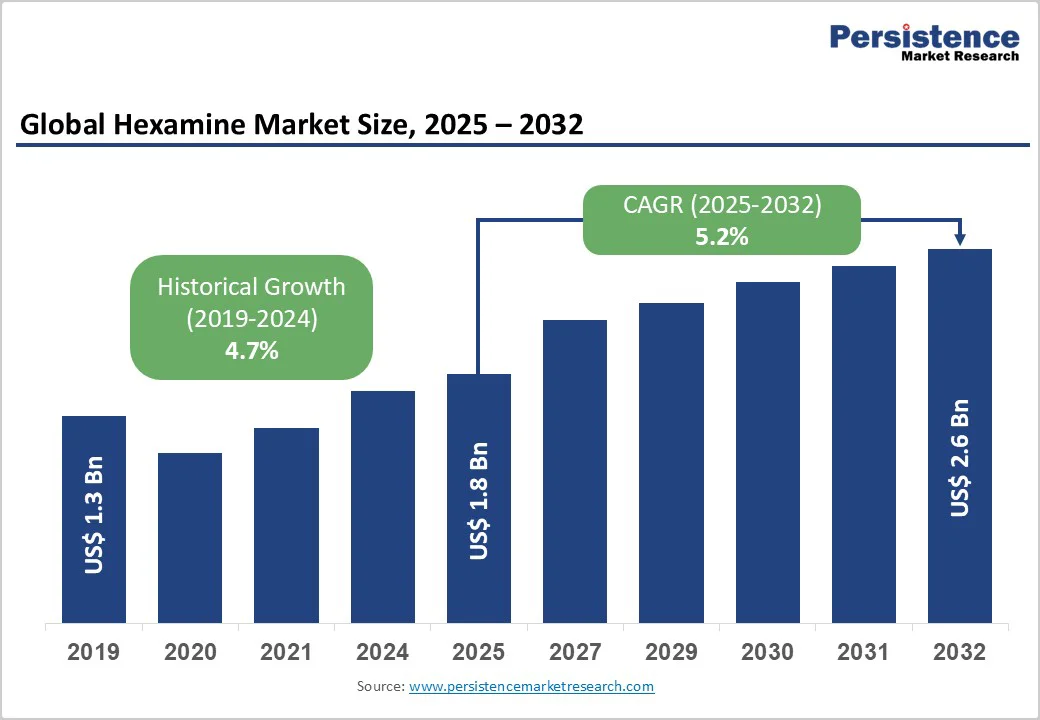
The global hexamine market size is likely to be valued US$1.8 Billion in 2025, projected to US$2.6 Billion by 2032, growing at a CAGR of 5.2% during the forecast period from 2025 to 2032, driven by the surging demand for phenolic and urea-formaldehyde resins in construction and automotive sectors, expanding pharmaceutical applications for urinary antiseptics, and rising use in rubber vulcanization and solid fuel tablets. The market is further propelled by innovations in stabilized formulations for enhanced thermal stability and eco-friendly production processes amid tightening environmental regulations on formaldehyde emissions. The growing acceptance of hexamine in high-performance composites, adhesives, and explosives underscores its role as a cost-effective, multi-functional compound, particularly in Asia Pacific's industrial boom.
Key Industry Highlights
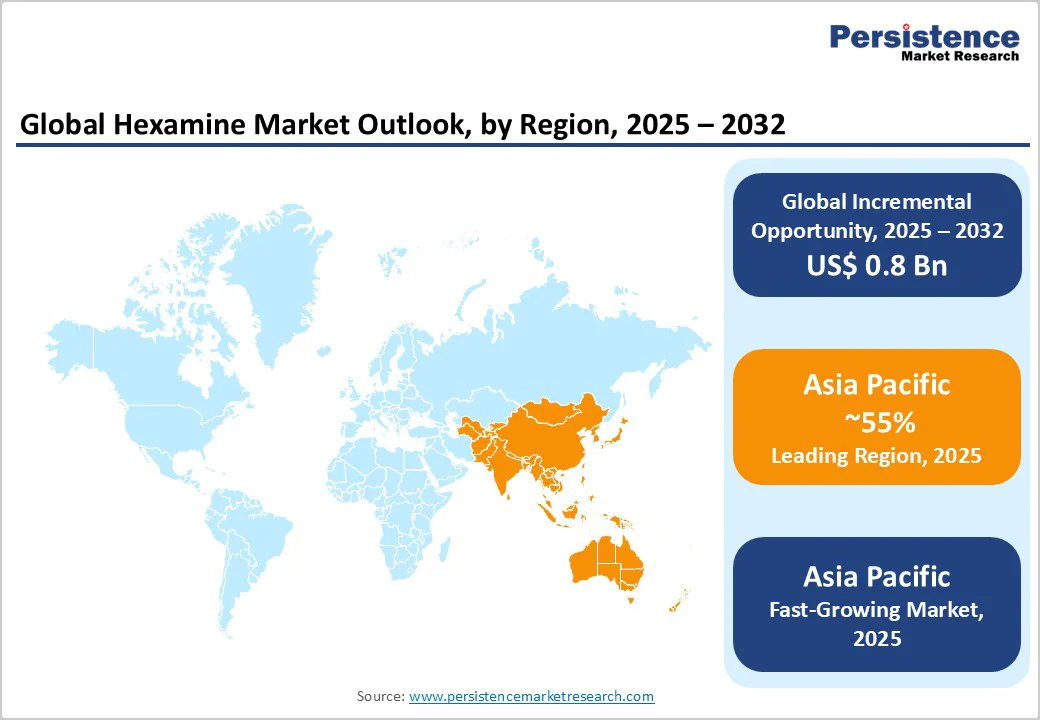
- Leading Region: Asia Pacific, commanding a 55% market share in 2025, driven by massive resin production in China and India's automotive surge.
- Fastest-growing Region: Asia Pacific , fueled by rapid industrialization and infrastructure development, driving further growth in hexamine demand
- Dominant Formulation Type: Solid Hexamine, holding 65% share due to superior stability in resin curing and fuel tablets.
- Leading Application: Resins, accounting for 50% revenue, propelled by phenolic resin demand in adhesives.
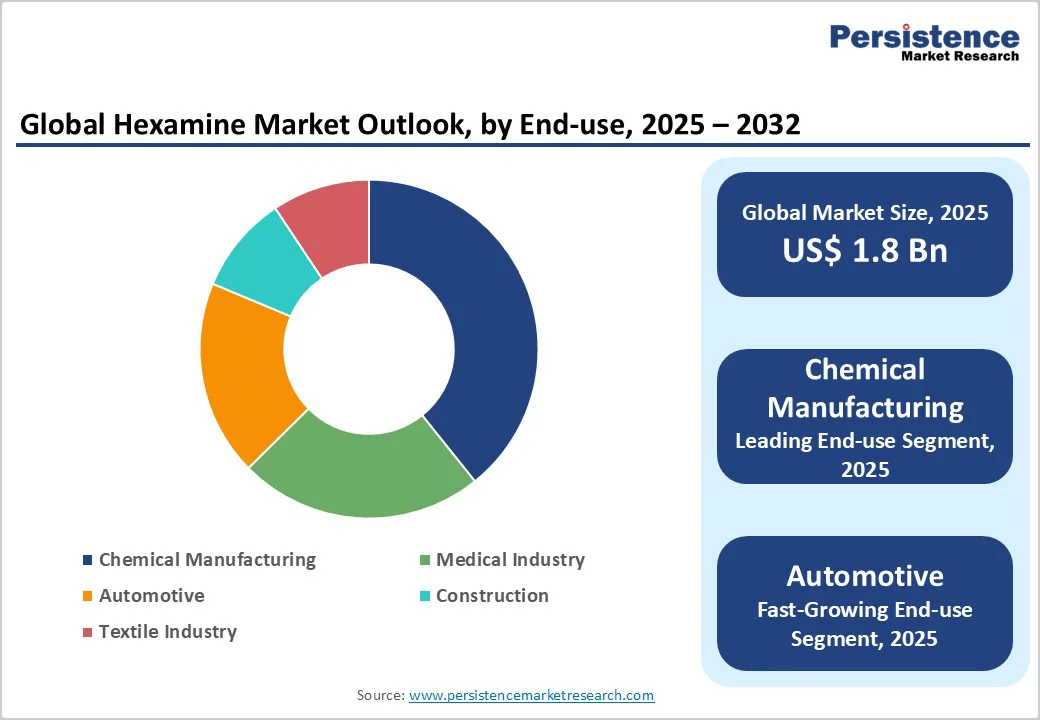
- Leading End-use: Chemical Manufacturing, contributing 45% via resin and rubber production.
- Key Market Driver: Hexamine is widely used in producing resins and rubber components that enhance durability, heat resistance, and structural strength essential for modern vehicles and infrastructure projects.
- Growth Opportunity: Growing demand for low-emission, high-purity hexamine in pharmaceuticals, coatings, and clean fuels presents opportunities for innovation and sustainable production technologies.
| Key Insights | Details |
|---|---|
| Hexamine Market Size (2025E) | US$1.8 Bn |
| Market Value Forecast (2032F) | US$2.6 Bn |
| Projected Growth (CAGR 2025-2032) | 5.2% |
| Historical Market Growth (CAGR 2019-2024) | 4.7% |
Market Factors – Growth, Barriers, and Opportunity Analysis
Booming Demand for Resins and Rubber in Automotive & Construction
The booming demand for resins and rubber in the automotive and construction industries is a key driver for the hexamine market. Hexamine serves as a vital curing and hardening agent in phenolic and amino resins, which are extensively used in brake linings, adhesives, insulation materials, and coatings. In the automotive sector, the shift toward lightweight, heat-resistant, and high-performance materials, especially in electric and hybrid vehicles, is increasing the consumption of hexamine-based resins for improved durability and thermal stability.
In construction, growing infrastructure development and urbanization across emerging economies are fueling demand for strong and weather-resistant materials. Phenolic resins derived from hexamine are essential for producing laminated panels, insulation boards, and molding compounds, which enhance building strength and energy efficiency. Rubber reinforced with hexamine improves flexibility and mechanical strength, making it ideal for tires, seals, and industrial components.
Raw Material Volatility & Stringent Environmental Regulations
Raw material price volatility and stringent environmental regulations pose significant challenges to the hexamine market. Hexamine production relies heavily on raw materials such as ammonia, formaldehyde, and methanol, all of which are subject to fluctuating global prices driven by crude oil trends, supply chain disruptions, and changing energy costs. This volatility directly impacts production margins and limits long-term pricing stability for manufacturers, especially in regions dependent on imported feedstock.
Hexamine manufacturing involves formaldehyde, a substance under strict scrutiny due to its toxic and volatile nature. Regulatory frameworks in regions such as Europe (REACH) and North America (EPA standards) mandate cleaner production technologies, waste management, and emission controls, increasing compliance costs for producers. Smaller manufacturers often struggle to invest in advanced purification and treatment systems, leading to market consolidation.
Sustainable Fuels & Pharma Innovations Ev/Hybrid Boom
The growing shift toward sustainable fuels and pharmaceutical innovations, coupled with the rapid expansion of electric and hybrid vehicles, is reshaping the demand landscape for hexamine. As countries aim to reduce carbon emissions, hexamine’s role as a clean-burning additive and fuel stabilizer is becoming increasingly important in the production of eco-friendly solid fuels and defense propellants. Its ability to enhance energy density and reduce harmful emissions supports the transition toward greener energy sources.
In the pharmaceutical sector, innovation in drug formulations and intermediates is boosting hexamine consumption as it serves as a precursor for several antibiotics and antiseptics. The rise in chronic diseases and expanding healthcare infrastructure in emerging markets further fuel demand. The electric and hybrid vehicle boom is indirectly contributing to market growth through increased use of high-performance resins and coatings, where hexamine acts as a curing and hardening agent.
Category-wise Analysis
Formulation Type Insights
Solid Hexamine leads with 65% share in 2025, owing to its stability, ease of handling, and extensive use in resins, pharmaceuticals, and fuel tablets. Its solid form ensures longer shelf life and safer storage, making it preferred for large-scale industrial applications and as a key material in chemical manufacturing processes.
Liquid Hexamine fastest-growing, driven by its superior blending efficiency in fuels and cleaner combustion properties. It offers enhanced solubility and uniform mixing, making it ideal for applications in solid fuel tablets, defense propellants, and clean energy formulations. Rising demand for portable and efficient energy sources further accelerates its market adoption.
Application Insights
Resins dominate 50% in 2025, as hexamine is a vital curing agent in phenolic and amino resins used across automotive, construction, and electrical applications. Its ability to enhance strength, heat resistance, and adhesion in molded components and coatings drives high demand from industrial and manufacturing sectors.
Pharmaceuticals fastest-growing, due to their use as a key intermediate in synthesizing drugs such as antibiotics and urinary antiseptics. Increasing R&D investments, expanding generic drug production, and rising healthcare demand globally are boosting hexamine consumption in pharmaceutical formulations and fine chemical manufacturing.
End-use Insights
Chemical Manufacturing is lead with 45% in 2025, owing to its extensive use as a raw material in producing resins, coatings, and specialty chemicals. Its role as a curing and stabilizing agent supports large-scale industrial processes, while rising demand for adhesives and intermediates in downstream industries further strengthens this segment’s dominance.
Automotive fastest-growing, driven by its use in phenolic resins and brake linings that enhance heat resistance and durability. Rising vehicle production, lightweight component demand, and increased adoption of high-performance materials in electric vehicles are accelerating hexamine consumption across both OEM and aftermarket applications.
Regional Insights
Asia Pacific Hexamine Market Trends
The Asia Pacific is expected to hold a 55% share in 2025, driven by the expansion of industrial and manufacturing activities across China, India, Japan, and South Korea. Rising demand from key end-use industries such as automotive, construction, textiles, and plastics is driving consumption. Hexamine is widely used in phenolic resins, rubber processing, and adhesive materials essential for infrastructure and vehicle production, which are growing rapidly in this region.
China remains the largest producer and consumer, supported by abundant raw material availability and large-scale resin manufacturing. India is emerging as a rapidly growing market, driven by increasing chemical exports and government initiatives that encourage domestic manufacturing. Additionally, rising environmental awareness is prompting producers to adopt cleaner, low-emission production processes.
North America Hexamine Market Trends
North America accounts for a 20% share in 2025. The mature chemical manufacturing base in the region especially in the United States and Canada – supports consistent demand from sectors such as synthetic resins, rubber processing, specialty chemicals, and pharmaceuticals. Growth is underpinned by replacement and speciality-grade applications, rather than broad commodity uptake. There is a rising shift toward high-purity hexamine grades and formulations tailored for advanced resins, pharmaceutical intermediates, and niche uses.
Sustainability, regulatory compliance, and process efficiency are major themes; producers are investing in cleaner manufacturing, emission controls, and supply-chain resilience. The region remains more reliant on global feedstock and has a higher production cost than low-cost regions, which limits large volume expansion. However, its strength lies in premium segments and innovation.
Europe Hexamine Market Trends
Europe commands a 15% share in 2025, due to its mature industrial base. Demand is anchored by well-established sectors such as synthetic resins, advanced rubber compounds, and specialty chemicals in countries such as Germany, France, Italy, and the UK. A strong distinguishing feature of the European region is the heavy emphasis on sustainability and regulatory compliance. Manufacturers are investing in cleaner production technologies and higher-purity grades to meet strict standards.
Many producers face cost pressures from high energy prices and the need to retrofit older plants, which dampens competitiveness relative to low-cost regions. Application-wise, growth is driven more by specialty and niche uses (such as high-performance composites or pharmaceutical intermediates) rather than broad volume expansion.
Competitive Landscape
The global hexamine market is highly competitive, multinational chemical producers along with numerous regional players compete for share. Leading players such as Hexion Inc., INEOS Group Holdings S.A., and Metafrax Group hold strong positions thanks to vertically-integrated feedstock sources, large production capacities and established global distribution networks. Regional players especially in China (e.g., Ruixing Group; Yuhang Chemical) and India (e.g., Kanoria Chemicals & Industries Ltd.) benefit from cost-advantage manufacturing and high local demand.
Key competitive strategies include capacity expansion, specialization into high-purity or stabilized grades for premium applications (plastics resins, adhesives, pharmaceutical intermediates), and regional supply chain optimization. Environmental and regulatory pressures especially in Europe and North America are also shaping competitive dynamics, as smaller players may struggle with investment in cleaner production.
Key Industry Developments
In August 2025, Huntsman Corporation (US) announced a significant investment in its hexamine production facility in Texas, aimed at increasing output to meet rising global demand. This strategic move not only enhances Huntsman's production capacity but also underscores its commitment to sustainability by incorporating energy-efficient technologies.
In September 2025, Mitsubishi Gas Chemical Company, Inc. (Japan) launched a new line of eco-friendly hexamine products designed for the resin industry. This initiative reflects a growing trend towards sustainability and positions the company favorably among environmentally conscious consumers.
Companies Covered in Hexamine Market
- BASF SE
- Hexion Inc.
- Huntsman Corporation
- Shandong Jinling Chemical
- Mitsubishi Gas Chemical Company, Inc.
- Chemanol
- Kraton Corporation
- Nippon Shokubai Co., Ltd.
Frequently Asked Questions
The global hexamine market is projected to reach US$1.8 Billion in 2025, driven by strong demand in phenolic resins, rubber vulcanization, and pharmaceutical applications.
Rapid growth in manufacturing, automotive, and construction sectors across Asia Pacific and the Middle East offers strong potential for capacity expansion and regional market penetration.
The hexamine market is expected to grow at a CAGR of 5.2% from 2025 to 2032.
Key opportunities include sustainable and low-emission fuel tablets, pharmaceutical R&D for antiviral and antiseptic applications, and lightweight composites in electric vehicles.
Leading players include BASF SE, Hexion Inc., Huntsman Corporation, Shandong Jinling Chemical, Mitsubishi Gas Chemical Company, Inc., Chemanol, Kraton Corporation, and Nippon Shokubai Co., Ltd.


