




- Food Ingredients & Additives
- Dairy-Based Ingredients Market
Dairy-Based Ingredients Market Size, Share, and Growth Forecast, 2026 – 2033
Dairy-Based Ingredients Market by Product Type: Milk Powders; Whey Ingredients; Milk Protein Concentrates (MPC); Milk Protein Isolates (MPI); Casein and Caseinates; Lactose and Lactose Derivatives; Milk Fat Concentrates; Other), Form (Powder; Liquid; Concentrate; Other), Source (Cow Milk; Goat Milk; Sheep Milk; Other), Application (Dairy Products; Bakery and Confectionery; Infant Nutrition; Sports and Performance Nutrition; Clinical and Medical Nutrition; Functional Foods and Beverages; Processed Foods and Convenience Foods; Pharmaceuticals; Other), and Regional Analysis for 2026-2033

Dairy-Based Ingredients Market Size and Trends Analysis
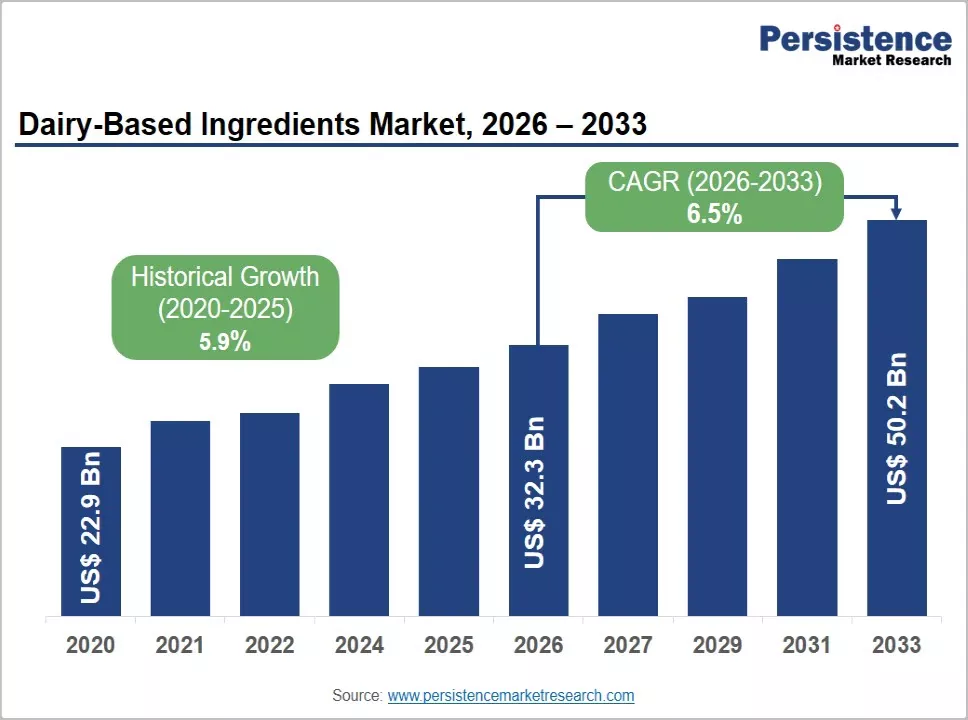
The global dairy-based ingredients market size is likely to be valued at US$32.3 billion in 2026 and is estimated to reach US$50.2 billion by 2033, growing at a CAGR of 6.5% during the forecast period from 2026 to 2033, driven by rising protein fortification, infant-nutrition demand, sports-nutrition adoption, and expanded whey-processing capacity.
Growth will be led by higher-value protein ingredients rather than commodity dairy powders. Aging populations, rising sports participation, and growing awareness of protein adequacy are increasing demand for whey proteins, milk protein concentrates, and clinical-nutrition formulations. Regulatory scrutiny of infant-formula composition and allergen labeling is encouraging manufacturers to use traceable, standardized dairy ingredients.
Key Industry Highlights:
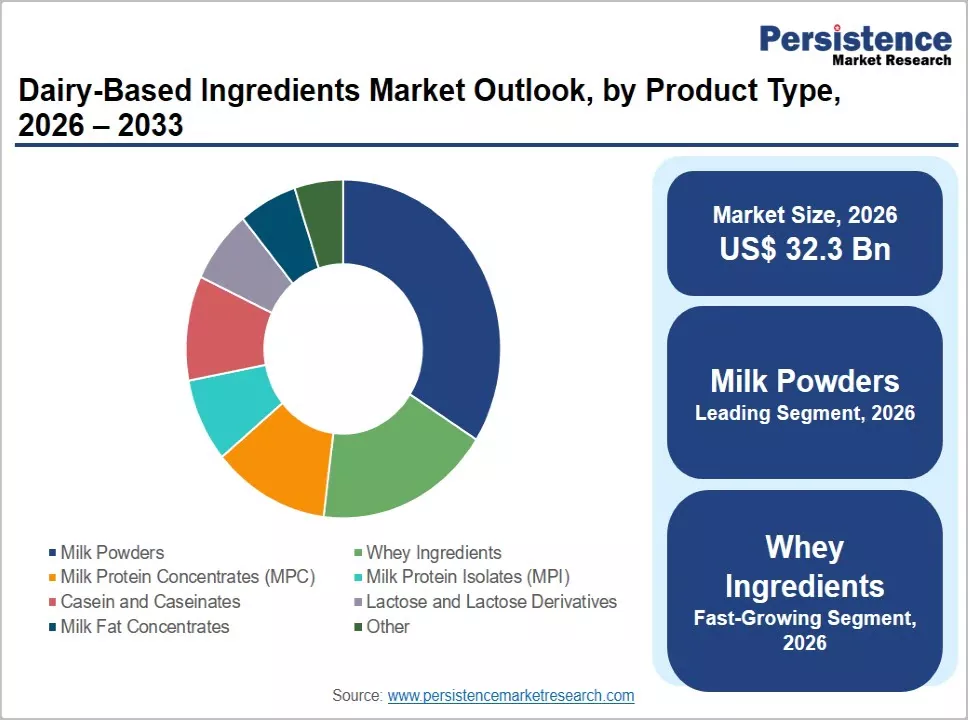
- Leading Product Type: Milk powder is expected to hold around 34% market share in 2026, driven by broad use in bakery, recombined dairy, confectionery, and convenience foods.
- Fastest-Growing Product Type: Whey ingredients are projected as the fastest-growing segment, driven by expansion in sports nutrition, functional beverages, and high-protein dairy formats.
- Leading Source: Cow milk is estimated to hold roughly 88% market share in 2026, driven by large-scale collection networks and established processing infrastructure.
- Leading Application: Dairy products are likely to hold around 31% market share in 2026, driven by protein fortification and premiumization across yogurt, cheese, and dairy beverages.
- Fastest-Growing Application: Sports and performance nutrition is anticipated to record the fastest growth, driven by mainstream adoption of protein beverages, bars, and recovery products.
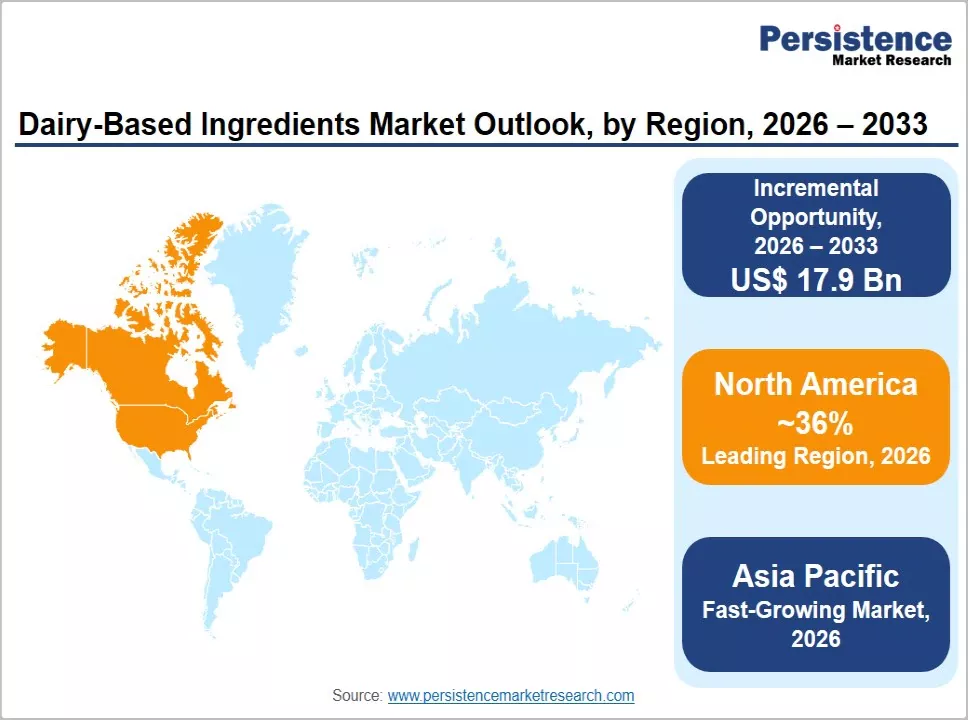
- Regional Leadership: North America is projected to capture roughly 36% of the market share in 2026, driven by advanced dairy-processing infrastructure and protein-nutrition demand.
- Competitive Environment: The market is moderately fragmented, with global cooperatives and nutrition companies competing through protein innovation, capacity expansion, and technical service.
- Innovation Trends: Clear whey proteins, milk-protein concentrates, lactose derivatives, and energy-efficient spray drying are expected to shape product development through 2033.
DRO Analysis
Driver - Infant nutrition and regulatory-driven quality requirements
Infant formula remains a structurally important application because dairy proteins provide the functional and nutritional foundation for many formulas. Whey-dominant formulations, casein ratios, lactose, and milk-fat fractions are selected to approximate the digestibility, texture, and nutrient profile expected in early-life nutrition. As regulatory expectations for safety, traceability, and labeling rise, manufacturers favor suppliers with documented quality systems and controlled production environments.
The U.S. Food and Drug Administration requires infant-formula manufacturers and distributors to comply with the Federal Food, Drug, and Cosmetic Act and related implementing regulations. FDA guidance also requires clear allergen identification when ingredients contain milk-derived protein; for example, enzymatically hydrolyzed whey protein isolate must be identified as milk-derived in ingredient labeling or through a “Contains milk” statement. Compliance complexity raises entry barriers and rewards vertically integrated dairy-ingredient producers.
Restraint - Trade, logistics, and cold-chain constraints
Dairy ingredients are traded extensively across regions, making international logistics a structural constraint. Powdered ingredients are easier to transport than liquid concentrates, yet they still require moisture control, hygienic handling, and compliance with import documentation. Liquid whey, permeate, and milk-protein streams face higher transport costs and shorter usable logistics windows, limiting the economic radius of certain facilities.
Trade policy, sanitary requirements, and import inspection regimes can delay shipments and increase working-capital needs. For exporters, a regulatory delay or documentation issue can interrupt supply to infant-nutrition, clinical-nutrition, and pharmaceutical customers that operate under strict qualification requirements. Supply interruptions therefore carry a higher commercial penalty in regulated applications than in general food manufacturing.
Opportunity - Regional capacity localization and export diversification
Localization of ingredient production close to high-growth demand centers. Regional facilities reduce freight exposure, shorten delivery cycles, and allow formulations to meet local regulatory and cultural requirements. This is particularly relevant for infant nutrition, clinical nutrition, and pharmaceutical applications, where supply continuity and batch-level traceability are essential.
The actionable pathway is to build or contract regional spray-drying, membrane-filtration, and blending capacity while maintaining global quality standards. A producer can serve nearby food manufacturers with tailored protein blends, then use the same facility to support export growth once regulatory approvals and customer qualifications are secured. Localized capacity therefore creates both resilience and a platform for international expansion.
Category-wise Analysis
Product Type Insights
Milk powders are expected to lead the segment, accounting for 34% of market revenue in 2026. Milk powders provide long shelf life, transport efficiency, and versatile functionality in recombined dairy, bakery, confectionery, and nutritional products. Spray-dried skim milk powder and whole milk powder are widely used where liquid-milk logistics are costly, or refri
geration is limited. For example, milk powder is used in reconstituted beverages and bakery premixes across regions with expanding processed-food production.
Whey ingredients are likely to represent the fastest-growing segment, propelled by demand for high-quality protein in sports nutrition, functional beverages, infant nutrition, and clinical products. Whey protein concentrate and isolate offer solubility, emulsification, and complete amino-acid profiles. A clear whey beverage formulated with whey protein isolate illustrates the segment shift toward convenient, high-protein consumption.
Form Insights
Powder is projected to lead the market, capturing around 58% of the market share in 2026. Powdered dairy ingredients offer extended shelf life, lower transport weight per unit of solids, and straightforward incorporation into dry blends. Milk powders, whey protein concentrates, caseinates, and lactose are commonly shipped and stored in powder form. A bakery premix producer relies on powder ingredients for consistent dosing and long inventory life. Logistics efficiency and formulation compatibility reinforce powder leadership.
Concentrate is likely to be the fastest-growing segment, fueled by demand for ingredients with higher solids content and reduced water transportation requirements. Concentrated dairy ingredients can simplify formulation and improve processing efficiency in selected applications. For example, a food manufacturer may use a milk protein concentrate to achieve targeted protein levels while managing ingredient handling.
Source Insights
Cow milk is projected to lead the market, capturing around 88% of the market share in 2026. Cow milk provides the largest, most reliable raw-material base for milk powders, whey, casein, lactose, and milk fat. Large-scale collection networks, standardized composition, and established processing technology support broad industrial use. A global whey-protein producer typically sources cow milk through large dairy cooperatives and processing networks. Scale and supply reliability make cow milk the foundational source.
Goat milk is likely to be the fastest-growing segment, fueled by interest in differentiated dairy products and specialized nutritional formulations. Its growth potential is linked to premium positioning and opportunities to serve customers seeking alternatives within the dairy category. For example, goat milk powder can be incorporated into specialty food formulations where its distinct composition is commercially relevant.
Application Insights
Dairy products are likely to be the leading segment with a projected 31% of the market share in 2026 due to established demand for ingredients that improve composition, texture, stability, and nutritional value. Yogurt, cheese, and dairy beverages require standardized functional inputs. For example, milk protein concentrates can help manufacturers adjust protein levels in yogurt formulations. Continued demand depends on consumer purchasing patterns, product innovation, milk availability, and efficient processing.
Sports and performance nutrition is anticipated to be the fastest-growing segment, fueled by interest in protein supplementation, convenient nutrition, and performance-oriented food products. Whey protein isolates and concentrates are relevant because they support protein enrichment in powders, bars, and ready-to-drink beverages. For example, a beverage manufacturer may incorporate whey protein isolate to develop a high-protein product with controlled formulation characteristics.
Regional Insights
North America Dairy-Based Ingredients Market Trends
North America is anticipated to be the leading region, accounting for around 36% of market share in 2026. The region is supported by integrated dairy processing, reliable milk supply, and strong demand for protein ingredients. The U.S. recorded 232 billion pounds of milk production in 2025, up 2.6% from 2024. Milk-supply scale supports commodity production and advanced protein fractionation.
Demand is expected to be led by sports nutrition, functional beverages, high-protein dairy, and clinical nutrition. Glanbia reported 4.2% like-for-like Dairy Nutrition volume growth in 2025, reflecting continued demand for protein solutions. Protein-led formulation is shifting procurement toward whey isolates and milk protein concentrates.
U.S. Dairy-Based Ingredients Market Insights
The U.S. is anticipated to dominate the North America market, capturing nearly 78% of market share in 2026. The country is supported by a large milk-processing base, extensive whey-valorization capacity, and strong consumption of protein-fortified foods. USDA data show that U.S. milk production reached 232 billion pounds in 2025. Domestic milk supply underpins ingredient manufacturing and export capacity.
Investment is expected to strengthen domestic protein capacity. Arla Foods Ingredients entered a contract-manufacturing agreement with Valley Queen to support demand for protein-enriched dairy in the United States. Contract manufacturing expands capacity without requiring immediate greenfield construction.
Canada Dairy-Based Ingredients Market Insights
Canada is forecast to hold around 22% of market share in 2026. The country is supported by structured milk marketing, strong food-processing capability, and proximity to the United States. The Canadian dairy system provides a stable collection framework that supports consistent raw-milk quality for powder, butter, cheese, and ingredient production. Supply stability is likely to support export-oriented ingredient manufacturing.
Demand is forecast to rise in high-protein yogurt, bakery, infant nutrition, and functional beverages. Canadian manufacturers are likely to increase use of whey protein concentrates, milk protein concentrates, and lactose. Protein fortification is expected to increase ingredient intensity in packaged foods.
Europe Dairy-Based Ingredients Market Trends
Europe is expected to command around 28% of market share in 2026, propelled by advanced dairy cooperatives, strong whey-protein technology, and established infant-nutrition manufacturing. The European Union produced an estimated 161.8 million tonnes of raw milk in 2024, an increase of 0.9 million tonnes from 2023. Large milk volumes support traditional dairy products and specialized ingredient streams.
Arla Foods Ingredients delivered revenue of EUR 1,452 million in 2025, an increase of 43.1%, driven by demand for value-added protein. European producers are converting dairy-processing scale into global protein leadership.
Germany Dairy-Based Ingredients Market Insights
Germany is projected to lead within Europe, accounting for 22% of market share in 2026. supported by a large dairy-processing sector, advanced machinery base, and strong food-manufacturing ecosystem. Germany is expected to support demand for milk powders, whey derivatives, caseinates, and functional protein blends across bakery, confectionery, clinical nutrition, and processed foods. Industrial food production sustains consistent ingredient demand. Regulatory alignment with European Union food-safety, labeling, and sustainability requirements is likely to favor suppliers with documented quality systems.
France Dairy-Based Ingredients Market Insights
France is anticipated to hold about 14% of market share in 2026, supported by a strong cheese industry, dairy cooperatives, and expertise in infant and clinical nutrition. Whey streams generated through cheese production provide feedstock for protein concentrates, isolates, and lactose derivatives. Cheese manufacturing and ingredient production are structurally linked.
Demand is likely to rise in premium dairy, bakery, infant nutrition, and medical nutrition. French manufacturers are expected to use milk protein concentrates and caseinates to improve texture, protein content, and stability in yogurts, desserts, and nutritional products.
Asia Pacific Dairy-Based Ingredients Market Trends
Asia Pacific is forecast to be the fastest-growing market for dairy-based ingredients. The region is supported by population growth, urbanization, rising protein awareness, and expanding infant-nutrition and packaged-food sectors. Demand is expected to rise for milk powders, whey protein, lactose, and milk protein concentrates across dairy beverages, bakery, confectionery, and nutritional products. Urban dietary diversification is increasing demand for stable, high-functionality ingredients.
Fonterra reported FY25 earnings from continuing operations of NZ$1,560 million, a 16% increase from FY24, with Ingredients-channel EBIT up NZ$163 million.
China Dairy-Based Ingredients Market Insights
China is expected to dominate the Asia Pacific region, command around 30% of market share in 2026, supported by a large infant-nutrition market, expanding health-and-wellness sector, and increasing use of whey and milk-protein ingredients. Domestic dairy production is expanding, while imports remain important for specialized whey proteins, lactose, and high-specification milk powders. Demand is likely to be driven by premium infant formula, adult nutrition, sports nutrition, and functional beverages. Manufacturers are expected to favor suppliers able to provide consistent protein quality, allergen documentation, and technical application support. Specification milk powders. Specialized ingredient imports are likely to remain structurally significant.
India Dairy-Based Ingredients Market Insights
India is estimated to hold nearly 20% of market share in 2026. The country is supported by a large milk-production base, an expanding processed-food sector, and rising demand for affordable nutrition. Milk powders, whey-based ingredients, casein, and lactose derivatives are expected to see greater use in bakery, confectionery, dairy beverages, and nutritional products. Domestic milk supply provides a foundation for ingredient scaling.
Urbanization and convenience-food consumption are likely to increase demand for ingredients that improve texture, shelf life, and nutritional density. A bakery manufacturer may use skim milk powder and whey ingredients to improve softness, browning, and protein content.
Competitive Landscape
The global dairy-based ingredients market is moderately fragmented, with a small group of globally integrated dairy cooperatives and nutrition companies operating alongside regional processors and specialty ingredient suppliers. Scale advantages arise from milk collection networks, drying capacity, protein-fractionation technology, and regulatory expertise. Large producers are gaining share in high-value whey and milk-protein categories.
Key participants include Fonterra, Arla Foods, Glanbia, FrieslandCampina, and Lactalis. These companies compete through protein innovation, capacity expansion, customer technical support, sustainability programs, and geographic supply coverage. Differentiation is shifting from commodity supply toward application-specific nutrition solutions.
Key Industry Developments:
- In October 2026, IFF published its Dear Dairy: The Life Stages Guide, highlighting opportunities for dairy manufacturers to align product innovation with changing consumer needs throughout life. The guide identified four stages: Taste of Nourishment, Taste of Growth, Taste of Balance, and Taste of Comfort. IFF emphasized taste, texture, and balanced nutrition for children; protein, energy, and gut health for younger consumers; convenience and functional benefits for adults; and nutrition, mobility, and vitality for older consumers.
Companies Covered in Dairy-Based Ingredients Market
- ARLA FOODS AMBA
- Emmi Group
- Fonterra Co-operative Group Limited
- Glanbia Plc
- Goat Specialty Ingredients B.V.
- Hilmar Cheese Company, Inc.
- Kerry Group Plc
- Lactalis Ingredients
- Royal FrieslandCampina N.V.
- Tirlán Limited
Frequently Asked Questions
The global dairy-based ingredients market is projected to reach US$32.3 billion in 2026.
The dairy-based ingredients market is driven by rising demand for protein-rich foods, specialized nutrition, functional food products, and advanced dairy processing technologies.
The dairy-based ingredients market is poised to witness a CAGR of 6.5% from 2026 to 2033.
Key opportunities include developing specialized dairy proteins, expanding sports and clinical nutrition applications, improving processing efficiency, and increasing the utilization of whey and other milk components.
Some of the key market players include Fonterra, Arla Foods Ingredients, FrieslandCampina Ingredients, Agropur, Kerry Group, and Ornua.


