




- Processed Food
- Egg Processing Equipment Market
Egg Processing Equipment Market Size, Share, and Growth Forecast, 2026 - 2033
Egg Processing Equipment Market by Product Type (Dried, Liquid, Frozen Egg Product), Equipment Type (Egg breaking & Separating Machines, Others), Size of Operation (Small Scale, Medium Scale, Large Scale), Application, and Regional Analysis for 2026 - 2033

Egg Processing Equipment Market Size and Trends Analysis
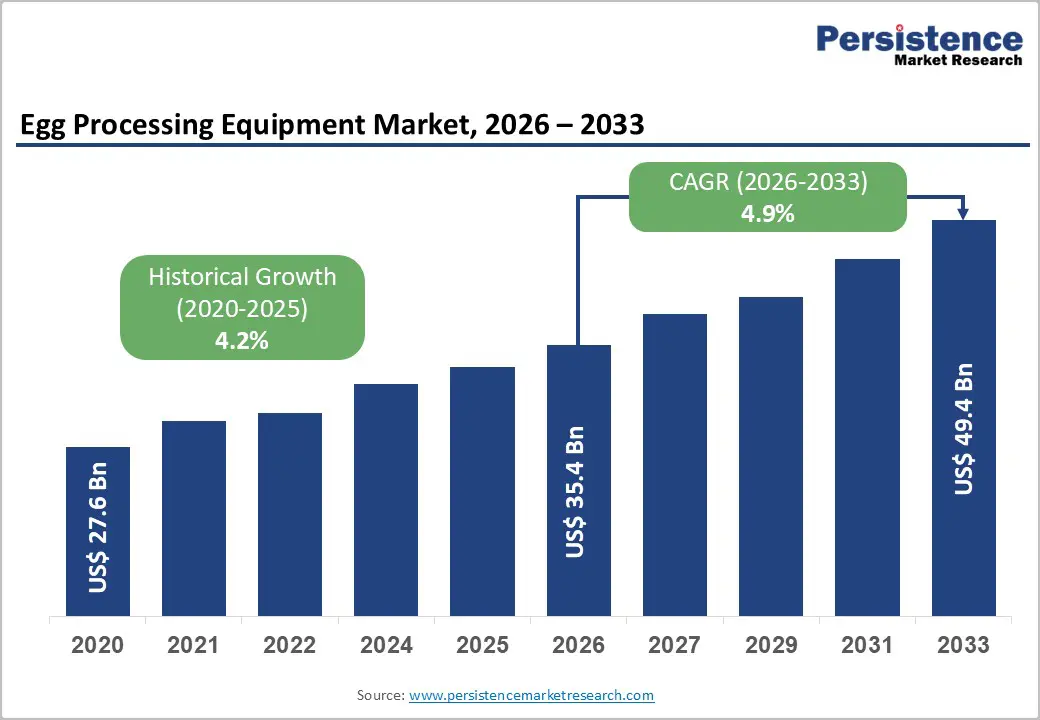
The global egg processing equipment market size is likely to be valued at US$35.4 billion in 2026, and is expected to reach US$49.4 billion by 2033, growing at a CAGR of 4.9% during the forecast period from 2026 to 2033, driven by the increasing demand for processed egg products and advancements in food processing technologies.
Egg processing equipment includes a wide range of industrial machinery and technological systems designed to transform shell eggs into value-added products, including liquid whole eggs, egg whites and yolks, pasteurized liquid egg blends, dried egg powders, and frozen egg products. The equipment portfolio comprises egg-breaking and separating machines, pasteurization systems, homogenizers, drying technologies (including spray dryers and freeze dryers), and mixing and blending units, supported by hygiene and quality control systems.
Key Industry Highlights:
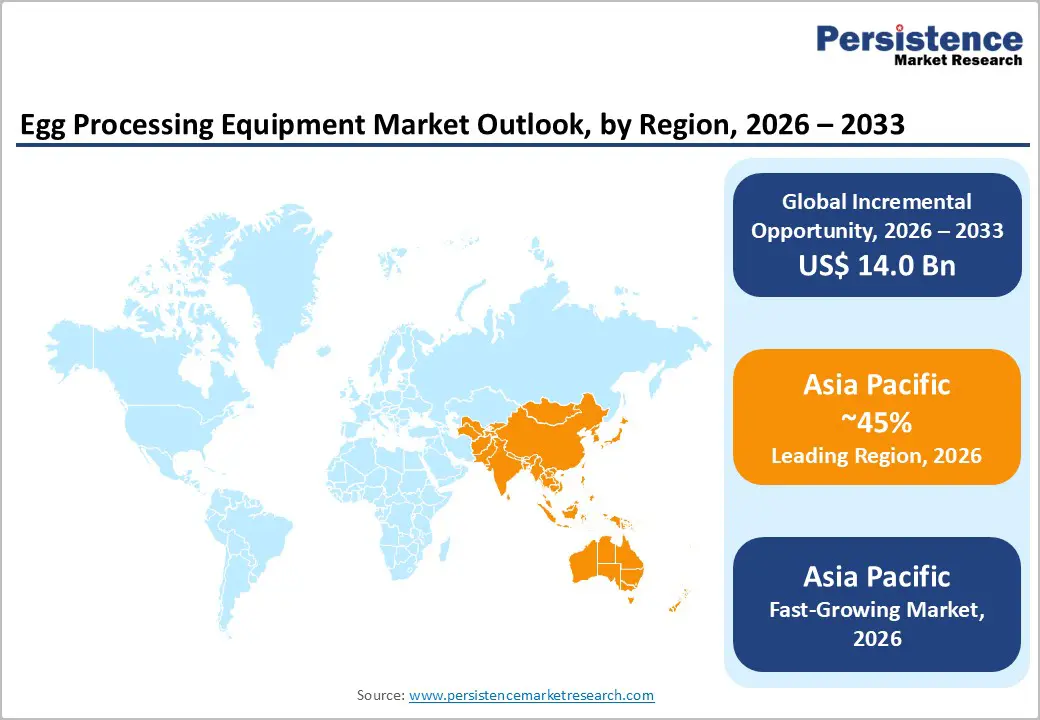
- Leading Region: Asia Pacific, anticipated to account for a 45% market share in 2026, driven by large-scale egg production and processing in China and India.
- Fastest-growing Region: Asia Pacific, fueled by rising food processing investments and growing demand for value-added egg products.
- Dominant Product Type: Liquid egg is projected to dominate the egg processing equipment market with over 58% share in 2026, driven by strong demand for pasteurized liquid whole eggs, whites, yolks, and specialized blends, which account for the highest processing volumes and equipment investments globally.
- Leading Equipment Type: Egg-breaking and separating machines are projected to dominate the egg processing equipment market, accounting for around 32% of the market share in 2026, as they serve as the first and most critical step in the processing chain.
| Key Insights | Details |
|---|---|
| Egg Processing Equipment Market Size (2026E) | US$35.4 Bn |
| Market Value Forecast (2033F) | US$49.4 Bn |
| Projected Growth CAGR (2026 - 2033) | 4.9% |
| Historical Market Growth (2020 - 2025) | 4.2% |
DRO Analysis
Driver - Demand for Processed Egg Products in Food Manufacturing
The most powerful and enduring driver of the egg processing equipment market is the sustained global expansion of demand for processed egg products, liquid, dried, and frozen, as preferred ingredients in food manufacturing over raw shell eggs. Processed egg products offer food manufacturers significant operational advantages: precise portion control, extended refrigerated and ambient shelf life, elimination of shell waste and labor costs, standardized protein and fat content, and reduced pathogen risk through pasteurization. The global processed egg market has grown consistently at approximately 5-7% annually over the past decade as food manufacturers across bakery, confectionery, dairy, and foodservice sectors progressively switch from shell egg procurement to processed egg ingredient supply chains.
The bakery industry alone accounts for approximately 35-40% of global processed egg ingredient consumption. Global bakery market revenues exceeded US$530 billion in 2023 and are forecast to reach US$700 billion by 2030, with processed egg products serving critical functional roles as binding agents in bread, emulsifiers in cakes, coagulants in custard fillings, and protein sources in high-nutrition bakery products. Companies such as Groupe Glon and Interovo Egg Group have significantly expanded their processed egg production facilities in recent years, thereby increasing demand for upgrades to egg-breaking, pasteurization, and drying equipment at scale. This demand-pull dynamic from food manufacturing is expected to sustain equipment market growth above GDP growth rates throughout the forecast period.
Food Safety Regulations Mandating Pasteurization of Egg Products
Stringent and expanding food safety regulatory requirements mandating the pasteurization of commercially sold liquid and processed egg products represent a significant structural demand driver for egg processing equipment, particularly pasteurizers, homogenizers, and associated hygiene-grade processing lines. Salmonella enteritidis, the primary egg-associated foodborne pathogen, remains a major public health concern worldwide. The U.S. Centers for Disease Control and Prevention (CDC) estimates that Salmonella causes approximately 1.35 million infections, 26,500 hospitalizations, and 420 deaths annually in the U.S. alone, with eggs identified as one of the most common vehicles of transmission.
In the U.S., the USDA's Egg Products Inspection Act mandates that all commercially sold liquid and frozen egg products must be pasteurized. The European Union's Regulation (EC) No 853/2004 similarly requires heat treatment of liquid egg products before sale. As food safety regulatory frameworks strengthen across Asia Pacific, Latin America, and the Middle East, where pasteurization requirements were historically less rigorously enforced, the mandatory adoption of food-grade pasteurization equipment is creating a large and durable new demand wave for egg processing equipment manufacturers. Sanovo Technology Group and Actini Group have specifically cited regulatory-compliance-driven equipment replacement as a key growth driver in their commercial operations, reflecting market realities across multiple geographies.
Restraint - High Capital Investment Requirements and Long Equipment Payback Periods
Egg processing equipment, particularly fully integrated, automated processing lines encompassing breaking, separating, pasteurization, homogenization, and drying systems, represents a substantial capital investment that constitutes a significant barrier to adoption, particularly for small and medium-scale egg processors in emerging markets. A complete industrial-scale liquid egg processing line from leading manufacturers such as Sanovo Technology Group or Moba B.V. can require a capital investment of US$500,000 to US$5 million or more, depending on throughput capacity, automation level, and product type flexibility. Equipment payback periods can extend to 5-10 years for smaller operations, making investment decisions sensitive to egg price cycles, end-market demand stability, and availability of equipment financing.
This capital intensity creates a bifurcated market dynamic where large-scale industrial processors in developed markets continuously invest in technology upgrades, while small and medium-scale processors in emerging markets, particularly in Africa, South Asia, and Southeast Asia, remain underequipped relative to their production potential. Manufacturers offering modular, scalable equipment configurations and flexible financing or leasing arrangements are better positioned to penetrate the cost-sensitive segment of the market, but the structural capital barrier remains a significant constraint on total addressable market realization.
Volatility in Raw Egg Supply and Avian Influenza Disruptions
The egg processing equipment market is exposed to significant upstream supply volatility through the raw shell egg supply chain, which is periodically disrupted by avian influenza (bird flu) outbreaks that can devastate laying hen populations and create acute egg shortages. The 2022-2023 Highly Pathogenic Avian Influenza (HPAI) outbreak in the U.S. resulted in the culling of over 46 million birds, the worst outbreak in U.S. history, causing wholesale egg prices to increase at peak in early 2023, severely impacting processed egg product margins for food manufacturers and creating uncertainty that delayed or deferred equipment investment decisions at multiple processing facilities.
Egg price volatility and supply disruptions create a challenging investment environment for egg processors considering capital equipment upgrades or new processing line installations, as revenue and margin projections become unreliable during disease-affected periods. The episodic but high-impact nature of avian influenza outbreaks, which have affected major egg-producing nations, including the U.S., France, Germany, Japan, and South Korea in recent years, represents a structural risk factor for the egg processing equipment market that cannot be fully mitigated through commercial planning or geographic diversification.
Opportunity - Automation and Industry 4.0 Technology Adoption in Egg Processing
The rapid adoption of automation, robotics, and Industry 4.0 digital technologies across food processing operations globally is creating a significant opportunity for equipment upgrades and replacements in the egg processing sector. Modern egg processing facilities are increasingly integrating automated egg-breaking and separating systems with throughput capacities exceeding 150,000 eggs per hour, inline pasteurizer monitoring systems with IoT-connected temperature and flow sensors, and AI-enabled quality inspection systems capable of detecting contamination, shell fragment inclusion, and deviations in product consistency in real time. These technology investments yield measurable operational benefits, including reduced labor costs, improved food safety compliance documentation, reduced product waste, and enhanced processing consistency.
Moba B.V., a global leader in egg grading and processing equipment, has been at the forefront of integrating automation technology into egg handling, developing high-speed grading and braking systems that are progressively replacing labor-intensive manual operations at commercial egg processing facilities across Europe, North America, and East Asia. The broader Industry 4.0 trend in food manufacturing, encompassing digital twins of processing lines, predictive maintenance platforms, and remote monitoring capabilities, is creating additional commercial opportunities for egg processing equipment suppliers who can offer connected, data-enabled equipment ecosystems.
Expansion of Dried Egg Product Manufacturing for Export and Shelf-Life Extension
The growing global demand for shelf-stable, long-life egg ingredient formats, particularly spray-dried egg powders (whole egg, egg white, egg yolk), freeze-dried specialty egg ingredients, and scrambled egg premixes for foodservice and military ration applications is creating a specific and high-value opportunity for drying equipment manufacturers within the egg processing equipment market. Dried egg products offer logistics and shelf-life advantages (typically 12-24 months at ambient storage) that are particularly valuable for export markets, remote or underdeveloped cold-chain markets, and high-volume foodservice operations seeking to simplify egg ingredient procurement and storage.
Global trade in dried egg products has been expanding at approximately 6-8% annually, with Germany, the Netherlands, India, and Argentina among the leading export markets. Spray dryer manufacturers, including GEA Group and Tetra Pak (which supply drying systems to egg processors), report rising order activity from egg processors investing in drying capacity to serve export-oriented and shelf-stable product markets. OVO-Tech and Pelbo S.P.A. have developed specialized spray drying systems optimized for egg protein preservation, offering equipment solutions that maintain the functional properties of egg whites and whole egg powders for bakery and confectionery applications, a technically demanding performance requirement that commands premium equipment pricing and supports healthy margin structures.
Category-wise Analysis
Product Type Insights
Liquid egg is anticipated to dominate with over 58% of share in 2026, driven by encompassing pasteurized liquid whole eggs, liquid egg whites, liquid yolks, and specialized liquid egg blends, which constitute the dominant product type segment in the egg processing equipment market, commanding the largest share of equipment investment and processing volumes globally. Liquid egg products are the preferred format for commercial food service operations, institutional catering, and food manufacturers prioritizing convenience, food safety compliance, and operational efficiency. Eggstation is one of the largest pasteurized liquid egg producers in the Middle East and Asia, with an annual production capacity of over 21,000 metric tons.
Frozen egg products represent the fastest-growing segment in the egg processing market due to their extended shelf life, operational flexibility, and suitability for bulk storage. Unlike liquid eggs, frozen variants can be stored for months without compromising quality, making them ideal for large-scale food manufacturers and export markets. Companies such as Michael Foods and SKM Egg Products Export (India) Limited have expanded frozen egg offerings to meet rising demand from bakery, confectionery, and ready-to-eat food sectors. Michael Foods, a leading egg processing company, offers a wide portfolio of frozen egg products under its Papetti’s® brand, including frozen whole eggs, egg yolks, and egg whites specifically designed for foodservice and industrial use.
Equipment Type Insights
Egg-breaking & separating machines are projected to dominate the egg-processing equipment market, accounting for around 32% of the market share in 2026, as they serve as the first and most critical step in the processing chain. These machines automatically crack eggs and separate yolk and albumen, converting shell eggs into liquid form required for further processes such as pasteurization, homogenization, and drying. Their widespread adoption is driven by the need for high efficiency, hygiene, and large-scale processing in food manufacturing. Hightop Egg Equipment provides industrial egg-breaking and separating machines capable of processing up to 20,000 eggs per hour, enabling efficient conversion of shell eggs into liquid form for downstream processing, thereby reinforcing the segment’s dominance as the foundational step in egg processing.
Pasteurizers are the fastest-growing equipment type, driven by increasingly stringent food safety regulations and rising consumer awareness. Pasteurization is essential for eliminating harmful pathogens, such as Salmonella, while preserving the functional properties of liquid egg products. Regulatory authorities such as the U.S. Department of Agriculture and the Food Safety and Standards Authority of India mandate strict hygiene standards, driving adoption. SANOVO is a global leader in egg processing solutions, offering advanced liquid egg pasteurization systems used worldwide. Its pasteurizers are designed to deliver high pathogen reduction efficiency while extending shelf life up to 4 months, making them highly attractive for industrial food producers.
Regional Insights
North America Egg Processing Equipment Market Trends
North America market is witnessing steady growth, driven by increasing demand for processed and value-added egg products across the foodservice and packaged food industries. The rising consumption of liquid, frozen, and dried egg products in bakery, confectionery, and ready-to-eat meals is encouraging manufacturers to invest in advanced processing technologies. Strong emphasis on food safety and hygiene standards, enforced by regulatory bodies such as the U.S. Department of Agriculture, is accelerating the adoption of pasteurization, automated breaking, and sanitation systems.
Technological advancements are another key trend, with companies integrating automation, AI-based sorting, and energy-efficient equipment to improve productivity and reduce labor dependency. Leading players like SANOVO Technology Group and Moba Group are introducing high-capacity, fully automated systems tailored for large-scale operations. Furthermore, the expansion of quick-service restaurants and institutional food providers is increasing demand for bulk egg processing solutions. Sustainability is also gaining importance, with manufacturers focusing on water-saving technologies and waste reduction systems.
Europe Egg Processing Equipment Market Trends
Europe is the second-largest regional market for egg processing equipment and the most technically advanced, with a dense concentration of leading global equipment manufacturers based in the Netherlands, Denmark, and Italy, and a food industry characterized by rigorous food safety standards, high automation penetration, and well-established processed egg product supply chains serving sophisticated food manufacturing customers.
Germany is the largest consumer market for egg processing equipment in Europe by domestic food manufacturing demand, reflecting the scale of the German bakery, confectionery, pasta, and convenience food industries, all major consumers of processed egg ingredients. The German egg products sector operates under some of Europe's strictest animal welfare regulations, following the phased elimination of conventional cage systems, which has driven significant investment in processing facilities capable of handling free-range and organic egg supplies. Sanovo Technology Group, headquartered in Denmark, maintains a significant commercial presence in Germany and serves as a key equipment supplier to the German egg-processing sector.
France is a significant egg processing equipment market, anchored by Groupe Glon and Igreca S.A., two of Europe's leading egg product companies whose large-scale processing operations represent substantial installed equipment bases and generate ongoing demand for capacity expansion and technology upgrades. Igreca S.A. specializes in high-quality liquid and dried egg products for the French and European food industries, with processing operations that require advanced breaking, pasteurization, and drying equipment.
Asia Pacific Egg Processing Equipment Market Trends
Asia Pacific is projected to dominate and be the fastest-growing, capturing 45% of the share in 2026. The region accounts for over 65% of global egg production, led by China, India, Japan, and Southeast Asian nations, yet the proportion of egg production channeled into processed formats remains significantly below Western market levels, indicating substantial headroom for the development of the processed egg product industry and associated equipment investment. China is the world's largest egg producer by a commanding margin, accounting for approximately 36% of global production at over 30 million metric tonnes annually, yet its processed egg product sector remains relatively underdeveloped as a percentage of total production.
The Chinese government's 14th Five-Year Plan for agricultural modernization includes targets for the food processing industry that encompass egg product industrialization and supporting capital investment in modern egg processing facilities. India is the fastest-growing egg processing equipment market in the Asia Pacific, supported by the Indian government's Production Linked Incentive (PLI) scheme for food processing, which includes poultry product processing as an eligible investment category, and by the country's rapidly expanding bakery and convenience food sectors.
Competitive Landscape
The global egg processing equipment market is moderately concentrated, with a small number of specialized equipment manufacturers commanding strong global market positions alongside a larger cohort of regional players serving domestic markets. The leading equipment companies, Sanovo Technology Group, Moba B.V., OVO-Tech, and Pelbo S.P.A., differentiate through technological innovation, global service networks, application engineering expertise, and the ability to supply complete integrated processing line solutions rather than individual equipment units. Large egg product companies, including Groupe Glon, Interovo Egg Group, Gruppo Eurovo, and Igreca S.A., function as both major equipment customers and, in some cases, technology development partners, providing commercial-scale testing environments for equipment innovations.
The leading egg processing equipment manufacturers, particularly Sanovo Technology Group and Moba B.V., are strategically differentiating by offering complete integrated processing plant solutions rather than individual equipment units. This turnkey approach encompasses process engineering, equipment supply, installation, commissioning, staff training, and ongoing technical service support for complete egg processing operations. By positioning as full-plant engineering partners, these companies capture a larger share of total project value, build deeper customer relationships, and create significant switching barriers that support long-term service and consumables revenue streams. The strategy is particularly effective when targeting large-scale greenfield investments in emerging markets where customers lack in-house processing engineering expertise.
Key Industry Developments
- In March 2026, Domino Printing Sciences launched the Egg Pack Printing Traverser (EPPT) to enhance high-speed, multi-lane egg packaging operations. The system improved printing accuracy, traceability, and efficiency while integrating with existing grading lines. It enabled high-resolution coding at speeds above 50 packs per minute, reducing waste and minimizing downtime, helping egg producers streamline operations and lower costs.
Companies Covered in Egg Processing Equipment Market
- Actini Group (Actini SAS)
- Bouwhuis Enthovan
- Glon Group (Groupe Glon)
- Gruppo Eurovo
- Igreca S.A.
- Interovo Egg Group B.V.
- Moba B.V.
- OVO-Tech
- Pelbo S.P.A.
- Sanovo Technology Group
Frequently Asked Questions
The global egg processing equipment market is projected to reach US$35.4 billion in 2026.
The egg processing equipment market is primarily driven by rising consumption of processed egg products and the need for automated, high-capacity processing lines.
The egg processing equipment market is poised to witness a CAGR of 4.9% from 2026 to 2033.
Key opportunities in the egg processing equipment market include the development of energy-efficient and fully automated systems, expansion in large-scale operations, and growth in emerging markets with rising demand for processed egg products.
Key players in the egg processing equipment market include Sanovo Technology Group, Moba B.V., Actini Group, and Pelbo S.P.A.


