




- Sensors & Controls
- Electronic Weighing Scales Market
Electronic Weighing Scales Market Size, Share, Growth, and Regional Forecast, 2026 - 2033
Electronic Weighing Scales Market Product Type (Table Top Scale, Platform Scale, Precision Scale, Pocket Scale, Others), Application (Laboratory Scales, Gem & Jewelry Scales, Retail Scales, Health Scales, Industrial Scales, Veterinary Scales), Regional Analysis, 2026–2033

Market Overview
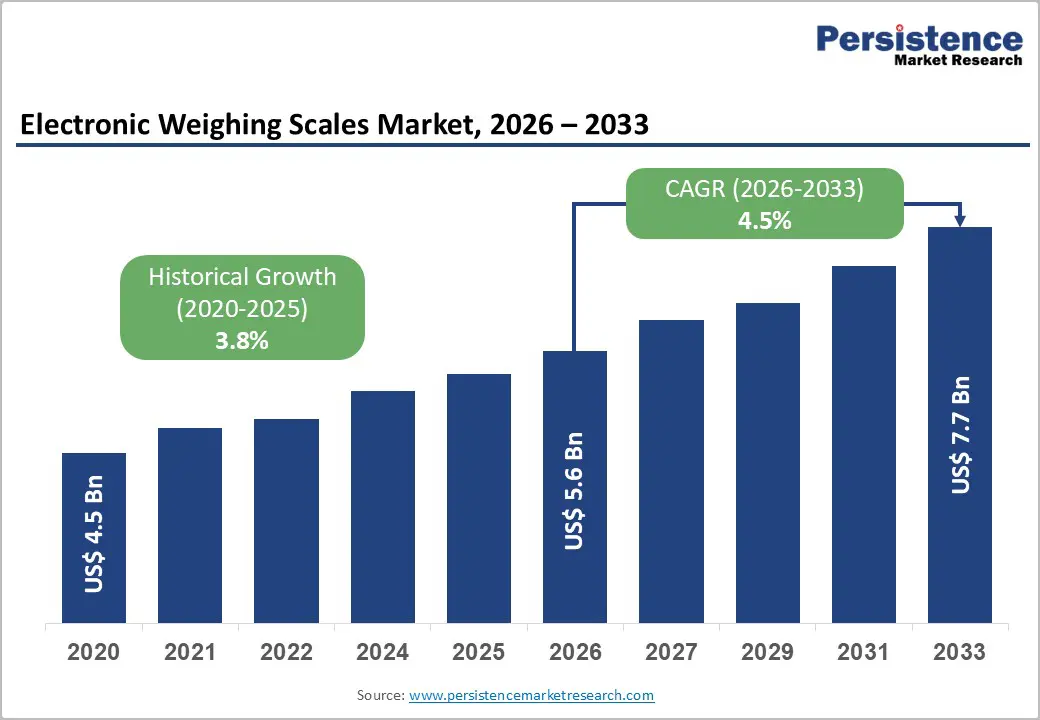
The global Electronic Weighing Scales Market is projected at US$5.6 billion in 2026 and is projected to reach US$7.7 billion by 2033, growing at a CAGR of 4.5% between 2026 and 2033. Growth is driven by widespread automation adoption across manufacturing, retail and healthcare sectors, coupled with stringent legal metrology standards mandated by national and international regulatory bodies. Integration of IoT and smart connectivity in weighing systems, combined with the rising e-commerce and food processing industries, sustains demand for precision measurement infrastructure globally.
Key Highlights Summary
- The global Electronic Weighing Scales Market is projected at US$5.6 billion in 2026, reaching US$7.7 billion by 2033, expanding at a CAGR of 4.5% during 2026–2033.
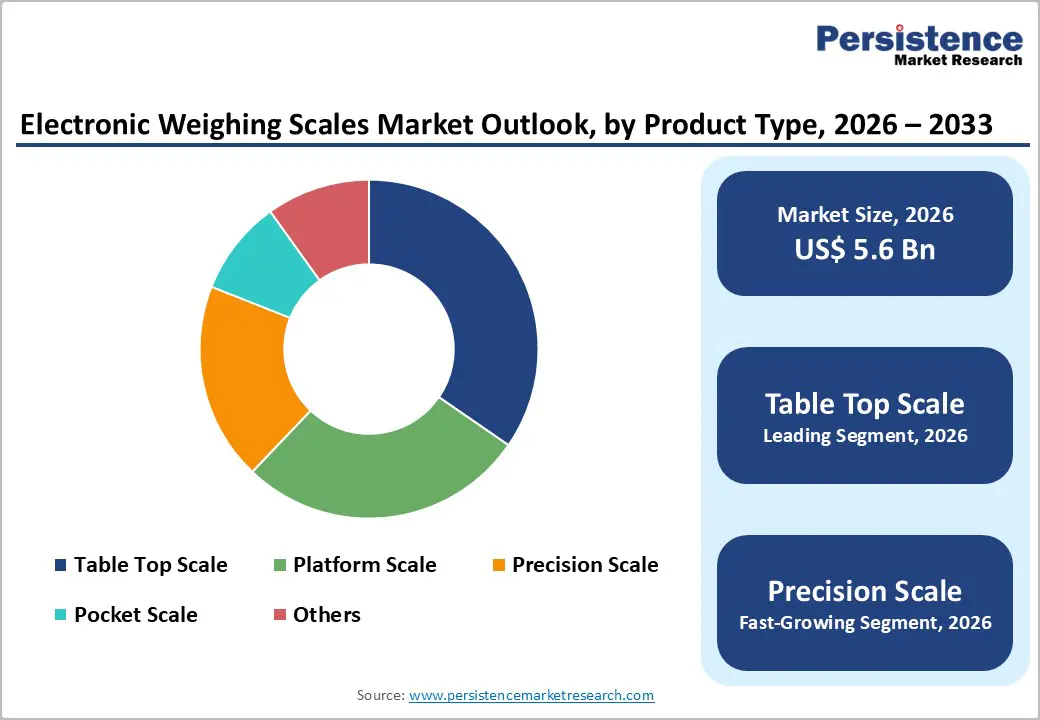
- Table Top Scales lead with approximately 35% market share, while Precision Scales represent the fastest-growing segment at an estimated 5.3% CAGR through 2033.
- Industrial Scales application dominates with roughly 30% share, whereas Health Scales are the fastest-expanding application segment at approximately 6.3% CAGR.
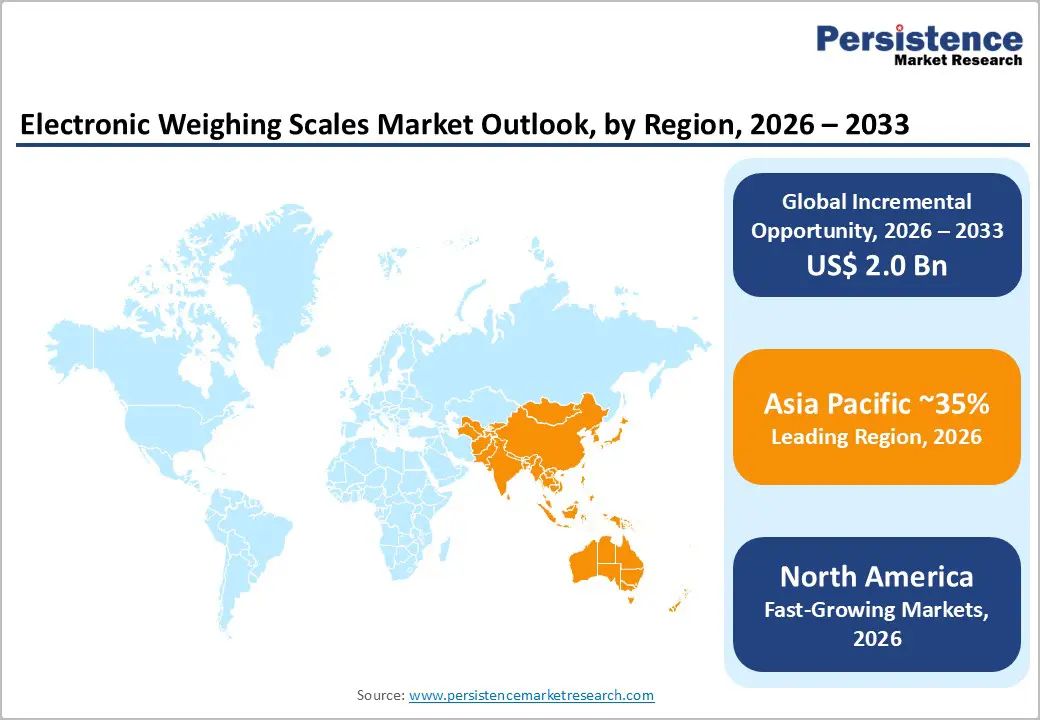
- Asia Pacific holds the largest regional share at approximately 35% of global market value, North America grows at about 4.2% CAGR, and Europe maintains roughly 24–25% share with about 3.9% CAGR.
- Recent strategic developments include advanced product launches in IoT-enabled and washdown-resistant scales, expanded label printing capabilities, and enhanced digital load cell systems targeting manufacturing and logistics optimization.
| Key Insights | Details |
|---|---|
| Electronic Weighing Scales Market Size (2026E) | US$ 5.6 billion |
| Market Value Forecast (2033F) | US$ 7.7 billion |
| Projected Growth CAGR (2026-2033) | 4.5% |
| Historical Market Growth (2020-2025) | 3.8% |
Market Dynamics Analysis
Market Drivers
Industrial automation and manufacturing sector expansion
The global manufacturing sector continues to prioritize automation, quality control and precision measurement as core operational requirements. Industry 4.0 initiatives, particularly in Asia Pacific and North America, drive significant investments in digital weighing systems that integrate with enterprise resource planning and manufacturing execution systems. Bench scales, floor scales and precision balances capable of real-time data transmission to production networks are experiencing sustained demand, with the industrial bench scale segment growing at a 4.5-5.0% CAGR. Pharmaceutical, chemical, and food processing industries mandate accurate weight measurement for compliance, batch traceability and regulatory audits under standards such as GMP and HACCP, reinforcing capital expenditure cycles on advanced electronic weighing infrastructure.
Rising e-commerce, retail expansion and supply chain digitalization
E-commerce and omnichannel retail growth globally have necessitated reliable weighing and dimensioning systems for parcel processing, inventory management and shipping operations. Retail scales segment was growing at 6.0% CAGR, reflecting accelerating adoption of label printing and barcode-integrated weighing solutions in supermarkets and logistics hubs. Smart, connected scales that provide real-time inventory updates and seamless point-of-sale system integration represent a significant value proposition for retailers facing heightened competition and operational cost pressures. Furthermore, the growing logistics and warehousing sectors in Asia Pacific and emerging markets create substantial demand for truck scales, platform scales and counting scales that enable efficient material handling and weight-based sorting.
Market Restraints
High capital costs and calibration complexity
Electronic weighing systems, particularly precision and laboratory scales, command significant upfront capital expenditure, with advanced analytical balances ranging from tens of thousands to hundreds of thousands of dollars. Ongoing calibration and verification expenses under NIST and OIML standards add recurring operational costs, deterring adoption among small retailers and independent operators. Load cell and sensor technology requirements, compliance certifications, and periodic recalibration services increase total cost of ownership, limiting market penetration in price-sensitive emerging markets and constraining growth among small to medium-sized enterprises unable to justify such capital allocations.
Market saturation in developed economies and digital payment shift
Mature markets in North America and Western Europe exhibit moderating growth rates, with saturation in urban retail and logistics segments limiting new unit deployment. The progressive shift toward contactless and digital payment methods, coupled with mobile payment platforms, reduces reliance on traditional cash-based retail environments where scales historically played central roles. Additionally, market maturity in developed regions intensifies price competition and compresses vendor margins, forcing consolidation and limiting vendor innovation investment in incremental feature enhancements.
Market Opportunities
Smart and IoT-enabled weighing systems for Industry 4.0 and process automation
The convergence of IoT, cloud computing, and artificial intelligence with weighing infrastructure is creating substantial opportunities for equipment manufacturers and system integrators globally. Smart weighing scales featuring real time data logging, predictive maintenance alerts, and remote diagnostics increasingly command premium pricing while enabling recurring value added service revenues. IoT enabled weight indicators deployed across pharmaceutical manufacturing, food processing, and logistics operations can automatically transmit measurement data to centralized systems, reducing manual intervention and lowering labor costs by an estimated 15-25%. Simultaneously, digital connectivity enhances regulatory compliance, audit readiness, and end to end traceability. As digital transformation accelerates across industrial and commercial environments, smart and connected weighing solutions are emerging as a high growth niche within the broader market through 2033.
Precision and laboratory scales demand in pharmaceutical, chemical and life sciences
Pharmaceutical, analytical chemistry, and life sciences research sectors worldwide increasingly prioritize ultra precision measurement infrastructure for research, development, and quality assurance activities. Advanced micro and analytical balances offering milligram level accuracy, automated internal calibration, and integrated data management capabilities are witnessing strong demand across laboratories. This demand is particularly concentrated in Europe, North America, and Asia Pacific, where research intensity, regulatory oversight, and innovation spending remain high. The laboratory scales segment is projected to maintain mid single digit growth through 2033, supported by rising global research expenditure, stringent compliance requirements for traceable calibration documentation, and the expanding presence of contract research organizations alongside pharmaceutical manufacturing outsourcing toward emerging and cost competitive markets globally to enhance efficiency, accuracy, and regulatory readiness.
Segmentation Analysis
Product Type Analysis
The Table Top Scale segment is the leading product category, accounting for approximately 35% of global market value in 2026. These portable, compact devices are the most widely deployed across retail, laboratory, small-scale industrial and home-use applications due to their cost-effectiveness, space efficiency and ease of operation. Widespread adoption in grocery stores, pharmacies, laboratories and small manufacturing facilities sustains base demand. Their ability to integrate with digital displays, rechargeable power options and wireless data transfer capabilities has enhanced utility and supported sustained market leadership.
The Precision Scale segment is the fastest-growing product type, expanding at an estimated 5.3% CAGR between 2026 and 2033. Growth is driven by increasing demand from pharmaceutical, analytical chemistry, medical research and precision engineering sectors requiring microgram-level accuracy and automated calibration systems. Integration with laboratory information systems and enhanced data traceability features support adoption in regulated industries where measurement documentation is mandatory for audit compliance.
Application Analysis
The Industrial Scales application segment leads the market with approximately 30% share, reflecting their critical role in manufacturing, logistics, food processing and quality assurance operations. Industrial scales encompassing bench, floor, platform and counting variants are deployed extensively in production environments where weight measurement directly impacts product quality, regulatory compliance and operational efficiency. Large manufacturing facilities in automotive, pharmaceutical, chemicals, and food sectors maintain substantial inventories of industrial weighing equipment, sustaining robust replacement demand.
The Health Scales application segment is the fastest-growing, projected to expand at roughly 6.3% CAGR through 2033. Growth is fueled by rising health consciousness, obesity management programs, fitness center proliferation and telemedicine adoption requiring reliable personal weight measurement devices. Integration of Bluetooth and smartphone connectivity in modern health scales, coupled with mobile health applications for weight tracking and fitness monitoring, has enhanced consumer engagement and driven adoption among health-conscious demographics, particularly in developed economies and urban areas across Asia Pacific.
Regional Market Insights
North America
North America represents a mature yet innovation-focused market, characterized by high penetration of advanced weighing systems and robust regulatory compliance infrastructure. The region is projected to grow at a CAGR of approximately 4.2% from 2026 to 2033, driven by sustained industrial automation investments, stringent NIST-based certification requirements and innovation in IoT-integrated weighing solutions. The United States dominates North America, leveraging advanced manufacturing capabilities, pharmaceutical and biotechnology research prominence, and a well-established logistics ecosystem requiring precision weight measurement. Federal initiatives supporting advanced manufacturing and automation further reinforce modernization trends.
North America's fastest growth is concentrated in smart, connected and automated weighing systems for manufacturing and logistics, supported by robust R&D investment and early adoption of Industry 4.0 technologies. Integration with enterprise systems, wireless data transmission and predictive analytics capabilities command premium pricing and drive above-average segment growth within the overall North American market.
Europe
Europe constitutes a significant market with an estimated 24–25% share of global electronic weighing scales revenue in 2026. The region is growing at a steady CAGR of approximately 3.9% between 2026 and 2033, with performance varying by country based on industrial intensity and automation adoption rates. Germany, with its strong precision engineering heritage and manufacturing sector, exhibits robust demand for laboratory and industrial scales, supported by strict DIN and OIML compliance requirements. The United Kingdom's pharmaceutical and manufacturing sectors sustain demand for precision measurement equipment, while France and Spain maintain active retail and food processing industries requiring scale infrastructure.
Regulatory harmonization across the European Union, emphasis on measurement traceability and sustainability objectives are driving vendor innovation in energy-efficient and digital-first weighing systems. European manufacturers such as Kern & Sohn and Bizerba are leading precision scale innovation, supporting steady modernization of the installed base and supporting mid-single-digit regional growth through 2033.
Asia Pacific
Asia Pacific is the largest regional market, holding an estimated 35% of global electronic weighing scales market value in 2026. China, with its massive manufacturing sector and logistics infrastructure, represents the dominant single market within the region, while India's rapid industrialization and organized retail expansion create substantial growth opportunities. The region experiences robust demand for all scale categories, driven by rapid factory automation, e-commerce logistics expansion and rising retail standardization. Government initiatives supporting Made in China 2025 and Make in India programs incentivize domestic electronic scales manufacturing and deployment.
Asia Pacific's growth trajectory is particularly strong in platform scales, industrial counting scales and retail label-printing scales, reflecting the region's expansion in manufacturing, food processing and organized retail sectors. Integration of locally-manufactured load cells and IoT modules into complete weighing systems is increasingly common, supporting competitive pricing while maintaining quality standards. Market expansion is expected to continue at above-global-average rates through 2033 due to ongoing industrialization and urbanization dynamics.
Competitive Landscape
Strategic Developments
- In August 2024, Mettler Toledo introduced an advanced series of wash-down resistant digital weight checkers with enhanced measurement accuracy and durability for food processing and pharmaceutical manufacturing applications.
- In November 2024, Sartorius AG expanded its precision analytical balance portfolio with automated calibration and real-time data logging capabilities, targeting laboratories and pharmaceutical R&D facilities requiring GMP-compliant measurement systems.
Business Strategies
Market leaders pursue innovation-led differentiation through IoT integration, cloud connectivity and automated calibration features enabling real-time process monitoring. Strategies emphasize cost-leadership in emerging markets, leveraging regional manufacturing and component sourcing to compete on price. Service-centric models bundling hardware, calibration verification and lifecycle support increasingly complement hardware sales, differentiate vendors and enhance customer retention across all market segments.
Companies Covered in Electronic Weighing Scales Market
- Mettler Toledo International
- Sartorius AG
- Avery Weigh-Tronix
- Ohaus Corporation
- Rice Lake Weighing Systems
- CAS Corporation
- Kern & Sohn GmbH
- Bizerba SE & Co.
- Adam Equipment
- Fairbanks Scales Inc.
- Doran Scales Inc.
- Cardinal Scale Manufacturing Company
- ESSAE Group
Frequently Asked Questions
The global Electronic Weighing Scales Market is expected to be approximately US$5.6 billion in 2026, reaching nearly US$7.8 billion by 2033.
The market is driven by industrial automation adoption, e-commerce and retail expansion, and stringent regulatory compliance mandates for measurement accuracy and traceability.
The Electronic Weighing Scales Market is projected to grow at a CAGR of approximately 4.5% between 2026 and 2033.
Key opportunities include deployment of smart IoT-enabled weighing systems for Industry 4.0, expansion in precision and analytical measurement for pharmaceuticals, and geographic expansion in emerging markets with underdeveloped retail and logistics infrastructure.
Major global players include Mettler Toledo, Sartorius AG, Avery Weigh-Tronix, Ohaus Corporation, Rice Lake Weighing Systems, CAS Corporation, Kern & Sohn, Bizerba, Adam Equipment, Fairbanks Scales, Doran Scales, Cardinal Scale Manufacturing, and ESSAE Group.


