




- Sporting Goods & Equipment
- Sports & Athletic Insoles Market
Sports & Athletic Insoles Market Size, Share, and Growth Forecast, 2026 - 2033
Sports & Athletic Insoles Market by Product Type (Gel-based, Foam-based, Air Cushion, Ethylene-vinyl Acetate (EVA), Leather), Insole (Shock-absorbing Insoles, Arch-supportive Insoles, Cushioned Insoles, Others), and Regional Analysis for 2026 - 2033

Sports & Athletic Insoles Market Size and Trends Analysis
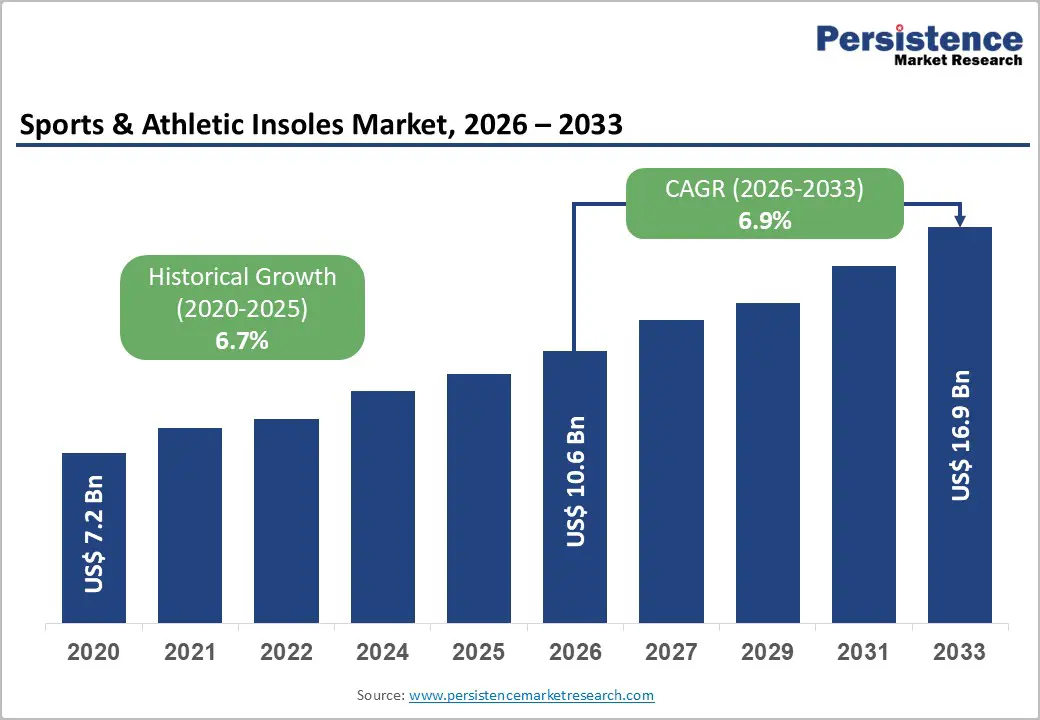
The global sports & athletic insoles market size is likely to be valued at US$10.6 billion in 2026 and is expected to reach US$16.9 billion by 2033, growing at a CAGR of 6.9% during the forecast period from 2026 to 2033, driven by sustained growth in sports participation, recreational fitness activities, and increasing consumer focus on foot health and biomechanical support.
The market continues to benefit from rising awareness about injury prevention, particularly conditions such as plantar fasciitis, flat feet, overpronation, and stress-related foot fatigue, which are common among athletes and active individuals. Advancements in materials science, including enhanced shock-absorbing polymers, breathable, moisture-wicking fabrics, lightweight ethylene-vinyl acetate (EVA), gel cushioning systems, and customizable, moldable technologies, are significantly improving product performance, durability, and comfort.
Key Industry Highlights:
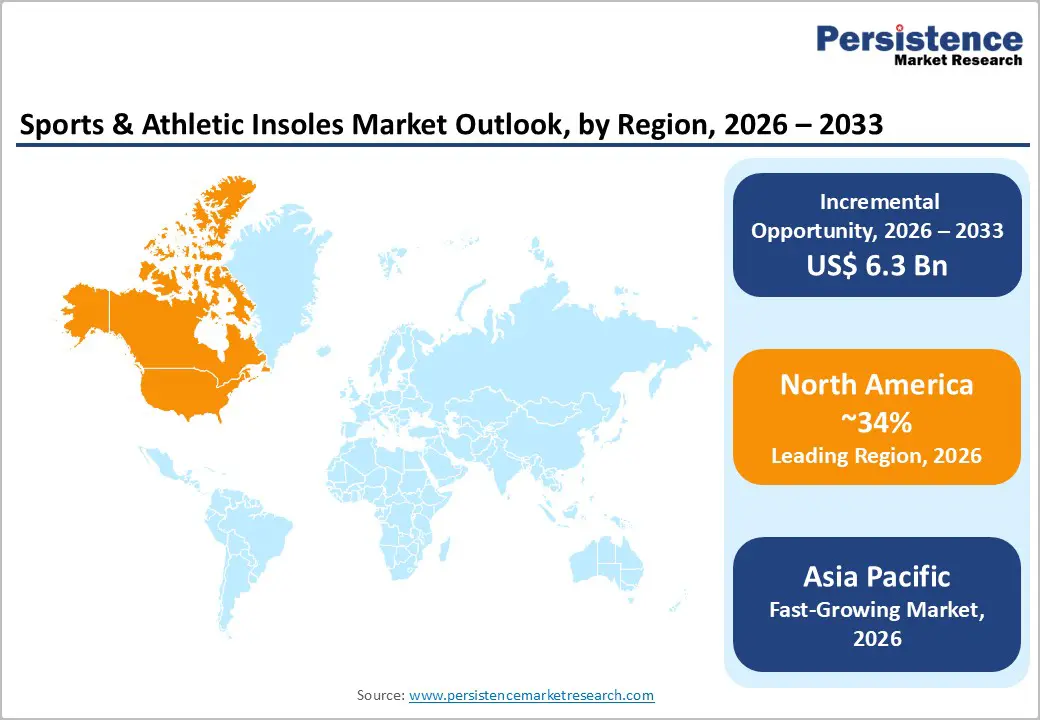
- Leading Region: North America, accounting for a market share of 34% in 2026, driven by strong athletic participation, advanced product innovation, high consumer awareness of injury prevention, established regulatory standards, and growing demand for premium and customizable insole solutions.
- Fastest-growing Region: Asia Pacific, supported by expanding sports participation, rising urbanization and disposable incomes, strong regional manufacturing capabilities, and growing demand across both mass-market and premium athletic segments.
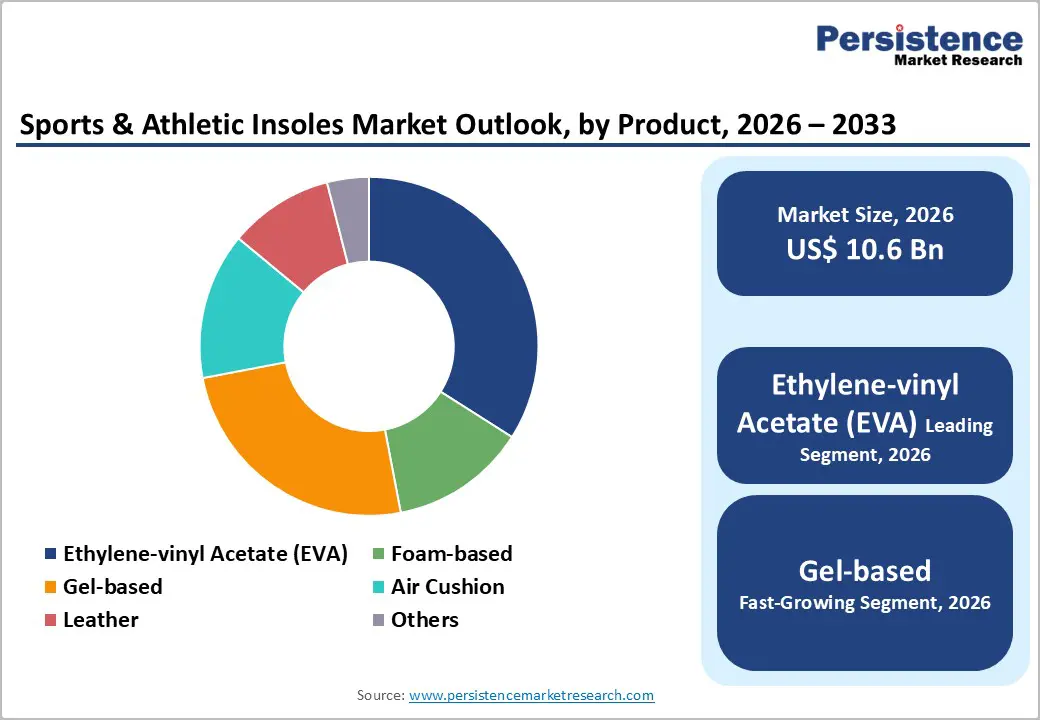
- Leading Product Type: Ethylene-vinyl acetate (EVA), accounting for 38% of the revenue share, driven by its lightweight structure, durability, and superior shock absorption in athletic applications.
- Leading Insole Type: Arch-supportive insoles, accounting for over 36% of the revenue share in 2026, supported by strong demand for biomechanical stability and injury prevention support.
| Key Insights | Details |
|---|---|
|
Sports & Athletic Insoles Market Size (2026E) |
US$10.6 Bn |
|
Market Value Forecast (2033F) |
US$16.9 Bn |
|
Projected Growth (CAGR 2026 to 2033) |
6.9% |
|
Historical Market Growth (CAGR 2020 to 2025) |
6.7% |
Market Factors - Growth, Barriers, and Opportunity Analysis
Growth Analysis - Rising Sports and Fitness Participation
Increasing engagement in running, gym workouts, cycling, cross-training, and recreational sports has elevated demand for performance-enhancing foot support products. Urban lifestyles, corporate wellness programs, and the expansion of fitness centers have encouraged individuals to adopt active routines. As participation grows across professional athletes and recreational users alike, the need for improved shock absorption, stability, and endurance support becomes essential. Insoles are increasingly viewed not merely as accessories but as performance optimization tools that enhance comfort, reduce fatigue, and support sustained athletic output.
Large-scale sporting events, marathon culture, and social media-driven fitness trends accelerate consumer spending on specialized footwear components. Athletes and fitness enthusiasts increasingly seek products that enhance biomechanical efficiency and reduce impact stress during high-intensity activities. This sustained behavioral shift toward active living has created consistent replacement demand, as insoles require periodic renewal due to wear. Growing female sports participation and youth engagement in organized athletics also expand the addressable consumer base.
Growing Awareness of Foot Health and Injury Prevention
Consumers are increasingly informed about common conditions such as plantar fasciitis, flat feet, overpronation, and heel pain, particularly among athletes and active individuals. Medical professionals, physiotherapists, and sports trainers frequently recommend supportive insoles to enhance alignment and reduce strain. As preventive healthcare gains prominence, insoles are recognized as practical solutions for minimizing repetitive stress injuries. Educational campaigns, digital health content, and improved product labeling help consumers better understand biomechanical benefits and proper foot support.
Aging athletic populations and long-distance runners are prioritizing injury prevention strategies to extend performance longevity. Workplace wellness initiatives and ergonomic awareness also encourage the use of supportive footwear accessories beyond competitive sports. The convergence of sports medicine research and consumer product innovation has strengthened credibility around orthotic-style insoles. With increased willingness to invest in preventive measures rather than corrective treatments, consumers demonstrate higher adoption rates of arch-supportive and shock-absorbing solutions.
Barrier Analysis - Limited Standardization in Product Efficacy Claims
Manufacturers often promote benefits such as improved performance, enhanced balance, or injury reduction without universally accepted testing benchmarks. Variability in clinical validation and testing methodologies can create skepticism among informed consumers. Inconsistent labeling practices and a lack of harmonized regulatory standards across regions may weaken trust in certain product categories. This challenge is particularly relevant in premium segments where consumers expect measurable biomechanical outcomes before making higher-value purchasing decisions.
Differences in consumer foot anatomy make it difficult to substantiate universal performance claims. Retail environments, especially online platforms, may lack professional assessment tools, leading to mismatched product selection. Negative user experiences resulting from improper fit can affect brand reputation and repeat purchases. Without standardized comparative data, consumers often rely heavily on reviews rather than verified clinical evidence.
Biomechanical Customization Challenges
Although personalized insoles promise enhanced comfort and alignment correction, accurate customization requires advanced scanning, gait analysis, or heat molding processes. Such solutions may not be universally accessible, particularly in mass-market retail settings. Variability in foot structure, arch height, and movement patterns makes standardized customization complex. Inadequate assessment tools can result in suboptimal fit, reducing the effectiveness of otherwise high-quality products. These barriers limit the widespread adoption of fully customized solutions in price-sensitive consumer segments.
The integration of 3D scanning or digital measurement technologies requires investment in equipment and trained personnel. Smaller retailers may lack the infrastructure to provide precise customization services. Even online customization platforms face challenges in ensuring measurement accuracy without in-person validation. Production lead times for custom products can also deter consumers seeking immediate solutions. Technical maintenance costs and software updates add operational complexity for retailers offering digital fitting systems. Data privacy considerations related to biometric foot scans create regulatory and consumer trust concerns in certain regions.
Opportunity Analysis - Unmet Needs in Customizable and Specialized Solutions
Different athletic disciplines, such as running, basketball, hiking, and cycling, require unique support structures and pressure distribution designs. Many consumers still rely on generic insoles that may not fully align with their biomechanical requirements. Expanding specialized product lines tailored to sport intensity, terrain, and foot morphology can unlock new growth avenues. Heat-moldable technologies and modular arch systems present scalable pathways to deliver semi-custom solutions without full clinical intervention.
Underserved consumer groups, including female athletes, youth sports participants, and individuals with specific orthopedic conditions, represent growth potential. Targeted product innovation focusing on ergonomic differentiation and anatomical precision can strengthen brand loyalty. Retailers that incorporate digital foot-scanning kiosks enhance engagement and personalization without excessive cost burdens. Consumer expectations are evolving toward individualized comfort and performance optimization; companies that can bridge the gap between mass production and tailored functionality are well-positioned to gain a competitive advantage.
Smart Insole Integration
Embedded sensors that monitor gait patterns, pressure distribution, step count, and impact force are redefining performance analytics. Athletes increasingly seek data-driven insights to improve technique and prevent injury. Smart insoles provide real-time biomechanical feedback, aligning with broader trends in wearable technology. Integration with mobile applications enhances user engagement and enables performance tracking over time. This convergence of sports science and consumer electronics expands the functional scope of traditional insoles beyond cushioning and support.
Rehabilitation programs and sports training facilities can utilize smart insole data for corrective interventions. Continuous monitoring helps identify imbalances before they escalate into chronic injuries. As wearable adoption grows, the acceptance of connected footwear accessories is expected to rise. Advancements in battery miniaturization and wireless connectivity improve practicality and comfort. Companies investing in sensor integration, data analytics platforms, and athlete-focused applications can capture premium segments seeking measurable performance enhancement and preventive healthcare solutions.
Category-wise Analysis
Product Type Insights
Ethylene-vinyl acetate (EVA) is expected to lead the sports & athletic insoles market, accounting for approximately 38% of revenue in 2026, driven by its lightweight structure, durability, flexibility, and strong shock-absorbing capacity. EVA is widely preferred in sports and athletic applications because it offers an optimal balance between cushioning and structural stability, making it suitable for running, training, and high-impact activities. For example, Superfeet Worldwide Inc. incorporates high-density EVA foam in several performance-focused models to deliver structured arch support and long-lasting resilience, demonstrating the material’s commercial scalability and reliability in competitive sports environments.
Gel-based insoles are likely to be the fastest-growing segment, driven by the acceleration in demand for advanced cushioning and pressure redistribution solutions. These insoles are increasingly adopted in high-impact sports such as basketball, long-distance running, and cross-training, where repetitive stress on heels and forefoot areas is significant. Gel materials adapt more effectively to foot contours, offering targeted shock absorption and enhanced comfort during prolonged activity. For example, Sorbothane Inc. utilizes proprietary viscoelastic gel technology designed to reduce impact forces, highlighting how material innovation supports segment expansion. Rising consumer preference for enhanced comfort and fatigue reduction continues to drive strong growth momentum in this category.
Insole Type Insights
Arch-supportive insoles are projected to lead the market, capturing around 36% of the revenue share in 2026, supported by their ability to correct biomechanical misalignment and reduce strain associated with overpronation and plantar fasciitis. Athletes and fitness enthusiasts prioritize stability and structured support to maintain proper posture and movement efficiency during high-intensity activities. These insoles enhance weight distribution and reduce localized joint stress, contributing to injury prevention and improved performance consistency. For example, Powerstep LLC offers arch-supportive insoles designed for athletic footwear, combining firm support shells with cushioned top layers to promote alignment and comfort, illustrating how biomechanical functionality sustains this segment’s leading position.
Customizable and moldable insoles are likely to be the fastest-growing insole type, driven by personalization trends gaining traction across both professional and recreational sports. Heat-moldable technologies and 3D scanning solutions allow users to achieve semi-custom fits tailored to individual arch height and gait patterns. This personalization enhances comfort, improves pressure distribution, and supports injury prevention strategies. Growth is driven by the growing availability of digital foot-scanning systems in specialty retail stores. For example, FootBalance System Ltd provides heat-moldable insoles customized in-store using foot analysis systems, demonstrating how accessible personalization technologies are accelerating adoption and strengthening demand for tailored performance solutions.
Regional Insights
North America Sports & Athletic Insoles Market Trends
North America is anticipated to be the leading region, accounting for 34% market share in 2026, driven by a strong emphasis on performance enhancement and preventive foot care. Consumers in the U.S. and Canada are increasingly prioritizing injury-prevention technologies and comfort features that support extended training sessions, long-distance running, and competitive sports participation. Growth in specialty running, CrossFit, and high-intensity interval training (HIIT) activities is driving demand for insoles engineered with advanced materials, such as multi-density foams, EVA blends, and moisture-wicking fabrics.
Personalization and digital innovation are reshaping the regional market. Technological advancements, such as in-store foot scanning, virtual fitting tools, and semi-custom orthotic production, are becoming more mainstream, enabling retailers to offer tailored solutions that improve fit and function. Brands such as Aetrex Worldwide, Inc. are capitalizing on this trend by offering 3D foot scanning and customized insole options in North American retail outlets, aligning with consumer preferences for individualized performance support. The convergence of digital health data and wearable compatibility also paves the way for the development of smart insoles, attracting tech-savvy athletes and rehabilitation markets alike.
Europe Sports & Athletic Insoles Market Trends
Europe is likely to be a significant market due to a strong focus on biomechanical performance, preventive foot care, and the integration of medical insights into consumer products. European consumers demonstrate heightened awareness of ergonomic support and long-term musculoskeletal health, particularly in countries with developed sports cultures such as the U.K., Germany, and Nordic regions. This has driven demand for insoles that support stability, alignment, and pressure distribution, especially among runners, hikers, and multi-sport athletes. Retailers and specialty stores increasingly offer biomechanical assessment and fitting services, which help reduce returns and enhance customer satisfaction.
Innovation and technology adoption are shaping Europe’s competitive landscape, particularly in customizable and adaptive insole solutions. Brands are using advanced materials and digital tools to deliver tailored fit and comfort across diverse athletic pursuits. For example, Bauerfeind AG leverages its expertise in medical orthopedics to develop high-performance insoles that combine anatomical precision with dynamic support for sports and rehabilitation. This approach appeals to consumers seeking scientifically validated products that can address both athletic performance goals and therapeutic needs.
Asia Pacific Sports & Athletic Insoles Market Trends
The Asia Pacific region is likely to be the fastest-growing region, driven by rising health consciousness, growing sports participation, and expanding middle-class disposable incomes across countries. Urbanization and improved access to fitness infrastructure, such as gyms, running clubs, and recreational sports facilities, have broadened the active consumer base beyond professional athletes to include fitness enthusiasts and weekend warriors. E-commerce penetration and digital retail platforms are key enablers, enabling both international and local brands to reach a wider audience while educating consumers about the benefits of insoles through online content and virtual fitting tools.
Innovation and customization are gaining traction as competitive differentiators in the Asia Pacific region. Traditional one-size-fits-most insoles are gradually giving way to more specialized and adaptive solutions that align with specific activity types and biomechanical needs. For example, Sidas S.A. has expanded its presence across the Asia Pacific with technology-driven insoles that feature advanced pressure relief and foot contour adaptation, appealing to runners and fitness enthusiasts seeking enhanced comfort and performance. Local manufacturers are also investing in R&D to develop materials suited to regional climate conditions, such as moisture-wicking and quick-dry properties tailored for tropical markets.
Competitive Landscape
The global sports & athletic insoles market exhibits a moderately fragmented structure, driven by a mix of established brands and agile regional specialists competing across performance, comfort, and orthopedic segments. The landscape is characterized by continuous innovation in materials and design, with companies investing in advanced EVA, gel, and custom orthotic technologies to address diverse needs. Established brands leverage brand recognition and strategic partnerships with sports retailers and healthcare professionals to retain leadership.
With key leaders including Powerstep LLC, Aetrex Worldwide, Inc., and FootBalance System Ltd, competition remains dynamic as companies strive to expand their market footprint across regions and channels. These players compete through innovation in product performance and customization, enhancing consumer engagement with technologies such as 3D scanning, digital foot profiling, and semi-custom fitting services. E-commerce and direct-to-consumer strategies are increasingly pivotal, allowing brands to expand reach, offer tailored experiences, and gather data for continuous improvement.
Key Industry Developments:
- In January 2026, CURREX®, a leader in activity-specific insoles, launched BASKETBALLPRO™, its first insole engineered specifically for basketball athletes. Designed to support explosive movement, quick cuts, and all-day court comfort, the insole combines Dynamic Arch Technology™ (DAT) with sport-driven performance features to enhance stability, energy return, and foot alignment. Key innovations include Supercritical Foam for improved energy return, firmer DAT for lateral support, targeted heel cushioning for shock absorption, TPU traction-lock for reduced slippage, and an anti-slip silicone grip for secure foot placement.
- In October 2025, Superfeet, a leader in performance insoles, introduced the Run Pacer Elite, featuring a combination of Carbitex® flexible carbon fiber and SuperRev™ advanced foam technologies. The insole is designed to provide unmatched propulsion, responsiveness, and comfort for runners of all levels. The Carbitex carbon fiber plate adapts dynamically to pace, delivering explosive energy at high speeds while maintaining flexibility at slower paces, while SuperRev™ foam offers maximum energy return, cushioning, and durability through a supercritical microcellular structure.
Companies Covered in Sports & Athletic Insoles Market
- Superfeet Worldwide Inc.
- Spenco Medical Corporation
- Powerstep LLC
- SOLE Custom Footbeds Inc.
- Dr. Scholl's Shoes
- Birkenstock Orthopädie GmbH
- New Balance Athletics Inc.
- ALINE Systems Inc.
- Bauerfeind AG
- FootBalance System Ltd
- Pedag International
- Profoot Inc.
- Sorbothane Inc.
- Tread Labs Inc.
- Protalus LLC
- Aetrex Worldwide, Inc.
- Sidas S.A.
- Enertor Limited
Frequently Asked Questions
The global sports & athletic insoles market is projected to reach US$10.6 billion in 2026.
The sports & athletic insoles market is driven by rising participation in sports and fitness activities, increasing awareness of foot health, and demand for performance-enhancing and injury-preventive footwear solutions.
The sports & athletic insoles market is expected to grow at a CAGR of 6.9% from 2026 to 2033.
Key market opportunities lie in customizable and sport-specific insoles, smart insole integration, and expanding demand in emerging regions with growing sports and fitness participation.
Superfeet Worldwide Inc., Spenco Medical Corporation, Powerstep LLC, and SOLE Custom Footbeds Inc. are the leading players.


