




- Clothing, Footwear, & Accessories
- Compression Sportswear Market
Compression Sportswear Market Size, Share, and Growth Forecast 2026 - 2033
Compression Sportswear Market by Product Type (Shirts, Shorts, Tights/Leggings, Innerwear, Others), by Distribution Channel (Hypermarket/Supermarket, Specialty Stores, Multi-Brand Stores, Online, Others), by End-user (Men, Women, Children), by Regional Analysis, 2026 - 2033

Compression Sportswear Market Size and Trend Analysis
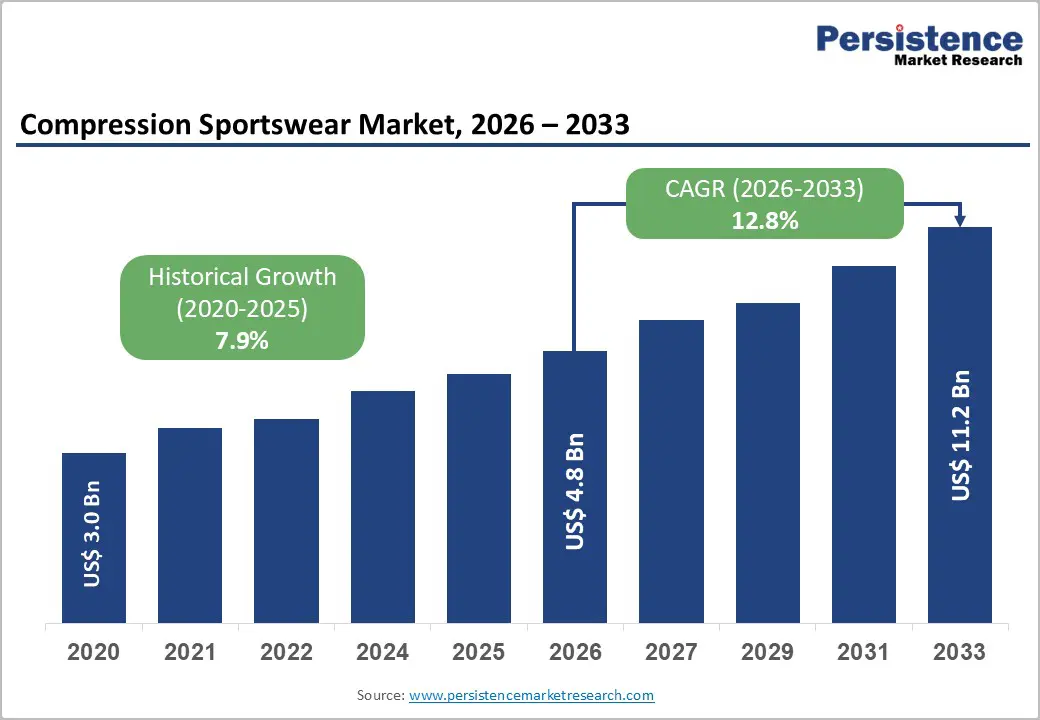
The global compression sportswear market size is likely to be valued at US$ 4.8 Billion in 2026 and is expected to reach US$ 11.2 Billion by 2033, growing at a CAGR of 12.8% during the forecast period from 2026 to 2033.
The market's exceptional growth momentum is driven by the powerful convergence of global health and fitness awareness megatrends, the mainstream adoption of athleisure as everyday apparel, and rapid technological advancements in performance fabric engineering that are expanding compression sportswear's applications across professional athletics, recreational fitness, medical recovery, and casual wear simultaneously.
Key Market Highlights
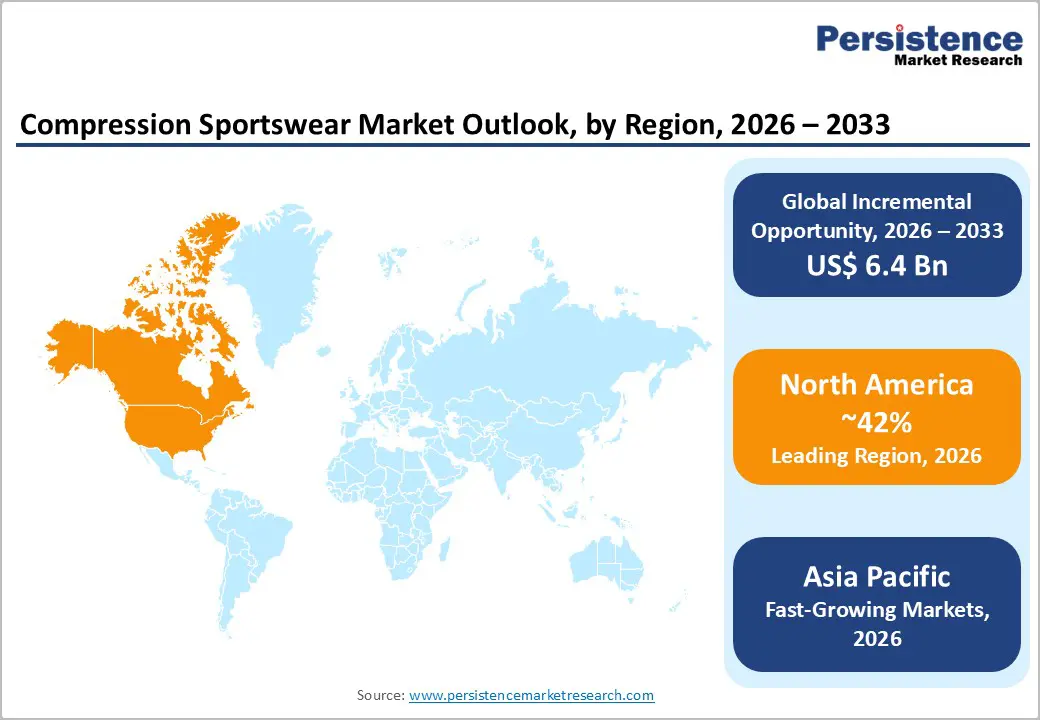
- Leading Region: North America leads the global Compression Sportswear market having 42% share, anchored by the U.S. activewear market's approximately US$ 50 billion annual retail scale tracked by the NPD Group, over 70% American fitness participation rates, and the dominant global market positions of Nike, Under Armour, and CW-X in compression product innovation and distribution.
- Fastest-Growing Region: Asia Pacific is the fastest-growing region with rising CAGR of 15.2%, with China's CNSF-reported sporting goods market exceeding CNY 300 billion annually and India's Fit India Movement generating record fitness participation growth, collectively creating the world's fastest-expanding consumer base for performance compression sportswear across both premium and value market tiers.
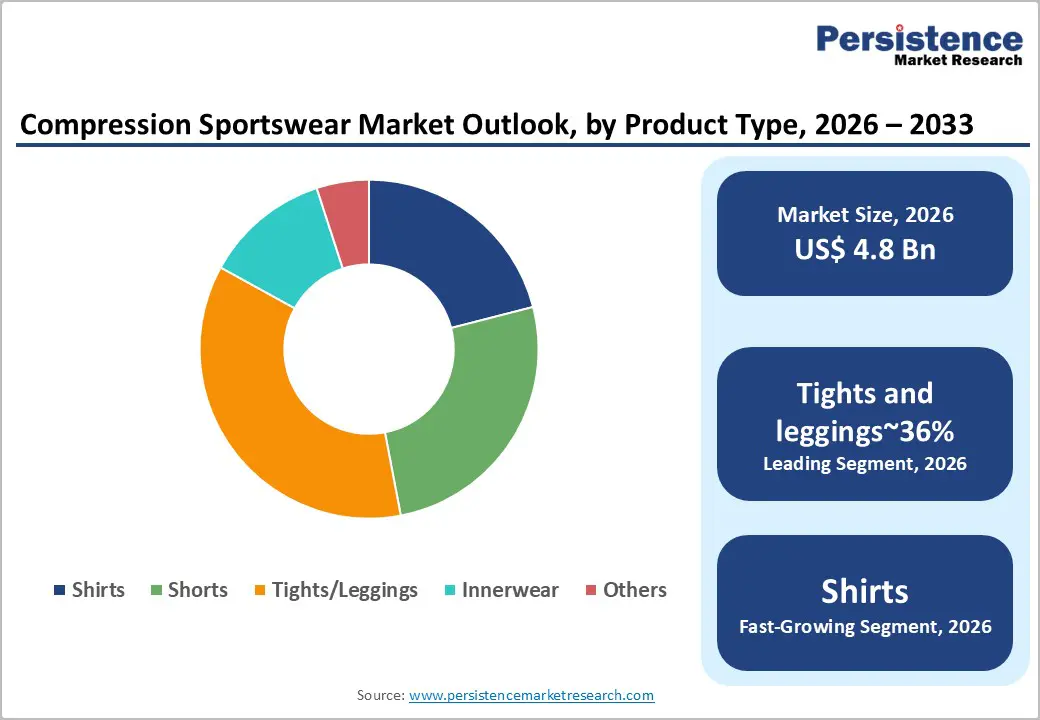
- Leading Segment: Tights/Leggings dominate the Product Type segment with approximately 36% market revenue share in 2026, driven by their unparalleled versatility spanning athletic performance, yoga, athleisure, and recovery applications, supported by the Textile Exchange's confirmation of stretch and activewear fabrics as the fastest-growing segment of global fiber demand globally.
- Fastest-Growing Segment: Online Distribution is the fastest-growing and leading channel, commanding approximately 38% market share in 2026, validated by Nike's Direct business generating over US$ 21 billion in FY2023 revenue and representing 44% of total company sales, demonstrating the transformative scale of DTC e-commerce for compression sportswear brands globally.
- Key Opportunity: Smart and biometric compression garments represent the key market opportunity, with embedded ECG, accelerometer, and lactic acid sensors, demonstrated by Under Armour's Athlete Data Platform and Hexoskin, enabling US$ 200-500 premium-priced connected compression garments that attract professional athletes and health-forward consumers driving above-average revenue growth.
| Key Insights | Details |
|---|---|
| Compression Sportswear Market Size (2026E) | US$ 4.8 Billion |
| Market Value Forecast (2033F) | US$ 11.2 Billion |
| Projected Growth CAGR (2026 - 2033) | 12.8% |
| Historical Market Growth (2020 - 2025) | 7.9% |
Market Dynamics and Growth Drivers
Global Fitness and Sports Participation Surge Amplifying Compression Garment Demand Across Demographics
The rapid global growth in fitness participation, including running, cycling, gym workouts, yoga, team sports, and competitive athletics, is significantly increasing consumer demand for compression sportswear across all age groups and demographics. According to the International Health, Racquet and Sportsclub Association (IHRSA), global gym membership surpassed 184 million before COVID-19 and has recovered strongly in recent years. Additionally, the U.S. Bureau of Labor Statistics reported that spending on sporting goods and activewear in the United States increased by more than 20% between 2019 and 2023.
Scientific research has also strengthened the credibility of compression sportswear. Studies published in the Journal of Strength and Conditioning Research show that graduated compression garments improve blood circulation, reduce muscle vibration during impact activities by up to 28%, and support faster muscle recovery after exercise. These performance benefits are widely promoted by professional athletes and are increasingly recognized by recreational fitness communities. Furthermore, the Paris 2024 Olympic Games increased global interest in sports and fitness culture, which directly boosted compression apparel sales across major markets.
Athleisure Trend and Fashion-Performance Fusion Expanding Compression Wear's Addressable Consumer Market
The global athleisure trend, where sportswear is widely accepted as everyday casual clothing, has significantly expanded the market potential for compression sportswear. Demand is no longer limited to professional athletes; it now includes a large population of fashion-conscious and health-focused consumers who wear athletic clothing for work, social events, and leisure activities. Retail data from The NPD Group shows that the U.S. activewear market has grown at nearly double the rate of the overall apparel market in recent years. Compression tights and leggings have become one of the most popular activewear categories for women across major retail channels.
Leading brands such as Nike, Adidas, and Lululemon Athletica have responded by launching compression products that combine advanced compression technology with stylish designs, moisture-wicking fabrics, and seasonal color collections. This strategy is blurring the traditional line between medical compression garments and fashionable athletic apparel. According to the Textile Exchange Preferred Fiber & Materials Report, consumers are also more willing to pay premium prices for performance activewear compared to conventional clothing.
Market Restraints
Premium Pricing Creating Accessibility Barriers in Price-Sensitive Emerging Markets
One of the key challenges facing the compression sportswear market is the relatively high cost of genuine graduated compression garments. These products are manufactured using advanced multi-layer fabrics designed to deliver precise and medically validated compression levels, which increases production costs. As a result, premium branded compression products typically retail between US$ 40 and US$ 150 per garment. This pricing can create affordability challenges in price-sensitive markets across Southeast Asia, Latin America, and Africa, as well as among lower-income consumer groups even in developed countries.
According to the McKinsey Global Fashion Index, although athleisure demand is growing worldwide, the premium performance segment is still largely concentrated among higher-income consumers. This limits the full growth potential of branded compression sportswear in developing economies where sports participation is rising but disposable income remains limited. Additionally, high pricing encourages the growth of low-cost imitation products, which can weaken brand value and create confusion among consumers.
Proliferation of Counterfeit and Sub-Standard Products Undermining Brand Value and Consumer Trust
The compression sportswear market also faces increasing challenges from counterfeit and low-quality products, particularly on unregulated online marketplaces. Many of these products falsely claim to offer graduated compression benefits but do not provide scientifically validated pressure levels. According to the International Anti-Counterfeiting Coalition (IACC), the global counterfeit apparel and footwear market exceeds US$ 450 billion annually, with performance sportswear being one of the most frequently counterfeited categories due to strong brand demand and premium pricing.
When consumers purchase these substandard compression garments, they often experience little or no performance improvement. In some cases, poorly designed compression garments can even cause discomfort or circulation issues. Such negative experiences can lead consumers to lose trust not only in counterfeit products but also in compression sportswear as a category. This situation can reduce repeat purchases and slow overall market adoption, especially among casual consumers who may not have enough knowledge to differentiate between authentic and counterfeit compression products.
Market Opportunities
Women's Compression Sportswear Segment Representing the Market's Highest-Growth Consumer Demographic
The women’s segment represents one of the most promising growth opportunities in the global compression sportswear market. This growth is largely driven by increasing participation of women in sports and fitness activities, the rising popularity of women’s professional sports leagues, and the growing influence of athleisure fashion trends. Compression leggings and tights have become a staple in women’s activewear wardrobes and are commonly worn not only for exercise but also for casual daily wear. The International Working Group on Women and Sport (IWG) reports that women’s sports participation has been steadily increasing worldwide.
In fact, female gym membership is growing nearly 1.5 times faster than male membership across IHRSA-affiliated fitness clubs. Major sporting events such as the FIFA Women’s World Cup 2023, which attracted approximately 2 billion viewers globally, have significantly increased the visibility of women’s sports and strengthened athletic identity among female consumers. Major brands such as Nike and Lululemon are actively expanding women-focused product lines, highlighting the enormous revenue potential in this demographic segment.
Smart and Biometric Compression Garments Creating a High-Value Technology-Driven Growth Frontier
The integration of wearable technology into compression sportswear is creating an exciting new growth opportunity for the market. Advanced smart compression garments now incorporate biometric sensors that can track physiological data such as heart rate, breathing patterns, body movement, and training intensity in real time. For example, Under Armour’s Athlete Data Platform and Hexoskin’s smart compression shirts integrate sensors that measure ECG signals, respiratory rate, and physical activity levels while transmitting data to mobile applications. These technologies allow athletes to monitor training performance, recovery status, and overall health metrics more effectively.
Research initiatives supported by the European Institute of Innovation and Technology (EIT) are also developing next-generation smart compression fabrics capable of monitoring hydration levels, muscle activity, and lactic acid buildup. Companies such as Bauerfeind AG are leveraging their medical-grade compression expertise to develop technologically advanced performance garments. These smart compression products can command premium prices between US$ 200 and US$ 500 per garment, attracting professional athletes and technology-oriented fitness consumers.
Category-wise Insights
By Product Type
Tights and leggings dominate the global compression sportswear market by product type, accounting for approximately 36% of total product segment revenue in 2026. Their popularity is largely driven by their versatility across multiple activities such as running, gym workouts, yoga, pilates, post-workout recovery, and even maternity fitness. This versatility makes them one of the most widely used compression garments across different consumer groups. Advances in textile engineering have also contributed to their strong market demand. High-performance fabrics made from nylon and spandex blends now provide excellent stretch, durability, and moisture management.
Circular knitting technologies allow manufacturers to produce seamless garments with precisely engineered compression zones. According to the Textile Exchange, stretch fabrics used in activewear are among the fastest-growing segments in global fiber demand. Major sportswear brands such as Nike, Under Armour, and Adidas continue to promote their compression tights collections, including Nike Pro, Under Armour HeatGear, and Adidas Techfit, which remain top-selling items across global sporting goods retail channels.
By Distribution Channel
Online retail has emerged as the leading and fastest-growing distribution channel in the global compression sportswear market, accounting for approximately 38% of total sales in 2026. The rapid expansion of e-commerce platforms and direct-to-consumer sales models has significantly transformed the way consumers purchase sportswear products. This shift was accelerated during the COVID-19 pandemic and has now become a permanent part of consumer shopping behavior. Major brands are heavily investing in their digital retail ecosystems to strengthen direct engagement with customers.
Nike’s direct sales channels, including its official website and mobile apps, generated over US$ 21 billion in revenue in fiscal year 2023, representing nearly 44% of the company’s total revenue. Online channels allow brands to capture higher profit margins, collect valuable consumer data, and offer personalized shopping experiences. Although online platforms dominate market growth, specialty sports stores still maintain strong relevance because they allow customers to physically evaluate product quality and receive professional sizing assistance before purchase.
By End-user
The men’s segment currently leads the global compression sportswear market, accounting for approximately 52% of total end-user revenue in 2026. Historically, male consumers have shown higher adoption of performance-oriented athletic apparel, particularly in sports such as running, cycling, gym training, and competitive team sports. Scientific research published in the International Journal of Sports Physiology and Performance has shown that compression garments can reduce muscle fatigue and support sustained performance during high-intensity exercise activities such as interval training and sprinting.
However, the women’s segment is expected to experience the fastest growth over the forecast period. Rising participation in yoga, pilates, barre workouts, and fitness training programs has significantly increased demand for compression leggings and shorts among women. Additionally, the growing visibility of female athletes in professional sports leagues is encouraging more women to adopt performance sportswear. The children’s segment is also emerging as a niche growth category, supported by expanding youth sports programs and increasing parental spending on performance sports gear for young athletes.
Regional Insights
North America Compression Sportswear Market Trends
North America currently leads the global compression sportswear market, primarily driven by the United States, which represents the world’s largest activewear market. According to The NPD Group, the U.S. activewear market generates approximately US$ 50 billion in annual retail sales. The region’s strong fitness culture, well-developed professional sports ecosystem, and high consumer spending power create a large and stable demand base for compression garments. The Physical Activity Council reports that more than 70% of Americans participate in some form of fitness or sports activity each year.
Major sportswear companies headquartered in North America, including Nike and Under Armour, continue to drive product innovation and market expansion through advanced compression technologies and strong retail distribution networks. Additionally, the U.S. Federal Trade Commission requires brands to provide scientific evidence supporting performance claims, which encourages companies to invest in clinical research. Canada is also witnessing growing demand for premium compression sportswear, particularly in urban centers such as Toronto, Vancouver, and Montreal.
Europe Compression Sportswear Market Trends
Europe represents the second-largest and one of the most technologically advanced markets for compression sportswear. Countries such as Germany, the United Kingdom, France, and Scandinavian nations are key demand centers due to their strong sports culture and large populations actively participating in running, cycling, and football. Germany leads the European market, supported by its globally recognized sporting goods industry and the presence of major brands such as Adidas and Puma. The German Olympic Sports Confederation reports approximately 27 million registered members across sports clubs nationwide, demonstrating the country’s strong sports participation base.
The United Kingdom also has a large recreational running community, with England Athletics estimating more than 10 million regular runners across the country. France has experienced rising adoption of compression sportswear, particularly for yoga, cycling, and endurance sports. Additionally, European Union regulations such as REACH and the General Product Safety Regulation establish strict quality standards for sportswear fabrics, which favor certified premium brands and limit the entry of low-quality imported products.
Asia Pacific Compression Sportswear Market Trends
Asia Pacific is the fastest-growing regional market for compression sportswear, supported by rising middle-class populations, increasing disposable income, and growing awareness of fitness and healthy lifestyles. China remains the largest market in the region, with the China National Sports Goods Federation estimating the country’s sporting goods market to exceed CNY 300 billion annually. Global brands such as Nike and Adidas are expanding their compression product portfolios in China, while domestic companies like Li-Ning and Anta are strengthening their market presence through competitive pricing and localized product development.
India is emerging as one of the fastest-growing markets due to increasing fitness awareness and government initiatives such as the Fit India Movement. The country’s large youth population actively participating in cricket, running, and gym training is also driving compression sportswear demand. Meanwhile, Japan’s strong sports science culture and advanced textile research continue to support demand for technically sophisticated compression garments among the country’s active running and cycling communities.
Competitive Landscape
The global Compression Sportswear market is moderately consolidated, with large athletic apparel multinationals, Nike, Adidas AG, Under Armour, and Puma SE, dominating premium brand equity and mass-market distribution, while technically specialized compression-focused brands, 2XU, Skins International, CW-X, and Bauerfeind AG, carve out defensible positions through clinical performance differentiation.
Market leaders differentiate through proprietary fabric technologies, Under Armour's HeatGear, Nike's Dri-FIT ADV, and Adidas Techfit+ compression systems, combined with elite athlete endorsement programs that validate performance claims. Emerging business model trends include subscription-based athletic apparel services, personalized biometric compression fitting using body-scanning apps, and direct-to-consumer subscription models bypassing retail intermediaries. Sustainability credentials, including bluesign® certified fabrics and Oeko-Tex compliance, are increasingly becoming competitive differentiators in premium European and North American market segments.
Key Developments:
- March 2025: Under Armour, Inc. introduced its next-generation UA RUSH™ compression collection featuring mineral-infused fibers that absorb body heat and convert it into far-infrared energy, which is reflected to muscles to enhance circulation, endurance, and post-exercise recovery for high-performance training and competition environments.
- January 2025: Nike, Inc. expanded its Nike Pro compression apparel portfolio using sustainable fabrics containing at least 75% recycled polyester. The move supports the company’s Move to Zero sustainability strategy aimed at reducing carbon emissions and material waste while maintaining high-performance athletic apparel standards.
- October 2024: 2XU Pty Ltd. announced expansion of its global distribution network across Southeast Asia and the Middle East through new sporting goods retail partnerships and localized e-commerce platforms, strengthening access to premium compression sportswear in rapidly growing athletic and fitness markets.
Companies Covered in Compression Sportswear Market
- Under Armour, Inc.
- Nike, Inc.
- Adidas AG
- Puma SE
- Skins International Trading AG
- 2XU Pty Ltd.
- CW-X
- Reebok International Ltd.
- Bauerfeind AG
- Asics Corporation
- Zensah
- Fuaark
- Lululemon Athletica Inc.
- Decathlon S.A.
- New Balance Athletics, Inc.
- Li-Ning Company Limited
- Anta Sports Products Limited
- Falke KGaA
- CEP Compression
Frequently Asked Questions
The global Compression Sportswear market is estimated to be valued at US$ 4.8 Billion in 2026 and is projected to reach US$ 11.2 Billion by 2033, registering a forecast CAGR of 12.8% over the period 2026 to 2033. The market recorded a historical growth rate of 7.9% CAGR between 2020 and 2025, driven by rising global fitness participation and athleisure adoption.
The key growth drivers are the global fitness participation surge, with IHRSA reporting over 184 million global gym memberships and the WHO identifying 1.8 billion physically inactive adults creating government-led health promotion programs, combined with the global athleisure megatrend normalizing compression wear as everyday attire, both validated by Nike's Direct business achieving over US$ 21 billion in FY2023 as consumers shift toward premium performance apparel.
Tights/Leggings lead the Product Type category with approximately 36% revenue share in 2026. Their leadership is driven by unparalleled versatility across running, yoga, gym, athleisure, and recovery applications, making them the dominant women's activewear category globally. The Textile Exchange confirms stretch and activewear textiles as the fastest-growing fiber demand segment, directly benefiting compression legging production volumes.
North America leads the global Compression Sportswear market, anchored by the U.S. activewear market's approximately US$ 50 billion annual retail scale, over 70% American sports and fitness participation rates documented by the Physical Activity Council, and the dominant global headquarters of market-leading brands including Nike, Under Armour, and CW-X that drive product innovation and global distribution.
Smart and biometric compression garments represent the most commercially significant growth opportunity, with embedded physiological sensors, demonstrated by Under Armour's Athlete Data Platform and Hexoskin's smart compression ecosystem, enabling premium US$ 200-500 per garment pricing for connected performance monitoring products. The EIT-backed research pipeline for real-time hydration and muscle monitoring compression platforms confirms significant commercial deployment within the forecast period.
The leading companies include Nike, Inc., Adidas AG, Under Armour, Inc., Puma SE, Lululemon Athletica Inc., 2XU Pty Ltd., Skins International Trading AG, Bauerfeind AG, Asics Corporation, CW-X, Reebok International Ltd., Zensah, Fuaark, Decathlon S.A., Li-Ning Company Limited, Anta Sports Products Limited, CEP Compression, and Falke KGaA, among other prominent global and regional compression sportswear participants.


