




- Display Technologies
- Smart Mirrors Market
Smart Mirrors Market Size, Share, and Growth Forecast 2026 - 2033
Smart Mirrors Market by Intelligence Level (AI-Enabled Smart Mirrors, Connected Smart Mirrors, Semi-Smart / Assistive Mirrors, Smart Automotive Mirrors), by Installation Type (Wall Mounted, Free-Standing), by Application (Smart home, Digital signage & virtual try-on, Beauty & Salon, Fitness & Wellness, Hospitality, Healthcare, Automotive), by End use, by Regional Analysis, 2026 - 2033

Smart Mirrors Market Size and Trend Analysis
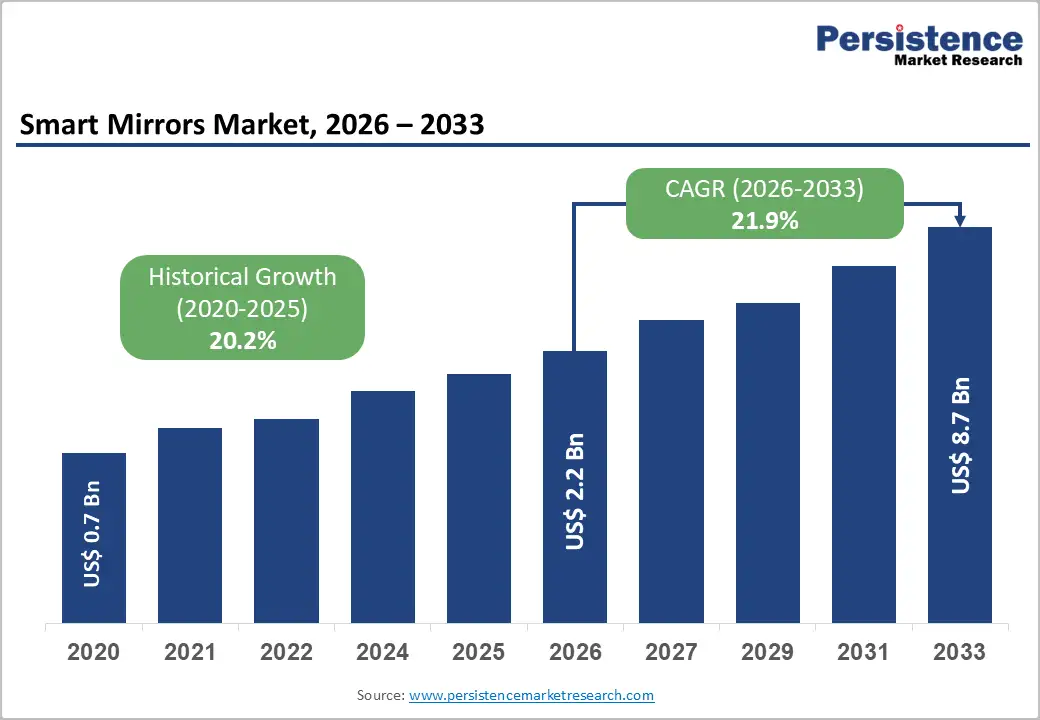
The global smart mirrors market size was valued at US$ 2.2 Bn in 2026 and is projected to reach US$ 8.7 Bn by 2033, growing at a CAGR of 21.9% between 2026 and 2033.
The rapid expansion of this market is primarily driven by the surging adoption of smart home technologies and advancements in artificial intelligence integration, which enhance user interaction and personalization in daily routines.
Key Market Highlights
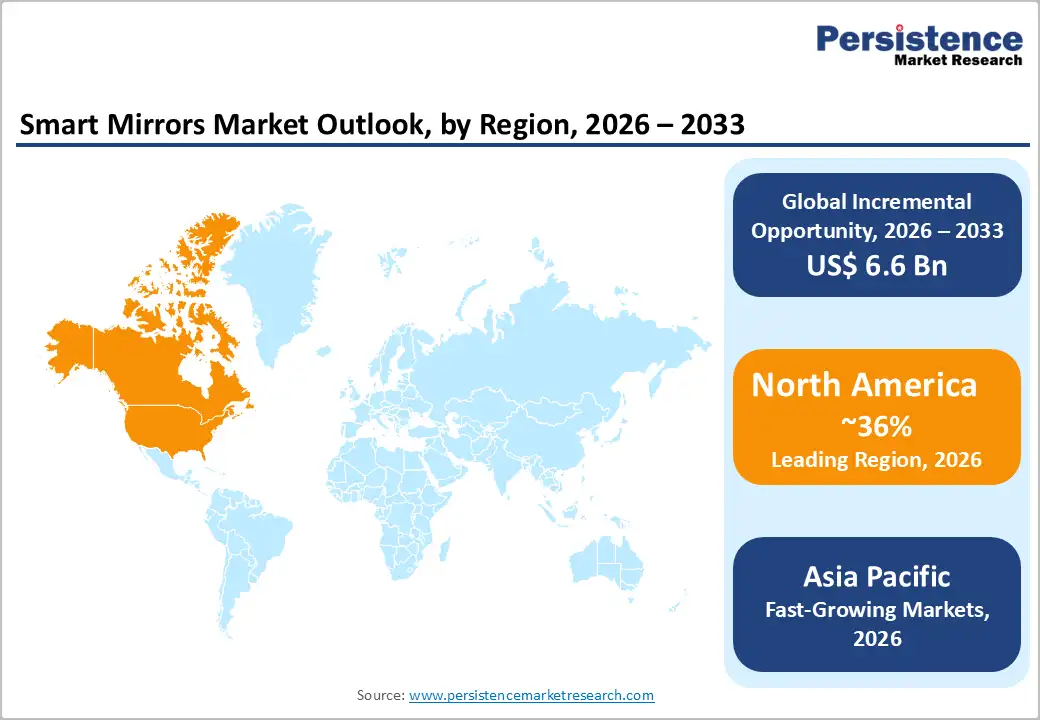
- Leading Region: North America leads the global smart mirrors market with a 36% share, driven by innovation hubs and the high adoption of smart home technologies in the U.S., setting benchmarks for AI integration.
- Fastest-Growing Region: Asia Pacific emerges as the fastest-growing region with rising CAGR of 30%, fueled by manufacturing strengths in China and urbanization in India, promising exponential demand through cost-effective productions.
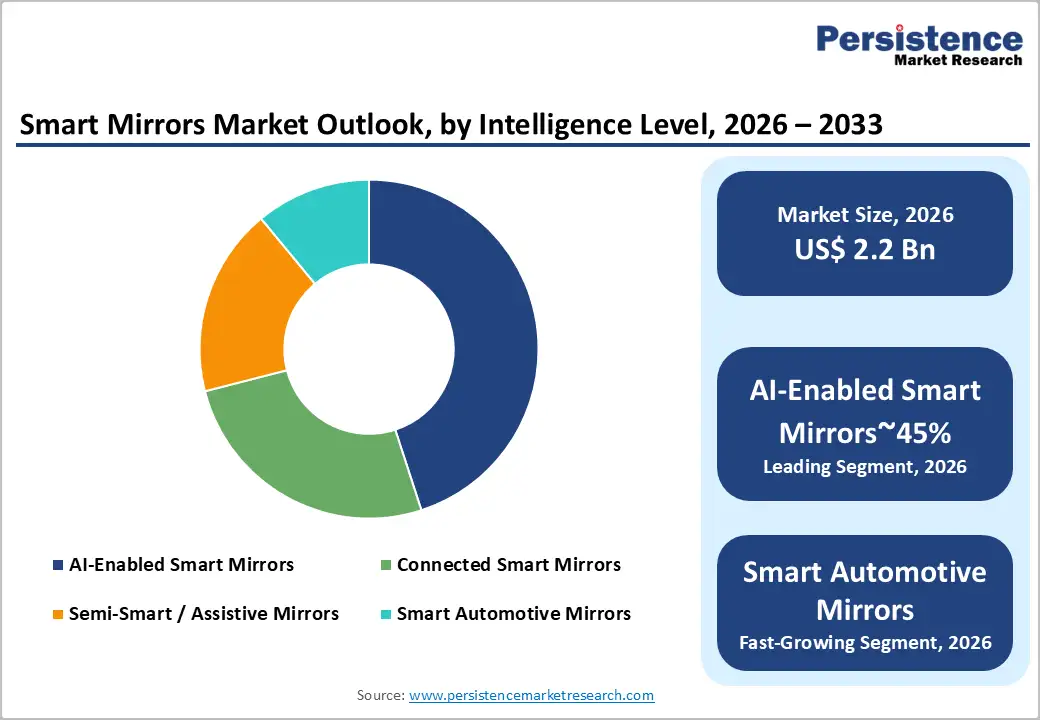
- Leading Category: AI-Enabled Smart Mirrors dominate the intelligence level category with around 45% market share, capturing significant share via advanced personalization features that enhance user engagement in diverse applications.
- Fastest-Growing Category: Wall-mounted installations lead the segment with a rising CAGR of 23.1%, offering space efficiency ideal for urban residential setups, with preferences rising amid modern interior designs.
- Key Opportunity: Integration with health monitoring presents a key opportunity, leveraging AI for wellness insights and telehealth, poised to generate substantial demand in residential markets.
| Key Insights | Details |
|---|---|
| Global Smart Mirrors Market Size (2026E) | US$ 2.2 Bn |
| Market Value Forecast (2033F) | US$ 8.7 Bn |
| Projected Growth CAGR (2026 - 2033) | 21.9% |
| Historical Market Growth (2020 - 2025) | 20.2% |
Market Dynamics
Market Growth Drivers
Smart Mirrors are Gaining Traction as Essential Components of Connected Smart Homes Driven by Rising Iot Adoption
The growing integration of smart mirrors into modern smart home ecosystems is becoming a major driver of market expansion, as consumers increasingly prefer connected devices that simplify daily routines. Smart mirrors seamlessly connect with IoT-enabled appliances such as lighting, thermostats, and security systems, helping users manage essential tasks from a single interface. Over 30% of households are expected to use connected smart home devices by 2025, directly driving higher demand for interactive mirrors with features such as weather updates, schedules, and personalized notifications.
Consumers value convenience and multitasking, making smart mirrors a practical upgrade for bathrooms, bedrooms, and dressing areas. Additionally, advancements in voice assistants and hands-free controls are boosting adoption, allowing users to interact with the mirror more intuitively. These innovations strengthen user engagement, increase product reliability, and enhance long-term market growth opportunities across residential and commercial environments.
Automotive Smart Mirrors are Expanding Rapidly due to Increasing Demand for Advanced Safety and Driver-Assistance Features
Innovations in automotive smart mirrors featuring advanced safety functions such as blind-spot detection, real-time navigation overlays, and augmented reality displays are significantly accelerating market growth. Visibility issues contribute to nearly 25% of global road accidents, encouraging automakers to adopt smart mirror technologies that reduce risks and improve driver response times. As electric vehicle adoption rises, projected to reach 40 million units, manufacturers are increasingly focused on integrating lightweight, energy-efficient components that enhance overall vehicle performance.
Smart mirrors address this demand by offering improved situational awareness and faster alerts, resulting in up to 15% better reaction time in pilot safety trials. These results build consumer trust and motivate automotive brands to invest in next-generation mirror systems. The growing emphasis on intelligent driving and road-safety regulations further supports widespread adoption, positioning smart mirrors as essential components of modern automotive design.Market Restraints
High Product Prices and Complex Installation Needs Continue to Limit Mass Adoption of Smart Mirrors
The high upfront cost of smart mirrors remains a significant barrier to mass adoption, especially in developing markets where consumers are more price-sensitive. Depending on features, smart mirrors typically cost between $500 and $5,000, driven by the costs of high-resolution displays, AI processors, sensors, and durable materials. These premium components increase production costs and limit affordability for average households. Additionally, many smart mirrors, especially wall-mounted or integrated models, require professional installation, which can increase total costs by 20-30%.
This added complexity discourages budget-conscious users who prefer simple or DIY solutions. In emerging economies, where per capita income is relatively lower, these challenges slow down market penetration despite rising interest in smart home technologies. Businesses and commercial spaces may adopt them gradually, but for widespread residential adoption, manufacturers must introduce more cost-effective options, streamlined installation processes, and modular designs that reduce purchasing and setup barriers.
Data privacy risks from cameras and sensors in smart mirrors reduce consumer trust and slow market growth
Concerns regarding privacy and data security represent another major restraint for the smart mirrors market, as these devices often include cameras, microphones, and sensors that collect sensitive personal information. The IoT-related data breaches have increased by nearly 25% in recent years, making consumers more cautious about adopting connected gadgets. Users worry that unauthorized access could expose details about their daily routines, health metrics, or family activities. This issue becomes more complex in healthcare, fitness, and hospitality applications where strict data protection regulations must be followed.
Businesses also face challenges in ensuring compliance with privacy laws, which add operational costs and slow down deployment decisions. Although manufacturers are investing in encryption technologies and secure cloud systems, trust-building remains a persistent challenge. Overall, security concerns may temporarily restrict growth, especially among users unfamiliar with smart device safety standards or those uncomfortable sharing personal information with technology platforms.
Market Opportunities
Smart Mirrors offer Major Opportunities through Biometric Monitoring and Telehealth-Aligned Wellness Features
The rising focus on personal health and wellness offers significant opportunities for smart mirror manufacturers, especially as consumers seek convenient tools to monitor their well-being. Smart mirrors with built-in biometric sensors can track heart rates, skin conditions, posture, and fitness progress, making them valuable additions to health-focused households. Global investments in health technologies reached nearly $50 billion in 2024, indicating strong momentum in the digital healthcare sector. Smart mirrors can integrate with wearables and telehealth apps to provide real-time, personalized insights, helping users make informed lifestyle decisions.
These capabilities also support virtual consultations, allowing healthcare professionals to offer guidance without in-person visits. Industry analysts project that such value-added features could increase residential adoption by 15%, as users increasingly prefer home-based health solutions. Additionally, collaborations between mirror manufacturers, wellness brands, and healthcare providers may generate new revenue streams and strengthen long-term market demand.
AR-Enabled Virtual Try-On Mirrors are Creating Strong Growth Potential across Fashion and Beauty Retail
The rapid development of augmented reality (AR) technologies is creating major opportunities for smart mirror companies, particularly in the retail sector. AR-enabled smart mirrors allow customers to visualize clothing, accessories, and cosmetics without physically trying them on, making the shopping experience more engaging and efficient. Retail studies show that interactive digital displays can increase sales by nearly 35%, as shoppers enjoy greater convenience and confidence in purchasing decisions. As e-commerce continues to expand rapidly, physical stores are adopting digital tools to maintain a competitive advantage and improve customer engagement.
Several governments, especially in the Asia Pacific, are offering incentives for digital transformation, supporting wider adoption of smart mirrors in fashion, beauty, and luxury retail stores. Technology partnerships between retailers and smart mirror companies are increasing, enabling the creation of seamless, immersive shopping environments. These trends highlight strong growth potential for smart mirrors in commercial spaces seeking to modernize their customer experience.
Category-wise Insights
By Intelligence Level Analysis
The AI-Enabled Smart Mirrors segment leads the intelligence level category with around 45% market share, driven by their ability to deliver personalized and interactive experiences. These mirrors use AI to process user data, support voice commands, and offer predictive recommendations that enhance daily routines. With smart home AI adoption rising by 28% annually, consumers increasingly prefer advanced features such as mood detection and smart suggestions. Automotive applications further strengthen this segment as AI improves safety functions, making these mirrors highly preferred across premium use cases.
By Installation Type Analysis
Wall-mounted smart mirrors hold nearly 55% market share, supported by their space-saving design and seamless integration into modern home interiors. Urban households show a 60% preference for these fixed installations because they enhance functionality without occupying floor space. Their ability to connect directly to electrical wiring ensures stable power for lighting and smart features. This installation type is preferred in both residential and commercial spaces due to its durability, clean appearance, and suitability for bathrooms, dressing areas, gyms, and salons.
By Application Analysis
The Smart Home segment dominates with approximately 40% market share, fueled by the growing demand for multifunctional devices that simplify home control. With over 1 billion IoT devices expected by 2025, smart mirrors are increasingly used as interactive dashboards for lighting, media, reminders, and personal updates. Consumers value convenience and the ability to integrate into daily routines. This segment outperforms specialized categories like automotive due to broader usage, strong scalability, and the rising adoption of connected home technologies worldwide.
By End Use Analysis
The Residential segment leads with about 60% market share, driven by rising interest in smart, personalized living spaces. Around 35% of new homes incorporate smart features, encouraging higher adoption of smart mirrors for wellness tracking, organization, and home aesthetics. Residential models are more affordable and versatile, making them popular among consumers renovating bathrooms or dressing areas. Strong sales in consumer electronics also support this dominance, as homeowners increasingly prioritize tech-enabled comfort and convenience over purely commercial applications.
Regional Insights
North America Smart Mirrors Trends
North America remains a global leader in the smart mirrors market due to its strong innovation ecosystem, high technology adoption rates, and significant consumer spending on advanced home and automotive products. The United States drives most regional growth, supported by active R&D investments in AI-enabled mirror technology and compliance with strong IoT standards set by regulatory agencies such as the FCC.
Adoption rates in urban areas have exceeded 40%, fueled by rising demand for smart home integrations and smart city initiatives. Automotive adoption is also accelerating as manufacturers align with NHTSA guidelines promoting safety enhancements in vehicles. Recent product launches showcased at prominent technology expos highlight the region’s leadership in developing health-focused and AI-driven mirror solutions. Additionally, strong data privacy regulations help build consumer trust, making North America an attractive market for both residential and commercial smart mirror applications.
Europe Smart Mirrors Trends
Europe’s smart mirror market is shaped by unified regulations and a well-developed technological infrastructure across major countries, including Germany, the U.K., France, and Spain. The European Union’s emphasis on energy efficiency, cybersecurity, and sustainability encourages the adoption of smart devices that meet strict standards. Germany leads in industrial and commercial usage, particularly in hospitality and retail, where technology integration is accelerating at nearly 25% annually.
The U.K. shows stronger adoption in residential wellness applications, driven by rising consumer interest in health-focused digital tools. France continues to grow in the beauty and luxury retail segment, where AR-enabled smart mirrors enhance customer experiences. Meanwhile, Spain is emerging due to increasing tourism and the modernization of hospitality facilities. Harmonized regulations like CE marking simplify cross-border trade and accelerate innovation. These factors collectively support steady market expansion and broader deployment of smart mirrors across Europe’s residential and commercial sectors.
Asia Pacific Smart Mirrors Trends
Asia Pacific is experiencing rapid growth in the smart mirrors market, driven by strong manufacturing capabilities, technological innovation, and rising urbanization across key countries such as China, Japan, India, and ASEAN nations. China leads production, accounting for nearly 60% of global smart mirror components, supported by large-scale manufacturing facilities and government investments in smart city programs worth over $100 billion annually. Japan focuses heavily on automotive smart mirrors due to its advanced automotive industry, while India sees increasing residential adoption supported by rising incomes and demand for affordable smart home devices.
ASEAN countries like Indonesia and Vietnam benefit from low labor costs and efficient supply chains, allowing them to expand production capacity. These combined advantages position the region for nearly 30% CAGR, making Asia Pacific one of the fastest-growing markets globally. Continued technological advancements, government incentives, and local manufacturing strengths will further accelerate adoption across residential, automotive, and commercial applications.
Competitive Landscape
The global smart mirrors market is moderately fragmented, with a mix of established automotive giants and niche home tech innovators competing for market share. Concentration is higher in automotive segments, where players like Gentex Corporation and Magna International Inc. hold sway through patents, while residential areas see diverse entrants. Expansion strategies include R&D investments in AI, with over $2 billion allocated across the industry in 2024 for IoT enhancements. Key differentiators involve customization, such as biometric features, and emerging models like subscription-based software updates. Business trends lean toward partnerships with retailers for virtual experiences, promoting sustainable growth in a competitive yet collaborative environment.
Key Market Developments
- January, 2025: Withings introduced Omnia at CES 2025, an AI-powered full-length smart mirror that scans weight, heart rate, and metabolism, and syncs with its devices for telehealth insights.
- January, 2025: Samsung launched a MICRO-LED Beauty Mirror in partnership with Amorepacific at CES; it uses AI to analyze skin features like pores, wrinkles, and pigmentation and then recommends personalized care.
- October, 2024: Gentex unveiled new automotive smart-mirror technology with its Full-Display Mirror (FDM) featuring camera-integrated video displays to improve rear visibility and driver safety.
Companies Covered in Smart Mirrors Market
- Gentex Corporation
- Magna International Inc.
- Dension, Pro Display
- Evervue
- Séura
- Alke
- ad notam AG
- Tech2o
- Samsung Electronics Co.,Ltd.
- Toshiba, Panasonic
- Perseus Mirrors
- Electric Mirror
- Kohler Co.
- Withings
Frequently Asked Questions
The global smart mirrors market is expected to reach US$ 8.7 Bn by 2033, reflecting strong growth from US$ 2.2 Bn in 2026 due to technological advancements.
The rising adoption of smart home ecosystems drives demand, with smart mirrors integrating IoTfor enhanced convenience and control in residences.
AI-Enabled Smart Mirrors lead with 45% share, offering advanced personalization through AI-driven features like predictive analytics.
North America leads, supported by U.S. innovation and high consumer tech spending, dominating with advanced AI and automotive applications.
Health and wellness integrations provide opportunities, with AI-enabled mirrors for biometric tracking poised to expand in telehealth and residential uses.
Key players include Gentex Corporation, Samsung Electronics Co., Ltd., Magna International Inc., Withings, and Panasonic, focusing on AI and automotive innovations.


