




- Clothing, Footwear, & Accessories
- Smart Backpack Market
Smart Backpack Market Size, Share, and Growth Forecast, 2026 - 2033
Smart Backpack Market by Product Type (Travel Backpack, Casual Backpack, Laptop Backpack, Others), Material (Polyester, Nylon, Leather, Others), Technology (USB Charging, Solar-Powered, Iot-Enabled, Smart Locking Systems, Sensors, Others), and Regional Analysis for 2026 - 2033

Smart Backpack Market Share and Trends Analysis
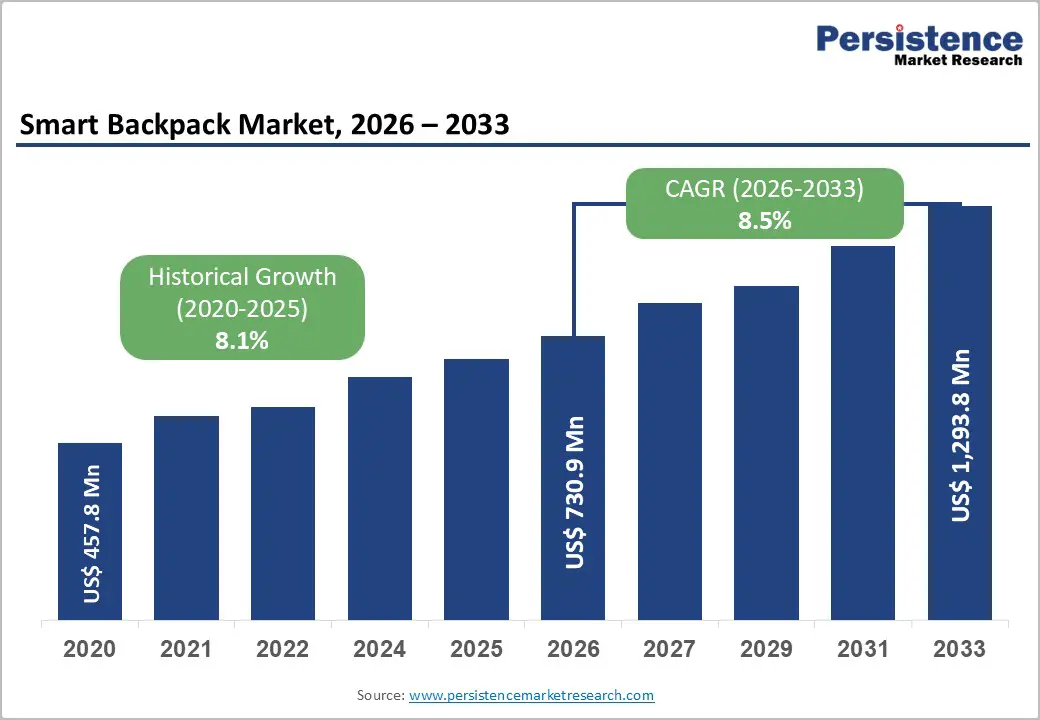
The global smart backpack market size is likely to be valued at US$ 730.9 million in 2026, and is projected to reach US$ 1293.8 million by 2033, growing at a CAGR of 8.5% during the forecast period 2026−2033.
Rising penetration of connected consumer electronics, increasing urban mobility, and sustained demand for multifunctional travel and laptop accessories are the foremost factors propelling the market. Growth is further supported by declining costs of embedded electronics, expanding e-commerce distribution, and higher adoption among students, professionals, and travelers. Regulatory acceptance of low-voltage electronics and lithium-ion battery standardization has also reduced commercialization barriers across major markets.
Key Industry Highlights
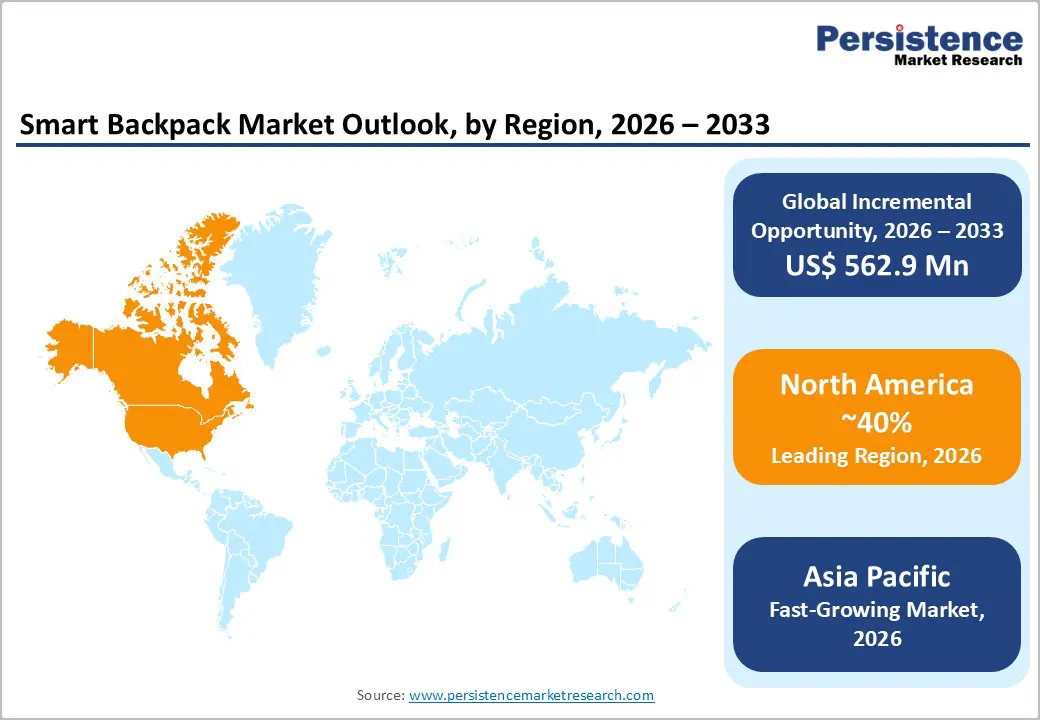
- Dominant Region: North America is predicted to hold a 40% market share in 2026, driven by the widespread integration of digital devices into educational and professional environments.
- Fastest-growing Regional Market: Asia Pacific is forecasted to be the fastest-growing market from 2026 to 2033, fueled by a rapidly expanding young and digitally connected population.
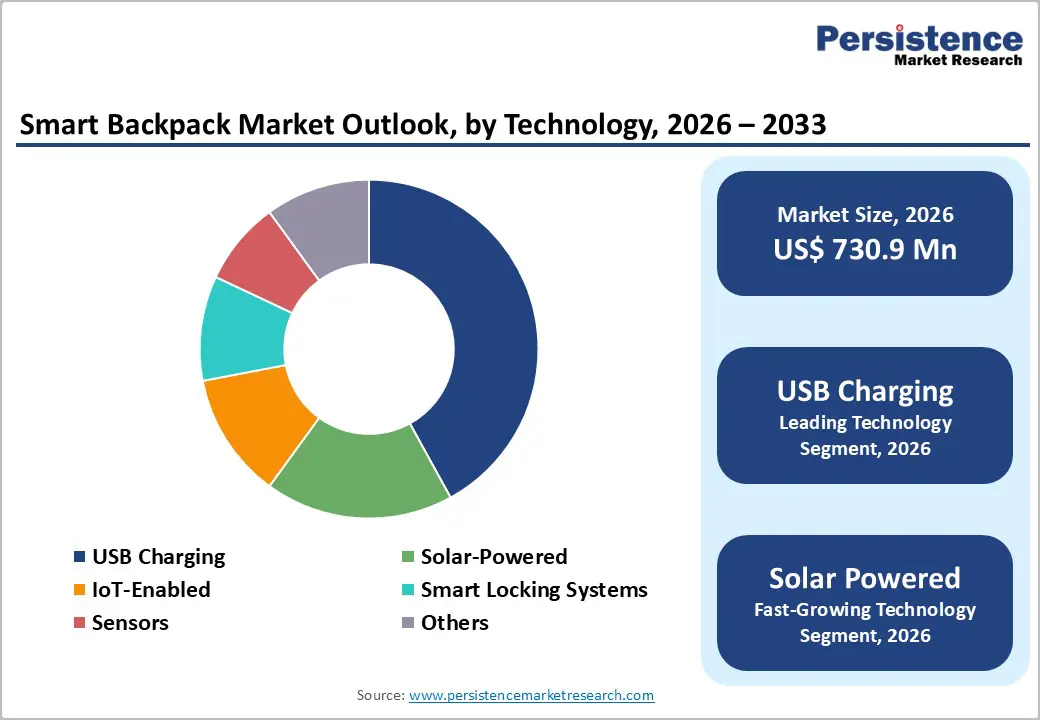
- Leading Technology: USB charging is likely to lead with about 42% revenue share in 2026 due to its essential role in supporting continuous device connectivity and widespread consumer adoption.
- Fastest-growing Technology: Solar-powered technology is slated to grow the fastest through 2033, owing to rising sustainability priorities and increasing demand for energy-independent mobility solutions.
- October 2025: Trust International released the Jersey Travel Backpack, a sustainable 25L commuter bag made from 19 recycled PET bottles with IPX4 water resistance, a 17-inch laptop compartment, AirTag pocket, and trolley strap.
| Key Insights | Details |
|---|---|
| Smart Backpack Market Size (2026E) | US$ 730.9 Mn |
| Market Value Forecast (2033F) | US$ 1293.8 Mn |
| Projected Growth (CAGR 2026 to 2033) | 8.5% |
| Historical Market Growth (CAGR 2020 to 2025) | 8.1% |
Market Factors - Growth, Barriers, and Opportunity Analysis
Technological Integration Enhancing Product Utility
Technological integration is elevating everyday carry from a storage accessory into a multifunctional productivity tool, driving strong consumer pull. Embedded power solutions, connectivity features, and intelligent security functions align with modern digital lifestyles where mobility, device dependence, and time efficiency dominate decision-making. Integrated USB charging, smart locking mechanisms, and sensor-based monitoring address practical pain points such as battery anxiety, theft risk, and asset tracking. The convergence of hardware and design has transformed backpacks into value-added companions for work, travel, and urban commuting.
Their expanding adoption is also linked to shifting user expectations influenced by the ubiquity of smart devices across personal and professional environments. Consumers seek seamless interaction, automation, and reliability in products they use daily. Technology-enabled features deliver differentiation in a crowded landscape, supporting premium positioning and brand loyalty. Data-driven functions such as location tracking and usage alerts create a perception of control and safety, strengthening user trust. Integration further enables manufacturers to innovate rapidly through modular upgrades and feature expansion, sustaining relevance across changing use cases.
Battery Efficiency and Durability Concerns
Concerns surrounding battery efficiency and durability have erected a critical roadblock for the smart backpack market growth due to the dependence of smart features on consistent and reliable power performance. Integrated components such as USB charging modules, tracking systems, sensors, and smart locks rely on compact batteries that are often constrained by size and weight requirements. Limited battery capacity leads to frequent recharging, reducing convenience and weakening the core value proposition of smart functionality. Performance degradation over repeated charge cycles further impacts reliability, especially for users who expect uninterrupted usage during travel, commuting, or outdoor activities.
Durability challenges amplify these concerns under real-world usage conditions. Smart backpacks are exposed to physical stress, environmental factors, and temperature variations that can negatively affect battery lifespan and electronic stability. Heat generation, moisture exposure, and mechanical pressure during daily use increase the risk of battery wear, swelling, or failure. Safety expectations are particularly high for wearable technology, and any perception of battery-related risk discourages adoption. Replacement and maintenance costs linked to battery degradation also reduce long-term value for users and institutional buyers.
Integration of Solar Charging and Eco-Friendly Materials
The incorporation of solar charging and eco-friendly materials can generate high-value opportunities for market players as consumer expectations shift toward products that combine functionality with responsible design. Portable power access has become a daily requirement driven by continuous use of mobile devices, navigation tools, and wearable technology. Solar charging embedded into everyday carry solutions supports uninterrupted connectivity without dependence on fixed power sources, which aligns well with travel, outdoor mobility, and urban commuting patterns. This feature enhances perceived product value by delivering energy independence and resilience, qualities increasingly associated with premium and future-ready solutions.
Eco-friendly materials reinforce this opportunity by aligning product innovation with sustainability priorities influencing purchasing decisions across income groups. Recycled polyester, bio-based fabrics, and low-impact manufacturing processes support corporate environmental goals while strengthening brand credibility among environmentally conscious consumers. Regulatory pressure on plastic usage and rising transparency expectations across supply chains elevate sustainable materials from optional features to strategic differentiators. Products designed around sustainability signal long-term relevance and reduced environmental footprint, factors valued by institutional buyers, retailers, and end users. The convergence of renewable energy integration and sustainable materials creates a clear pathway for premium positioning, stronger margins, and long-term customer loyalty.
Category-wise Analysis
Product Type Insights
Laptop backpacks are poised to lead with a forecasted 46% share in 2026, owing to strong adoption across education, corporate, and remote work environments where secure laptop transportation is essential. High laptop ownership, recurring replacement cycles, and structured organizational requirements sustain steady demand. Design features such as reinforced padded compartments, integrated USB charging ports, radio-frequency identification (RFID) protection, and ergonomic load distribution enhance usability and safety. Procurement by enterprises and academic institutions further strengthens volume stability, positioning this segment as the most commercially established and revenue-concentrated category.
Travel backpacks are anticipated to be the fastest-growing segment between 2026 and 2033, fueled by shifting mobility patterns, recovering tourism activity, and rising adoption of flexible work lifestyles. Increased reliance on carry-on travel and growth of digital nomadism elevate demand for multifunctional designs incorporating anti-theft construction, Global Positioning System (GPS) tracking compatibility, and solar-charging features. These capabilities address security, power access, and convenience expectations of modern travelers, supporting accelerated uptake and premium positioning within evolving travel and lifestyle consumption patterns.
Material Insights
Polyester-based materials are likely to lead with a projected 52% of the smart backpack market revenue share in 2026, due to their cost efficiency, high durability, and strong compatibility with integrated electronic components. Polyester supports lightweight construction, water resistance, and structural stability, enabling large-scale production and reliable performance across diverse usage conditions. Stable raw material availability and manufacturing efficiency support competitive pricing and wide market penetration, reinforcing dominance across mass-market and institutional distribution channels.
The leather materials are expected to witness the fastest growth between 2026 and 2033, as premiumization strategies and demand for refined aesthetics reshape material preferences. Leather delivers superior durability, tactile appeal, and long-term wear performance, positioning it as a high-value choice within smart backpack portfolios. Rising preference for craftsmanship, design sophistication, and status-oriented accessories strengthens adoption in professional and lifestyle segments. Consumer willingness to invest in durable, premium products remains strong, particularly in Europe and Japan, where quality perception and material authenticity support higher price realization and sustained segment expansion.
Technology Insights
USB charging technology is slated to hold a dominant position, with an anticipated 42% of revenue share in 2026, driven by its essential role in supporting continuous device connectivity across commuting, academic, and professional use cases. High smartphone penetration, reliance on portable electronics, and seamless integration with power banks strengthen adoption. Ease of implementation and user familiarity position USB charging as a standard feature rather than an optional enhancement, reinforcing its leadership across mass-market and premium product categories.
Solar-powered technology is forecasted to be the fastest-growing segment between 2026 and 2033, boosted by rising sustainability priorities and demand for energy-independent mobility solutions. Advancements in lightweight solar panels and improved energy conversion efficiency increase practicality for everyday and travel applications. Strong appeal among outdoor users, travelers, and digital nomads supports accelerated adoption, while alignment with renewable energy goals enhances long-term growth potential and premium differentiation.
Regional Insights
North America Smart Backpack Market Trends
North America is expected to dominate with an estimated 40% of the smart backpack market share in 2026, reflecting advanced consumer technology adoption, high disposable income, and widespread integration of digital devices into educational and professional environments. The regional market demonstrates strong integration of technology into daily lifestyles, particularly among students, professionals, and frequent travelers. Educational institutions and corporate enterprises increasingly provide laptops, tablets, and other digital devices as standard tools, creating a consistent demand for backpacks that offer secure storage, device protection, and built-in charging solutions. Consumer preference for multifunctional products that enhance productivity and convenience further reinforces adoption.
Another critical factor driving the North America market is the deep and consistent emphasis on safety, security, and premium product standards in the region. Regulatory frameworks and industry guidelines promote products with integrated anti-theft features, sustainable materials, and compliance with electronic safety standards, ensuring higher trust and adoption among end users. The concentration of leading technology companies and startups in the U.S. and Canada fosters rapid innovation in wearable electronics and connected accessories, allowing smart backpacks to evolve with cutting-edge features such as solar-powered charging, sensor-based tracking, and app-enabled device monitoring. A culture of early adoption and willingness to invest in premium, tech-enabled lifestyle products sustains higher average selling prices and revenue generation.
Europe Smart Backpack Market Trends
Europe is predicted to hold a significant position in the market through 2033, supported by high consumer awareness of technology-driven lifestyle products, strong purchasing power, and a well-established retail and e-commerce infrastructure. The market benefits from widespread adoption of laptops, smartphones, and wearable devices, which drives demand for smart backpacks offering secure storage, device protection, and integrated functionalities such as USB charging, RFID protection, and IoT connectivity. Educational institutions, corporate offices, and co-working spaces actively encourage the use of multifunctional backpacks that enhance mobility and productivity, reinforcing consistent adoption.
Sustainability considerations also play a pivotal role in market dynamics, influencing product design and material selection. Consumers increasingly demand eco-friendly, durable materials such as recycled nylon, organic polyester, and ethically sourced leather, driving innovation among manufacturers to meet these expectations. Regions such as Germany, France, the U.K., and the Nordics show strong receptivity to high-performance backpacks that combine technology, design, and sustainability. Lifestyle trends such as urban commuting, frequent travel, and outdoor recreation amplify the need for multifunctional backpacks equipped with solar charging, tracking capabilities, and ergonomic features.
Asia Pacific Smart Backpack Market Trends
Asia Pacific is forecasted to be the fastest-growing regional market for smart backpacks between 2026 and 2033, stimulated by increasing urbanization, rising disposable incomes, and a rapidly expanding young and digitally connected population. The regional market is witnessing significant growth in smartphone, laptop, and wearable device penetration, creating a strong need for multifunctional backpacks that offer secure storage, device protection, and integrated technology features such as USB charging, IoT connectivity, and RFID security. Expansion of e-commerce platforms, coupled with the adoption of mobile payment solutions, enhances product accessibility across both urban and semi-urban areas, enabling manufacturers to reach a broad consumer base. Educational institutions, corporate campuses, and co-working spaces also encourage adoption by promoting tech-enabled and productivity-focused carrying solutions, which further strengthens market growth.
Key factors driving rapid expansion include increasing digital literacy, supportive government initiatives aimed at fostering electronics innovation, and heightened consumer awareness of lifestyle-oriented technology products. Leading markets such as China and India show strong receptivity to smart backpacks with advanced functionalities, including solar-powered charging, sensor-enabled tracking, and durable eco-friendly materials. The rise of digital nomadism, travel-oriented lifestyles, and outdoor recreational activities also fuels demand for mobility-friendly solutions. Competitive pricing strategies and growing local manufacturing capabilities enhance affordability while maintaining product quality.
Competitive Landscape
The global smart backpack market structure exhibits moderate fragmentation, with key players including Targus, Samsonite IP Holdings S.AR.L., Xiaomi, and Lenovo commanding a significant market presence. Fragmentation persists among smaller manufacturers and specialized innovators, creating a competitive structure that contrasts with the stronger positioning of established global brands. This dual-layer market dynamic reflects differing barriers to entry across product segments, with leading companies leveraging brand recognition, distribution networks, and technology integration, while emerging firms capture growth opportunities through innovative features, advanced designs, and sustainability-oriented solutions.
Strategic positioning favors innovation-driven companies such as Xiaomi, which integrates advanced technology features, including IoT connectivity and solar-powered charging into user-friendly designs, enhancing functional differentiation. Established players such as Targus and Samsonite leverage operational scale, global distribution, and brand reputation to maintain premium positioning and market resilience. This competitive structure allows larger firms to invest in product development, marketing, and strategic partnerships, while ongoing activity among smaller brands reflects intensifying competitive pressures.
Key Industry Developments
- In September 2025, Nu Republic launched the Triphop Voyager Series of smart backpacks, featuring built-in USB-A and Type-C charging ports, anti-theft zips, water-resistant fabrics, and laptop compartments, starting at INR 1,099 across five models. Bollywood actor Abhay Deol joined as brand ambassador and co-creator, with the collection now available on Amazon, Blinkit, and Nu Republic's website.
- In September 2025, Targus introduced the HyperPack™ Tech Backpack, a lightweight, sustainable, and feature?rich carry solution for mobile professionals that combines pass?through charging, secure storage, weather?resistant construction, and a built?in locator pocket to keep devices protected and connected on the go.
- In August 2025, Dutch researchers from Radboud University Medical Center, Delft University of Technology (TU Delft), and Erasmus Medical Center developed the Gyropack, a smart backpack that helps people with ataxia, a movement disorder affecting balance and coordination, walk more steadily by using rotating gyroscopes to counteract torso rotation. A study of 14 patients showed that the backpack significantly improved balance and straight-line walking ability.
Companies Covered in Smart Backpack Market
- Targus.
- Xiaomi.
- Samsonite IP Holdings S.AR.L.
- Lenovo.
- HP INDIA SALES PRIVATE LIMITED
- Dell Inc.
- SWISSGEAR
- Kingsons Bags.
- NOMATIC.
- MATEIN
- Thule Group
Frequently Asked Questions
The global smart backpack market is projected to reach US$ 730.9 million in 2026.
Rising adoption of mobile devices, demand for multifunctional and technology-integrated carrying solutions, and growing urban and professional mobility drive the market.
The smart backpack market is poised to witness a CAGR of 8.5% from 2026 to 2033.
Integration of advanced technology features, eco-friendly materials, and connectivity solutions in backpacks presents key growth opportunities in the market.
Some of the key market players include Targus, Samsonite IP Holdings S.AR.L., Xiaomi, and Lenovo.


