




- Hardware & Software IT Services
- Managed Learning Services Market
Managed Learning Services Market Size, Share, and Growth Forecast 2026 - 2033
Managed Learning Services by Service (Learning Administration, Learning Delivery, Learning Analytics, Measurement, & Evaluation and Content Design & Development), by Applications (Small & Medium Enterprises (SMEs) and Large Enterprises), and End- user (BFSI, Consumer Goods and Retail, Telecommunication & IT, Healthcare and Manufacturing) and Regional Analysis for 2026 - 2033

Managed Learning Services Market Share and Trends Analysis
The global Managed Learning Services Market size was valued at US$ 4.3 Bn in 2026 and is projected to reach US$ 8.9 Bn by 2033, growing at a CAGR of 11.1% between 2026 and 2033.
Market expansion is fundamentally driven by an organizational imperative to transform workforce capabilities through outsourced, end-to-end learning management. Enterprises increasingly recognize that 44% of workers' skills will be disrupted by 2027, according to World Economic Forum estimates, necessitating rapid reskilling programs delivered through specialized partners.
Key Market Highlights
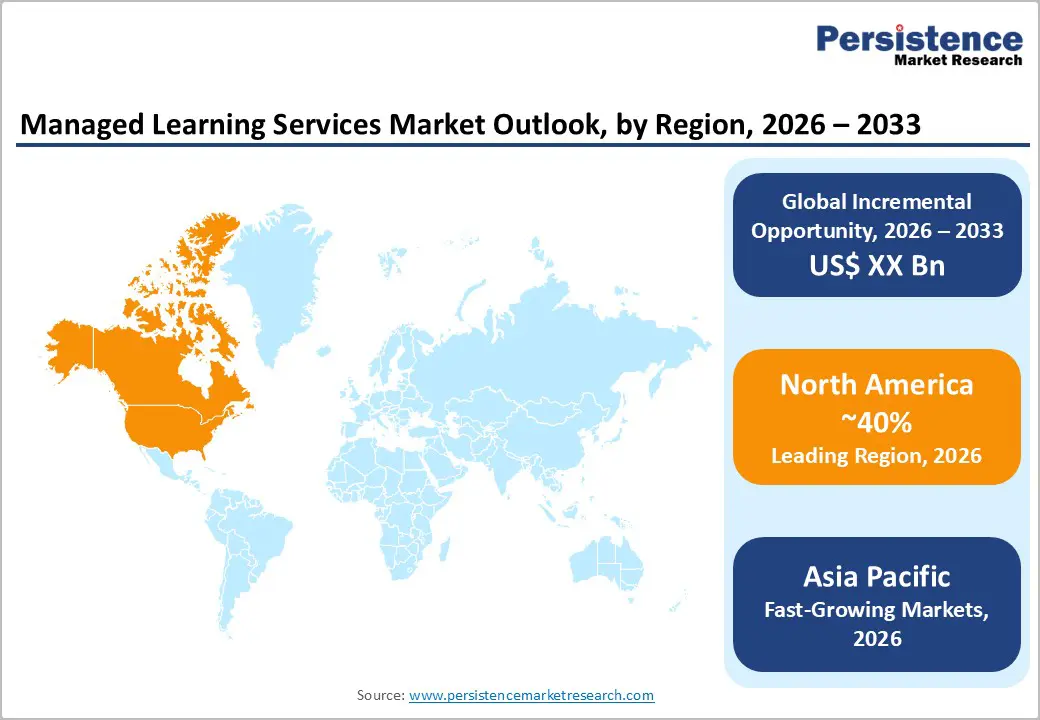
- Leading region: North America dominates the Managed Learning Services Market with approximately 40% global revenue share, driven by concentration of large enterprises with substantial L&D budgets, mature outsourcing markets, regulatory compliance requirements, and sophisticated learning technology infrastructure investments.
- Fastest growing region: Asia Pacific is the fastest-growing regional market, expanding at 16% CAGR, fueled by rapid economic growth, expanding corporate sectors in China and India, talent competition intensification, and increasing government emphasis on workforce skills development and digital transformation initiatives.
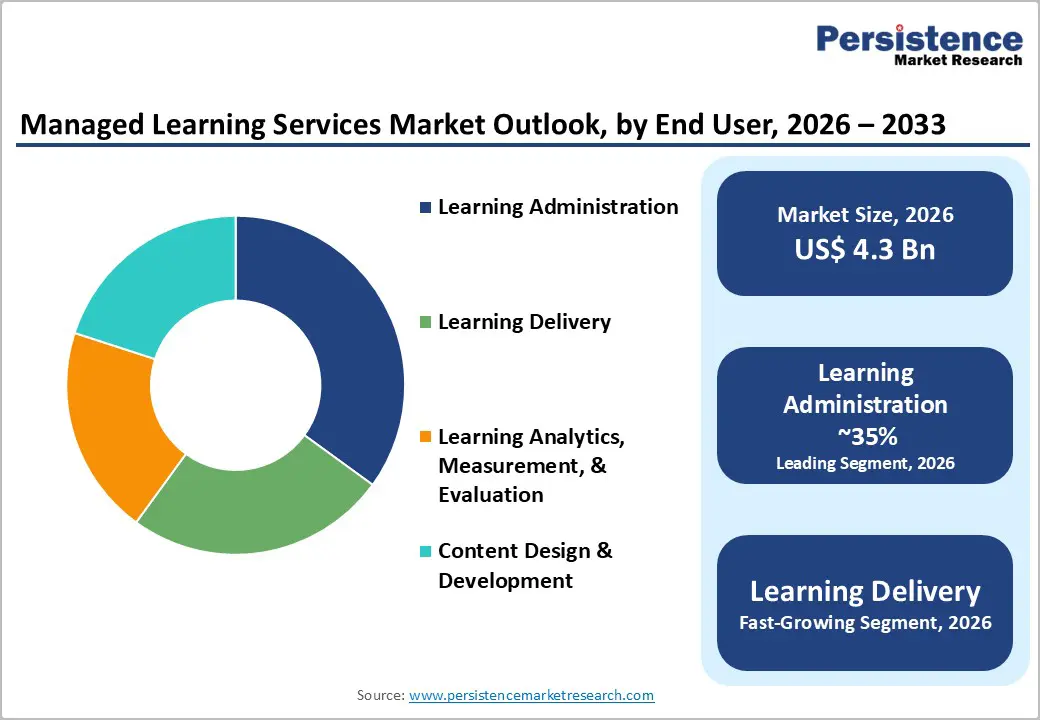
- Dominant segment: Learning Administration dominates service offerings with approximately 35% market share, reflecting organizations' preference to outsource transactional learning operations while retaining strategic learning initiatives, driven by cost reduction, compliance assurance, and ability to focus internal resources strategically.
- Fastest growing segment: Learning Analytics, Measurement, and Evaluation is the fastest-growing service segment, expanding at 16% CAGR, driven by increasing organizational focus on demonstrating training ROI, measuring business impact, and optimizing learning effectiveness through advanced data analytics and predictive workforce modeling.
- Key market opportunity: Generative AI-powered adaptive learning and immersive learning technologies, including augmented and virtual reality, represent major growth opportunities, enabling personalized learning experiences, faster skill acquisition, and measurable improvements in training effectiveness and organizational performance.
| Key Insights | Details |
|---|---|
|
Managed Learning Services Size (2026E) |
US$ 4.3 Bn |
|
Market Value Forecast (2033F) |
US$ 8.9 Bn |
|
Projected Growth (CAGR 2026 to 2033) |
11.1% |
|
Historical Market Growth (CAGR 2020 to 2025) |
8.2% |

Market Dynamics
Market Growth Drivers
Accelerating Skills Disruption and Reskilling Imperative
The World Economic Forum projects that 44% of workers' skills will be disrupted by 2027, creating an unprecedented reskilling crisis that organizations cannot address through traditional, in-house L&D functions. Enterprise digital transformation initiatives, widespread adoption of artificial intelligence and automation, and rapid evolution of industry 4.0 technologies are necessitating continuous workforce upskilling at scale, driving organizations to engage specialized managed learning services providers possessing deep domain expertise, global delivery networks, and proven reskilling methodologies.
Organizations partnering with managed learning services providers report dramatically improved talent mobility, faster productivity gains, and measurable business outcomes, including 7–13 times improvement in key performance metrics among users of enterprise resource planning systems, strongly incentivizing adoption.
Cloud?Enabled Learning Platforms and Analytics?Driven Personalization
Advanced cloud-based learning management systems, learning experience platforms (LXPs), and artificial intelligence-powered adaptive learning technologies are fundamentally transforming managed learning service delivery models, enabling personalization, real-time analytics, and scalable global deployment. Modern managed learning services leverage integrated analytics dashboards providing granular visibility into learner engagement, performance outcomes, and business impact metrics, enabling continuous optimization and demonstrating training ROI to executive stakeholders.
Digital adoption platforms, immersive technologies including augmented reality and virtual reality, and generative AI-based content generation are enabling providers to deliver engaging, cost-effective learning at unprecedented scale while reducing content development timelines and enhancing learner outcomes. Organizations adopting analytics-driven managed learning services report improved training effectiveness, faster onboarding cycles, enhanced employee engagement and retention, and measurable improvements in operational productivity and business outcomes, positioning managed learning services as strategic talent management infrastructure.
Market Restraints
High Implementation Costs and Vendor Consolidation Complexity
Despite strong adoption momentum, comprehensive managed learning services implementation requires substantial capital investment including platform licensing, professional services for customization and integration, change management support, and ongoing operational expenses, creating barriers to adoption among budget-constrained organizations. Consolidation trends, including LTG's acquisition of GP Strategies in 2022, creating complex integration challenges across acquired brands and technology platforms, can create organizational transition risks and service delivery disruptions for existing clients. Small and mid-sized enterprises face significant barriers to entry due to cost structures that typically Favor larger implementations, complex vendor ecosystems, and requirements for dedicated learning technology expertise.
Talent Scarcity and Service Delivery Expertise Constraints
The managed learning services market confronts persistent talent constraints, including scarcity of instructional designers, learning technology specialists, and experienced learning consultants capable of delivering complex transformation initiatives. Organizations report difficulty sourcing experienced providers with deep expertise across specific industries, technologies, or functional domains, creating extended vendor selection processes and potential quality risk. Rising labor costs for specialized expertise, particularly in technology-adjacent skills such as digital adoption platform implementation and generative AI integration, compress margins for service providers and limit their capacity to expand, constraining market growth velocity.
Market Opportunities
Generative AI Integration and Adaptive Learning Transformation
Generative AI integration into managed learning services represents a transformative growth opportunity, enabling automated content generation, personalized learning path creation, and real?time adaptive learning experiences tailored to individual learner needs and performance. Leading providers including NIIT, GP Strategies, and Infopro Learning are integrating AI?powered capabilities that dramatically reduce content development timelines, improve learning personalization, and enhance learning outcomes and engagement. Accenture, a major technology services firm, launched Accenture Learn Vantage in March 2024, a comprehensive learning and training service leveraging AI to assist clients in reskilling and upskilling their workforce in technology, data, and artificial intelligence, representing a major competitive initiative and market validation of AI-augmented managed learning services. Organizations adopting AI-enabled managed learning services report faster time-to-competency, improved learner satisfaction, and measurable acceleration of digital transformation initiatives, positioning this as the fastest-growing opportunity segment.
Immersive Learning Technologies and Simulation?Based Training Expansion
Immersive learning technologies including augmented reality, virtual reality, and simulation-based training platforms are creating premium, high-impact learning experiences that dramatically improve skill transfer, confidence, and learning retention compared to traditional classroom or e-learning modalities. Simulation?based digital adoption platforms enable employees to practice workflows in realistic, risk-free environments identical to live systems, reducing onboarding time and improving accuracy and consistency across global teams.
Leading providers are differentiating through immersive learning capabilities that enable hands-on, scenario-based skill development for enterprise system training, technical skills, and soft skills development. Organizations implementing immersive training through managed learning service providers report significantly higher learning engagement, faster adoption of enterprise systems, and improved employee confidence, creating substantial market opportunity as organizations prioritize training effectiveness and measurable ROI in technology implementations.
Category wise Insights
Service Analysis
Learning Administration dominates the Managed Learning Services Market, capturing an estimated 35–38% of revenue, as enterprises increasingly outsource end-to-end learning operations management, including learner enrolment, scheduling, compliance tracking, certification management, and reporting to specialized service providers. Organizations benefit from outsourced learning administration through reduced operational overhead, improved service levels, enhanced compliance assurance, and the ability to focus internal resources on strategic learning initiatives rather than transactional operations. Learning Delivery represents the second-largest segment at approximately 28%, encompassing instructor-led training, virtual classrooms, e-learning facilitation, and blended learning delivery across onsite, nearshore, and offshore delivery models tailored to organizational preferences and budget constraints.
Applications Analysis
Large Enterprises represent the dominant application segment, commanding approximately 58–62% of the Managed Learning Services Market, as global Fortune 500 and multinational corporations leverage comprehensive managed learning services to support enterprise-wide digital transformation, compliance training, leadership development, and global workforce upskilling initiatives. Large enterprises benefit from scaled, specialized managed learning services capable of handling complex organizational structures, multiple business units, diverse geographic requirements, and integration with enterprise systems including HR information systems, learning management systems, and talent management platforms. Small & Medium Enterprises (SMEs) constitute a rapidly growing segment at approximately 30% CAGR, driven by affordable, cloud-based managed learning service models offering scalable, cost-effective training without requiring significant internal L&D infrastructure investment.
End-User Analysis
The BFSI (Banking, Financial Services, and Insurance) sector dominates the Managed Learning Services Market, commanding approximately 42% of demand, driven by stringent regulatory compliance requirements (GDPR, HIPAA, SOX), mandatory training in financial products, risk management, and anti-fraud protocols, and intense competition for specialized talent requiring continuous reskilling in digital banking, fintech innovation, and cybersecurity. Telecommunication & IT enterprises represent the second-largest segment at approximately 25%, pursuing comprehensive managed learning services to address rapid technology evolution, digital transformation, cybersecurity reskilling, and talent pipeline development in highly competitive technology labor markets.
Regional Insights
North America Managed Learning Services Market Trends
North America, led by the United States, dominates the global Managed Learning Services Market, commanding approximately 42–45% of worldwide revenue, anchored by concentration of major corporations with substantial L&D budgets, mature outsourcing markets, established managed security services and talent management ecosystems, and sophisticated HR and learning technology infrastructure. The U.S. managed learning services market is estimated to have reached approximately US$ 1.8 billion in 2024 and is projected to grow at a CAGR of approximately 10.5% through 2033, driven by persistent talent shortages, competitive pressure to reskill workforces, and substantial investments in digital transformation by leading enterprises across BFSI, technology, healthcare, and manufacturing sectors.
The region features an advanced managed learning services ecosystem encompassing major providers including GP Strategies, Learning Tree International, KPMG, and specialized emerging vendors, combined with strong technology partnerships and integration capabilities with enterprise systems. Regulatory pressures, including workplace safety training, ethics and compliance training, and industry-specific certifications, create sustained demand for managed learning services capable of ensuring consistent, auditable training delivery across geographically distributed workforces, positioning North America as the largest and most mature market through the forecast period.
Europe Managed Learning Services Market Trends
Europe is experiencing steady market expansion, with key economies including Germany, U.K., France, and Spain increasingly investing in managed learning services to address European Union regulatory compliance requirements including GDPR, digital skills enhancement initiatives, and workforce reskilling driven by industry 4.0 adoption and digital transformation mandates. European organizations demonstrate strong demand for managed learning services that emphasize learner experience, advanced analytics, and integration with HRIS systems, combined with expectations for geographically localized delivery, multilingual support, and data-residency compliance with European regulations.
Hemsley Fraser Group Ltd. and Knowledge Pool operate as significant regional providers, combined with global vendors establishing European headquarters and localized service delivery models, supporting moderate but steady market growth through the forecast period. The region is characterized by increasing focus on skills certification, continuous professional development, and strategic workforce planning among large multinational corporations and public sector institutions, supporting sustained managed learning services adoption.
Asia Pacific Managed Learning Services Market Trends
Asia Pacific is the fastest-growing regional market for managed learning services, with CAGR potentially exceeding 16% through 2033, driven by rapid economic growth, expanding corporate sectors in China, India, and emerging ASEAN economies, escalating competition for talent in technology and professional services sectors, and increasing government emphasis on workforce skills development. India represents a particularly significant opportunity, combining rising demand from multinational corporations operating regional hubs, domestic enterprises undergoing digital transformation, and cost advantages enabling scalable managed learning service delivery through offshore models.
NIIT, headquartered in India, operates as a global leader in managed learning services, leveraging deep regional presence and cost-competitive delivery models to serve multinational and domestic clients across the Asia Pacific and globally. Japan features mature corporate training markets and technology adoption, while emerging markets in China, Vietnam, and Indonesia present substantial long-term opportunities as digital transformation accelerates and organizations increasingly recognize managed learning services as strategic talent development infrastructure.
Competitive Landscape
Market Structure Analysis
The Managed Learning Services Market is moderately consolidated, with leading global providers including GP Strategies, NIIT, Learning Tree International, KPMG, Infopro Learning, and specialized regional vendors competing across diverse service offerings, industry expertise, geographic reach, and delivery models. Market leaders differentiate through breadth and depth of managed learning service portfolios spanning learning administration, delivery, analytics, content development, and strategic consulting; technological capabilities in artificial intelligence, immersive learning, and advanced analytics; and proven delivery capabilities serving Fortune and Global 500 companies with complex, multi-geography requirements. LTG's acquisition of GP Strategies in 2022 created a technology-driven managed learning services conglomerate combining platform capabilities from Open LMS, PeopleFluent, and Breezy with GP's global service delivery network, establishing a significant competitive force. Emerging business models emphasize AI-powered adaptive learning, outcome-based pricing aligned with measurable business impact, and modular service delivery enabling customization and cost optimization.
Key Market Developments
- In July 2024, Happiest Minds Technologies announced the release of WATCH360, a Complete 360 IT Managed Service offering designed to help businesses easily manage their IT environment.
- In March 2024, Accenture Plc launched Accenture LearnVantage, a comprehensive learning and training service designed to assist clients in reskilling and upskilling their workforce in technology, data, and artificial intelligence, representing a major competitive expansion into managed learning services and validation of the AI-augmented training market opportunity.
Companies Covered in Managed Learning Services Market
- GP Strategies Corporation
- Learning Tree International, Inc.
- Infopro Learning, Inc.
- Hemsley Fraser Group Ltd.
- G-Cube
- TTA (The Training Associates)
- Knowledge Pool
- NIIT
- DDLS Australia Pty Ltd.
- NetCom Learning
- KPMG
- Other Key Players
Frequently Asked Questions
The global Managed Learning Services Market is projected to reach approximately US$ 8.9 billion by 2033, expanding from US$ 4.3 billion in 2026, at a forecast CAGR of 11.1% between 2026 and 2033.
Key demand drivers include accelerating skills disruption with 44% of workers' skills expected to be disrupted by 2027, increasing enterprise focus on reskilling and upskilling driven by digital transformation, quantifiable ROI from managed learning partnerships.
Learning Administration currently leads the service segment with approximately 35–38% market share, as organizations increasingly outsource transactional learning operations management to specialized providers capable of ensuring compliance, improving service levels, and enabling focus on strategic learning initiatives.
North America, particularly the United States, dominates the global Managed Learning Services Market with approximately 40% of worldwide revenue, driven by concentration of large enterprises with substantial L&D investments, mature outsourcing markets, regulatory compliance requirements, and advanced learning technology infrastructure.
Major players include GP Strategies Corporation, NIIT Learning Systems Limited, Learning Tree International, Inc., and NetCom Learning.


